Within Bhutan Weird
When Bhutan's Landscape Seems to Answer Back
Bhutanese landscape lore often explains floods, accidents and rural misfortune as signs of offended territorial powers.
On this page
- Territorial deities and moral geography
- Floods, shrines and remembered danger
- Road accidents and broken ritual obligations
Page outline Jump by section
Introduction
Bhutanese stories about dangerous places often begin with a simple idea: the landscape is not morally neutral. A mountain, river crossing or twisting road may be understood not merely as difficult terrain but as the domain of a local protective power whose favour has to be maintained. When floods destroy villages or a stretch of road develops a reputation for fatal crashes, some communities have traditionally interpreted these events not simply as bad luck or natural hazards but as signs that the relationship between people and the unseen guardians of the land has broken down. This way of understanding danger occupies an important place in Bhutan’s strange folklore because it links real environmental risks with enduring religious memory. It is not evidence that supernatural beings caused disasters, but it does show how communities have explained and remembered them across generations.[Cambridge University Repository]repository.cam.ac.ukbridge University RepositoryTHE TERRITORY AND ITS DEITY IN BHUTANMay 2, 2012 — by F Pommaret · 2004 · Cited by 59 — some people attrib…

Territorial deities and a morally charged landscape
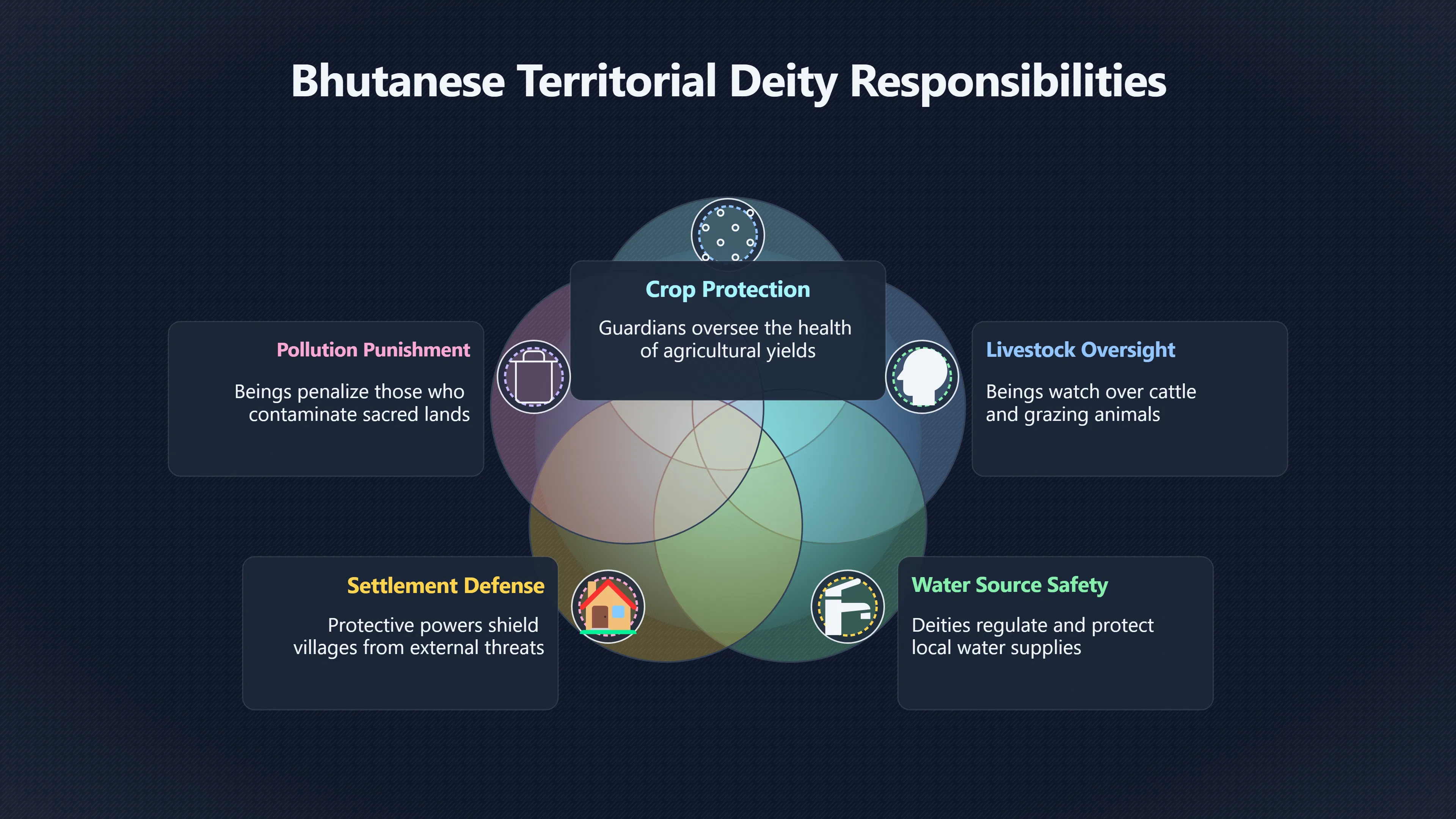
Across Bhutan, anthropologists have documented beliefs in territorial deities associated with villages, mountains, forests, rivers and grazing lands. Rather than existing as distant gods, these beings are understood in local tradition as guardians of particular places. Their responsibilities may include protecting crops, livestock, water sources and settlements, while also punishing pollution, broken promises or neglected ritual obligations.[SHS Hal Science]shs.hal.scienceOn local and mountain deities in Bhutan''by F Pommaret · 1994 · Cited by 66 — On local and mountain deities in Bhutan Françoise Pommare…
For readers interested in Fortean traditions, the striking feature is not the existence of supernatural claims in themselves but the mechanism by which apparently ordinary disasters become meaningful.
Instead of asking only:
- Why did the flood happen?
- Why did this road become notorious?
- Why did livestock suddenly die?
traditional explanations might also ask:
- Was a sacred place disturbed?
- Were offerings discontinued?
- Did people violate an old taboo connected with the land?
This creates what anthropologist Françoise Pommaret describes as an understanding of territory that combines geography, community, memory and invisible agency. Mountains are not simply topographic features, while rivers are not merely channels of water; each may possess its own history of relationships between humans and protective powers.[Cambridge University Repository]repository.cam.ac.ukbridge University RepositoryTHE TERRITORY AND ITS DEITY IN BHUTANMay 2, 2012 — by F Pommaret · 2004 · Cited by 59 — some people attrib…
Unlike many ghost stories, these traditions are less concerned with frightening apparitions than with maintaining balance between communities and the places they inhabit.
Floods remembered as signs of divine displeasure
Bhutan’s steep valleys and glacier-fed rivers have always been vulnerable to destructive flooding. Modern hydrology explains many of the country’s worst disasters through heavy monsoon rainfall, landslides and glacial lake outburst floods, where water suddenly escapes from unstable mountain lakes.
Yet local memory has sometimes preserved these same disasters through a different narrative.
A frequently cited example concerns the glacial lake outburst flood of 1996 in the remote Lugnak region. Scientific investigations linked the event to the failure of a glacial lake, producing a devastating flash flood downstream. At the same time, Pommaret records that many local inhabitants interpreted the catastrophe as evidence that the territorial deity had become angry. Both explanations existed simultaneously, serving different purposes: one describing the physical mechanism, the other explaining the disaster’s moral meaning within community life.[Cambridge University Repository]repository.cam.ac.ukbridge University RepositoryTHE TERRITORY AND ITS DEITY IN BHUTANMay 2, 2012 — by F Pommaret · 2004 · Cited by 59 — some people attrib…
Elsewhere in upper Paro, local tradition associates a shrine dedicated to a territorial deity with protection against river flooding. Offerings are made near the river because the deity is believed to regulate its flow and restrain destructive waters. Such shrines are not engineering works, yet they represent an important cultural response to living beside unpredictable Himalayan rivers.[Cambridge University Repository]repository.cam.ac.ukbridge University RepositoryTHE TERRITORY AND ITS DEITY IN BHUTANMay 2, 2012 — by F Pommaret · 2004 · Cited by 59 — some people attrib…
These stories illustrate an important distinction. They are not attempts to replace practical knowledge of floods. Instead, they provide a framework for remembering disasters, encouraging respect for dangerous places and reinforcing community rituals around shared environmental risks.
Why certain roads acquire uncanny reputations
Perhaps the most striking example of “active landscape” thinking involves dangerous roads.
One case recorded by Pommaret concerns the south-western jungle region crossed by the highway connecting Thimphu with the Indian border. According to local belief, this stretch experienced repeated vehicle accidents because a powerful local deity had been offended.
The tradition explains that people formerly made animal offerings at a large sacred stone on the mountain. When those offerings ceased, some residents believed the deity responded by taking revenge through fatal crashes along the road.[Cambridge University Repository]repository.cam.ac.ukbridge University RepositoryTHE TERRITORY AND ITS DEITY IN BHUTANMay 2, 2012 — by F Pommaret · 2004 · Cited by 59 — some people attrib…
From a modern perspective, there are many obvious alternative explanations:
- steep mountain roads;
- sharp bends and poor visibility;
- heavy rain and landslides;
- mechanical failures;
- human driving error.
None of these prevent the religious explanation from retaining cultural significance. Instead, the two interpretations answer different questions. Engineering investigates why collisions occur physically. Folklore asks why one place becomes known as particularly dangerous and why repeated tragedy acquires moral meaning.
This pattern appears elsewhere in mountain cultures across the Himalayas, but Bhutan preserves unusually detailed ethnographic descriptions of how such beliefs remain connected to named locations rather than surviving only as distant legends.[Cambridge University Repository]repository.cam.ac.ukbridge University RepositoryTHE TERRITORY AND ITS DEITY IN BHUTANMay 2, 2012 — by F Pommaret · 2004 · Cited by 59 — some people attrib…

Broken ritual obligations and remembered misfortune
Many Bhutanese traditions describe disasters not as arbitrary punishment but as the consequences of damaged relationships.
Examples documented by researchers include beliefs that territorial deities may respond negatively to:
- abandoning traditional offerings;
- polluting sacred springs or lakes;
- violating customary rules about mountains or forests;
- ignoring seasonal ritual obligations;
- disturbing places associated with protective beings.
These accounts are often linked with practical concerns such as cattle health, water supplies or access to high pastures. In several regions, grazing patterns were traditionally coordinated with the seasonal movements attributed to local deities, illustrating how religious belief became woven into everyday land management rather than existing separately from it.[Cambridge University Repository]repository.cam.ac.ukbridge University RepositoryTHE TERRITORY AND ITS DEITY IN BHUTANMay 2, 2012 — by F Pommaret · 2004 · Cited by 59 — some people attrib…
Anthropologists generally interpret these traditions not as evidence for supernatural intervention but as cultural systems that reinforce environmental respect, social cohesion and collective memory.
How believers and sceptics interpret the same events
The contrast between religious and scientific interpretations is often less confrontational than outsiders might assume.
Believers may regard floods or accidents as having both natural and spiritual causes. Heavy rainfall can be physically responsible while an offended deity explains why the disaster occurred at that particular time or place.
Researchers, meanwhile, point to measurable causes:
- unstable glacial lakes;
- Himalayan geology;
- erosion and landslides;
- rapidly changing weather;
- difficult road engineering.
Neither perspective necessarily eliminates the other within local communities. Instead, they operate on different levels—one describing mechanisms, the other expressing values about responsibility, memory and respectful behaviour towards the landscape.[Cambridge University Repository]repository.cam.ac.ukbridge University RepositoryTHE TERRITORY AND ITS DEITY IN BHUTANMay 2, 2012 — by F Pommaret · 2004 · Cited by 59 — some people attrib…
For students of folklore and Forteana, this coexistence is especially revealing. The stories persist not because they compete successfully with geology or engineering, but because they answer questions that science does not attempt to address: how people remember repeated misfortune, why certain places acquire reputations, and how communities transform dangerous terrain into meaningful cultural landscapes.

Why these traditions remain important in Bhutan’s Fortean record
Stories linking local deities with floods and dangerous roads illustrate a distinctive feature of Bhutanese strange traditions. The mystery does not usually centre on ghost sightings or spectacular miracles. Instead, the landscape itself appears to respond to human conduct.
Whether discussing rivers believed to require ritual care, mountain shrines associated with protection from floods or highways thought to pass through the territory of offended guardians, these narratives present Bhutan as a place where geography carries moral weight as well as physical danger.
Modern disaster science explains the mechanics of flash floods, landslides and hazardous roads with increasing precision. The older stories endure because they preserve another kind of knowledge: how generations of Bhutanese communities remembered risk, expressed respect for powerful places and made sense of unpredictable disasters in one of the world’s most challenging mountain environments.[Cambridge University Repository]repository.cam.ac.ukbridge University RepositoryTHE TERRITORY AND ITS DEITY IN BHUTANMay 2, 2012 — by F Pommaret · 2004 · Cited by 59 — some people attrib…
Amazon book picks
Further Reading
Books and field guides related to When Bhutan's Landscape Seems to Answer Back. Use these as the next step if you want deeper reading beyond the article.




Bhutan: A Kingdom in the Himalayas
Explains sacred landscapes and territorial beliefs.
eBay marketplace picks
Marketplace Samples
Live-tested eBay searches with available results related to this page.



Endnotes
1.
Source: repository.cam.ac.uk
Link:https://www.repository.cam.ac.uk/bitstreams/07a35b51-2c30-4a69-ba8e-02d8215778d4/download
Source snippet
bridge University RepositoryTHE TERRITORY AND ITS DEITY IN BHUTANMay 2, 2012 — by F Pommaret · 2004 · Cited by 59 — some people attrib...
Published: May 2, 2012
2.
Source: shs.hal.science
Link:https://shs.hal.science/halshs-00717941/document
Source snippet
''On local and mountain deities in Bhutan''by F Pommaret · 1994 · Cited by 66 — On local and mountain deities in Bhutan Françoise Pommare...
3.
Source: regenerativeplace.earth
Title: BHUTA N
Link:https://www.regenerativeplace.earth/bhutan
Source snippet
BHUTAN - Regenerative Place practices, cultures and systemsThe practices had foremost a spiritual purpose in appeasing local deities but...
Additional References
4.
Source: researchgate.net
Link:https://www.researchgate.net/publication/278780043_Bon_and_chos_community_rituals_in_Bhutan
Source snippet
Bon and chos, community rituals in BhutanThis history of Bon within Bhutan has resulted in a number of traditions/practices. Pommaret (20...
5.
Source: lib.icimod.org
Link:https://lib.icimod.org/records/tyvna-zd188/files/6674.pdf?download=1
Source snippet
AND YUL LHA: THE TERRITORY AND ITS DEITY IN...some people attribute frequent car accidents to the wrath of a powerful local deity (calle...
6.
Source: semanticscholar.org
Link:https://www.semanticscholar.org/paper/On-local-and-mountain-deities-in-Bhutan-Pommaret/b582800928314fcac8e1386c69fc424f17f29c31
Source snippet
On local and mountain deities in BhutanIn Bhutan, one hears of btsan, dge bsnyen, yul lha, "nep" (gnas pa), gter bdag and gzhi bdag. Thes...
7.
Source: brill.com
Link:https://brill.com/display/book/9789047429449/Bej.9789004176003.i-202_006.pdf?srsltid=AfmBOooNcpi7SCWNJUDAqhZVRClyZYUvUcnlqnBITswNcUyw8xG3bOjC
Source snippet
documentation and tentative reading1 françoise pommaretTwo religious schools of Tantric Buddhism have shaped the history and the religiou...
8.
Source: oling.bt
Link:https://www.oling.bt/publications/Estate%20and%20deities%20A%20ritual%20from%20central%20Bhutan.%20The%20Bskang%20Gso%20of%20O%20Rgyan%20Chos%20Gling.%20F.%20Pommaret.%202003%2C%20in%20Proceedings%20of%20the%20Tenth%20Seminar%20of%20the%20IATS%2C%20Volume%205-compressed.pdf
Source snippet
the bskang gso of o rgyan chos glingThe chos rje family and the villagers view the ritual as a structured ceremony and the most important...
9.
Source: facebook.com
Link:https://www.facebook.com/groups/209531279933807/posts/674069263480004/
Source snippet
ertwine with social life in Bhutanese rural communities.Read more...
10.
Source: youtube.com
Link:https://www.youtube.com/watch?v=ekHALKoIZCA
Source snippet
A Himalayan Life: The Secret Rituals of Bhutan | Free Documentary...
11.
Source: youtube.com
Title: Inside Bhutan’s Yeti Land | House Consecration in Sakteng
Link:https://www.youtube.com/watch?v=jDxFnkYgLj0
Source snippet
This is how Bhutan is bolstering transport infrastructure against landslide risks...
12.
Source: texts.mandala.library.virginia.edu
Title: node ajax
Link:https://texts.mandala.library.virginia.edu/shanti_texts/node_ajax/51241
Source snippet
abound of the feats of the local territorial deities, their rivalry and conflicts with neighbouring ones and the boons they grant faithfu...
13.
Source: youtube.com
Title: The Most Dangerous Road in Bhutan Was CLOSED! (E4)
Link:https://www.youtube.com/watch?v=SQXryace0HQ
Source snippet
Inside Bhutan's Yeti Land | House Consecration in Sakteng...
Topic Tree