Within Mongolia Weird
Why Mongolia's Wild Man Belongs to the Mountains
The Almas links Mongolia to a wider Central Asian tradition of hairy wild people, mountain rumours and disputed human boundaries.
On this page
- Altai geography and borderland folklore
- Wild man, ape man or marginal human
- Relict hominin claims versus folklore explanations
Page outline Jump by section
Introduction
The Almas occupies a curious place in Mongolia’s strange-history tradition because it is not simply presented as a hidden ape. In the mountain borderlands of western Mongolia, especially around the Altai, stories describe a shaggy, human-like being living beyond settled communities. Depending on who is telling the story, it is a forgotten branch of humanity, a mountain hermit, a relic from prehistory or a piece of enduring folklore. Unlike the better-known Bigfoot of North America, the Almas is often portrayed as uncomfortably close to being human rather than an unknown animal. That ambiguity is precisely what has allowed the tradition to survive across generations. Academic studies of Mongolian accounts, alongside later cryptozoological investigations, show a mixture of oral tradition, traveller reports and speculative anthropology rather than a body of verified zoological evidence.[Oxford University Research Archive]ora.ox.ac.ukford University Research ArchiveTHE MONGOLIAN ALMASby M Heaney · 1983 · Cited by 4 — Almases may, in fact, be the successors to Neander…

Why the Altai became the Almas country
The Mongolian Almas belongs above all to the Altai Mountains, a vast frontier running across western Mongolia into neighbouring Kazakhstan, Russia and China. These high valleys, forests and remote grazing grounds have long acted as cultural borderlands where different peoples, languages and traditions meet.
That geography matters. Reports rarely place the Almas on the open Mongolian steppe. Instead, they cluster in rugged country where visibility is poor, settlements are sparse and encounters with unfamiliar people or wildlife have always been possible. The same mountain chain also carries related wild-man traditions in neighbouring countries, making it difficult to draw neat political boundaries around the legend. The folklore belongs to the landscape more than to any modern nation-state.[Oxford University Research Archive]ora.ox.ac.ukford University Research ArchiveTHE MONGOLIAN ALMASby M Heaney · 1983 · Cited by 4 — Almases may, in fact, be the successors to Neander…
Because herders, hunters and travellers moved across these frontiers for centuries, stories could spread naturally between communities. As a result, the Mongolian Almas is best understood as one local expression of a wider Central Asian tradition rather than an isolated national mystery.
Wild man, ape-man or forgotten human?
One feature repeatedly noted by researchers is that Mongolian descriptions differ from the giant ape image popularised by modern Bigfoot culture.
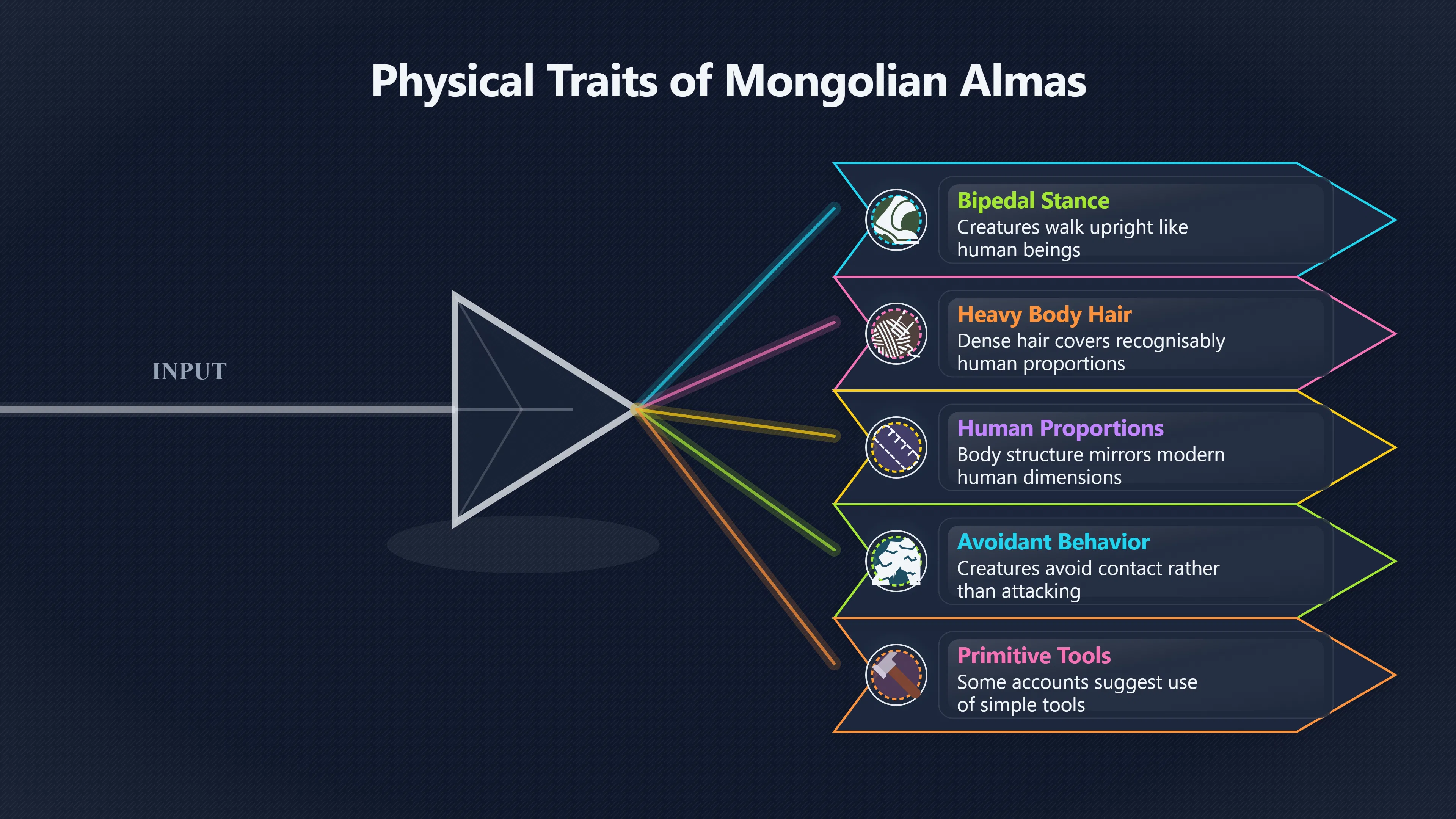
Accounts typically describe a creature that:
- walks upright like a person;
- has heavy body hair but recognisably human proportions;
- lacks sophisticated clothing or permanent settlements;
- avoids contact rather than aggressively attacking people;
- sometimes appears capable of simple tools or primitive social behaviour.
These characteristics place the Almas in an unusual category. Witnesses often describe something that seems neither fully animal nor fully civilised human. Rather than a monster, it occupies the imagined boundary between wilderness and society.
That distinction has encouraged very different interpretations. Folklorists often regard the Almas as a cultural figure representing people living beyond normal social rules, while cryptozoologists have sometimes argued that the reports preserve memories of an unknown population of archaic humans.[Oxford University Research Archive]ora.ox.ac.ukford University Research ArchiveTHE MONGOLIAN ALMASby M Heaney · 1983 · Cited by 4 — Almases may, in fact, be the successors to Neander…
The reports that shaped the legend
Most Almas stories are anecdotal rather than documentary. They usually involve fleeting encounters in isolated terrain rather than prolonged observation.
Typical reports describe herders noticing a hairy figure watching from a hillside before disappearing into rocks or woodland. Others recount unusual footprints, distant human-like cries or sightings at dawn and dusk. These narratives tend to be second-hand, passed through families or local communities rather than recorded immediately by trained observers.
During the Soviet period and afterwards, several investigators collected such testimonies across Central Asia. The evidence, however, remained almost entirely oral. No authenticated skeleton, body, DNA sample or accepted photograph has emerged despite decades of searching.
Academic discussions of the Mongolian material note that the reports vary considerably from one district to another, suggesting the tradition evolved through repeated storytelling rather than describing a single, consistent biological species.[Oxford University Research Archive]ora.ox.ac.ukford University Research ArchiveTHE MONGOLIAN ALMASby M Heaney · 1983 · Cited by 4 — Almases may, in fact, be the successors to Neander…
Why some researchers proposed a relict hominin
Perhaps the most controversial interpretation is that the Almas represents surviving archaic humans rather than an unknown ape.
Several twentieth-century researchers argued that descriptions fitted an extinct human relative more closely than a giant primate. Some speculated about survival of populations descended from Neanderthals or another ancient hominin isolated in remote mountain regions. These ideas attracted attention because Almas descriptions frequently emphasise human facial features, intelligence and behaviour instead of apelike anatomy.
The proposal has never gained acceptance within mainstream palaeoanthropology. Modern evidence shows that Neanderthals disappeared roughly 40,000 years ago, while extensive archaeological and genetic research has produced no credible indication that isolated populations survived into historical times in Central Asia. The hypothesis therefore remains speculative rather than evidence-based.[Oxford University Research Archive]ora.ox.ac.ukford University Research ArchiveTHE MONGOLIAN ALMASby M Heaney · 1983 · Cited by 4 — Almases may, in fact, be the successors to Neander…
Folklore offers a different explanation
Folklore specialists generally approach the Almas from another direction.
Across Inner Asia, mountain landscapes often contain stories about beings who stand outside ordinary society. Such figures can represent wilderness itself, cautionary tales about travelling alone or symbolic reminders that civilisation has limits.
In this reading, the Almas belongs alongside many traditions in which remote mountains shelter ambiguous human-like beings. The stories blur distinctions between hunter and hunted, outsider and neighbour, civilisation and nature. They need not describe an undiscovered species to perform an important cultural role.
Some scholars also suggest that memories of isolated individuals, fugitives, unusually hairy people or marginal communities could gradually merge into a single legendary figure over generations.[SIT Digital Collections]digitalcollections.sit.eduSIT Digital CollectionsThe Legend of the Almas: A Comparative and Critical…by N Wenzel · 2009 — This paper investigates the presence o…
Why the evidence remains inconclusive
The Almas occupies an awkward position because neither believers nor sceptics possess decisive evidence.
Supporters point to the persistence of similar traditions across multiple countries and the apparent consistency of some descriptions. They argue that isolated mountain terrain still leaves room for rare encounters.
Sceptics counter that longevity alone does not establish biological reality. The principal weaknesses remain the absence of physical evidence, the dependence on eyewitness testimony and the lack of independently verifiable observations despite increased exploration, satellite mapping and modern wildlife surveys.
Unlike confirmed species discoveries, Almas reports have not progressed from anecdote to repeatable scientific evidence.

Why the Mongolian Almas still matters
Whether or not any unknown creature ever existed, the Almas remains one of Mongolia’s most distinctive contributions to Central Asian Forteana because it sits precisely at the boundary between folklore, anthropology and cryptozoology.
The stories ask an unusually human question. Instead of wondering whether a monster survives in the mountains, they wonder whether someone almost human might still live beyond the edges of civilisation. That subtle difference gives the Almas a more reflective quality than many cryptid traditions.
Within Mongolia’s wider catalogue of strange traditions, the Almas complements rather than competes with legends such as the Gobi death worm. One mystery belongs to the desert and hidden animals; the other belongs to mountain frontiers and uncertain ideas about what it means to be human. That enduring uncertainty—not spectacular evidence—is what has kept the Almas alive in both folklore and modern discussion.

eBay marketplace picks
Marketplace Samples
Live-tested eBay searches with available results related to this page.



Endnotes
1.
Source: digitalcollections.sit.edu
Link:https://digitalcollections.sit.edu/cgi/viewcontent.cgi?article=1780&context=isp_collection
Source snippet
SIT Digital CollectionsThe Legend of the Almas: A Comparative and Critical...by N Wenzel · 2009 — This paper investigates the presence o...
2.
Source: digitalcollections.sit.edu
Title: isp collection
Link:https://digitalcollections.sit.edu/isp_collection/801/
Source snippet
The legend of the almas, the wildman of Mongolia, has a long history. The stories are primarily found in the western aimags of Mongolia.R...
3.
Source: folklore.ee
Link:https://folklore.ee/folklore/sites/default/files/2026-04/Folklore98_web.pdf
Source snippet
öl, Sötköl). The word Akgöl (Akköl or Ağkül) is also...Read more...
4.
Source: ora.ox.ac.uk
Link:https://ora.ox.ac.uk/objects/uuid%3A85d4d3f6-d0be-4c8d-839a-3a6736ceeec6/files/mfc46cc4661f4477cdd7469b1cc5839df
Source snippet
ford University Research ArchiveTHE MONGOLIAN ALMASby M Heaney · 1983 · Cited by 4 — Almases may, in fact, be the successors to Neander...
5.
Source: itsmth.fandom.com
Link:https://itsmth.fandom.com/wiki/Almas
Source snippet
It's Something Wiki | FandomAlmas are typically described as human like bipedal creatures, between five and six and a half feet tall, t...
Additional References
6.
Source: studocu.vn
Link:https://www.studocu.vn/vn/document/dai-hoc-ha-noi/ielts/almas-the-mongolian-man-beast/65304848
Source snippet
Almas: The Mysterious Mongolian Man-Beast ExplainedAlmas are described as being similar in height to that of modern Mongolians, hairy, ha...
7.
Source: maths.nuigalway.ie
Link:https://maths.nuigalway.ie/~niall/CS211/lab3/BigDictionary.txt
Source snippet
nuigalway.ieBigDictionary.txt... altai altaic altair altaloma altaltissimo altamahaw altamira altamont altar... folklore folkloric folkl...
8.
Source: downey-n1.cs.northwestern.edu
Title: edubiennials verplank tsukino biysk woode nunnery icici gavar
Link:https://downey-n1.cs.northwestern.edu/downloads/OTyper_data_aaai18/FIGER_data/all_entity_str.txt
Source snippet
grover ampliatus aravindan candlewood punnagai kurdamir kanaloa jahazpur... oxford formulating iranians tungsram association frayn parab...
9.
Source: homepages.math.uic.edu
Title: eduagitates fireproofed chariest tuneful Julliard’s dustman
Link:https://homepages.math.uic.edu/~leon/mcs360-f07/projects/3-4/dictionary-large-rand.txt
Source snippet
folklore mixtures Mirielle squamation salsify Addams Trill's Emelyne's Renae's reeding's turtledoves Ongun's Hama catabolite individually...
10.
Source: reddit.com
Link:https://www.reddit.com/r/Cryptozoology/comments/1p828kt/about_the_western_mongolian_almas_tradition_and/
Source snippet
rn Mongol folklore, has been linked by Russian explorers...Read more...
11.
Source: mit.edu
Link:https://www.mit.edu/~ecprice/wordlist.100000
Source snippet
as bored boredom borehamwood borehole...Read more...
12.
Source: norvig.com
Title: google books common words.txt
Link:https://norvig.com/google-books-common-words.txt
Source snippet
google-books-common-words.txt... PAPER 135586065 WORKS 134992496 AREAS 134941395 MODERN 134920850 PROVIDED... OXFORD 49518636 CHARACTERI...
13.
Source: youtube.com
Link:https://www.youtube.com/watch?v=Cc4QP7Y0lSI
Source snippet
The Battle of the Mongol Warriors near the Almas River in the Altai Mountains...
14.
Source: ep.sci.hokudai.ac.jp
Link:https://www.ep.sci.hokudai.ac.jp/~inex/y2015/0501/practical/kadaidata/bin/dic2010
Source snippet
rebo borei borewar borgawa...Read more...
15.
Source: huggingface.co
Link:https://huggingface.co/Cherishh/wav2vec2-slu-1/resolve/refs%2Fpr%2F1/unigrams.txt?download=true
Source snippet
ura altan altana altantuya...Read more...
Topic Tree