Within Madagascar Weird
Why Madagascar's Forest Beings Still Haunt Stories
Kalanoro spirits and aye-aye death omens show how living landscapes and animals become uncanny in Malagasy tradition.
On this page
- Kalanoro in rivers, caves and forests
- Aye aye omens and fear
- Folklore, taboo and conservation
Page outline Jump by section
Introduction
Madagascar’s most enduring strange stories are often attached not to haunted buildings or mysterious lights, but to forests and the creatures that inhabit them. Two of the island’s best-known traditions illustrate this vividly. The first concerns the Kalanoro, elusive forest beings said to dwell near rivers, caves and remote woodland. The second centres on the living aye-aye, an extraordinary nocturnal lemur whose appearance has made it a powerful omen in parts of Malagasy tradition. One belongs firmly to folklore, the other to zoology, yet both reveal how Madagascar’s landscapes are understood as places where nature, ancestors and unseen forces overlap.

For anyone exploring Madagascar’s Fortean traditions, these stories are important not because they prove the supernatural, but because they show how unusual wildlife and sacred places become woven into living belief, influencing everything from healing customs to modern conservation.
Why Madagascar’s Forest Beings Still Haunt Stories
Kalanoro in rivers, caves and forests
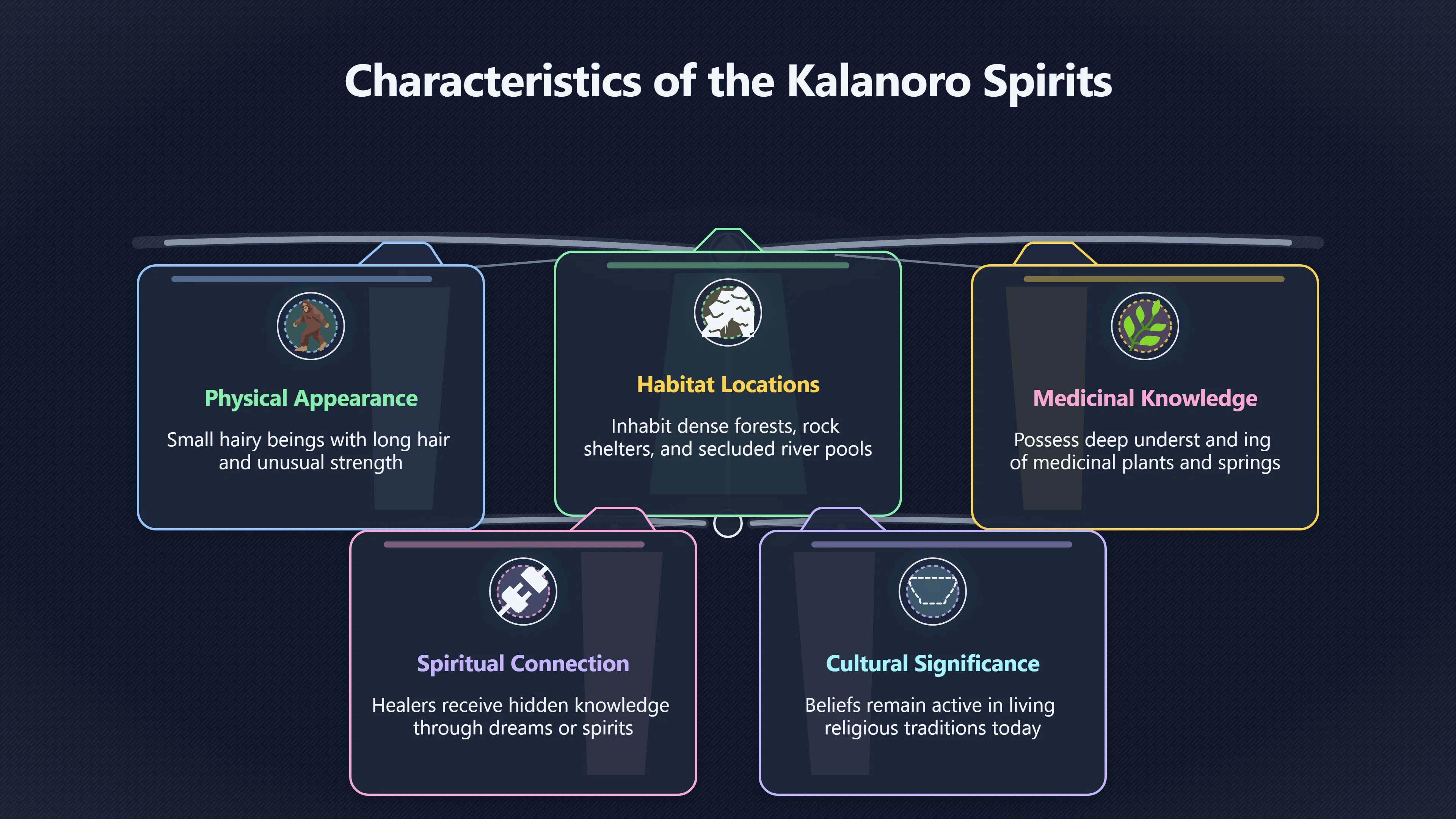
The Kalanoro occupy a distinctive place in Malagasy oral tradition. Rather than being monsters to be hunted, they are usually described as shy, small, hairy beings living far from villages in dense forest, rocky shelters, caves or beside secluded streams. Descriptions vary between regions, but recurring features include long hair, unusual strength despite their size, and an avoidance of ordinary human society. Older ethnographic accounts collected from several Malagasy communities show that there is no single “official” Kalanoro story; instead, the traditions shift according to local history and landscape.[Wikipedia]WikipediaOpen source on wikipedia.org.
Their role is more complex than that of a simple woodland ghost. In some traditions they possess remarkable knowledge of medicinal plants, springs and fertility. Certain healers and diviners have long claimed relationships with Kalanoro spirits, believing they can receive advice, healing powers or hidden knowledge through dreams or spirit communication. Accounts describe consultations taking place indirectly, sometimes with the spirit speaking through an intermediary rather than appearing openly. These stories belong to living religious traditions rather than abandoned mythology, making them culturally significant even where outsiders interpret them symbolically.[Wikipedia]WikipediaOpen source on wikipedia.org.
European travellers occasionally treated Kalanoro stories as reports of undiscovered human-like creatures, encouraging later cryptozoological speculation. However, historians and anthropologists generally regard the traditions as part of Malagasy spiritual belief, closely connected with ideas about ancestors, sacred places and specialist ritual practitioners rather than hidden biological species.[Wikipedia]WikipediaOpen source on wikipedia.org.
The association with caves and waterways is especially striking. Forest pools, secluded rivers and rock shelters frequently appear as places where ordinary rules weaken and encounters become possible. Such locations often carry local taboos, reinforcing the idea that certain parts of the landscape deserve caution and respect rather than casual exploration. UNESCO has highlighted how these landscapes remain spiritually significant for communities whose cultural traditions continue alongside conservation efforts.[UNESCO]unesco.orgPreserving culture and nature: the Earth Network project…5 Dec 2024 — For this communities, Kalanoro is not only a source of foo…
Why the aye-aye became an omen
Unlike the Kalanoro, the aye-aye is entirely real. It is one of Madagascar’s most unusual lemurs, with continuously growing incisors, enormous ears and an exceptionally long middle finger used to tap wood and extract insect larvae. Its appearance and nocturnal habits have inspired powerful folklore for centuries.[Wikipedia]WikipediaOpen source on wikipedia.org.
Across many parts of Madagascar, the aye-aye has acquired a reputation as a harbinger of misfortune or death. Stories differ considerably between regions. Some traditions claim that if an aye-aye enters a village or points its long finger towards someone, tragedy will follow. Others maintain that the animal should be killed immediately to prevent disaster. Yet neighbouring communities may hold completely different beliefs, treating the species as protected by taboo or even associating it with honoured ancestors.[lemurconservationnetwork.org]lemurconservationnetwork.orgPoaching LemursFor example, in some areas, aye-ayes are killed because they are considered a bad omen. But in other areas, it is actually…
Recent ethnoprimatological research—combining anthropology with primate conservation—has shown that older descriptions of the aye-aye as simply an “evil omen” are too simplistic. Interviews across eastern Madagascar revealed remarkably diverse beliefs. Some communities conduct rituals after killing an aye-aye, while others perform funeral-like ceremonies because they regard the animal as embodying an ancestral spirit. Rather than a single superstition, researchers found a patchwork of local traditions shaped by history, ethnicity and place.[Springer]link.springer.comUnshrouding Narratives, Beliefs, and Practices Related to the…by A Anania · 2025 — In Madagascar, lemurs are deeply embedded i…
This diversity explains why sweeping statements about Malagasy beliefs often mislead readers. What is considered dangerous in one district may be strictly protected in another, reflecting the highly local nature of Malagasy customary law and taboo.
Folklore, taboo and conservation
The relationship between folklore and wildlife has practical consequences. Because some communities believe the aye-aye predicts death or disaster, individuals are sometimes killed when encountered. Conservation organisations identify these cultural beliefs, alongside habitat loss and deforestation, as important pressures affecting an already endangered species.[lemurconservationnetwork.org]lemurconservationnetwork.orgAye-ayes are often poached because of cultural traditions (fady or taboos that vary from…Read more…
At the same time, conservationists increasingly stress that local traditions cannot be reduced to obstacles. Malagasy fady—customary taboos governing behaviour towards places, animals and ancestors—sometimes protect wildlife rather than threaten it. Researchers caution against trying to replace one belief with another or inventing conservation myths, arguing instead that successful protection depends on understanding local traditions as they actually exist.[brookes.ac.uk]brookes.ac.ukOxford Brookes University Embodied ancestor or harbinger of bad luck?Study…27 Oct 2025 — The aye-aye is commonly feared as a harbinger of bad luck across eastern Madagascar. In some communities in the no…
The Kalanoro traditions also intersect with conservation in unexpected ways. Sacred forests associated with spirits are often treated with particular respect, limiting exploitation and preserving patches of habitat that also benefit wildlife. Modern cultural heritage projects increasingly recognise that safeguarding biodiversity and safeguarding traditional beliefs can reinforce one another rather than compete.[UNESCO]unesco.orgPreserving culture and nature: the Earth Network project…5 Dec 2024 — For this communities, Kalanoro is not only a source of foo…
Why these traditions matter in Madagascar’s strange history
From a Fortean perspective, Kalanoro stories and aye-aye omens occupy an unusual middle ground between myth and lived experience.
The Kalanoro remain elusive because they were never primarily intended as zoological discoveries. They belong to a worldview in which forests contain unseen inhabitants, sacred knowledge and ancestral power. Attempts to reinterpret them as undiscovered hominids reveal more about later cryptozoological enthusiasm than about the original traditions.[Wikipedia]WikipediaOpen source on wikipedia.org.
The aye-aye, by contrast, demonstrates how a genuine animal can become uncanny through its appearance and behaviour. Its huge eyes, nocturnal habits and skeletal-looking finger make it seem almost supernatural to observers unfamiliar with its ecology. Modern biology explains its specialised feeding technique, but that explanation does not erase centuries of cultural meaning.[Wikipedia]WikipediaOpen source on wikipedia.org.
Together these traditions capture a distinctive feature of Madagascar’s weird history. The island’s forests are not simply settings for mysterious tales; they are living cultural landscapes where extraordinary wildlife, sacred geography and ancestral belief have long shaped one another. The result is a body of folklore that remains influential today, not because it offers proof of hidden creatures or supernatural powers, but because it continues to affect how people understand the land, its animals and the unseen dimensions of place.

Amazon book picks
Further Reading
Books and field guides related to Why Madagascar's Forest Beings Still Haunt Stories. Use these as the next step if you want deeper reading beyond the article.


The anthropology of religion, magic, and witchcraft
Provides context for spirit traditions, taboo and belief.

The Book of Yōkai
Useful comparative folklore reading for understanding how cultures transform fears and places into stories.
eBay marketplace picks
Marketplace Samples
Live-tested eBay searches with available results related to this page.


Endnotes
1.
Source: Wikipedia
Link:https://en.wikipedia.org/wiki/Kalanoro
2.
Source: unesco.org
Link:https://www.unesco.org/en/articles/preserving-culture-and-nature-earth-network-project-supports-kalanoro-community-madagascar
Source snippet
Preserving culture and nature: the Earth Network project...5 Dec 2024 — For this communities, Kalanoro is not only a source of foo...
3.
Source: Wikipedia
Link:https://en.wikipedia.org/wiki/Aye-aye
4.
Source: lemurconservationnetwork.org
Link:https://www.lemurconservationnetwork.org/learn/conservation-threats-and-solutions-for-lemurs/poaching-lemurs/
Source snippet
Poaching LemursFor example, in some areas, aye-ayes are killed because they are considered a bad omen. But in other areas, it is actually...
5.
Source: link.springer.com
Link:https://link.springer.com/article/10.1007/s10764-025-00515-0
Source snippet
Unshrouding Narratives, Beliefs, and Practices Related to the...by A Anania · 2025 — In Madagascar, lemurs are deeply embedded i...
6.
Source: lemurconservationnetwork.org
Title: Lemur Conservation Network (LCN) is a USA-registered
Link:https://www.lemurconservationnetwork.org/on-the-ground-in-madagascar-with-ellie-dobbs-researching-aye-aye-taboos/
Source snippet
On the Ground in Madagascar with Ellie Dobbs31 Jan 2022 — there are fundamental fadys such as the aye-aye being fady to eat, to harm, or...
7.
Source: lemurconservationnetwork.org
Link:https://www.lemurconservationnetwork.org/learn/lemur-species-fact-sheets/aye-aye/
Source snippet
Aye-ayes are often poached because of cultural traditions (fady or taboos that vary from...Read more...
8.
Source: lemurconservationnetwork.org
Title: the power of storytelling to inspire lemur conservation
Link:https://www.lemurconservationnetwork.org/the-power-of-storytelling-to-inspire-lemur-conservation/
Source snippet
15 Sept 2015 — In the late 1500s, adventurers on a Portuguese expedition to the tangled forests of Madagascar were awakened from their sl...
9.
Source: brookes.ac.uk
Title: Oxford Brookes University Embodied ancestor or harbinger of bad luck?
Link:https://www.brookes.ac.uk/about-brookes/news/news-from-2025/10/embodied-ancestor-or-harbinger-of-bad-luck-study-r
Source snippet
Study...27 Oct 2025 — The aye-aye is commonly feared as a harbinger of bad luck across eastern Madagascar. In some communities in the no...
10.
Source: earth.org
Link:https://earth.org/the-aye-aye-paradox-between-preservation-and-economic-pressures/
Source snippet
Aye-Aye: Between Preservation and Economic Pressures4 Nov 2025 — For generations, the aye-aye was considered an omen of death...
11.
Source: cryptidz.fandom.com
Link:https://cryptidz.fandom.com/wiki/Kalanoro
Source snippet
Cryptid Wiki - FandomAll the tribes of island of Madagascar, located off the east coast of Africa, know of the Kalanoro, according to fol...
Additional References
12.
Source: facebook.com
Link:https://www.facebook.com/groups/sanctuaryasia/posts/10156933076131103/
Source snippet
Aye aye lemur conservation and unique featuresThe Aye-aye is currently listed as Endangered on the IUCN Red List, and its population is u...
13.
Source: francis-press.com
Link:https://francis-press.com/papers/20492
Source snippet
Folklore, Aesthetics, and Cultural Imagination in MadagascarRooted in African and Indonesian cultural heritages, Malagasy folklore encomp...
14.
Source: news.xbox.com
Link:https://news.xbox.com/en-us/2026/04/23/kalanoro-charming-debut-indie-game/
Source snippet
Kalanoro Mixes Malagasy Folkore, Lemur Bands, and...23 Apr 2026 — Kalanoro is a handcrafted indie adventure made with love and coffee...
15.
Source: tri.yale.edu
Link:https://tri.yale.edu/tropical-resources/tropical-resources-30th-anniv/aye-aye-lemur-madagascar-feeding-ecology-social
Source snippet
social system of the aye-aye over a period of eighteen months.Read more...
16.
Source: reddit.com
Link:https://www.reddit.com/r/HighStrangeness/comments/1rrt3ps/the_kalanoro_of_madagascar_physical_cryptids_or/
Source snippet
iving in the deep rainforests and caverns of the island.Read more...
17.
Source: youtube.com
Title: Lemur Legends: Madagascar’s Folklore and Cultural Significance!
Link:https://www.youtube.com/watch?v=cZ2dJv9BLSY
Source snippet
Kalanoro Madagascar folklore forest spirit The Kalanoro: Madagascar's Mysterious Forest Spirit | 60-Second Lore Legends of The Unknown...
18.
Source: instagram.com
Link:https://www.instagram.com/p/DQULbYXk_iS/
Source snippet
Madagascar's mysterious aye-aye. Far from being a “...Read more...
19.
Source: facebook.com
Link:https://www.facebook.com/DukeLemurCenter/posts/fun-facts-about-aye-aye-fady-her-name-means-taboo-or-superstition-in-malagasy-fa/1372167928271303/
Source snippet
a family or village member. they are often killed on sight and...
20.
Source: instagram.com
Title: How could you hate the aye aye?!
Link:https://www.instagram.com/reel/DPD1ONjCBDo/
Source snippet
This incredible and slightly...This incredible and slightly strange looking lemur is sadly endangered due to local superstitions in Mada...
21.
Source: madamagazine.com
Title: The little forest spirits
Link:https://www.madamagazine.com/en/die-kleinen-waldgeister-kalanoro/
Source snippet
The little forest spirits - KalanoroMany myths and legends surround the Kalanoro, the small forest spirits of Madagascar. The...
Topic Tree