Within New Zealand Weird
Why Did the Kaikoura Lights Become Famous?
New Zealand's most famous UFO case stands out because witnesses, radar reports, film footage and official files all shaped the debate.
On this page
- What was reported in December 1978
- Film, radar and official files
- Sceptical explanations and lasting appeal
Page outline Jump by section
Introduction
The Kaikōura lights are New Zealand’s best-known UFO case because they combined several forms of evidence that rarely appear together: multiple eyewitnesses, reports from experienced pilots, airborne and ground radar observations, colour film shot by a professional television crew, and an official investigation whose records were later released to the public. The main events unfolded during December 1978 over the Kaikōura coast of the South Island, and they quickly became an international news story. More than four decades later, the case remains a benchmark for debates about unidentified aerial phenomena because neither believers nor sceptics regard it as a simple, single-witness sighting. Instead, the argument centres on how different pieces of evidence fit together—and whether they point to one extraordinary event or several ordinary phenomena mistakenly linked into a single mystery.[Wikipedia]WikipediaKaikōura lightsKaikōura lights
What was reported in December 1978?
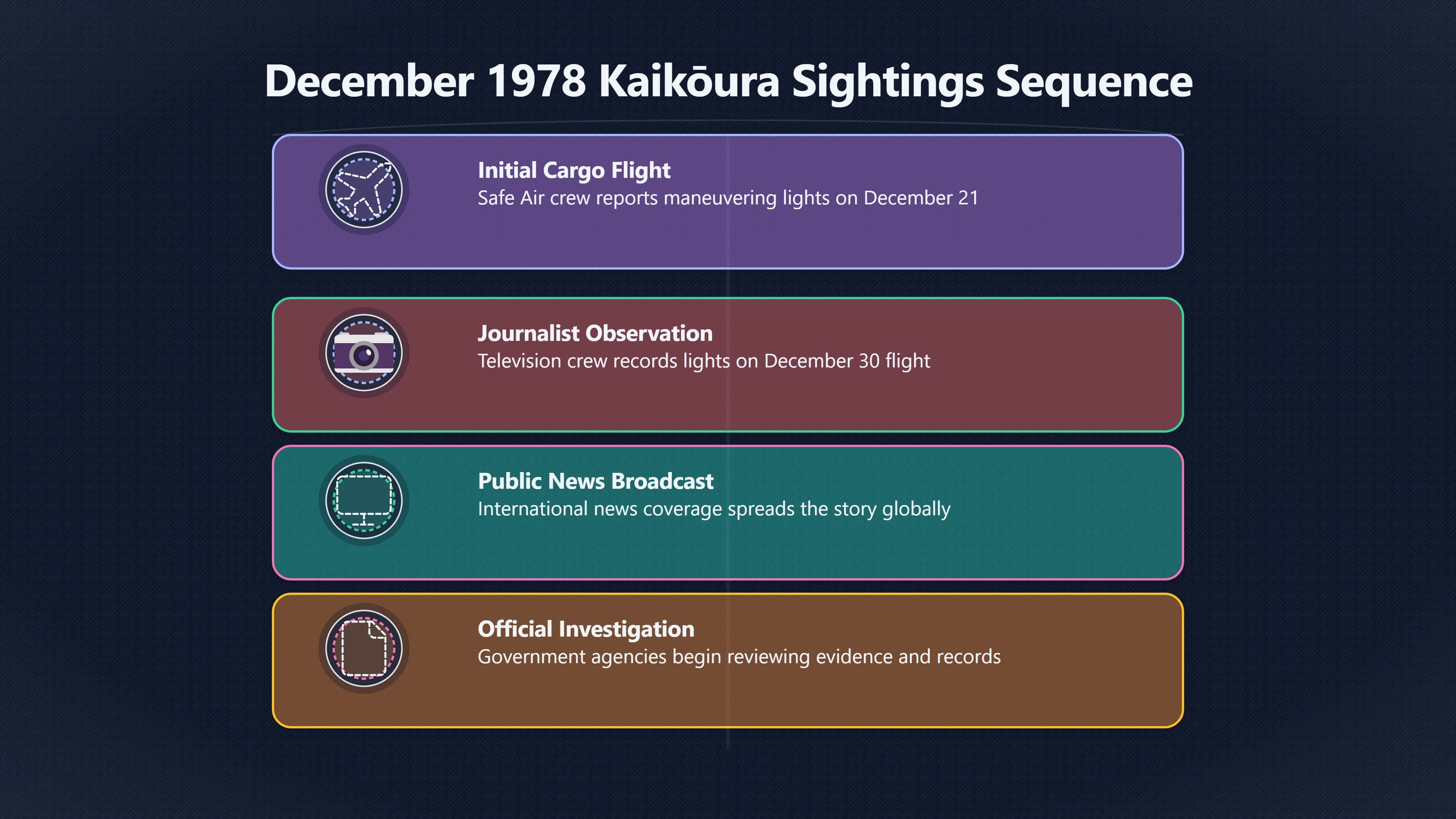
The Kaikōura story actually consists of several closely connected sightings rather than one isolated incident. The first widely reported encounters occurred on 21 December 1978, when the crew of a Safe Air cargo aircraft flying between Wellington and Christchurch reported brilliant lights apparently manoeuvring near their aircraft. Some of these lights were said to correspond with radar returns observed by Wellington air traffic control, giving the reports an importance beyond ordinary visual sightings.[Wikipedia]WikipediaKaikōura lightsKaikōura lights
The incident became famous nine days later. On the night of 30–31 December, Australian television reporter Quentin Fogarty and cameraman David Crockett boarded another Safe Air Argosy freight flight intending to film a report about the earlier sightings. Instead, the crew themselves witnessed unusual lights.
According to the pilots and television crew:
- Bright lights appeared to pace the aircraft.
- One particularly luminous object seemed to move above, below and ahead of the plane.
- The phenomena were observed repeatedly over many minutes rather than as a brief flash.
- Parts of the encounter were recorded on 16 mm colour film.
- Audio recordings captured the reactions of those on board as events unfolded.[Wikipedia]WikipediaKaikōura lightsKaikōura lights
Because experienced commercial pilots, journalists and camera operators were involved, the story carried greater credibility in the public imagination than many UFO reports based solely on anonymous witnesses.
Why did the evidence become so influential?
The Kaikōura case occupies a special place in UFO history because several different forms of evidence appeared to reinforce one another. Each category has been interpreted differently by supporters and sceptics, but together they created an unusually rich evidential trail.
The film footage
Perhaps the most enduring legacy of the incident is the professionally shot colour film broadcast internationally shortly afterwards. Unlike many alleged UFO photographs, the footage was taken by a television cameraman using professional equipment during an unfolding news event rather than during a private investigation.
The images themselves, however, are ambiguous. They show bright moving lights but reveal little about their actual size, distance or physical nature. Analysts have argued for decades over whether the footage records distant lights, optical artefacts, atmospheric effects or genuinely unexplained aerial objects.[Wikipedia]WikipediaKaikōura lightsKaikōura lights
Radar reports
Radar is one reason the case continues to attract attention.
Witnesses reported:
- airborne radar indications aboard the aircraft;
- unidentified returns observed by Wellington air traffic controllers during parts of the incidents;
- apparent correspondence between some visual sightings and radar observations.
To UFO researchers this combination is significant because it appears to combine independent instrumental and eyewitness evidence.
Sceptics respond that radar is not infallible. Weather conditions can produce anomalous propagation, sometimes called “freak propagation”, creating false or distorted returns that appear as solid targets. Modern investigators generally regard radar evidence as valuable only when interpreted alongside environmental conditions and equipment limitations.[Otago Daily Times Online News]odt.co.nzair force report explains kaikoura ufo sightingsOtago Daily Times Online NewsAir Force report explains Kaikoura "UFO sightings"23 Dec 2010 — The RNZAF attributed the sightings to "freak…
Official records
Unlike many famous UFO stories, the Kaikōura lights generated substantial government paperwork.
Investigations involved:
- the Royal New Zealand Air Force;
- police;
- the Carter Observatory;
- government scientific agencies including the Department of Scientific and Industrial Research (DSIR).
Many of these records were later released under New Zealand’s Official Information Act, allowing researchers to compare official assessments with public claims instead of relying purely on rumours or leaked documents.[Wikipedia]WikipediaKaikōura lightsKaikōura lights
What did investigators conclude?
One reason the Kaikōura lights remain controversial is that there was no single official verdict.
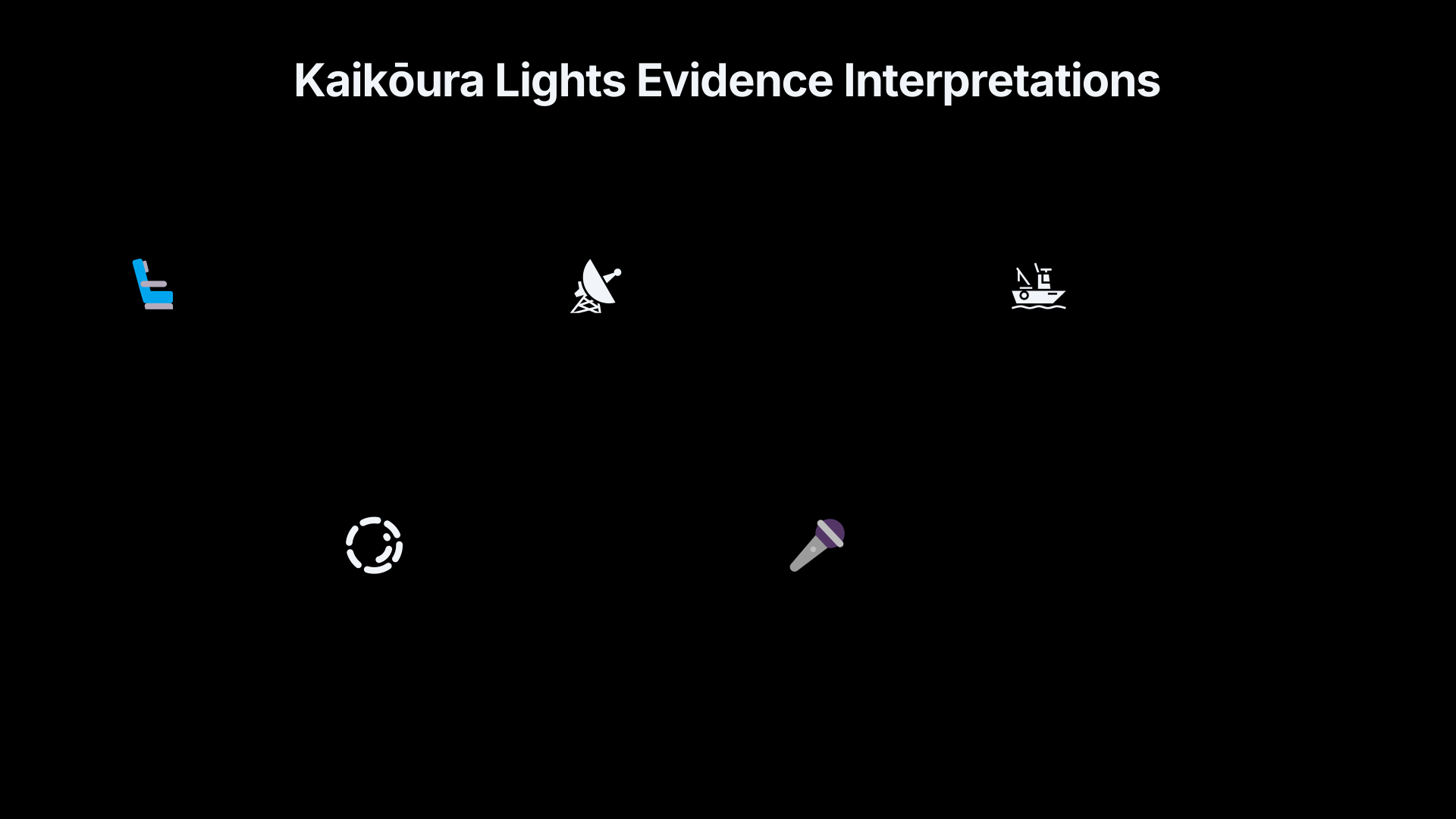
The Department of Scientific and Industrial Research examined the available evidence and suggested several ordinary explanations rather than one extraordinary one. These included:
- lights from squid fishing boats reflected or refracted through unusual atmospheric conditions;
- an unusually bright appearance of Venus in some observations;
- meteors in certain instances;
- optical distortions produced by filming through aircraft windows;
- anomalous radar propagation producing misleading radar contacts.[Wikipedia]WikipediaKaikōura lightsKaikōura lights
The DSIR also examined the film itself. Investigators argued that some images could be reproduced by shining lights through aircraft windows, demonstrating that at least part of the recorded imagery might result from reflections rather than external objects. At the same time, they considered some television footage worthy of further analysis because it had been filmed without shooting through multiple aircraft windows, making it more difficult to dismiss immediately as an optical artefact.[Wikipedia]WikipediaKaikōura lightsKaikōura lights
Importantly, the official investigation did not claim that every reported light had exactly the same explanation. Instead, different observations may have resulted from different natural causes occurring during the same period.
Why do believers still regard it as a strong UFO case?
Supporters of an unexplained interpretation argue that no single conventional explanation accounts for every part of the evidence simultaneously.
They point to several features:
- multiple independent eyewitnesses;
- experienced professional pilots;
- prolonged observations rather than momentary flashes;
- apparent radar correlations;
- recorded conversations made during the events rather than later recollections;
- surviving film that can still be re-analysed.
American optical physicist Bruce Maccabee became one of the best-known investigators supporting this interpretation. After studying the film and interviewing witnesses, he argued that some observed objects did not fit straightforward explanations such as ball lightning or simple reflections, concluding that at least part of the case remained unidentified.[Wikipedia]WikipediaKaikōura lightsKaikōura lights
Even declassified CIA material described the incident as unusual among civilian UFO reports because of the quantity of documentary evidence available, although that observation should not be mistaken for an endorsement of any extraterrestrial explanation.[Wikipedia]WikipediaKaikōura lightsKaikōura lights
Why do sceptics remain unconvinced?
Sceptical investigators generally argue that the case appears stronger than it is because several separate events have become merged into one dramatic narrative.
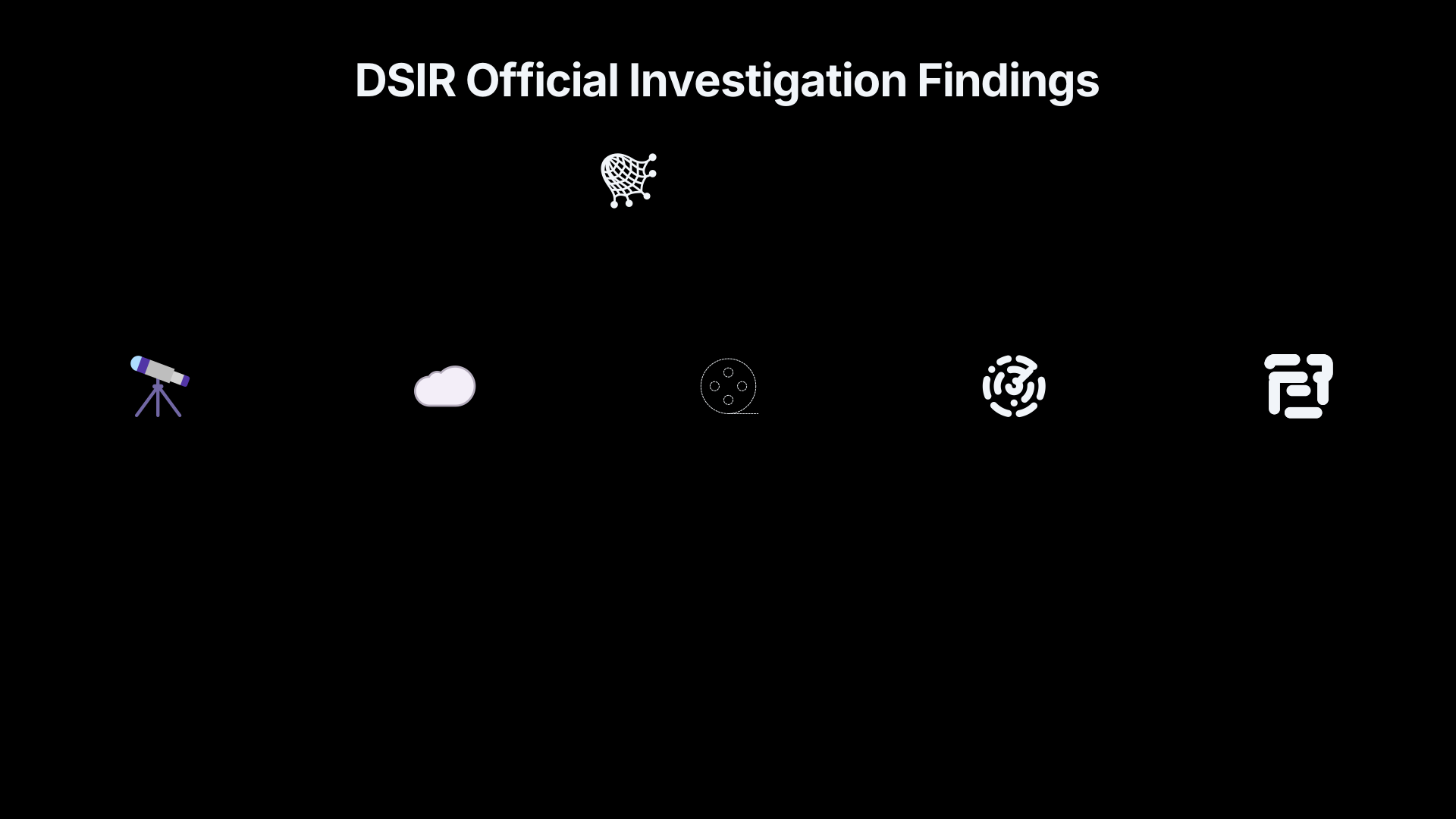
Common sceptical arguments include:
- the lights need not all have had the same source;
- bright squid fishing vessels were operating in New Zealand waters at the time;
- Venus can appear remarkably bright under suitable atmospheric conditions;
- reflections inside aircraft windows can create misleading images on film;
- unusual weather can produce both optical mirages and anomalous radar returns;
- memories became influenced by intense international media coverage after the first broadcasts.[Otago Daily Times Online News]odt.co.nzair force report explains kaikoura ufo sightingsOtago Daily Times Online NewsAir Force report explains Kaikoura "UFO sightings"23 Dec 2010 — The RNZAF attributed the sightings to "freak…
From this perspective, the Kaikōura lights are an example of several individually explainable events becoming linked into a single legendary incident through news reporting and public fascination.
Why the Kaikōura lights still matter
The Kaikōura lights occupy an unusual position in New Zealand’s strange-history record. They are neither a simple folklore tale nor a claim resting entirely on anecdote. Instead, they left behind film, audio recordings, official correspondence, scientific reports and declassified government files that continue to be scrutinised decades later.[Otago Daily Times Online News]odt.co.nzair force report explains kaikoura ufo sightingsOtago Daily Times Online NewsAir Force report explains Kaikoura "UFO sightings"23 Dec 2010 — The RNZAF attributed the sightings to "freak…
That evidence trail explains why the case remains influential. Sceptics see it as a lesson in how multiple ordinary phenomena—astronomical objects, atmospheric optics, radar behaviour and media attention—can combine into an apparently extraordinary event. UFO researchers see the same archive as evidence that at least some observations remain insufficiently explained.
Whichever interpretation proves more persuasive, the Kaikōura lights remain New Zealand’s defining UFO case because they shifted the discussion away from isolated eyewitness testimony towards a rarer question: what should investigators conclude when visual sightings, instruments, recordings and official files all point to an event that is still debated many years later?
Amazon book picks
Further Reading
Books and field guides related to Why Did the Kaikoura Lights Become Famous?. Use these as the next step if you want deeper reading beyond the article.

UFOs : Generals, Pilots, and Government Officials Go on the R...
Matches the evidential themes of the Kaikōura lights.
eBay marketplace picks
Marketplace Samples
Example marketplace items related to this page. Use the search link to explore similar finds on eBay.

Endnotes
1.
Source: Wikipedia
Title: Kaikōura lights
Link:https://en.wikipedia.org/wiki/Kaik%C5%8Dura_lights
2.
Source: archive.org
Title: Full text of “Declassified New Zealand UFO documents”
Link:https://archive.org/stream/NewZealandUFO/AIR-1080-6-897-Volume-1-1978-1981_djvu.txt
Source snippet
New Zealand film of December 31, 1978. The background neutral density is... Zealand were conducive to freak effects on radar and light w...
Published: December 31, 1978
3.
Source: odt.co.nz
Title: air force report explains kaikoura ufo sightings
Link:https://www.odt.co.nz/news/politics/air-force-report-explains-kaikoura-ufo-sightings
Source snippet
Otago Daily Times Online NewsAir Force report explains Kaikoura "UFO sightings"23 Dec 2010 — The RNZAF attributed the sightings to "freak...
Additional References
4.
Source: ngataonga.org.nz
Link:https://www.ngataonga.org.nz/search-use-collection/search/F1910/
5.
Source: facebook.com
Title: the rnzafs orions were called to help in a variety of missions over the years bu
Link:https://www.facebook.com/AirForceMuseumofNewZealand/posts/the-rnzafs-orions-were-called-to-help-in-a-variety-of-missions-over-the-years-bu/745880247571085/
Source snippet
The RNZAF's Orions were called to help...In late December 1978 New Zealand was gripped by UFO fever after a series of unexplained sighti...
Published: December 1978
6.
Source: reddit.com
Title: in 1978 this footage was the best example of ufos
Link:https://www.reddit.com/r/UFOs/comments/15hzj2i/in_1978_this_footage_was_the_best_example_of_ufos/
Source snippet
Kaikōura Lights - in 1978 these were considered the best examples of UFOs caught on a professional TV camera at 14,000 feet...
7.
Source: facebook.com
Link:https://www.facebook.com/rnznewzealand/posts/declassified-government-documents-show-officials-were-struggling-to-debunk-tv1-f/10158728324658731/
Source snippet
ootage of the Kaikōura lights UFO sightings in December 1978.Read more...
Published: December 1978
8.
Source: reddit.com
Link:https://www.reddit.com/r/UnresolvedMysteries/comments/1mqrt7/the_1978_kaikoura_lights_an_enduring_new_zealand/
Source snippet
The 1978 Kaikoura Lights: an enduring New Zealand mysteryThe pilots described some of the lights to be the size of a house and others sma...
9.
Source: circuit.org.nz
Link:https://www.circuit.org.nz/work/kaik-ura-lights
Source snippet
Caryline Boreham Kaikōura Lights (2023)24 Sept 2024 — In early January 1979, TV1 investigated the sightings, recording 16mm film footage...
Published: January 1979
10.
Source: youtube.com
Title: Caught on Camera and Radar | Kaikoura UFO Lights Incident, New Zealand
Link:https://www.youtube.com/watch?v=j9iyUHmHaEo
Source snippet
The 1978 New Zealand UFO Footage (Season 5) | The Proof Is Out There...
11.
Source: tvi.show
Link:https://www.tvi.show/skywatch-files/the-1978-kaikoura-lights-new-zealands-ufo-enigma-examined-through-eyewitness-accounts-and-investigations
Source snippet
The 1978 Kaikoura Lights UFO Incident: Eyewitness...1 May 2025 — The Air Force gathered and passed evidence, including audio transcripts...
Published: May 2025
12.
Source: youtube.com
Link:https://www.youtube.com/watch?v=lqHKN56ajKs
Source snippet
ConspiraSeries | Ep2 - Are the Kaikoura Lights Aliens?...
13.
Source: ngataonga.org.nz
Link:https://www.ngataonga.org.nz/search-use-collection/search/31842/
Source snippet
[Unidentified flying objects].[On the morning of Sunday 30th December 1978 a UFO was sighted and filmed over the Clarence River by a tele...
Published: December 1978
Topic Tree