Within Fiji Forteana
Why Do Fiji's Ghost Stories Feel So Local?
Fiji's ghost stories are often about belonging, colonial places and social unease as much as supernatural fear.
On this page
- Levuka and colonial haunted landscapes
- Ghosts, spirits and village boundaries
- Why social meaning matters in haunting stories
Page outline Jump by section
Introduction
Fiji’s ghost stories rarely work as simple tales of haunted houses or restless spirits. They are deeply tied to ideas of place, belonging and history. A ghost in a Fijian story often appears at a village boundary, an abandoned colonial building, an old road or land marked by conflict and memory. The question is frequently not “Did someone really see a ghost?” but “Why does this place attract that story?”

Anthropological research suggests that contemporary ghost narratives in Fiji help people make sense of changing relationships between Indigenous Fijians, Indo-Fijians, colonial history, Christianity and the landscape itself. Rather than existing outside everyday life, ghosts often become a language through which communities discuss ownership, identity, social obligation and historical unease.[Academia]academia.eduAcademia(PDF) Ghosts and the everyday politics of race in FijiThe paper explores the sociocultural significance of ghosts in Fiji, emphas…
Why do Fiji’s ghost stories feel so local?
Across Fiji, reported hauntings tend to be remarkably specific. Instead of anonymous spectres wandering at random, stories are attached to identifiable locations with recognised histories.
Common settings include:
- former colonial settlements and government buildings;
- village paths and boundaries;
- schools and boarding institutions;
- old cemeteries;
- roads where accidents occurred;
- places associated with warfare or social conflict.
This local character reflects an important feature of many Fijian traditions: land is not merely physical territory but part of social identity. A place carries memories of previous generations, disputes, obligations and historical events. Ghost stories therefore become another way of expressing the continuing importance of those places rather than simply frightening listeners.[Academia]academia.eduAcademia(PDF) Ghosts and the everyday politics of race in FijiThe paper explores the sociocultural significance of ghosts in Fiji, emphas…
Unlike many Western ghost traditions that focus on unfinished personal business, Fijian stories frequently emphasise relationships between people and landscape. The haunting is meaningful because the location matters.
Levuka and colonial haunted landscapes
No town illustrates this better than the old capital of Levuka on Ovalau.
Levuka occupies a distinctive place in Fiji’s imagination. As the country’s first colonial capital, it contains nineteenth-century government buildings, trading houses, churches, cemeteries and steep streets that preserve an unusually visible colonial past. Its designation as a UNESCO World Heritage Site reflects this historical importance.
For that reason, Levuka has also become one of Fiji’s most frequently described haunted settings. Visitors, residents and writers have long repeated stories about strange figures, unexplained footsteps, deserted buildings and apparitions associated with colonial-era locations.
Anthropologist Geir Henning Presterudstuen begins one of his studies with an experience in Levuka where a late-night visitor was interpreted differently by two companions. The incident itself is less important than the discussion that followed. Why did one person immediately interpret the event as a ghost while another did not? The answer lay not in proving the supernatural but in understanding how Levuka’s layered colonial history made ghostly explanations culturally meaningful.[Academia]academia.eduAcademia(PDF) Ghosts and the everyday politics of race in FijiThe paper explores the sociocultural significance of ghosts in Fiji, emphas…
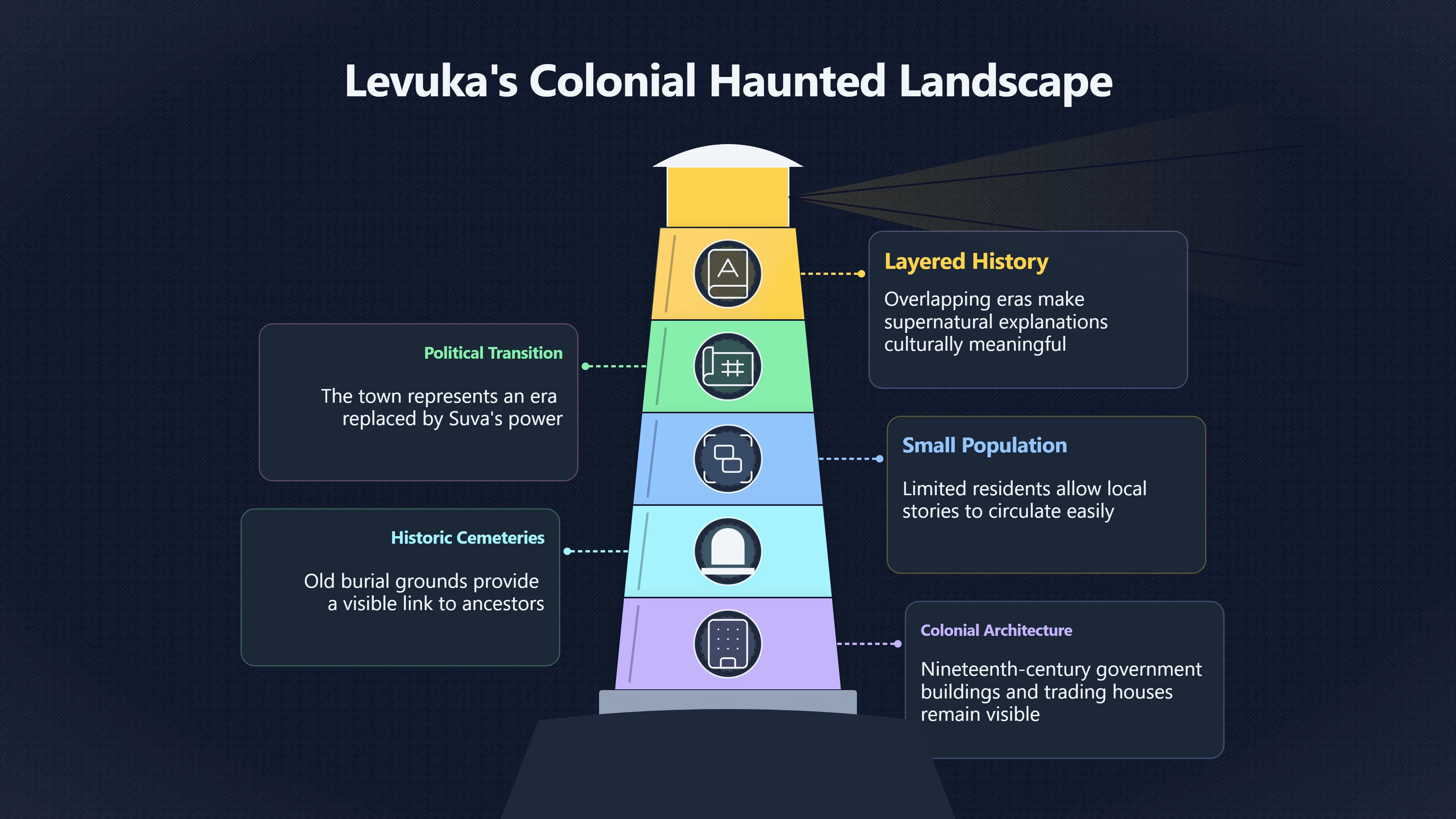
Levuka’s haunted reputation therefore grows from several overlapping factors:
- visible reminders of colonial rule;
- historic cemeteries and abandoned buildings;
- a small population where stories circulate easily;
- awareness that the town represents an earlier political era now largely replaced by Suva.
The result is a landscape where history feels unusually close, encouraging supernatural interpretations without requiring belief that every reported encounter was paranormal.
Ghosts, spirits and village boundaries
Outside colonial towns, ghost stories often revolve around social boundaries rather than historic buildings.
Traditional village life places considerable emphasis on respect for land, kinship and community obligations. Stories about supernatural encounters commonly occur when someone travels alone at night, crosses unfamiliar territory or behaves disrespectfully in places regarded as socially significant.
Researchers note that modern Fijian discussions often blend older ideas about ancestral spirits with newer concepts of ghosts and Christian ideas about demons. The categories are no longer always sharply distinguished. Instead, they overlap in everyday conversation, producing flexible explanations for unusual experiences.[Academia]academia.eduAcademia(PDF) Ghosts and the everyday politics of race in FijiThe paper explores the sociocultural significance of ghosts in Fiji, emphas…
This blending reflects broader cultural change rather than confusion. Fiji has experienced more than a century of interaction between Indigenous traditions, Christian missions, colonial administration and contemporary urban life. Ghost stories have adapted alongside these changes.
In practical terms, many stories reinforce behavioural expectations:
- respect unfamiliar places;
- avoid wandering at night without reason;
- observe village customs;
- acknowledge the importance of local history;
- treat ancestral places carefully.
Whether listeners believe the ghosts literally is often less significant than the social lessons embedded in the stories.
Ghosts as markers of belonging
One of the most striking conclusions of recent anthropological work is that ghost stories frequently express questions of belonging.
Presterudstuen argues that ghosts can symbolically police boundaries between categories such as Indigenous and non-Indigenous, traditional and modern, or local and outsider. The supernatural becomes a way of discussing who truly belongs in a place and who occupies uncertain social ground.[Academia]academia.eduAcademia(PDF) Ghosts and the everyday politics of race in FijiThe paper explores the sociocultural significance of ghosts in Fiji, emphas…
This is especially significant in Fiji because modern national identity has developed through interactions between Indigenous communities, descendants of Indian indentured labourers, Europeans and other Pacific peoples. Land ownership, cultural identity and historical memory have all played major roles in political debate.
Ghost stories rarely resolve these tensions directly. Instead, they offer symbolic narratives in which landscape itself appears to recognise or respond to human relationships.
Christianity and changing ideas about spirits
Another important development is the changing religious interpretation of ghosts.
Earlier Indigenous traditions often treated ancestral spirits as active participants in community life. They were not necessarily evil and could be associated with protection, legitimacy and continuity.
Contemporary Christian influences—particularly more conservative and Pentecostal forms of Christianity—have increasingly reframed many spirits as dangerous or spiritually polluting. In these interpretations, hauntings may be understood as evidence of demonic influence requiring prayer, cleansing or spiritual intervention rather than negotiation with ancestral forces.[Western Sydney University]researchers.westernsydney.edu.aumore sinister, violent and forebodingWestern Sydney UniversityGhost, spirits and Christian denominational politics: a case…by GH Presterudstuen · 2014 · Cited by 6 — Ance…
This represents a significant shift in meaning.
Instead of asking whether a spirit belongs to the land or the ancestors, newer interpretations may ask whether it threatens the Christian community. The same reported experience can therefore receive very different explanations depending on religious background.
Why social meaning matters more than proof
For readers interested in Fortean subjects, Fiji’s ghost traditions are unusual because the cultural interpretation often matters more than establishing whether an apparition objectively existed.
Unlike famous haunted houses elsewhere that depend on eyewitness evidence alone, many Fijian stories continue because they perform social work.
They can:
- preserve memories of colonial occupation;
- reinforce respect for important places;
- express anxiety about social change;
- explain feelings of unease in historically significant landscapes;
- negotiate questions of identity and belonging.
From a sceptical perspective, experiences may arise through expectation, folklore, misperception, sleep disruption, suggestion or the powerful atmosphere of historically charged locations.
From the perspective of believers, however, the persistence of similar stories across generations suggests that certain places genuinely retain spiritual presence.
Neither interpretation fully explains why the stories remain compelling. Their endurance comes from the way they connect personal experience with collective memory.

Ghosts as part of Fiji’s strange history
Within Fiji’s wider catalogue of Fortean traditions, ghost stories stand apart because they reveal more about society than about spectacular paranormal claims.
Rather than depending on dramatic evidence or famous investigations, they occupy the meeting point between oral tradition, colonial history, religious change and attachment to place. Levuka’s haunted streets, village boundary stories and accounts linked to remembered landscapes all demonstrate how supernatural narratives can become repositories for history itself.
Whether viewed as folklore, lived spiritual experience or cultural metaphor, Fiji’s ghost stories continue to remind listeners that landscapes are rarely just physical settings. They are places where memory, identity and history remain vividly alive.
Amazon book picks
Further Reading
Books and field guides related to Why Do Fiji's Ghost Stories Feel So Local?. Use these as the next step if you want deeper reading beyond the article.

Ghostland: An American History in Haunted Places
Explores how hauntings reflect culture and place, matching the article's themes.

The Golden Bough
First published 1890. Subjects: Mythology, Magic, Superstition, Religion, Primitive Religion.
The Rough Guide to Fiji
Provides historical and geographical context for haunted locations.

eBay marketplace picks
Marketplace Samples
Live-tested eBay searches with available results related to this page.




Endnotes
1.
Source: academia.edu
Link:https://www.academia.edu/30968990/Ghosts_and_the_everyday_politics_of_race_in_Fiji
Source snippet
Academia(PDF) Ghosts and the everyday politics of race in FijiThe paper explores the sociocultural significance of ghosts in Fiji, emphas...
2.
Source: academia.edu
Link:https://www.academia.edu/19438291/A_Mission_Divided_Race_Culture_and_Colonialism_in_Fijis_Methodist_Mission
Source snippet
tagonism over land and labour, that were used to justify this separation...
3.
Source: researchers.westernsydney.edu.au
Title: more sinister, violent and foreboding
Link:https://researchers.westernsydney.edu.au/en/publications/ghost-spirits-and-christian-denominational-politics-a-case-from-f/
Source snippet
Western Sydney UniversityGhost, spirits and Christian denominational politics: a case...by GH Presterudstuen · 2014 · Cited by 6 — Ance...
Additional References
4.
Source: researchgate.net
Link:https://www.researchgate.net/publication/281168590_Land_Tenure_Competition_and_Ecology_in_Fijian_Prehistory
Source snippet
Land Tenure, Competition and Ecology in Fijian PrehistoryThe author shows that land holding recorded in historic times may also provide a...
5.
Source: transreads.org
Link:https://transreads.org/wp-content/uploads/2021/07/2021-07-296102ebf67a512_GenderontheEdgeTransgenderGayandOtherPacificIslandersbyNikoBesnierz-lib.org.pdf
Source snippet
Gender on the Edge: Transgender, Gay, and Other Pacific...29 Jul 2021 — Library of Congress Cataloging-in-Publication Data...
6.
Source: dokumen.pub
Link:https://dokumen.pub/performing-masculinity-body-self-and-identity-in-modern-fiji-9781350043343-9781350043367-9781350043350.html
Source snippet
f how men in the multicultural urban centres...
7.
Source: jstor.org
Title: Ghosts and the everyday
Link:https://www.jstor.org/stable/44012040
Source snippet
LITTLE PEOPLE, GHOSTS AND THE ANTHROPOLOGY...by M TOMLINSON · 2016 · Cited by 11 — Fijian ghosts … visiting Levuka, Fiji's old colo...
8.
Source: youtube.com
Title: Time Travel in the Tropics: Exploring Fiji’s Historical Sites
Link:https://www.youtube.com/watch?v=9l32UO-BRhk
Source snippet
Episode 2: Fijian Legends, Myths & Early Colonial Stories - TARA-NINDURU...
9.
Source: youtube.com
Title: Episode 2: Fijian Legends, Myths & Early Colonial Stories
Link:https://www.youtube.com/watch?v=dDmQdwNML5k
Source snippet
Why Do Fijians Worship A Mighty Snake God?...
10.
Source: youtube.com
Title: INDO-FIJIANS History: Life, People, Secrets | Documentary
Link:https://www.youtube.com/watch?v=XZ5v7imzeK4
Source snippet
Time Travel in the Tropics: Exploring Fiji's Historical Sites...
11.
Source: youtube.com
Title: Levuka: Exploring Fiji’s Historical Port and Colonial Past
Link:https://www.youtube.com/watch?v=7wCNrBiu9YE
Source snippet
INDO-FIJIANS History: Life, People, Secrets | Documentary...
12.
Source: link.springer.com
Link:https://link.springer.com/content/pdf/10.1057/9781137448651.pdf
Source snippet
Anthropology in Australasia and BeyondFiji “spirits” and “ghosts” interchangeably in our conversation—“are. Fijian land could invoke the...
13.
Source: justpacific.com
Title: fiji bib
Link:https://www.justpacific.com/fiji/bibliographies/fiji-bib.pdf
Source snippet
A Fiji Bibliography13 Oct 2022 — "Ghosts and the everyday politics of race in Fiji". Ch. 8 In Monster anthropology in. Australasia and be...
Topic Tree