Within Ghana Strange
Can Sacred Objects Hold a Nation Together?
The Golden Stool and Okomfo Anokye's sword turn supernatural tradition into a public language of unity, authority and danger.
On this page
- The Golden Stool descending from the sky
- The sword that must not be removed
- Reverence, tourism and the politics of wonder
Page outline Jump by section
Introduction
Among Ghana’s most enduring strange traditions, few are as influential as the stories surrounding the Asante Golden Stool and the sword of Okomfo Anokye. Their importance does not rest on claims of supernatural power alone. Instead, they show how sacred objects can become the foundation of political authority, binding communities together through shared belief, ritual and history. Whether one accepts the miraculous traditions literally or views them as powerful founding myths, these objects continue to shape public life, ceremonial practice and cultural identity. Their unusual status lies in the fact that they are treated not as museum pieces but as living symbols whose spiritual significance remains inseparable from questions of leadership and legitimacy.[British Museum]britishmuseum.orgBritish MuseumAsante Gold RegaliaThis is the largest collection of Asante regalia in the UK and one of the most significant assemblages o…

The Golden Stool descending from the sky
According to Asante oral tradition, the priest and statesman Okomfo Anokye summoned the Golden Stool from the heavens during the late seventeenth century. Amid thunder, darkness and swirling white dust, the stool is said to have descended onto the lap of Osei Tutu, who became the first Asantehene, or king of the united Asante state. Rather than being a royal throne in the ordinary sense, the stool was declared to contain the collective spirit of the Asante people. From that moment, allegiance belonged not simply to a ruler but to the sacred object itself.[British Museum]britishmuseum.orgBritish MuseumAsante Gold RegaliaThis is the largest collection of Asante regalia in the UK and one of the most significant assemblages o…
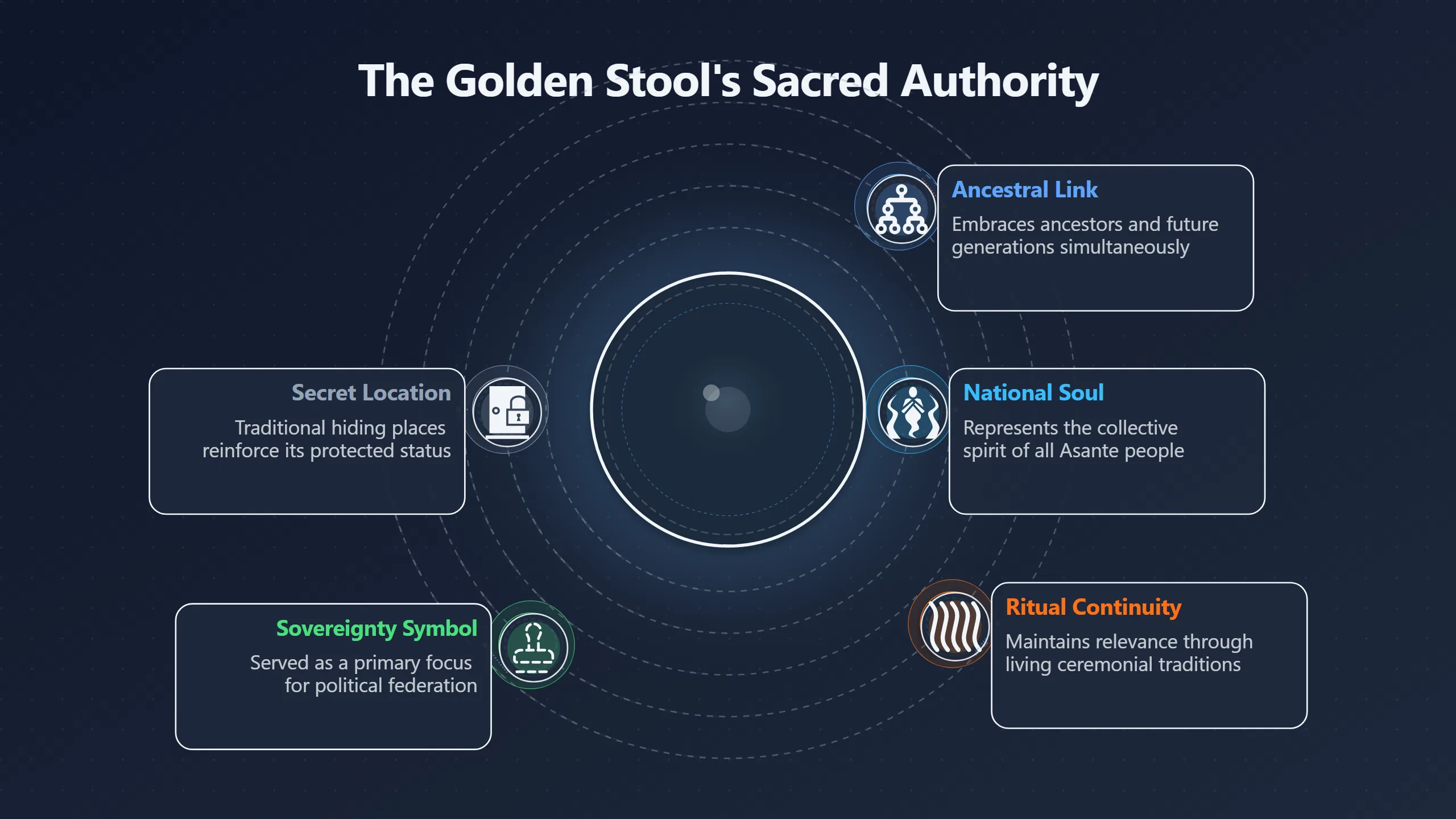
That distinction matters. Across Akan societies, stools traditionally symbolise political office, but the Golden Stool is regarded as unique. It represents the nation itself—embracing ancestors, the living and future generations—and therefore stands above any individual monarch. An Asante king is enthroned in relation to the Golden Stool rather than sitting upon it, emphasising that even the ruler serves something greater than himself. Historians have argued that this belief helped transform a loose alliance of chiefdoms into a durable political federation by giving every member a common spiritual focus.[Wikipedia]WikipediaPolitical systems of the Asante EmpirePolitical systems of the Asante Empire
From a Fortean perspective, the remarkable feature is not whether the stool literally descended from the sky. The enduring mystery is how a supernatural origin story became accepted as the constitutional language of a powerful West African state. The miracle tradition remains central to Asante identity centuries after the kingdom’s foundation, illustrating how extraordinary narratives can acquire lasting political force.
Why belief became political power
The Golden Stool demonstrates that sacred objects can exercise influence without needing to perform visible miracles. Its authority depends on collective acceptance, ritual practice and historical memory.
Several features distinguish it from an ordinary royal treasure:
- It is treated as the nation’s soul rather than the king’s property.
- Its location is traditionally kept secret, reinforcing the idea that it is protected rather than displayed.
- Its legitimacy comes from tradition, not written law or military force alone.
- Every ruler owes allegiance to it, reversing the usual relationship between monarch and throne.[Wikipedia]WikipediaGolden StoolGolden Stool
This unusual arrangement helped create continuity through political change. Kings could die, chiefs could disagree and governments could change, yet the sacred object remained the permanent embodiment of Asante unity.
The power of this belief became dramatically visible during the British colonial period. In 1900 Governor Frederick Hodgson demanded to sit upon the Golden Stool, apparently assuming it represented ordinary royal authority. To many Asante, the request amounted to an attempt to dominate the spirit of the nation itself. The resulting War of the Golden Stool was therefore fought over far more than possession of a ceremonial object. It became a struggle over sovereignty, identity and the limits of colonial rule.[Wikipedia]WikipediaWar of the Golden StoolWar of the Golden Stool
The sword that must not be removed
If the Golden Stool represents invisible authority, Okomfo Anokye’s sword offers a visible and tangible mystery.
The sword stands within the grounds of the Komfo Anokye Teaching Hospital in Kumasi. According to longstanding tradition, Okomfo Anokye thrust it into the earth while declaring that no one would ever remove it and that the stability of the Asante nation depended upon it remaining in place. Numerous popular retellings claim that attempts have been made to pull it free without success, although there is no reliable historical documentation describing controlled scientific tests or verified removal attempts.[Wikipedia]WikipediaOkomfo AnokyeOkomfo Anokye
Unlike legends whose locations have vanished, this tradition is attached to a specific public site. Visitors can see the sword’s setting for themselves, making the story unusually accessible. The combination of physical presence and supernatural claim gives it continuing appeal: believers regard it as proof of Okomfo Anokye’s extraordinary powers, while sceptics point out that there is little documented evidence beyond oral tradition and later accounts.
The absence of definitive evidence has not weakened the story. Instead, uncertainty has become part of its attraction. The sword functions less as a puzzle awaiting laboratory resolution than as a public reminder of the kingdom’s sacred foundation.
Reverence, tourism and the politics of wonder
Neither the Golden Stool nor Okomfo Anokye’s sword has become merely an archaeological curiosity. Both remain embedded in living ceremonial traditions.
This creates an unusual balance between heritage and reverence. Visitors are encouraged to learn about these traditions, but there are clear limits to what may be photographed, touched or publicly displayed. Such restrictions are not simply matters of conservation; they express the continuing belief that these objects possess authority extending beyond historical interest.[British Museum]britishmuseum.orgBritish MuseumAsante Gold RegaliaThis is the largest collection of Asante regalia in the UK and one of the most significant assemblages o…
The continuing prestige of the Asante monarchy also means that the stories remain politically relevant. Modern Ghana is a constitutional democracy, yet traditional authorities continue to exercise recognised cultural and customary roles. The Golden Stool therefore operates simultaneously as a historical symbol, a religious object and a constitutional emblem within Asante society.[African Studies Centre Leiden]ascleiden.nlasante kingdomAfrican Studies Centre LeidenAsante Kingdom11 Sept 2024 — The Golden Stool is also passed down matrilineally, to one of the king's matern…
For tourists, these traditions often appear as fascinating legends. For many Asante people, however, they are expressions of identity rather than entertainment. That difference explains why stories about miraculous origins remain treated with respect even in an age of historical scholarship and scientific explanation.
What makes these traditions Fortean?
The Golden Stool and Okomfo Anokye’s sword occupy a distinctive place in Ghana’s strange-history record because they blur boundaries that modern readers often expect to remain separate.
They combine:
- supernatural origin traditions with documented political history;
- sacred objects with constitutional authority;
- public monuments with continuing ritual significance;
- historical evidence alongside enduring mystery.
No independent evidence can confirm that a golden stool descended from the sky or that supernatural power prevents the sword’s removal. Yet neither tradition depends entirely on proving miraculous events. Their influence is visible in historical decisions, wars, ceremonies and public memory. In that sense, they illustrate one of the defining themes of Ghanaian Forteana: extraordinary claims matter not only because people tell them, but because generations have acted as though they were true.
Amazon book picks
Further Reading
Books and field guides related to Can Sacred Objects Hold a Nation Together?. Use these as the next step if you want deeper reading beyond the article.
King Leopold's ghost
First published 1998. Subjects: Politics and government, Race relations, Forced labor, Human rights movements, Indigenous peoples.

African myths of origin
First published 2005. Subjects: Tales, Mythology, Folklore, africa, African Mythology.

The golden stool
First published 1926. Subjects: Politics and government, Civilization, Race relations, Economic conditions, History.
eBay marketplace picks
Marketplace Samples
Live-tested eBay searches with available results related to this page.



Endnotes
1.
Source: Wikipedia
Title: Golden Stool
Link:https://en.wikipedia.org/wiki/Golden_Stool
2.
Source: Wikipedia
Title: Political systems of the Asante Empire
Link:https://en.wikipedia.org/wiki/Political_systems_of_the_Asante_Empire
3.
Source: Wikipedia
Title: War of the Golden Stool
Link:https://en.wikipedia.org/wiki/War_of_the_Golden_Stool
4.
Source: Wikipedia
Title: Okomfo Anokye
Link:https://en.wikipedia.org/wiki/Okomfo_Anokye
5.
Source: Wikipedia
Title: Asante people
Link:https://en.wikipedia.org/wiki/Asante_people
Source snippet
Asante peopleThe Asante, also known as Ashanti in English are part of the Akan ethnic group and are native to the Ashanti Region of mo...
6.
Source: Wikipedia
Title: Asante Empire
Link:https://en.wikipedia.org/wiki/Asante_Empire
Source snippet
Asante EmpireOkomfo Anokye established the Asante Kingdom, with the Golden Stool of Asante as a sole unifying symbol...
7.
Source: britishmuseum.org
Link:https://www.britishmuseum.org/about-us/british-museum-story/contested-objects-collection/asante-gold-regalia
Source snippet
British MuseumAsante Gold RegaliaThis is the largest collection of Asante regalia in the UK and one of the most significant assemblages o...
8.
Source: ascleiden.nl
Title: asante kingdom
Link:https://www.ascleiden.nl/content/webdossiers/asante-kingdom
Source snippet
African Studies Centre LeidenAsante Kingdom11 Sept 2024 — The Golden Stool is also passed down matrilineally, to one of the king's matern...
Additional References
9.
Source: asantehealth.org
Link:https://www.asantehealth.org/
10.
Source: feelnubia.org.uk
Link:https://feelnubia.org.uk/index.php/2012/discover-history/queens-and-mothers-of-afre-kh-yaa-ashantewaa-and-the-golden-stool-of-ashanti-ghana/
Source snippet
Yaa Ashantewaa and the Golden Stool of Ashanti (Ghana)...1 Feb 2012 — The myth is told that Okomfo Anokye conjured the famous Golden Sto...
11.
Source: youtube.com
Link:https://www.youtube.com/watch?v=ygv_sS4wB54
Source snippet
The War Of The Golden Stool: Britain's Colonial Blunder in AfricaIt was made in the late 17th century when the high priest of Asante, Oko...
12.
Source: facebook.com
Title: The history of the golden stool from a British historian Not a chair
Link:https://www.facebook.com/100063709954174/posts/the-history-of-the-golden-stool-from-a-british-historian/1366739735459679/
Source snippet
Not a symbol of wealth. But the soul of the Ashanti people. And it all began with a man called Okomfo Anokye, the legendary priest...Rea...
13.
Source: medium.com
Link:https://medium.com/write-a-catalyst/the-return-of-the-golden-stool-from-buckingham-palace-to-kofiasua-twafo-royal-palace-the-6ccb7b47f2bd
Source snippet
established as the central symbol of unity for the Asante states.Read more...
14.
Source: facebook.com
Title: Kindly listen and learn something out of this
Link:https://www.facebook.com/Mey3asanteni/posts/kindly-listen-and-learn-something-out-of-this-how-lands-in-ghana-are-classified-/942336478430724/
Source snippet
How lands in...Okomfo Anokye declared that the stool contained the spirit of the Ashanti people—their strength, unity, and future prospe...
15.
Source: facebook.com
Link:https://www.facebook.com/blackstarofafrica/posts/origin-of-the-golden-stool-of-the-ashanti-kingdomaccording-to-oral-tradition-oko/1016641359830351/
Source snippet
rs of the Ashanti Confederacy, conjured the Golden Stool...Read more...
16.
Source: ancient-origins.net
Link:https://www.ancient-origins.net/ancient-places-africa/asante-empire-0016395
Source snippet
The Asante Empire of Ghana and the Anglo-Asante Wars8 Feb 2022 — According to Asante tradition, the Golden Stool was brought down from he...
17.
Source: ghanatrvl.com
Title: okomfo anokye sword site
Link:https://ghanatrvl.com/places-to-see/cultural/okomfo-anokye-sword-site/
Source snippet
13 Apr 2023 — The Golden Stool is the royal throne of kings of the Ashanti people. It is the ultimate symbol of power in Asante culture...
18.
Source: youtube.com
Link:https://www.youtube.com/shorts/lCiwNkfVKLY
Source snippet
the Golden Stool. That Defied the British and United a Nation...
Topic Tree