Within Hungary Forteana
Why Do Hungary's Seer Stories Still Matter?
Hungarian seer traditions link older folklore about gifted people with modern psychic claims made during moments of fear and uncertainty.
On this page
- The taltos in Hungarian belief
- Psychics, disappearances and failed certainty
- Belief, grief and evidence aware storytelling
Page outline Jump by section
Introduction
Stories about gifted seers have occupied a distinctive place in Hungarian folklore for centuries. The best-known figure is the táltos, an extraordinary person believed to possess unusual insight, healing abilities or knowledge hidden from ordinary people. In modern retellings, the táltos is sometimes described as a psychic, prophet or shaman, but those labels do not perfectly match the older traditions. For readers interested in Hungarian Forteana, the fascination lies not in proving supernatural powers but in understanding how these figures came to represent hidden knowledge during times of uncertainty, war, illness and social upheaval. The evidence is a mixture of folklore, historical court records, ethnographic research and modern spiritual reinterpretation, with scholars frequently disagreeing over how much reflects genuine historical practice and how much is later reconstruction.[ResearchGate]researchgate.netResearch Gate(PDF) The Hungarian táltos and the shamanism of paganResearchGate(PDF) The Hungarian táltos and the shamanism of pagan…June 1, 2018 — One of the purposes of this study is to outline the r…

Why do Hungary’s seer stories still matter?
Unlike modern stage psychics who claim paranormal abilities for entertainment or personal consultation, the traditional Hungarian táltos belonged to a much broader system of rural belief. Communities did not necessarily seek predictions of the future alone. Instead, a táltos might be consulted to explain illness, locate hidden causes of misfortune, restore harmony or interpret extraordinary events.
Many traditions held that a genuine táltos was marked from birth rather than trained. Folk accounts describe unusual birth signs, such as being born with extra teeth, a caul or additional fingers, as indications that the child had been chosen for an exceptional destiny. During childhood the future táltos was sometimes said to experience mysterious illnesses, dreams or trances before accepting the role expected of them. These themes resemble initiation stories found elsewhere in Eurasia, although historians caution against assuming they prove the existence of a single ancient shamanic religion.[ResearchGate]researchgate.netResearch Gate(PDF) The Hungarian táltos and the shamanism of paganResearchGate(PDF) The Hungarian táltos and the shamanism of pagan…June 1, 2018 — One of the purposes of this study is to outline the r…
Within Hungarian Forteana these traditions matter because they blur several boundaries at once: between religion and folklore, healing and prophecy, psychological experience and supernatural interpretation.
The táltos in Hungarian belief
Modern readers often encounter dramatic descriptions of the táltos travelling through invisible worlds or communicating with spirits. Some of those ideas genuinely appear in folk traditions, while others come from twentieth-century scholarly reconstructions or modern neo-pagan movements.
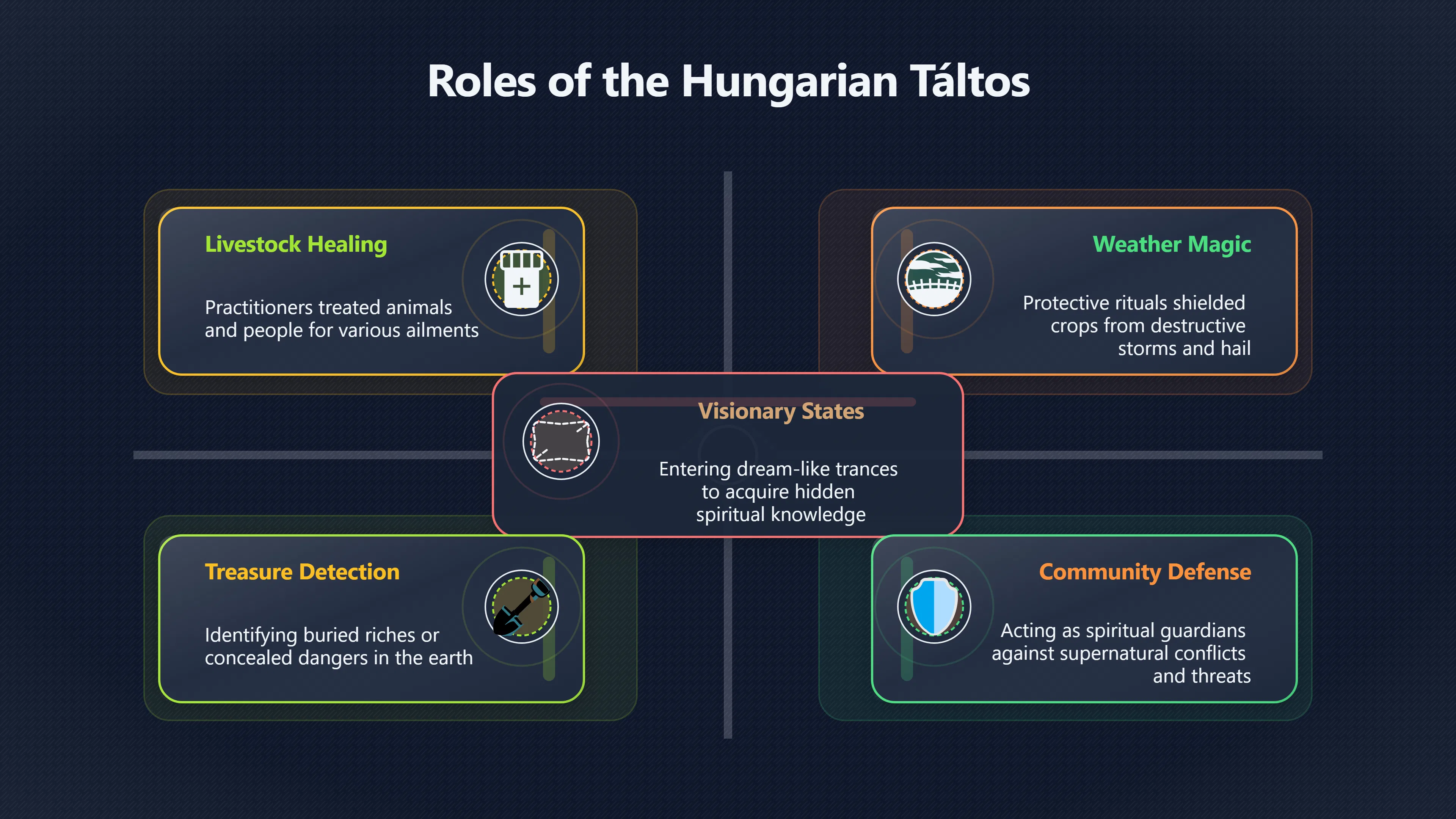
Older ethnographic evidence presents a more grounded picture. Historical táltos figures were commonly associated with:
- healing people and livestock;
- weather magic, especially protecting crops from destructive storms;
- entering visionary or dream-like states to gain hidden knowledge;
- recognising buried treasure or concealed dangers;
- acting as defenders of the wider community during supernatural conflicts.
One striking feature of Hungarian folklore is the belief that rival táltos fought invisible battles above the clouds during thunderstorms. These struggles supposedly determined whether hail or destructive weather would strike neighbouring communities. To believers, violent storms therefore reflected an unseen conflict rather than random weather alone. Modern folklorists see these narratives as symbolic attempts to explain natural disasters before meteorology offered more satisfactory answers.[ResearchGate]researchgate.netResearch Gate(PDF) The Hungarian táltos and the shamanism of paganResearchGate(PDF) The Hungarian táltos and the shamanism of pagan…June 1, 2018 — One of the purposes of this study is to outline the r…
Recent scholarship has complicated older assumptions that the táltos should simply be called a “Hungarian shaman”. Ethnologist Éva Pócs argues that while genuine traditions of weather-magicians almost certainly existed, nineteenth- and twentieth-century researchers also assembled an idealised image by combining fragments of Hungarian folklore with Siberian and Central Asian shamanic models. According to this view, the famous image of the táltos undertaking drum-assisted spirit journeys owes as much to scholarly reconstruction as to direct historical evidence.[ResearchGate]researchgate.netResearch Gate(PDF) The Hungarian táltos and the shamanism of paganResearchGate(PDF) The Hungarian táltos and the shamanism of pagan…June 1, 2018 — One of the purposes of this study is to outline the r…
Psychics, disappearances and failed certainty
As Hungary modernised, belief in gifted seers did not disappear. Instead, older expectations about extraordinary insight gradually merged with international ideas about clairvoyance, spiritualism and psychic investigation.
During periods of crisis—especially wars, political upheaval and unexplained disappearances—newspapers occasionally reported claims that clairvoyants could identify missing people, locate hidden bodies or predict future events. Such stories rarely ended with convincing confirmation. Like comparable reports elsewhere in Europe, they often faded quietly when predictions failed or produced only vague similarities with later events.
This pattern is important because it illustrates a recurring feature of Fortean history. Public demand for certainty increases precisely when reliable information is scarce. Psychics frequently become prominent not because evidence has improved, but because uncertainty creates a powerful market for confident explanations.
Hungary has experienced the same cycle seen in many other countries:
- disappearances encouraging appeals to clairvoyants;
- dramatic predictions attracting media attention;
- selective memories preserving apparent successes;
- unsuccessful predictions gradually being forgotten.
Researchers in psychology describe this as a mixture of confirmation bias, retrospective interpretation and the human tendency to remember striking “hits” while overlooking numerous inaccurate forecasts. That does not mean every witness was dishonest. Many practitioners appear to have sincerely believed in their own experiences, while clients often approached them during periods of genuine grief and desperation.
Why seer traditions survived into the modern age
The persistence of táltos stories reflects more than belief in supernatural powers. Several social factors helped them endure.
First, rural communities valued individuals who appeared unusually perceptive. Someone with medical knowledge, strong intuition or exceptional observational skills could gradually acquire a reputation for possessing hidden gifts.
Second, Christianity did not completely erase older folk traditions. Instead, local beliefs often blended Christian imagery with older ideas about chosen individuals, miracles and spiritual protection. Historical court records from the early modern period show that accusations of witchcraft sometimes overlapped with accounts of beneficial magical specialists, illustrating how communities distinguished between feared and respected practitioners.[ResearchGate]researchgate.netResearch Gate(PDF) The Hungarian táltos and the shamanism of paganResearchGate(PDF) The Hungarian táltos and the shamanism of pagan…June 1, 2018 — One of the purposes of this study is to outline the r…
Third, twentieth-century interest in national identity encouraged renewed fascination with the táltos as a symbol of an ancient Hungarian spiritual heritage. This cultural revival inspired both academic debate and modern spiritual movements, although the latter often incorporate practices that cannot be traced directly to historical folklore.[JSTOR]jstor.orgPsychic Phenomena, Neoshamanism, and the Cultic Milieu…by L Kürti · 2001 · Cited by 29 — Rice may have read the articles by the H…
Belief, grief and evidence-aware storytelling
Hungarian seer traditions continue to attract attention because they occupy an unusual middle ground between myth, history and lived experience.
Believers often point to recurring motifs—visionary dreams, remarkable healings, unexplained knowledge or stories passed through generations—as signs that the traditions preserve genuine encounters with extraordinary abilities. Some modern practitioners identify themselves as heirs to the táltos tradition and describe altered states of consciousness as authentic spiritual experiences.
Sceptics note that none of these claims has produced consistent scientific evidence demonstrating paranormal perception. Historical documentation usually consists of oral testimony, folklore collections or retrospective reports rather than controlled observation. The more spectacular claims, particularly those involving prophecy or locating missing people, have generally failed to withstand careful verification.
For Fortean readers, however, the enduring value of these stories lies elsewhere. They reveal how people respond when ordinary explanations feel inadequate. Whether confronting devastating storms, unexplained illness, political uncertainty or personal loss, Hungarian communities repeatedly turned to figures believed capable of seeing beyond everyday reality.
That combination of hope, cultural memory and unresolved mystery explains why the táltos remains one of the most recognisable figures in Hungarian strange history. The traditions are historically rich enough to reward careful study, yet ambiguous enough to invite continuing debate over where folklore ends, personal experience begins and the truly unexplained, if anything, still remains.

Amazon book picks
Further Reading
Books and field guides related to Why Do Hungary's Seer Stories Still Matter?. Use these as the next step if you want deeper reading beyond the article.

The Varieties of Religious Experience
First published 1817. Subjects: Religious Psychology, Religion, Conversion, Experience (Religion), Philosophy and religion.


eBay marketplace picks
Marketplace Samples
Live-tested eBay searches with available results related to this page.


Endnotes
1.
Source: researchgate.net
Title: Research Gate(PDF) The Hungarian táltos and the shamanism of pagan
Link:https://www.researchgate.net/publication/328115934_The_Hungarian_taltos_and_the_shamanism_of_pagan_Hungarians_Questions_and_hypotheses
Source snippet
ResearchGate(PDF) The Hungarian táltos and the shamanism of pagan...June 1, 2018 — One of the purposes of this study is to outline the r...
Published: June 1, 2018
2.
Source: jstor.org
Link:https://www.jstor.org/stable/10.1525/nr.2001.4.2.322
Source snippet
Psychic Phenomena, Neoshamanism, and the Cultic Milieu...by L Kürti · 2001 · Cited by 29 — Rice may have read the articles by the H...
3.
Source: researchgate.net
Link:https://www.researchgate.net/publication/326883834_Hungarian_shamanism_material_and_history_of_research
Source snippet
Hungarian shamanism, material and history of research29 Mar 2026 — This article considers the relevance of shamanism to Hungarian folk be...
4.
Source: Wikipedia
Link:https://en.wikipedia.org/wiki/T%C3%A1ltos
Source snippet
TáltosThe táltos is a figure in Hungarian mythology, a person with supernatural power who acts as a spiritual mediator, akin to a sham...
Additional References
5.
Source: eng.polgariszemle.hu
Link:https://eng.polgariszemle.hu/archive/148-vol-14-special-issue-2018/religious-policy-history-and-ideologies/930-taltos-witch-incubus-succubus-and-other-beings-in-hungarian-folklore-and-mythology
Source snippet
he living and that of the dead, but he may have had numerous other roles in the...Read more...
6.
Source: scispace.com
Title: Sci Space The Hungarian Táltos and the Shamanism of Pagan
Link:https://scispace.com/pdf/the-hungarian-taltos-and-the-shamanism-of-pagan-hungarians-1e7j8dybgc.pdf
Source snippet
The Hungarian Táltos and the Shamanism of Pagan...Abstract: One of the purposes of this study is to outline the research problem related...
7.
Source: facebook.com
Link:https://www.facebook.com/groups/historyandfolklore/posts/2620303554880327/
Source snippet
a person born with spiritual abilities—a bridge between...
8.
Source: academia.edu
Link:https://www.academia.edu/126954959/The_Way_of_the_T%C3%A1ltos_A_Critical_Reassessment_of_a_Religious_Magical_SpecialistPota_taltosov_Kriti%C4%8Dno_ovrednotenje_posve%C4%8Denca_v_religijo_in_magijo
Source snippet
tic practices. This article reassesses the táltos...
9.
Source: youtube.com
Title: Drum Circle
Link:https://www.youtube.com/watch?v=2n632OwCrOA
Source snippet
Mágia: Hungarian Myth, Magic, and Folklore by Margit Tóth · Audiobook preview...
10.
Source: youtube.com
Title: Mágia: Hungarian Myth, Magic, and Folklore by Margit Tóth · Audiobook preview
Link:https://www.youtube.com/watch?v=uVixGCH-tAI
Source snippet
7 Hungarian Origin Myths...
11.
Source: youtube.com
Title: Hungarian Shaman Drum With Chanting
Link:https://www.youtube.com/watch?v=ybATUFmGBx0
Source snippet
The Hungarian Mythical Stag After Christianity...
12.
Source: youtube.com
Title: 7 Hungarian Origin Myths
Link:https://www.youtube.com/watch?v=4r18r2pHrwQ
Source snippet
Hungarian Shaman Drum With Chanting...
13.
Source: youtube.com
Title: The Hungarian Mythical Stag After Christianity
Link:https://www.youtube.com/watch?v=CdWyjS7ysoo
Topic Tree