Within Weird Japan
When Plague and Earthquakes Became Creatures
Amabie and earthquake catfish show how Japanese strange images gave disease and disaster a body people could share, print and reinterpret.
On this page
- Amabie from sea light prophecy to pandemic image
- Namazu and the catfish body of earthquakes
- Why crisis folklore works so well as a picture
Page outline Jump by section
Introduction
Japanese crisis folklore has often turned invisible dangers into memorable creatures. Instead of treating epidemics or earthquakes as abstract forces, stories and prints gave them faces, bodies and personalities that people could draw, copy, joke about and even argue with. Two of the best examples are Amabie, the mysterious sea-being said to protect against disease, and the giant catfish known as namazu, blamed for earthquakes. Neither was intended as a scientific explanation in the modern sense. Rather, they provided a visual language for coping with uncertainty, allowing communities to transform fear into something that could be shared through prints, posters and stories. Their lasting appeal lies not in whether anyone believed they were literally real, but in how effectively they made overwhelming disasters feel imaginable and, perhaps, slightly more manageable.
When a glowing sea creature became an epidemic symbol
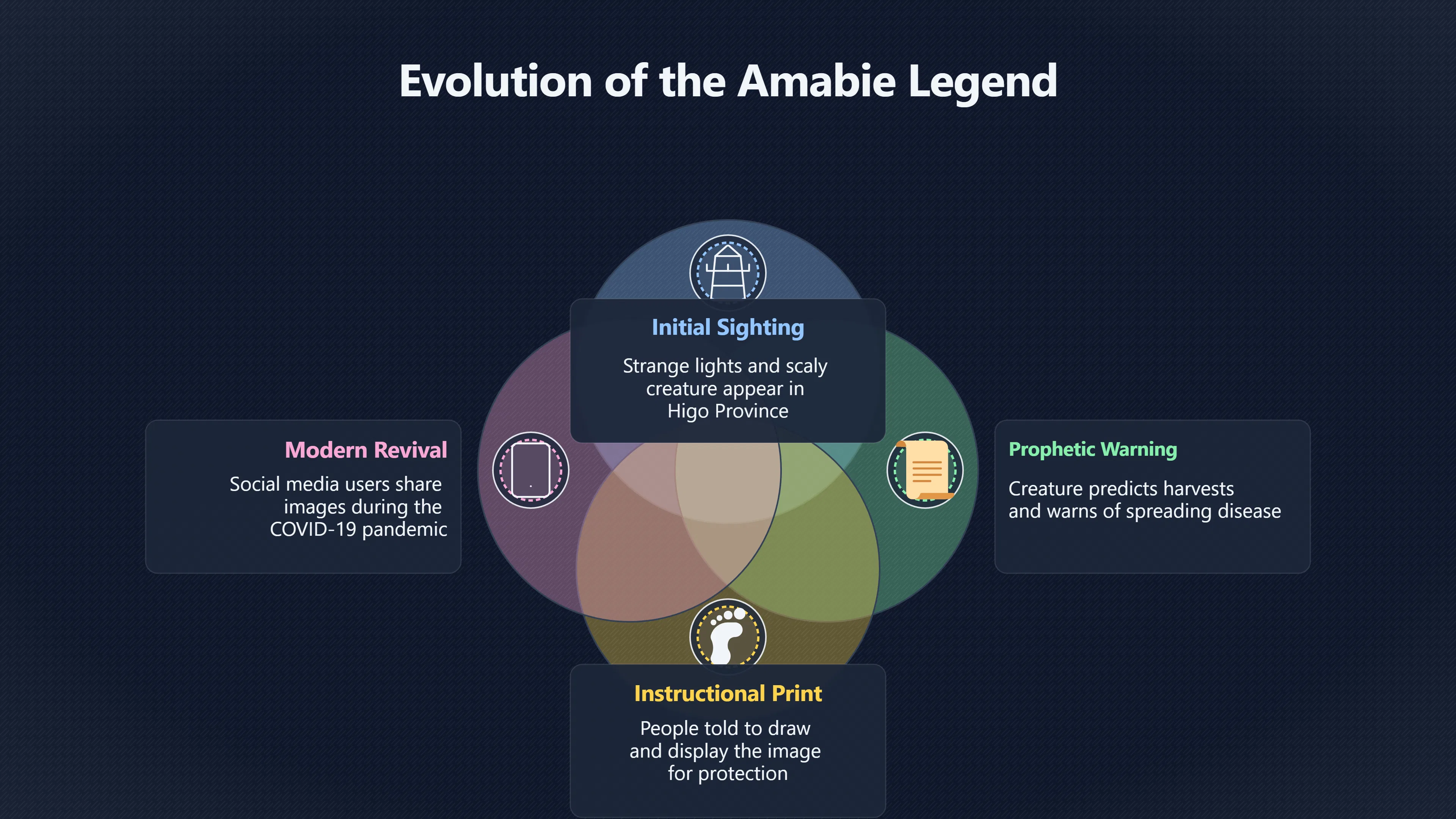
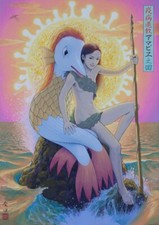
The earliest known account of Amabie comes from an illustrated news sheet produced in 1846 during the late Edo period. According to the report, strange lights had been appearing off the coast of Higo Province, now part of Kumamoto Prefecture. A local official investigating the lights encountered a scaly creature with long hair, a bird-like beak and three legs. It introduced itself as Amabie, predicted six years of good harvests, warned that disease would spread, and instructed people to draw and display its image if an epidemic appeared. The creature then disappeared beneath the sea.[Wikipedia]WikipediaOpen source on wikipedia.org.
The story survives in a single known printed source, making it an unusually fragile piece of folklore. Researchers have also noted that Amabie appears closely related to a family of similar prophetic creatures with slightly different names and appearances, suggesting that printers or storytellers adapted an existing tradition rather than inventing something entirely new. The important feature was not its precise anatomy but its unusual instruction: protection came through reproducing the image itself.[University of Winnipeg]uwinnipeg.caamabie an accidental creature of covid 19University of WinnipegAmabie: An Accidental Creature of Covid-19The Amabie was seen only once, in the middle of the fourth month of 1846…
That idea became unexpectedly relevant during the COVID-19 pandemic. Beginning in early 2020, artists, schoolchildren, museums, health organisations and ordinary social media users produced thousands of new versions of Amabie under the hashtag #AmabieChallenge. The creature appeared on posters, sweets, shrine charms, public health campaigns and cartoons. Although nobody suggested that drawings could replace medicine or vaccination, the image offered a culturally familiar way to express solidarity and hope while following scientific public health advice.[jamanetwork.com]jamanetwork.comJAMA NetworkAmabié—A Japanese Symbol of the COVID-19 Pandemicby Y Furukawa · 2020 · Cited by 11 — Amabié (pronounced a-ma-bee-ay), a lege…
Amabie therefore illustrates an unusual kind of folklore survival. Rather than remaining a museum curiosity, it became a living symbol whose original instruction—to copy and circulate its image—proved remarkably suited to the age of social media.
Why the earthquake became a catfish
If Amabie gave disease a face, namazu gave earthquakes a body.
By the seventeenth century, many people in Japan associated earthquakes with an enormous catfish living beneath the islands. According to popular belief, the deity of Kashima restrained the creature beneath a great foundation stone. Whenever the deity relaxed his grip or was distracted, the catfish thrashed beneath the earth, shaking the landscape above. Although educated people also discussed earthquakes through natural philosophy and later geology, the catfish offered an instantly recognisable visual shorthand for destructive shaking.[nii.ac.jp]nichibun.repo.nii.ac.jpAt left the Kashima deity pins down the earthquake catfish with the foundation stone (kaname ishi). At right, he uses a bottle…Read more…
The image exploded in popularity after the devastating Ansei Edo earthquake of 1855. Within days, printers were producing hundreds of different namazu-e, or “catfish pictures”. These woodblock prints did much more than blame a mythical animal. Some showed furious citizens beating the catfish for causing suffering. Others portrayed the creature as a force that redistributed wealth by destroying the homes of the rich while creating employment for builders, carpenters and labourers during reconstruction. In these prints, the earthquake became a form of world correction rather than simply random destruction.[publicdomainreview.org]publicdomainreview.orgearthquakes in japanese woodblock printsThe Public Domain ReviewTales of the Catfish God: Earthquakes in Japanese…21 Feb 2024 — A type of woodblock print known as namazu-e…
The catfish therefore became an extraordinarily flexible political cartoon. Artists could criticise officials, question social inequality or comment on rebuilding without directly attacking the authorities. The mythical creature carried meanings that everyone recognised while allowing satire to pass beneath the surface of censorship.[meijiat150dtr.arts.ubc.ca]meijiat150dtr.arts.ubc.caCatfish functioned as a visually striking and usefully…Read more…
Why these images worked so well
Amabie and namazu addressed different disasters, yet they relied on the same underlying mechanism: they translated invisible forces into memorable characters.
Several features made them especially effective.
- They made abstract dangers visible. Viruses cannot be seen with the naked eye, and underground tectonic forces are equally hidden. A sea prophet or giant catfish gave those threats a shape people could picture.
- They encouraged collective action. Amabie’s legend explicitly instructed people to copy and display its portrait. Namazu prints spread rapidly after earthquakes, allowing communities to share explanations, humour and criticism during recovery.
- They mixed fear with familiarity. Neither creature is purely terrifying. Amabie is strange but approachable, while namazu often appears comic or even apologetic. That balance makes frightening events psychologically easier to discuss.
- They accepted uncertainty. Rather than claiming complete knowledge, the images acknowledged that disasters exceed ordinary understanding. Folklore filled emotional and social gaps without replacing practical responses.
Modern psychologists might describe these creatures as narrative tools that help people process collective trauma. Folklore scholars instead emphasise their role as culturally meaningful symbols. Both perspectives recognise that crisis images perform social work even when nobody treats them as literal explanations of natural events.[ubc.ca]meijiat150dtr.arts.ubc.caCatfish functioned as a visually striking and usefully…Read more…
More than monsters
From a Fortean perspective, neither Amabie nor namazu is primarily interesting because of claims that such beings exist. Their significance lies in the strange reports, printed images and folklore that grew around moments of national anxiety.
Amabie emerged from an account of mysterious lights at sea and became a protective image against epidemic disease. Namazu transformed earthquakes into a creature whose adventures could explain, criticise and even satirise social upheaval. Both show how Japanese folklore repeatedly turns unseen crises into memorable visual forms that survive long after the original disasters have passed.
Their continued presence in museums, popular culture, disaster education and modern art demonstrates that these images remain more than historical curiosities. They are reminders that people often respond to catastrophe not only with science and engineering, but also with stories and symbols that make the unimaginable easier to share.
Amazon book picks
Further Reading
Books and field guides related to When Plague and Earthquakes Became Creatures. Use these as the next step if you want deeper reading beyond the article.

Kwaidan: Stories and Studies of Strange Things
Shows how strange beliefs entered literary tradition.

The Book of Yōkai
Useful comparative folklore reading for understanding how cultures transform fears and places into stories.

Pandemonium and Parade
Examines how yokai imagery responds to social change and crisis.
eBay marketplace picks
Marketplace Samples
Live-tested eBay searches with available results related to this page.
Endnotes
1.
Source: Wikipedia
Link:https://en.wikipedia.org/wiki/Amabie
2.
Source: nichibun.repo.nii.ac.jp
Link:https://nichibun.repo.nii.ac.jp/record/189/files/JN2402.pdf
Source snippet
At left the Kashima deity pins down the earthquake catfish with the foundation stone (kaname ishi). At right, he uses a bottle...Read more...
3.
Source: meijiat150dtr.arts.ubc.ca
Link:https://meijiat150dtr.arts.ubc.ca/essays/smits/
Source snippet
Catfish functioned as a visually striking and usefully...Read more...
4.
Source: Wikipedia
Link:https://en.wikipedia.org/wiki/Namazu
Source snippet
NamazuNamazu-e: Earthquake catfish prints from the period after the Great Ansei Earthquake struck the city of Edo (now Tokyo) in Novem...
5.
Source: Wikipedia
Title: 1855 Edo earthquake
Link:https://en.wikipedia.org/wiki/1855_Edo_earthquake
6.
Source: youtube.com
Title: Japanese Folklore | River Monsters
Link:https://www.youtube.com/watch?v=bNYYKEmmQwU
Source snippet
3 Catfish Namazu and Earthquakes...
7.
Source: jamanetwork.com
Link:https://jamanetwork.com/journals/jama/fullarticle/2768645
Source snippet
JAMA NetworkAmabié—A Japanese Symbol of the COVID-19 Pandemicby Y Furukawa · 2020 · Cited by 11 — Amabié (pronounced a-ma-bee-ay), a lege...
8.
Source: uwinnipeg.ca
Title: amabie an accidental creature of covid 19
Link:https://www.uwinnipeg.ca/east-asian-languages-and-cultures/amabie-an-accidental-creature-of-covid-19.html
Source snippet
University of WinnipegAmabie: An Accidental Creature of Covid-19The Amabie was seen only once, in the middle of the fourth month of 1846...
9.
Source: newyorker.com
Link:https://www.newyorker.com/culture/cultural-comment/from-japan-a-mascot-for-the-pandemic
Source snippet
Amid the COVID-19 pandemic, Japanese have turned to a 19th-century folklore character, Amabié, a mermaid-like yokai with the power to war...
10.
Source: publicdomainreview.org
Title: earthquakes in japanese woodblock prints
Link:https://publicdomainreview.org/collection/earthquakes-in-japanese-woodblock-prints/
Source snippet
The Public Domain ReviewTales of the Catfish God: Earthquakes in Japanese...21 Feb 2024 — A type of woodblock print known as *namazu-e*...
11.
Source: yokai.com
Link:https://yokai.com/amabie/?srsltid=AfmBOop5RkegMjMsIW7VXZfnxsnT2yRdNsgAc9ND1WFcAejtumYRikyf
Source snippet
Legends: The only recorded sighting of an amabie comes from Higo Province (present-day Kumamoto prefecture) in April of 1846. For some ni...
Additional References
12.
Source: theguardian.com
Title: amabie japanese twitter sensation yokai pandemic defeating monster hope to japan
Link:https://www.theguardian.com/travel/2020/apr/10/amabie-japanese-twitter-sensation-yokai-pandemic-defeating-monster-hope-to-japan
Source snippet
the pandemic-defeating monster bringing hope to Japan10 Apr 2020 — Japanese Twitter is alive with images of a duck-billed mermaid yōkai f...
13.
Source: circusandloaf.com
Title: art in the aftershocks how earthquake legends inspired japanese catfish prints
Link:https://circusandloaf.com/culture/art-in-the-aftershocks-how-earthquake-legends-inspired-japanese-catfish-prints
Source snippet
How Earthquake Legends Inspired Japanese Catfish Prints27 Jul 2024 — These prints feature the giant catfish Namazu, believed to cause ear...
14.
Source: researchgate.net
Title: 343035187 Amabie A Japanese Symbol of the COVID 19 Pandemic
Link:https://www.researchgate.net/publication/343035187_Amabie-A_Japanese_Symbol_of_the_COVID-19_Pandemic
Source snippet
Amabié—A Japanese Symbol of the COVID-19 Pandemic5 Jun 2026 — This Arts and Medicine feature discusses Amabié, a 19th-century Japanese yō...
15.
Source: orientations.com.hk
Title: the namzu e album at the royal ontario museum
Link:https://www.orientations.com.hk/highlights/the-namzu-e-album-at-the-royal-ontario-museum
Source snippet
The Namazu-e Album at the Royal Ontario Museum and Its...15 Feb 2023 — These catfish were usually said to be controlled by the deity Kas...
16.
Source: tokyo2020chiba.com
Title: The citizens bought the prints and hung
Link:https://www.tokyo2020chiba.com/post/woodblock-prints-depicting-a-giant-catfish-%E9%AF%B0%E7%B5%B5%EF%BC%89
Source snippet
Woodblock Prints Depicting a Giant Catfish(鯰絵)The namazu-e prints, depicting a giant catfish were in great demand because namazu was supp...
17.
Source: blogs.egu.eu
Title: eu Geomythology
Link:https://blogs.egu.eu/divisions/ts/2021/10/22/geomythology-japans-earthquakes-the-work-of-namazu/
Source snippet
Japan's Earthquakes – The work of Namazu?22 Oct 2021 — Namazu is a cheeky catfish, who likes to cause trouble, and each time he moves his...
18.
Source: facebook.com
Title: 𝗗𝗶𝗱 𝗬𝗼𝘂 𝗞𝗻𝗼𝘄?
Link:https://www.facebook.com/CGofJapanInDavao/posts/%F0%9D%97%97%F0%9D%97%B6%F0%9D%97%B1-%F0%9D%97%AC%F0%9D%97%BC%F0%9D%98%82-%F0%9D%97%9E%F0%9D%97%BB%F0%9D%97%BC%F0%9D%98%84-%F0%9D%97%9D%F0%9D%97%AE%F0%9D%97%BD%F0%9D%97%AE%F0%9D%97%BB-%F0%9D%97%A2%F0%9D%97%BB%F0%9D%97%B0%F0%9D%97%B2-%F0%9D%97%95%F0%9D%97%B2%F0%9D%97%B9%F0%9D%97%B6%F0%9D%97%B2%F0%9D%98%83%F0%9D%97%B2%F0%9D%97%B1-%F0%9D%97%9A%F0%9D%97%B6%F0%9D%97%AE%F0%9D%97%BB%F0%9D%98%81-%F0%9D%97%96%F0%9D%97%AE%F0%9D%98%81%F0%9D%97%B3%F0%9D%97%B6%F0%9D%98%80%F0%9D%97%B5-%F0%9D%97%96%F0%9D%97%AE%F0%9D%98%82%F0%9D%98%80%F0%9D%97%B2%F0%9D%98%80-%F0%9D%97%98%F0%9D%97%AE%F0%9D%97%BF%F0%9D%98%81%F0%9D%97%B5%F0%9D%97%BE%F0%9D%98%82%F0%9D%97%AE%F0%9D%97%B8%F0%9D%97%B2%F0%9D%98%80for-centuries-m/1346313330972872/
Source snippet
𝗝𝗮𝗽𝗮𝗻 𝗢𝗻𝗰𝗲 𝗕𝗲𝗹𝗶𝗲𝘃𝗲𝗱 𝗚𝗶𝗮𝗻𝘁...Namazu-e are Japanese catfish prints, based upon the folk belief that a giant catfish causes earthquakes. In...
19.
Source: youtube.com
Title: Amabie アマビエ
Link:https://www.youtube.com/watch?v=5iA0KntCEUA
Source snippet
5 Fall Asleep to The Epic History of Japanese Mythology & Folklore...
20.
Source: youtube.com
Title: Amabie: The Ocean Yokai Behind Japan’s COVID Era
Link:https://www.youtube.com/watch?v=fPiTL87UChc
Source snippet
2 Japanese Folklore | River Monsters...
21.
Source: youtube.com
Title: Fall Asleep to The Epic History of Japanese Mythology & Folklore
Link:https://www.youtube.com/watch?v=7WOmsJGe4Fw
Topic Tree