Within Algeria Strange
When Stones From the Sky Fall in Algeria
Algeria turns old thunderstone wonder into a modern meteorite story shaped by desert preservation, science and folklore.
On this page
- The Ghardaia thunderstone in Fortean writing
- Why the Sahara preserves meteorites so well
- Falls, finds and the limits of old reports
Page outline Jump by section
Introduction
Algeria occupies one of the world’s richest meteorite landscapes, and that has given the country an unusual place in both science and folklore. For centuries, stories circulated about mysterious “thunderstones” that seemed to arrive from the sky after terrifying flashes and explosions. Today, researchers know that many stones found across the Algerian Sahara really are meteorites, preserved by one of the driest environments on Earth. Yet the older folklore has not disappeared. Instead, modern discoveries have reframed ancient beliefs, creating a meeting point between traditional sky-fall legends, desert exploration and planetary science.

Unlike tales of ghosts or monsters, the mystery here rests on something tangible. Stones genuinely do fall from space, but separating witnessed falls, ancient folklore and meteorites discovered centuries after landing is often surprisingly difficult.
The Ghardaïa thunderstone in Fortean writing
Older European folklore often used the word “thunderstone” for unusual rocks believed to have fallen during storms. Similar ideas appeared across North Africa, where dramatic fireballs, loud detonations and unexpected stones inspired stories that linked the heavens with the Earth long before meteorites were accepted by science.
In Fortean literature, Algeria occasionally appears through references to “thunderstones” around Ghardaïa and the wider Sahara. These accounts are usually not descriptions of individually documented meteorite falls. Instead, they reflect the persistence of a traditional explanation for strange stones whose origin seemed impossible to explain.
Modern science approaches these stories differently. Rather than assuming every legendary thunderstone was a meteorite, researchers ask whether a tradition may preserve the memory of a genuine witnessed fall, whether an unusual terrestrial rock was mistaken for one, or whether the story simply reflects a widespread human tendency to connect dramatic weather with mysterious objects found afterwards.
The Ghardaïa region itself has proved genuinely rich in meteorites. Numerous officially recognised finds have been recorded there, including ordinary chondrites, iron meteorites, rare lunar meteorites and material originating from the asteroid Vesta. These discoveries explain why older stories from the area continue to attract attention, even if individual legends cannot usually be verified.[LPI]lpi.usra.eduAbbrev, Status, Fall, Year, Place, Type, Mass, MetBullRead more…
Why the Sahara preserves meteorites so well
The Algerian Sahara is not a place where meteorites fall unusually often. Instead, it is a place where they survive unusually well.
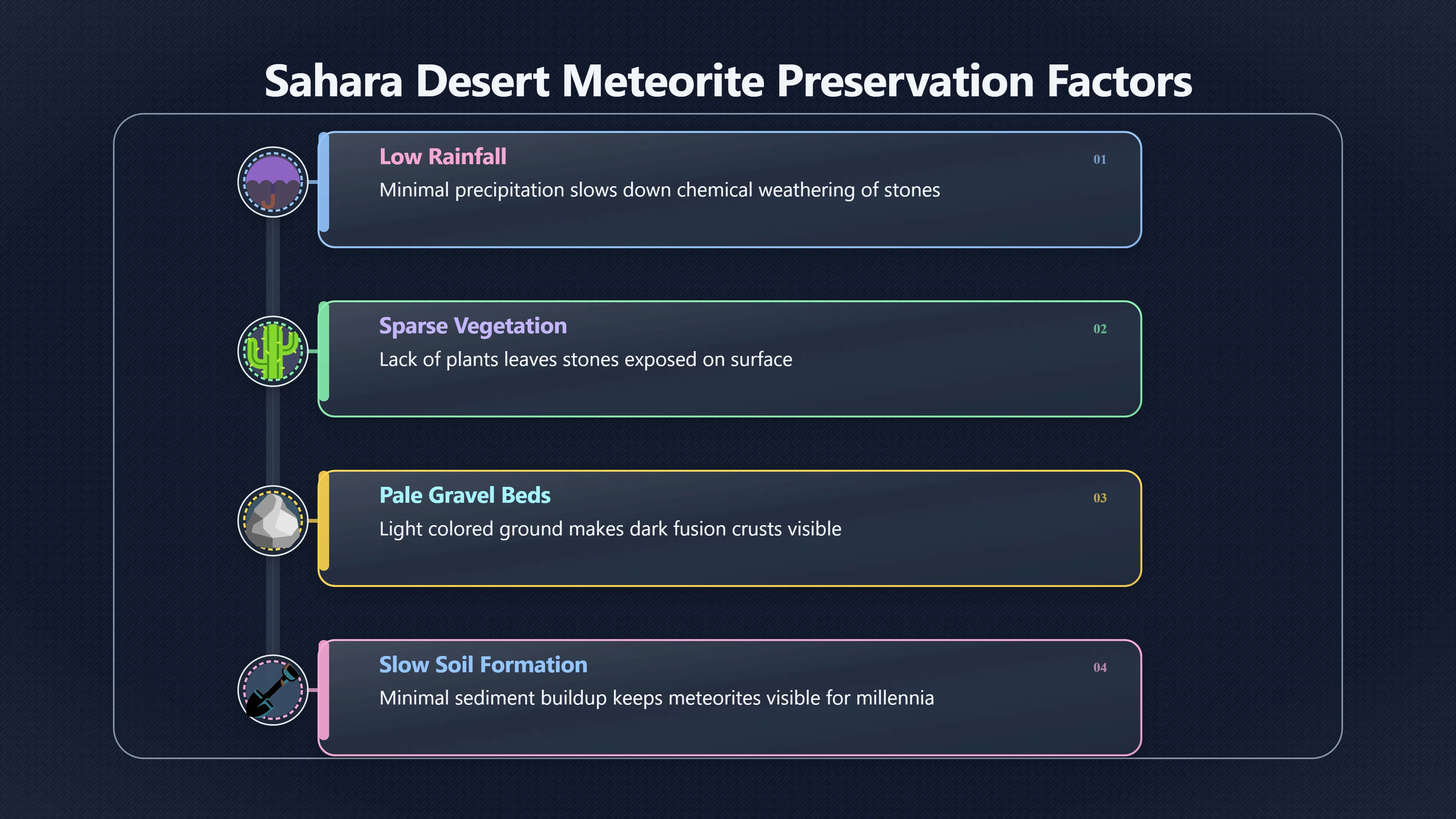
Several factors combine to make the desert an exceptional natural archive:
- Extremely low rainfall slows chemical weathering.
- Sparse vegetation leaves stones exposed instead of burying them.
- Large areas of pale gravel make the dark fusion crust of many meteorites easier to recognise.
- Slow rates of soil formation mean meteorites can remain visible for thousands, and sometimes tens of thousands, of years.
This preservation effect has transformed the Sahara into one of the world’s most productive meteorite hunting grounds. Many specimens are found not because anyone saw them fall, but because they remained lying on the desert surface long enough to be discovered by travellers, local residents or professional search teams.
For Fortean enthusiasts this creates an unusual twist. Many “stones from the sky” are undeniably genuine, yet almost all arrived long before any human observer was present. The desert preserves the evidence while erasing the event itself.
Falls, finds and the limits of old reports
One reason meteorite folklore can be confusing is that scientists distinguish carefully between falls and finds.
A fall is observed as it happens. Witnesses see a fireball, hear sonic booms and recover fresh stones shortly afterwards. A find is a meteorite discovered later, often with no knowledge of when it landed.
Most Algerian meteorites belong to the second category. The Meteoritical Bulletin lists hundreds of approved Algerian meteorites recovered from the Sahara, but only a handful are confirmed witnessed falls.[LPI]lpi.usra.eduAbbrev, Status, Fall, Year, Place, Type, Mass, MetBullRead more…
A particularly important modern example is the El Menia fall of March 2023. Multiple eyewitnesses in Algeria and neighbouring Mauritania reported a brilliant fireball travelling north to south, followed by sonic booms. Fresh fusion-crusted stones were recovered within hours across a mapped strewn field, eventually yielding roughly 75 kilograms of material. Because the observations, recovery and laboratory analysis all align, this represents the kind of evidence that older thunderstone stories usually lack.[LPI]lpi.usra.eduMeteoritical Bulletin: Entry for El MeniaEl Menia; Observed fall: Yes, confirmed fall; Year fell: 2023; Country: Algeria; Mass: 75…
By contrast, many historical reports consist only of someone remembering that a stone “fell during thunder” or that an unusual rock had long been regarded as heavenly. Such traditions are culturally valuable but difficult to verify scientifically. Without contemporary observations, surviving specimens or reliable documentation, it is impossible to know whether they describe a genuine meteorite, a misunderstood natural rock or a legend that grew through repeated retelling.
From folklore to planetary science
Modern classification has revealed that Algeria’s deserts contain remarkable material from across the Solar System.
The Ghardaïa area alone has yielded several lunar meteorites, including Ghardaïa 001 and Ghardaïa 002, identified as feldspathic breccias originating from the Moon’s crust. Other finds from the same region include ordinary chondrites, eucrites linked to the asteroid Vesta, and iron meteorites. These discoveries demonstrate that the Sahara preserves an extraordinary diversity of extraterrestrial rocks rather than representing a single ancient impact event.[LPI]lpi.usra.eduMeteoritical Bulletin: Entry for Ghardaïa 001This is 1 of 15 approved meteorites from Ghardaia, Algeria This is 1 of 1654 approved met…
This scientific catalogue has changed the meaning of older sky-stone traditions. Instead of dismissing every thunderstone legend as superstition, researchers recognise that some communities living in meteorite-rich landscapes may occasionally have encountered genuine extraterrestrial rocks, even if the stories attached to them became embellished over generations.

Why the legends still matter
The enduring appeal of Algeria’s meteorite stories comes from the unusual overlap between myth and measurable reality. Unlike many Fortean traditions, this is a field where extraordinary objects genuinely exist. People really do find rocks that formed on asteroids or the Moon lying on the desert floor.
That reality, however, does not automatically validate every historical tale. The evidence supports the Sahara as an exceptional repository of meteorites, but it rarely allows historians to connect a specific ancient thunderstone legend with a specific surviving specimen.
For readers interested in Algeria’s strange history, this makes Saharan meteorites distinctive. They show how folklore can grow around real natural phenomena, while modern geology and planetary science gradually disentangle witnessed events, archaeological memory and imaginative storytelling. The result is not the disappearance of mystery, but its refinement: the wonder shifts from asking whether stones really fall from the sky to understanding how cultures remember them long after the fireball has vanished.
Amazon book picks
Further Reading
Books and field guides related to When Stones From the Sky Fall in Algeria. Use these as the next step if you want deeper reading beyond the article.
Rocks from Space
Directly explains meteorites, falls and finds like those associated with the Sahara.
The Cambridge Encyclopedia of Meteorites
Explores meteorite science and famous discoveries.

eBay marketplace picks
Marketplace Samples
Live-tested eBay searches with available results related to this page.

Endnotes
1.
Source: lpi.usra.edu
Link:https://www.lpi.usra.edu/meteor/metbull.php?country=Algeria&lrec=50&sea=Ghardaia&sfor=places&srt=&stype=exact
Source snippet
Abbrev, Status, Fall, Year, Place, Type, Mass, MetBullRead more...
2.
Source: lpi.usra.edu
Link:https://www.lpi.usra.edu/meteor/metbull.php?code=74118
Source snippet
Meteoritical Bulletin: Entry for Ghardaïa 001This is 1 of 15 approved meteorites from Ghardaia, Algeria This is 1 of 1654 approved met...
3.
Source: lpi.usra.edu
Link:https://www.lpi.usra.edu/meteor/metbull.php?code=80139
Source snippet
Meteoritical Bulletin: Entry for El MeniaEl Menia; Observed fall: Yes, confirmed fall; Year fell: 2023; Country: Algeria; Mass: 75...
4.
Source: lpi.usra.edu
Link:https://www.lpi.usra.edu/meteor/metbull.php?code=74303
Source snippet
Bulletin: Entry for Ghardaïa 002Name: Ghardaïa 002 This is an OFFICIAL meteorite name. Abbreviation: There is no official abbreviation fo...
5.
Source: lpi.usra.edu
Link:https://www.lpi.usra.edu/meteor/metbull.php?code=44857
Source snippet
Bulletin: Entry for Al Haggounia 001Observed fall: No; Year found: 2006; Country: Western Sahara; Mass: 3 t; State/Prov/County: All H...
Additional References
6.
Source: peltramminerals.com
Link:https://www.peltramminerals.com/en/lunar-meteorite-adrar-013—1-2g—algeria/
Source snippet
Lunar meteorite Adrar 013 – 1,2g – AlgeriaAdrar 013 – an authentic fragment of the lunar crust. A rare lunar melt breccia meteorite found...
7.
Source: facebook.com
Link:https://www.facebook.com/groups/920989489263873/posts/1649058613123620/
8.
Source: youtube.com
Title: The oldest volcanic thing on EARTH is a METEORITE! ☄️
Link:https://www.youtube.com/watch?v=Oteffkvjfew
Source snippet
Giant, 3.75 billion year-old space rock part of private meteor collection on display in Spain...
9.
Source: sites.wustl.edu
Title: lm ghardaia 001
Link:https://sites.wustl.edu/meteoritesite/items/lm_ghardaia_001/
Source snippet
Meteorite: Ghardaïa 001 & Ghardaïa 002History: The meteorite was found south of El Guerrara, Algeria and subsequently purchased by the ma...
10.
Source: youtube.com
Title: Sahara Overland: Camel Trek to Amguid Meteor Crater, Algeria
Link:https://www.youtube.com/watch?v=GAnZ7QhkqiQ
Source snippet
This Rock Is Older Than Earth's Planets! | WION Podcast...
11.
Source: youtube.com
Title: Amguid Crater: The Sahara’s Hidden Meteorite Impact Site
Link:https://www.youtube.com/watch?v=kgCn9xvYpT8
Source snippet
Sahara Overland: Camel Trek to Amguid Meteor Crater, Algeria...
12.
Source: youtube.com
Title: This Rock Is Older Than Earth’s Planets! | WION Podcast
Link:https://www.youtube.com/watch?v=VLL8X35jDqI
Source snippet
The oldest volcanic thing on EARTH is a METEORITE! ☄️...
13.
Source: youtube.com
Link:https://www.youtube.com/watch?v=xWJTH8i_xQI
Topic Tree