Within Indonesia Weird
Did Flores Folklore Remember the Hobbit People?
Flores folklore became newly fascinating when Homo floresiensis made old stories of small human-like beings harder to ignore.
On this page
- Ebu Gogo in local tradition
- What Homo floresiensis actually proves
- Where folklore and fossils stop lining up
Page outline Jump by section
Introduction
The discovery of the tiny human species now known as Homo floresiensis transformed one of Indonesia’s best-known folklore traditions. Before the fossils were announced in 2004, stories about the little forest people of Flores were usually treated as local legend. Afterwards, many readers wondered whether the tales might preserve a distant cultural memory of a real human species that once shared the island with modern people. That possibility is intriguing, but it remains unproven. The fossils changed the questions researchers asked about the stories, not the standard of evidence needed to answer them. Today, Flores stands as one of the world’s most fascinating meeting points between archaeology, anthropology and folklore, where genuine scientific discoveries have given old oral traditions an unexpected new significance.[aeon.co]aeon.coinvestigating homo floresiensis and the myth of the ebu gogoInvestigating Homo floresiensis and the myth of the ebu gogoFeb 3, 2020 — An ancient legend from the Indonesian island of Flores spea…
Ebu Gogo in local tradition
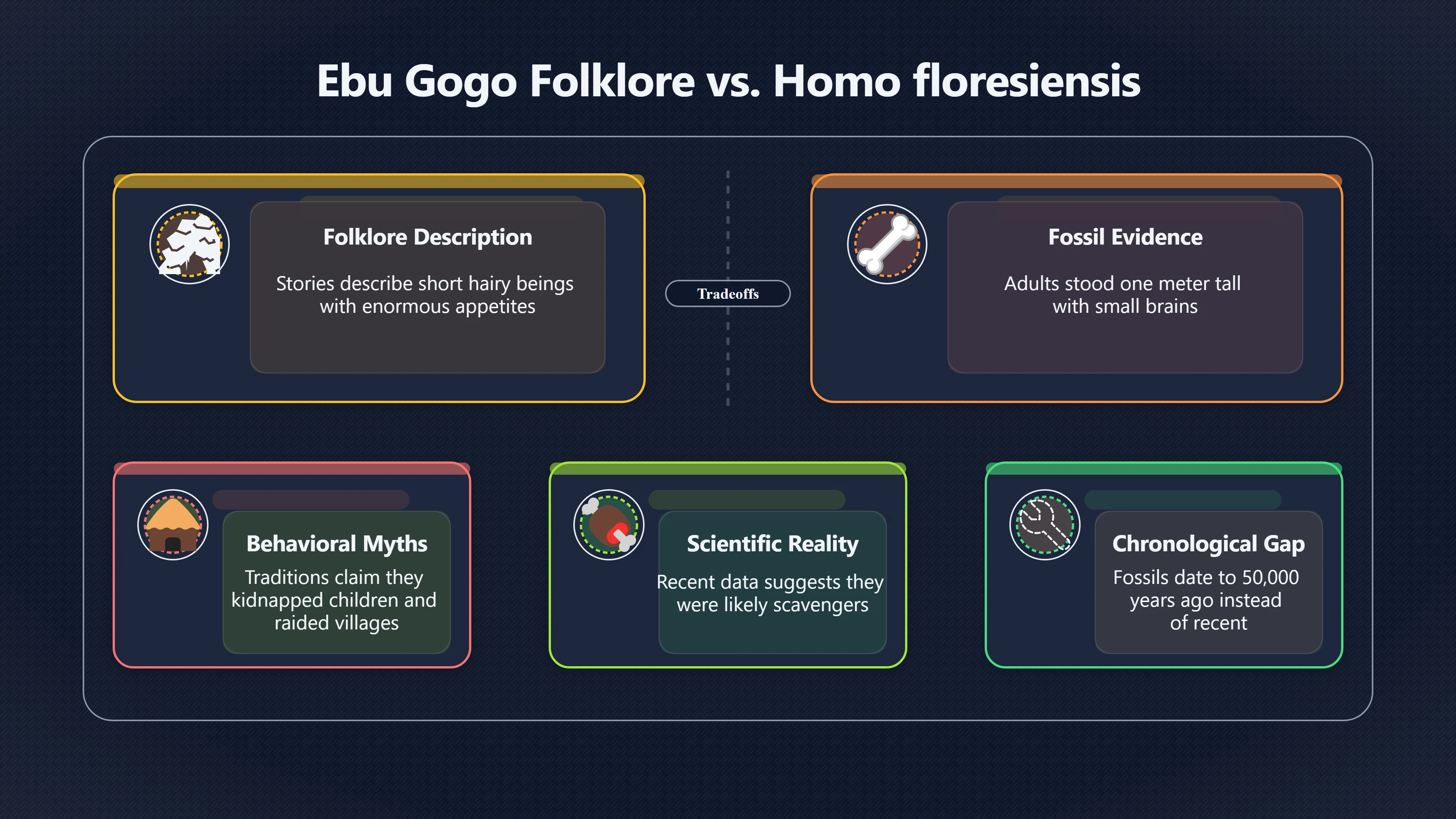
Long before anyone unearthed the remains of Homo floresiensis, people in parts of Flores told stories about small, human-like beings commonly known as the Ebu Gogo. These figures were described as short, hairy and broad-faced, with long arms, awkward speech and enormous appetites. Some versions portray them as comic nuisances who stole crops or food. Others make them more threatening, claiming they kidnapped children or raided villages.
One famous version says villagers finally destroyed the Ebu Gogo by tricking them into carrying bundles of dry palm fibre into a cave before setting the entrance alight. Whether understood as myth, moral tale or remembered history, the stories explain why the creatures disappeared from the landscape while leaving open the possibility that a few escaped into the forest.[wikipedia.org]WikipediaEbu gogoEbu gogo
Anthropologists recorded these traditions decades before the fossil discovery. That timing matters because it shows the stories were not invented to explain the “hobbit” fossils. Instead, the archaeological discovery prompted people to reread traditions that already existed in local oral culture.[Aeon]aeon.coinvestigating homo floresiensis and the myth of the ebu gogoInvestigating Homo floresiensis and the myth of the ebu gogoFeb 3, 2020 — An ancient legend from the Indonesian island of Flores spea…
What Homo floresiensis actually proves
The fossils from Liang Bua cave demonstrated something remarkable but limited: a previously unknown species of small-bodied human really did live on Flores.
Adults stood roughly one metre tall, had unusually small brains but clearly made stone tools, and survived on the island for hundreds of thousands of years. Improved dating now indicates that the youngest known Homo floresiensis fossils are around 60,000 years old, while the latest associated stone tools are about 50,000 years old—far earlier than the few hundred years suggested by Ebu Gogo folklore.[wikipedia.org]WikipediaHomo floresiensisHomo floresiensis
Recent research has also revised assumptions about how these tiny humans lived. Earlier interpretations suggested they hunted dwarf elephants and regularly controlled fire. New analyses of animal bones instead indicate that Komodo dragons probably made many of the feeding marks previously attributed to human hunters, while the absence of burnt cave-floor remains weakens evidence for habitual fire use. These findings change ideas about their behaviour but do not alter the basic fact that an extinct species of small human once inhabited Flores.[Live Science]livescience.comOriginally thought to have engaged in big-game hunting and mastered fire, recent findings suggest H. floresiensis were scavengers who con…
The scientific discovery therefore established one extraordinary fact: folklore about little human-like beings exists on the same island where a genuinely tiny human species once evolved. It did not demonstrate that the folklore is historically accurate.

Where folklore and fossils stop lining up
This is where the debate becomes genuinely interesting.
On one side are anthropologists such as Gregory Forth, who argue that repeated descriptions of small, hairy, human-like forest dwellers deserve careful attention rather than immediate dismissal. Forth suggests some Flores traditions may preserve memories—direct or indirect—of encounters with unusual hominins, even while acknowledging that such a claim remains speculative and lacks physical proof.[Aeon]aeon.coinvestigating homo floresiensis and the myth of the ebu gogoInvestigating Homo floresiensis and the myth of the ebu gogoFeb 3, 2020 — An ancient legend from the Indonesian island of Flores spea…
Most palaeoanthropologists remain unconvinced for several reasons.
- The archaeological dates place Homo floresiensis tens of thousands of years before the historical period described in many Ebu Gogo stories.
- Oral traditions can change dramatically over centuries, making it extremely difficult to trace them back tens of millennia.
- No modern bones, DNA, photographs or verified specimens support claims that the creatures survived into recent historical times.
- Many features of the Ebu Gogo resemble widespread “wild people” traditions found elsewhere in Southeast Asia, suggesting that folklore can develop independently of actual encounters with extinct human relatives.[aeon.co]aeon.coinvestigating homo floresiensis and the myth of the ebu gogoInvestigating Homo floresiensis and the myth of the ebu gogoFeb 3, 2020 — An ancient legend from the Indonesian island of Flores spea…
The mismatch in chronology is particularly significant. Earlier estimates suggested Homo floresiensis might have survived until around 12,000 years ago, making a cultural memory seem slightly less implausible. Improved dating has pushed their disappearance back to roughly 50,000 years ago, creating a much greater gap between fossil evidence and recorded folklore.[Wikipedia]WikipediaHomo floresiensisHomo floresiensis
Why the story became a Fortean classic
Few places illustrate the overlap between folklore and science as vividly as Flores.
Unlike many cryptid stories, the Ebu Gogo tradition gained attention because science unexpectedly confirmed one part of the apparently impossible picture: tiny humans really had existed on the island. That discovery encouraged writers, journalists and documentary-makers to revisit local traditions with fresh curiosity.
The temptation is obvious. The descriptions share striking features—small stature, human appearance and an island setting—that seem almost too coincidental to ignore. Yet coincidences, however suggestive, are not proof. Human imagination also tends to reshape older stories around spectacular new discoveries.
For Fortean enthusiasts, Flores therefore occupies a rare middle ground. It is neither a simple debunking nor a confirmed mystery. Instead, it demonstrates how archaeology can unexpectedly illuminate folklore without validating every legendary detail. The fossils made the stories more interesting, but they did not turn them into eyewitness reports.
Why the question still matters
The enduring appeal of Flores lies less in whether the Ebu Gogo were real than in what the debate reveals about memory, storytelling and scientific discovery.
The discovery of Homo floresiensis reminded researchers that human evolution was far stranger than previously imagined. At the same time, it encouraged a more respectful reading of local traditions that had often been dismissed as mere fantasy. The result is not evidence that folklore preserved an exact historical record, but a powerful reminder that myths sometimes gain unexpected significance when new discoveries change the questions scientists are willing to ask.
Within Indonesia’s wider catalogue of strange traditions, the Flores little people remain one of the country’s most compelling examples of folklore standing beside genuine scientific surprise—close enough to invite comparison, yet separated by a gap in evidence that has never been bridged.
Amazon book picks
Further Reading
Books and field guides related to Did Flores Folklore Remember the Hobbit People?. Use these as the next step if you want deeper reading beyond the article.

eBay marketplace picks
Marketplace Samples
Live-tested eBay searches with available results related to this page.




Endnotes
1.
Source: aeon.co
Title: investigating homo floresiensis and the myth of the ebu gogo
Link:https://aeon.co/ideas/investigating-homo-floresiensis-and-the-myth-of-the-ebu-gogo
Source snippet
Investigating Homo floresiensis and the myth of the ebu gogoFeb 3, 2020 — An ancient legend from the Indonesian island of Flores spea...
2.
Source: australian.museum
Title: homo floresiensis
Link:https://australian.museum/learn/science/human-evolution/homo-floresiensis/
Source snippet
The Australian MuseumHomo floresiensis23 Dec 2019 — Interestingly, local legends exist in Flores of the Ebu Gogo – small, hairy, cave dwe...
3.
Source: Wikipedia
Title: Homo floresiensis
Link:https://en.wikipedia.org/wiki/Homo_floresiensis
4.
Source: Wikipedia
Title: Ebu gogo
Link:https://en.wikipedia.org/wiki/Ebu_gogo
5.
Source: spafajournal.org
Title: Ebu Gogo
Link:https://www.spafajournal.org/index.php/spafa1991journal/article/view/138
Source snippet
the Little People of Flores | Weerawardaneby P Weerawardane · 2004 · Cited by 1 — The legends tell of a little people, Ebu Gogo, who exis...
6.
Source: iias.asia
Link:https://www.iias.asia/the-review/folk-zoology-southeast-asian-wildmen
Source snippet
scovery of Homo floresiensis in 2003, very probably a new species of...Read more...
7.
Source: Wikipedia
Link:https://en.wikipedia.org/wiki/Homo
Source snippet
HomoHomo (from Latin homō 'human') is a genus of great ape (family Hominidae) that emerged from the early hominin genus Australopithec...
8.
Source: livescience.com
Link:https://www.livescience.com/archaeology/human-evolution/diminutive-species-the-hobbit-did-not-hunt-or-control-fire-deepening-the-mystery-of-its-ancestry-dwarf-elephant-bones-reveal
Source snippet
Originally thought to have engaged in big-game hunting and mastered fire, recent findings suggest H. floresiensis were scavengers who con...
9.
Source: cryptidz.fandom.com
Title: Ebu Gogo
Link:https://cryptidz.fandom.com/wiki/Ebu_Gogo
Source snippet
Gogo - Cryptid Wiki - FandomThe Ebu Gogo are believed to have been hunted to extinction by the human inhabitants of Flores. They believe...
10.
Source: livescience.com
Title: What are Homo sapiens?
Link:https://www.livescience.com/homo-sapiens.html
Source snippet
May 25, 2021 — Homo sapiens is a species of highly intelligent primate that includes all living humans, who are often referred to as H. s...
Published: May 25, 2021
Additional References
11.
Source: nhm.ac.uk
Link:https://www.nhm.ac.uk/discover/homo-erectus-our-ancient-ancestor.html
Source snippet
Homo erectus, our ancient ancestorThe extinct ancient human Homo erectus is a species of firsts. It was the first of our relatives to hav...
12.
Source: popularmechanics.com
Link:https://www.popularmechanics.com/science/a71729435/homo-floresiensis-tiny-human/
Source snippet
These 3.5-foot-tall hominins lived about 50,000 years ago and showed surprising physical traits more primitive than other Homo species, i...
13.
Source: researchgate.net
Link:https://www.researchgate.net/publication/41017164_Flores_after_floresiensis_Implications_of_local_reaction_to_recent_palaeoanthropological_discoveries_on_an_eastern_Indonesian_island
Source snippet
(PDF) Flores after floresiensis: Implications of local reaction...3 Jun 2026 — The discovery was, and remains, controversial, not least...
14.
Source: reddit.com
Link:https://www.reddit.com/r/Anthropology/comments/ez60a3/investigating_homo_floresiensis_and_the_myth_of/
Source snippet
It's also been speculated that their relatives continue...Read more...
15.
Source: inference-review.com
Title: The Genus Homo | Ian Tattersall
Link:https://inference-review.com/article/the-genus-homo
Source snippet
Inference ReviewA compact, phylogeny-based, consensus-based definition of the genus Homo of the kind already sketched by Wood and Collard...
16.
Source: medium.com
Title: The Last Fire in the Cave
Link:https://medium.com/%40joshlevin10/the-last-fire-in-the-cave-da8c67f07560
Source snippet
Homo floresiensis, the Ebu Gogo...The local people tell of small hairy beings called the Ebu Gogo.... The discovery of Homo floresiensi...
17.
Source: theguardian.com
Link:https://www.theguardian.com/education/2004/oct/28/research.highereducation1
Source snippet
Our not so distant relative | ResearchOct 28, 2004 — The clue to the origin of Homo floresiensis comes from earlier work sug gestive of t...
18.
Source: youtube.com
Link:https://www.youtube.com/watch?v=9W005V6OV_E
Source snippet
ergence of our genus, focusing on possible antecedents to Homo...
19.
Source: youtube.com
Title: How H floresiensis made fire
Link:https://www.youtube.com/watch?v=jQUJ88WN0Y0
Source snippet
The mysterious Ebu gogo...An ancient legend from the Indonesian island of Flores speaks of a mysterious creature of the forest, the "Ebu...
20.
Source: socialsci.libretexts.org
Title: 3.3: Homo Genus
Link:https://socialsci.libretexts.org/Bookshelves/Anthropology/Biological_Anthropology/Book%3A_Biological_Anthropology_%28Saneda_and_Field%29/III%3A_Human_Evolution/3.3%3A_Homo_Genus
Source snippet
libretexts.org3.3: Homo GenusNov 17, 2020 — The emergence of the genus Homo marks the advent of larger brains, the emergence of material...
Topic Tree