Within Serbia Mysteries
The Screaming Creature of Serbian Folklore
The drekavac remains a powerful Serbian legend where frightening sounds, spirits and rural storytelling meet.
On this page
- Origins of the drekavac legend
- Animal sounds and mistaken sightings
- Folklore meaning across generations
Page outline Jump by section
Introduction
The drekavac is one of the most enduring and unsettling figures in Serbian folklore. Its name is usually translated as “the screamer” or “the screecher”, reflecting the terrifying cry that defines almost every version of the legend. Unlike many mythical creatures with a fixed appearance, the drekavac changes from region to region. It may be a restless child, an animal-like apparition, an emaciated humanoid or simply an unseen presence heard in the darkness. What unites these traditions is not a single monster but a shared belief that strange sounds in lonely places deserve respect and caution.[Wikipedia]WikipediaOpen source on wikipedia.org.
Within Serbia’s wider tradition of uncanny folklore, the drekavac occupies the meeting point between oral storytelling, religious belief, natural observation and fear of the night. The legend has survived because it adapts easily to changing times: mysterious cries in forests, unexplained livestock deaths and frightening encounters after dark can all be woven into the same enduring narrative.
Origins of the drekavac legend
The oldest surviving descriptions place the drekavac within the wider tradition of South Slavic supernatural beliefs rather than as a uniquely Serbian invention. The name derives from a South Slavic verb meaning “to scream” or “to screech”, emphasising sound over appearance. In many accounts, hearing the creature is more significant than seeing it.[Wikipedia]WikipediaOpen source on wikipedia.org.
Traditional Serbian beliefs preserved several different origins for the creature.
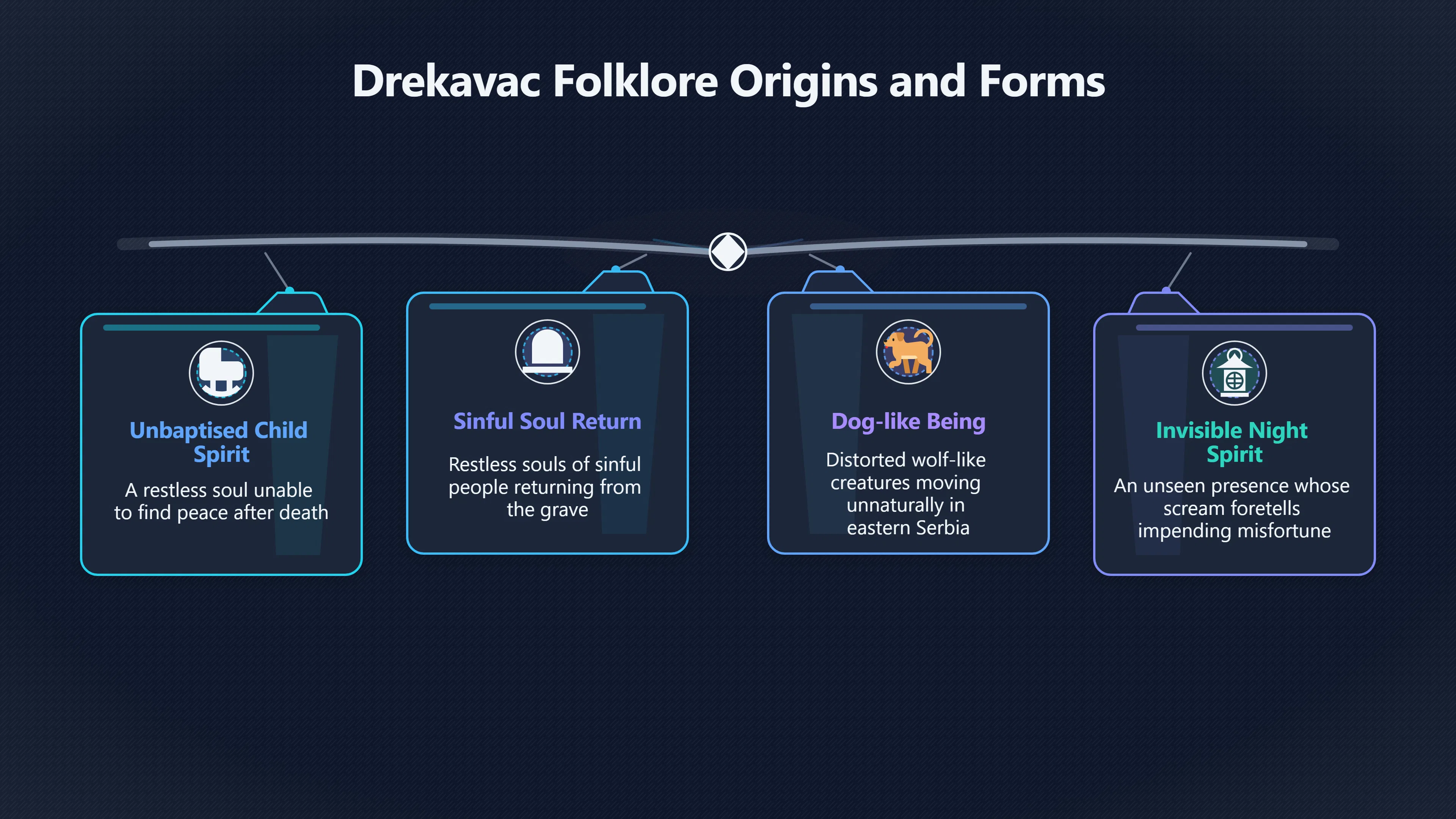
- In perhaps the best-known version, the drekavac is the spirit of an unbaptised child, unable to find peace after death.
- Other traditions describe it as the restless soul of a sinful person who returns from the grave.
- In eastern Serbia, it sometimes appears as a distorted, dog-like or wolf-like being that moves unnaturally.
- Elsewhere, it is an invisible night spirit whose scream foretells illness, misfortune or death.[Wikipedia]WikipediaOpen source on wikipedia.org.
These variations reflect centuries of local storytelling rather than contradictions. Serbian folklore often allows supernatural beings to change form according to landscape, religious tradition and village memory.
The association with unbaptised children illustrates how older folk beliefs became intertwined with Christian ideas about burial, salvation and the fate of the dead. Rather than replacing earlier supernatural traditions, Christianity often reshaped them into stories that reinforced religious and social values.[OUP Academic]academic.oup.comOUP AcademicInverted Behavior in South Slavic Ritual and Magic | The Oxford Handbook of Slavic and East European Folklore | Oxford Academic…
Why is the drekavac always heard at night?
The scream is the defining feature of the legend. Accounts typically place the creature around forests, graveyards, abandoned fields, mountains or isolated paths after sunset. Unlike many monsters that attack directly, the drekavac often announces itself through sound alone.
Night was traditionally viewed as a dangerous time in rural Serbia. Before electric lighting, darkness genuinely increased the risks posed by wolves, uneven ground and unfamiliar terrain. Folklore transformed those practical dangers into memorable stories that encouraged people—especially children—not to wander after dark.[folkloristics.org]folkloristics.orgSerbian Folklore AssociationSerbian Folklore Association…
Some traditions also associate the drekavac with particular seasons, especially the winter festival period or early spring, when many South Slavic communities believed supernatural forces were especially active. These seasonal beliefs appear across a wider network of Balkan folklore rather than belonging exclusively to the drekavac.[Wikipedia]WikipediaOpen source on wikipedia.org.
Animal sounds and mistaken sightings
One reason the legend has remained believable is that rural Serbia contains many animals capable of producing startling nocturnal calls.
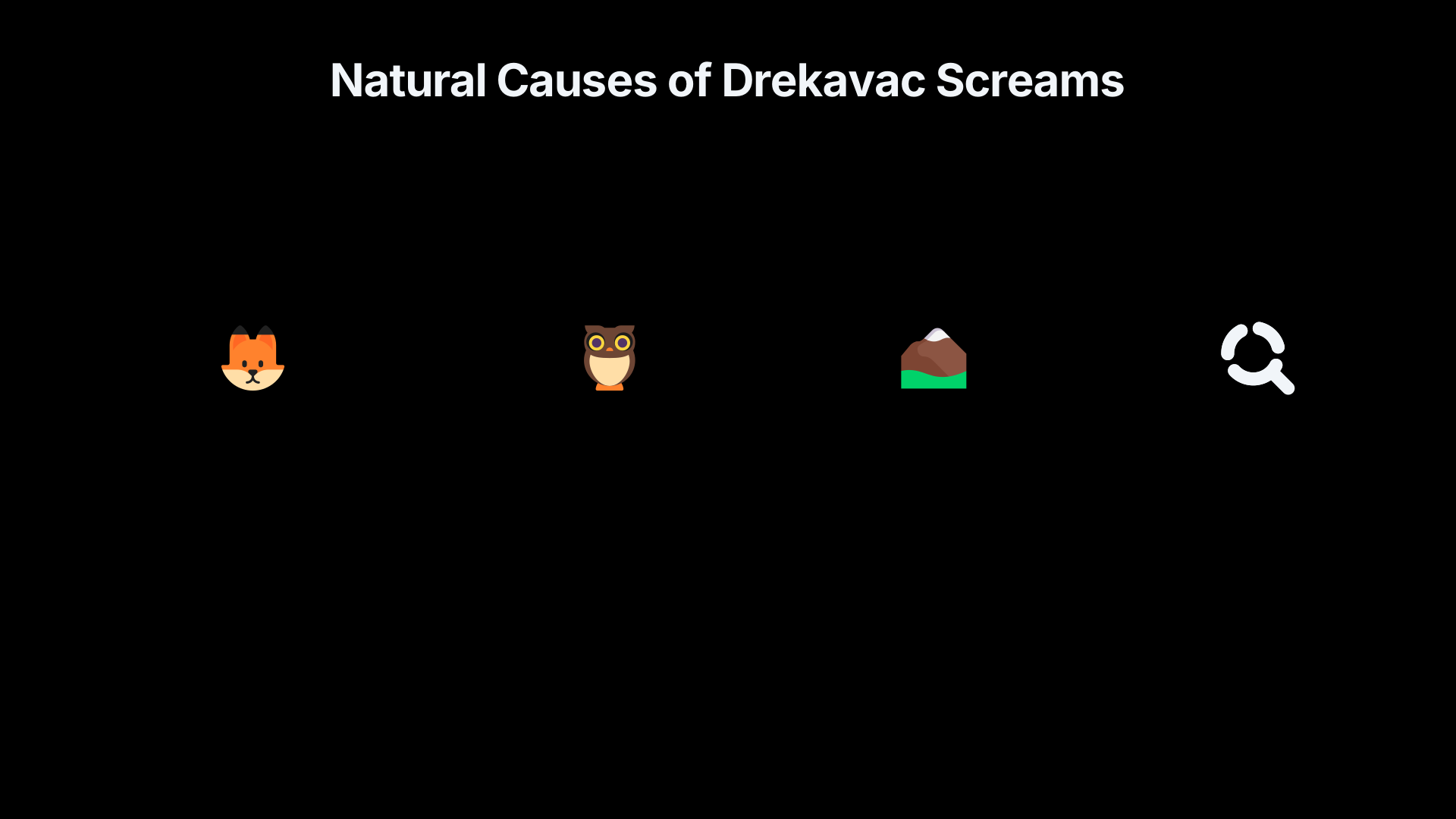
Owls, foxes, wildcats, deer and other wildlife can emit cries that sound remarkably human to listeners unfamiliar with them. Fox screams in particular are frequently mistaken for someone shouting or crying in distress, while some owl species produce eerie, almost child-like calls. In mountainous or forested landscapes, echoes can make these sounds seem to move through the darkness or come from impossible directions.
This provides a straightforward explanation for many traditional encounters. A traveller hearing an unfamiliar scream without seeing its source could easily conclude that something supernatural was nearby. Folklore then supplied a familiar identity for the unexplained sound.
Modern folklore researchers generally treat these stories as examples of how communities interpret ambiguous experiences rather than as evidence of unknown creatures. The stories reveal how people understand landscapes filled with uncertainty instead of proving that the creature exists.[folkloristics.org]folkloristics.orgSerbian Folklore AssociationSerbian Folklore Association…
Modern sightings and media stories
Although primarily a creature of folklore, the drekavac periodically reappears in modern newspapers and popular culture.
During the 1990s, reports circulated of an unusual carcass found near the village of Krvavica, which some locals claimed belonged to a drekavac. Subsequent investigation suggested it was the decomposed remains of an ordinary fox, distorted by decay.[Wikipedia]WikipediaOpen source on wikipedia.org.
In 2003, livestock attacks around Tometino Polje prompted speculation that the legendary creature had returned. However, the attacks occurred during daylight, leading many local residents themselves to doubt that the folklore explanation fit the reported events. Ordinary predators remained the more likely cause.[Wikipedia]WikipediaOpen source on wikipedia.org.
These episodes illustrate an important pattern in Serbian Forteana. Extraordinary interpretations often emerge quickly when unusual events occur, but mundane explanations frequently prove more convincing once additional evidence becomes available.
What the legend meant to rural communities
The drekavac served purposes beyond simply frightening listeners.
Stories about the creature reinforced practical advice:
- avoid isolated places after dark;
- respect cemeteries and sacred places;
- keep children close to home at night;
- treat unexplained sounds with caution rather than curiosity.
In this sense, the legend functioned as social guidance wrapped in memorable storytelling. Fear became an effective teaching tool, ensuring that warnings would be remembered across generations.
Field recordings collected by Serbian folklorists show that belief narratives involving the drekavac often sit alongside stories about fairies, magical protection, haunted places and encounters with other supernatural beings. Rather than existing in isolation, the creature belongs to a much broader landscape of traditional belief that once helped rural communities explain uncertain experiences.[folkloristics.org]folkloristics.orgSerbian Folklore AssociationSerbian Folklore Association…

Why the drekavac still fascinates people
Unlike vampires, whose appearance has become heavily standardised through novels and films, the drekavac remains remarkably flexible. Every village tradition can describe it differently while preserving its essential identity as the mysterious screamer of the night.
That flexibility explains its continuing popularity. Horror writers, artists and filmmakers can adapt the creature without abandoning its folkloric roots, while local communities continue to tell stories that connect the legend to familiar woods, hills and abandoned paths.
For readers interested in Serbia’s strange traditions, the drekavac represents an ideal example of how folklore grows from ordinary experiences. Strange animal cries, religious beliefs about the dead, the dangers of travelling after dark and generations of oral storytelling combined to create a creature that has remained one of the country’s most recognisable night-time legends. Whether understood as a ghost story, a cautionary tale or a cultural memory of life before modern lighting and wildlife knowledge, the drekavac continues to embody the uneasy boundary between natural explanation and supernatural imagination.
Amazon book picks
Further Reading
Books and field guides related to The Screaming Creature of Serbian Folklore. Use these as the next step if you want deeper reading beyond the article.
The Mammoth Book of Unexplained Phenomena
Places regional monster legends into a wider unexplained context.
The Encyclopedia of Ghosts and Spirits
Explains folklore beings and spirit traditions related to creatures like the drekavac.
Mysteries of the Unexplained
Appeals to readers interested in folklore and unexplained stories.
Serbian Folk Tales
Strong introduction to Serbian folklore that includes the cultural world of the drekavac.
eBay marketplace picks
Marketplace Samples
Live-tested eBay searches with available results related to this page.

Endnotes
1.
Source: Wikipedia
Link:https://en.wikipedia.org/wiki/Drekavac
2.
Source: folkloristics.org
Title: Serbian Folklore Association
Link:https://folkloristics.org/terenski-zapisi-narodnih-predanja-i-verovanja-iz-dubocice.php
Source snippet
Serbian Folklore Association...
3.
Source: academic.oup.com
Link:https://academic.oup.com/edited-volume/43182/chapter-abstract/405991022
Source snippet
OUP AcademicInverted Behavior in South Slavic Ritual and Magic | The Oxford Handbook of Slavic and East European Folklore | Oxford Academic...
4.
Source: youtube.com
Link:https://www.youtube.com/watch?v=-rrPlQCZZN0
Source snippet
The Cursed Child of Slavic Folklore - Drekavac...
5.
Source: folklorethings.blogspot.com
Link:https://folklorethings.blogspot.com/2024/11/drekavac.html
Source snippet
November 1, 2024 — FOLKLORE LEGENDS DREKAVAC November 01, 2024 The Drekavac originates from South Slavic mythology and translates to “the...
Published: November 1, 2024
6.
Source: mythicalencyclopedia.com
Link:https://mythicalencyclopedia.com/drekavac/
Source snippet
The name “Drekavac” is derived from the verb “drečati” which means “to screech”. The creature is also known as “...
7.
Source: sagengestalten.com
Link:https://sagengestalten.com/drekavac/
Source snippet
Image: Drekavac DREKAVAC DREKAVAC – NACHTAKTIVE, SCHREIENDE KREATUR Der Drekavac ist Teil der südslawische...
Additional References
8.
Source: researchgate.net
Link:https://www.researchgate.net/publication/344839047_Propp_Revisited_A_Structural_Analysis_of_Vuk_Karadzic%27s_Collection_Serbian_Folk_Fairy_Tales
Source snippet
August 1, 2020 — PROPP REVISITED: A STRUCTURAL ANALYSIS OF VUK KARADŽIĆ’S COLLECTION SERBIAN FOLK FAIRY TALES * August 2020 * Zeitschrift...
Published: August 1, 2020
9.
Source: en-academic.com
Link:https://en-academic.com/dic.nsf/enwiki/416705
Source snippet
DrekavacDREKAVAC Drekavac Drekavac (Serbo-Croatian pronunciation: [drɛkaʋats]) (literally "the screamer"^{[1]}), also called drek and dre...
10.
Source: enciklopedija.cc
Link:https://enciklopedija.cc/wiki/Drekavac
Source snippet
Drekavac – Hrvatska internetska enciklopedijaDREKAVAC Prijeđi na navigaciju Prijeđi na pretraživanje Drekavac može značiti: * Drekavci il...
11.
Source: balcanica.rs
Link:https://balcanica.rs/index.php/journal/article/view/509
Source snippet
Annual of the Institute for Balkan StudiesDecember 1, 2002 — НЕКЕ СРПСКЕ ПАРАЛЕЛЕ ИСТОЧНОСЛОВЕНСКОМ ВИЈУ (SOME SERBIAN PARALLELS TO THE E...
Published: December 1, 2002
12.
Source: ceeol.com
Title: Vesković Subject(s): Customs / Folklore, Studies of Literature Published by: Ун
Link:https://www.ceeol.com/search/article-detail?id=815409
Source snippet
Article DetailDownload КУЛТ ДРВЕТА У СРПСКОЈ НАРОДНОЈ ТРАДИЦИЈИ THE CULT OF THE TREE IN SERBIAN FOLK TRADITION Author(s): Jelena Đ...
13.
Source: thesrpskatimes.com
Title: The ‘’Drekavac’’ – Monster From South Slavic Mythology | The Srpska Times
Link:https://thesrpskatimes.com/the-drekavac-monster-from-south-slavic-mythology/
Source snippet
January 13, 2020 — The Srpska Times [Input][Input] Home Entertainment The ‘’Drekavac’’ – Monster From South Slavic Mythology THE ‘’DREKAV...
Published: January 13, 2020
14.
Source: 24sedam.rs
Title: Ispušta zastrašujuće krike i napada noću: Kako su Srbi zamišljali drekavca?
Link:https://24sedam.rs/drustvo/vesti/137479/ispusta-zastrasujuce-krike-i-napada-nocu-kako-su-srbi-zamisljali-drekavca/vest
Source snippet
11.06.2022 06:30 1 Autor: Milan Ivanić U mitologiji i narodnim predanjima postoji nekoliko različitih opisa drekavca k...
15.
Source: ufomagazines.com
Link:https://www.ufomagazines.com/north-american-biofortean-review-north-american-biofortean-review-issue-07/
Source snippet
In Kula, on April 4, 2001, loud, terrible sounds were heard from a beast across the river, ide...
Published: April 4, 2001
16.
Source: degruyterbrill.com
Title: Propp Revisited: A Structural Analysis of Vuk Karadžić’s
Link:https://www.degruyterbrill.com/document/doi/10.1515/slaw-2020-0017/html
Source snippet
August 20, 2020 — PROPP REVISITED: A STRUCTURAL ANALYSIS OF VUK KARADŽIĆ’S COLLECTION SERBIAN FOLK FAIRY TALES * [Button: Dijana Vučković...
Published: August 20, 2020
17.
Source: abcdocz.com
Title: imitation of animal sound patterns in serbian folk music
Link:https://abcdocz.com/doc/98928/imitation-of-animal-sound-patterns-in-serbian-folk-music-
Source snippet
Milena PetrovicMarch 20, 2012 — IMITATION OF ANIMAL SOUND PATTERNS IN SERBIAN FOLK MUSIC MILENA PETROVIC journal of interdisciplinary mus...
Published: March 20, 2012
Topic Tree