What Makes Burkina Faso's Weird History So Earthbound?
Burkina Faso’s strange-history record is not dominated by famous flying saucers or lake monsters.
Page outline Jump by section
The sky stone at Gao-Guenie
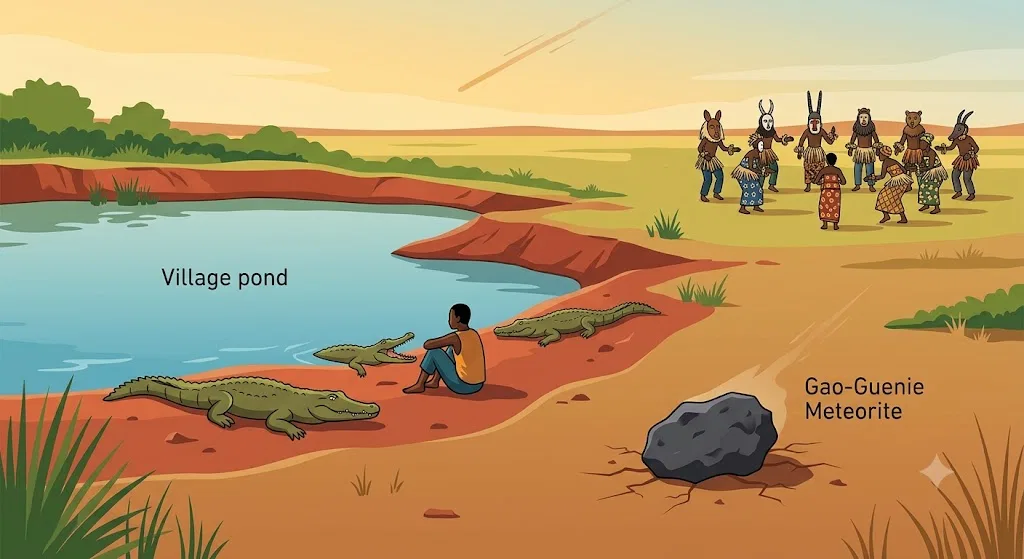
The most concrete anomalous event associated with Burkina Faso is the Gao-Guenie meteorite fall of 5 March 1960, when the country was still widely identified in older records as Upper Volta. The Meteoritical Bulletin lists Gao-Guenie as an official meteorite name, an observed fall, and an H5 ordinary chondrite that fell in Burkina Faso in 1960. Its older write-up places the fall near Gao, about 60 km north of Léo, at around 17:00, and notes that at least 16 stones were recovered, the largest weighing 2.5 kg.[LPI]lpi.usra.eduLPIMeteoritical Bulletin: Entry for Gao-GuenieLPIMeteoritical Bulletin: Entry for Gao-Guenie
What makes Gao-Guenie especially Fortean is not that a meteorite fell — that is natural — but that the event acquired a confusing double life. Arizona State University’s Buseck Center for Meteorite Studies explains that stones were seen to fall near Gao on 5 March 1960, with the sound reportedly audible from more than 100 km away, and that a second shower was later reported about a month afterwards only 10 km away. For nearly 40 years, specimens from the area were treated as two falls, “Gao” and “Guenie”, until the Meteorite Nomenclature Committee accepted the combined name Gao-Guenie after research indicated they were most likely one fall rather than two.[meteorites.asu.edu]meteorites.asu.eduGao-Guenie – Buseck Center for Meteorite StudiesGao-Guenie – Buseck Center for Meteorite Studies
This is a useful warning for any strange-report archive. A dramatic natural event can become stranger in the record because witnesses, collectors, scientists and catalogues organise the evidence differently over time. Believers in anomalies may see the “two showers” story as a marvel; the better-supported explanation is more prosaic but still fascinating: one major fall, a wide strewn field, later finds and a long period of classification uncertainty.[LPI]lpi.usra.eduLPIMeteoritical Bulletin: Entry for Gao-GuenieLPIMeteoritical Bulletin: Entry for Gao-Guenie
A related archival oddity appears in a United States Air Force Project Blue Book file for Upper Volta dated August 1962. The summary says an object fell during the afternoon on 14 August 1962, alarming field workers with a loud noise and bright light overhead; the recovered object was described as grapefruit-sized, about 8 kg, and found in a hole. The Air Force card assumed it was a meteorite and said it was sent to Brookhaven for analysis, but the case file itself is thin and marked with insufficient data.[govweird]govweird.comupper volta africa august 1962 28998624upper volta africa august 1962 28998624
For a Fortean reader, the 1962 file is not strong evidence of anything exotic. It is, however, a neat example of how “UFO” archives often contain mundane but striking skyfall reports. In Burkina Faso’s case, the more substantial sky mystery is not an alien craft but the old problem of how falling stones are witnessed, recovered, named, renamed and folded into both scientific and popular memory.
Sacred crocodiles and the village pond that behaves like a shrine
The most visually famous strange tradition in Burkina Faso is the relationship between people and crocodiles at places such as Bazoulé and Sabou. News reports describe Bazoulé as a village about 30 km from Ouagadougou where people share a pond with more than 100 crocodiles and where visitors may see locals approach, sit near or even sit on the reptiles. Local accounts reported by AFP say the connection dates back at least to the 15th century, when crocodiles are said to have led women to water during a drought.[www.ndtv.com]ndtv.comOpen source on ndtv.com.
The Fortean pull of the Bazoulé story is obvious: crocodiles are usually symbols of danger, yet here they are presented as protectors, ancestors and warning beings. In the AFP account, Pierre Kaboré says the crocodiles are treated as sacred, that dead crocodiles are buried with funerary attention, and that their cries may be interpreted by elders as warnings of misfortune. The annual Koom Lakre celebration is described as a time when villagers make sacrifices and ask for health, prosperity and good harvests.[www.ndtv.com]ndtv.comOpen source on ndtv.com.
Sceptical interpretation does not need to sneer at the tradition. The animals are real, the local reverence is real, and the visitor economy around them is real. What is uncertain is the supernatural layer: whether crocodile cries foretell trouble, whether the animals act as ancestral souls, or whether long coexistence, feeding practices, local rules and species behaviour explain why attacks are not central to the village story. The same AFP report notes the tourist practice of using chickens to entice crocodiles from the pond, which is a reminder that staged encounters and sacred meanings can exist side by side.[www.ndtv.com]ndtv.comOpen source on ndtv.com.
There is also a biological twist. Research on Burkina Faso’s crocodiles identifies the West African crocodile, Crocodylus suchus, as the country’s only crocodilian and notes that it was only recently separated taxonomically from the Nile crocodile. The same study describes C. suchus as smaller than C. niloticus and less inclined to attack humans or livestock, while also warning that data on its ecology in Burkina Faso remain scarce.[SCIRP]scirp.orgImpact of Anthropogenic Activities on the Abundance of Crocodylus suchus (Saint-Hilaire 1807) within the Nazinga Game Ranch, Burkina Faso…
That matters because it gives the sacred-crocodile story a grounded mechanism without emptying it of cultural meaning. A 2020 study of the sacred ponds at Bazoulé and Sabou counted 268 crocodiles at Bazoulé and 249 at Sabou during monitoring from January 2016 to May 2017, and concluded that traditional beliefs play an important role in protecting C. suchus in both villages. At the same time, it warned that human pressures could still affect the animals’ abundance.[European Scientific Journal]eujournal.orgCroyances Traditionnelles et Conservation du Crocodylus Suchus Dans les Mares Sacrées de Bazoulé et de Sabou (Burkina Faso) | European Sc…
So the crocodile ponds are neither mere folklore nor proof of supernatural animal guardianship. They are living examples of how belief, ecology and tourism can form a local compact: the animals are protected because they are sacred, the sacredness is reinforced because the animals remain visible, and the whole arrangement becomes one of Burkina Faso’s most memorable weird-history landmarks.
Spirits made visible: masks, animals and the bush
Burkina Faso’s mask traditions are not “paranormal evidence” in the modern ghost-hunting sense, but they belong in a Fortean account because they show how invisible powers are made publicly visible. Princeton University Art Museum describes traditional Bwa religion as involving relationships with powerful nature spirits, which may be honoured and approached through commissioned and danced masks. These masks can represent insects, water creatures such as fish and crocodiles, or land animals including antelopes, monkeys, pigs and buffalo.[Princeton University Art Museum]artmuseum.princeton.eduUniversity Art Museum Bwa and Wé Masks | Princeton University Art MuseumUniversity Art Museum Bwa and Wé Masks | Princeton University Art Museum
For outsiders, a mask may look like an art object. In its proper ritual setting, it can be a charged presence: a moving, dancing, socially recognised form of a power that is not otherwise visible. That is why these traditions matter to a country-level Forteana page. They complicate the simple question “do people believe in strange beings?” by showing that the answer is often practical, artistic and communal. A being may be encountered through performance, costume, rhythm, initiation and seasonal ceremony rather than through a one-off sighting in the dark.
The same museum account notes that buffalo masks may appear at annual renewal ceremonies, market-day celebrations, funerals, burials and initiations, with the dancer using canes to represent the animal’s forelegs and imitate its movements. It also cautions that museums do not always know the full significance or collection history of such objects in their original communities.[Princeton University Art Museum]artmuseum.princeton.eduUniversity Art Museum Bwa and Wé Masks | Princeton University Art MuseumUniversity Art Museum Bwa and Wé Masks | Princeton University Art Museum
That caution is important. The Fortean temptation is to flatten every masked figure into a “spirit creature” entry. A better reading is that Burkina Faso’s mask traditions sit at the meeting point of religion, art, performance, social order and memory. They do not need to be reduced to either “just theatre” or “literal monsters”. Their strangeness lies in the way they give shape and public force to relationships with powers understood as living outside ordinary human sight.
Divination and the invisible world
Another major strand of Burkina Faso’s strange-history material is divination: not as a stage trick, but as a culturally serious method for diagnosing misfortune. Anne Fournier’s work on Seme divination describes a system in which the Seme of Burkina Faso attribute problems to interventions from the invisible world and use divination to identify both the cause and the proper remedy. The diviner is described as being called by the invisible and linked through initiation to a bush spirit that becomes his assistant and intermediary.[OpenEdition Journals]journals.openedition.orgOpen source on openedition.org.
This is Fortean in a more anthropological sense. Instead of asking whether a ghost appeared at the foot of a bed, the Seme material asks how a community reasons about hidden causation. Why did illness strike? Which relationship has gone wrong? Which power has been offended? What action might restore balance? The strange element is not a single spectacle, but an entire diagnostic world in which stones, sticks, cowries, bells, sacrifices, ancestors and bush spirits form an organised procedure for getting at truth.[Horizon Documentation]horizon.documentation.ird.frOpen source on ird.fr.
Fournier’s account is especially valuable because it does not present divination as random superstition. It describes a highly structured rite in which the diviner’s visible actions are understood as corresponding to simultaneous actions in the invisible world. The divination stone is a key stage, cowries may represent invisible entities, and the bush spirit’s assistance is central to the production of an answer.[Horizon Documentation]horizon.documentation.ird.frOpen source on ird.fr.
For sceptics, this is a social and symbolic technology for negotiating uncertainty, responsibility and repair. For participants, it is a way of communicating with real invisible powers. For a Fortean reader, the most interesting point is the overlap: divination works as a mystery practice not because it produces laboratory-style proof, but because it offers a disciplined local grammar for misfortune. It turns chaos into a conversation.
Witchcraft accusations: when strange belief becomes social danger
No evidence-aware account of Burkina Faso’s supernatural landscape should treat witchcraft only as colourful folklore. Accusations have had severe consequences, especially for older women. A joint submission to the United Nations Universal Periodic Review by HelpAge International and partner organisations stated that belief in witchcraft is widespread in Burkina Faso and that older women are often accused, leading to psychological trauma, physical harm, social exclusion, loss of property and banishment.[OHCHR]ohchr.orgHAI BFA UPR S3 2008 HelpAgeInternational Etal uprsubmissionHAI BFA UPR S3 2008 HelpAgeInternational Etal uprsubmission
The same submission reported that research conducted in 2006 by HelpAge International and Burkina Faso’s Ministry of Social Action and National Solidarity found that residents of 11 reception centres were overwhelmingly there because of rejection and banishment linked to witchcraft accusations. It also reported that most victims were women, illiterate, Mossi and over 50. These figures should be handled carefully because the source itself notes that very little quantitative data exists, but they clearly show that the issue is not a harmless fireside legend.[OHCHR]ohchr.orgHAI BFA UPR S3 2008 HelpAgeInternational Etal uprsubmissionHAI BFA UPR S3 2008 HelpAgeInternational Etal uprsubmission
A 2012 report published by The Guardian, drawing on IPS reporting, described a practice known as “the bearing of the body”, in which a corpse in a suspicious death is carried through a community in the belief that it will indicate the person responsible. The accused, described as almost always women in that report, may then be chased from their homes. The same article said Burkina Faso had adopted an action plan intended to end the banishment of women accused of witchcraft, with promised legal, psycho-social and financial support.[The Guardian]theguardian.comOpen source on theguardian.com.
This is where Forteana has to be humane. It is possible to study witchcraft beliefs as part of a country’s strange-history record while refusing to romanticise accusations. The mystery claim — that a person has caused death, sickness or misfortune by hidden powers — is not supported as a factual charge by these human-rights sources. What is well supported is the damage done when such claims become socially actionable: exile, poverty, fear and violence.

Why Burkina Faso’s Forteana feels different
Burkina Faso’s strongest strange material is not a tidy catalogue of monsters. It is a set of encounters between visible and invisible worlds: stones fall from the sky and confuse catalogues; crocodiles become ancestors and conservation subjects; masks let nature spirits enter public space; diviners consult powers that cannot be seen; accusations of occult harm become a brutal social fact. The common thread is not “the paranormal is proven”, but “unusual claims matter because people act around them”.
That makes the country especially useful for readers who want strange-but-grounded material. The Gao-Guenie meteorite shows how a real celestial event can become archivally strange through witness reports and later classification. The crocodile ponds show how sacred status can protect dangerous animals while also attracting tourism and sceptical curiosity. Bwa and related mask traditions show how spirits may be performed rather than merely sighted. Seme divination shows a sophisticated local method for reasoning about hidden causes. Witchcraft accusations show the ethical limit: some supernatural claims are not quaint mysteries but mechanisms of exclusion and harm.
The result is a Burkina Faso page that rewards careful reading. Its weird history is not thin; it is simply not always packaged in the familiar modern forms of UFO flaps, haunted castles or lake beasts. The country’s Forteana is strongest where folklore, ecology, ritual, sky science and social life meet — and where the evidence asks for curiosity without credulity.
Amazon book picks
Further Reading
Books and field guides related to What Makes Burkina Faso's Weird History So Earthbound?. Use these as the next step if you want deeper reading beyond the article.
African religions & philosophy
Provides broad context for beliefs, spirits and traditions discussed across Burkina Faso.
Meteorites
An account of the present knowledge about meteorites, and a discussion of what they tell us about the evolution of the solar system and l...
METEORITES: A PETROLOGIC, CHEMICAL AND ISOTOPIC SYNTHESIS
Explains the science behind documented meteorite falls such as Gao-Guenie.
eBay marketplace picks
Marketplace Samples
Live-tested eBay searches with available results related to this page.
Endnotes
1.
Source: lpi.usra.edu
Title: LPIMeteoritical Bulletin: Entry for Gao-Guenie
Link:https://www.lpi.usra.edu/meteor/metbull.php?code=10854
2.
Source: meteorites.asu.edu
Title: Gao-Guenie – Buseck Center for Meteorite Studies
Link:https://meteorites.asu.edu/meteorites/gao-guenie
3.
Source: govweird.com
Title: upper volta africa august 1962 28998624
Link:https://www.govweird.com/topics/ufo/project-blue-book/upper-volta-africa-august-1962-28998624
Published: august 1962
4.
Source: ndtv.com
Link:https://www.ndtv.com/world-news/sacred-snappers-in-bazoule-a-burkina-faso-village-people-sit-lie-on-crocodiles-1869627
5.
Source: scirp.org
Link:https://www.scirp.org/journal/paperinformation?paperid=121956
Source snippet
Impact of Anthropogenic Activities on the Abundance of Crocodylus suchus (Saint-Hilaire 1807) within the Nazinga Game Ranch, Burkina Faso...
6.
Source: eujournal.org
Title: European Scientific Journal
Link:https://eujournal.org/index.php/esj/article/view/12762
Source snippet
Croyances Traditionnelles et Conservation du Crocodylus Suchus Dans les Mares Sacrées de Bazoulé et de Sabou (Burkina Faso) | European Sc...
7.
Source: artmuseum.princeton.edu
Title: University Art Museum Bwa and Wé Masks | Princeton University Art Museum
Link:https://artmuseum.princeton.edu/art/stories-perspectives/bwa-and-we-masks-0
8.
Source: journals.openedition.org
Link:https://journals.openedition.org/anthrovision/8453?lang=en
9.
Source: ohchr.org
Title: HAI BFA UPR S3 2008 HelpAgeInternational Etal uprsubmission
Link:https://www.ohchr.org/sites/default/files/lib-docs/HRBodies/UPR/Documents/Session3/BF/HAI_BFA_UPR_S3_2008_HelpAgeInternational_Etal_uprsubmission.pdf
10.
Source: journals.openedition.org
Link:https://journals.openedition.org/anthrovision/8453
11.
Source: books.openedition.org
Link:https://books.openedition.org/edul/5250?lang=en
12.
Source: journals.openedition.org
Link:https://journals.openedition.org/anthrovision/8287
13.
Source: journals.ug.edu.gh
Link:https://journals.ug.edu.gh/index.php/wajae/article/download/2654/1464/
14.
Source: space.com
Title: rare daytime fireball spotted from orbit as residents report powerful sonic boom
Link:https://www.space.com/stargazing/meteor-showers/rare-daytime-fireball-spotted-from-orbit-as-residents-report-powerful-sonic-boom
15.
Source: dl.iir.edu.ua
Title: the sacred crocodiles of bazoule burkina faso 1767647869
Link:https://dl.iir.edu.ua/iir-news/the-sacred-crocodiles-of-bazoule-burkina-faso-1767647869
16.
Source: folklore.ee
Link:https://www.folklore.ee/rl/pubte/ee/sator/sator5/ufo.pdf
17.
Source: horizon.documentation.ird.fr
Link:https://horizon.documentation.ird.fr/exl-doc/pleins_textes/2024-01/010087044.pdf
18.
Source: theguardian.com
Link:https://www.theguardian.com/global-development/2012/may/14/burkina-faso-women-accused-witchcraft
19.
Source: lpi.usra.edu
Link:https://www.lpi.usra.edu/meteor/metbull.php?code=10855
20.
Source: lpi.usra.edu
Link:https://www.lpi.usra.edu/meteor/metbull.cfm?country=Burkina+Faso&lrec=50&sea=&sfor=names&srt=type&stype=contains
21.
Source: Wikipedia
Title: West African crocodile
Link:https://en.wikipedia.org/wiki/West_African_crocodile
22.
Source: facebook.com
Title: [Burkina Faso
Link:https://www.facebook.com/jwang815/posts/burkina-faso-bazoule-un-country-183we-sat-on-wild-crocodiles-today-voluntarily-t/10118068270447993/
23.
Source: horizon.documentation.ird.fr
Link:https://horizon.documentation.ird.fr/exl-doc/pleins_textes/2024-01/010087043.pdf
24.
Source: documentation.ird.fr
Link:https://www.documentation.ird.fr/hor/fdi%3A010087044
25.
Source: opengenderjournal.de
Link:https://opengenderjournal.de/article/view/178
26.
Source: meteoritemarket.com
Link:https://www.meteoritemarket.com/GAO.htm
27.
Source: animalia.bio
Title: West African Crocodile
Link:https://animalia.bio/west-african-crocodile
Additional References
28.
Source: youtube.com
Link:https://www.youtube.com/watch?v=21MZ6xATBWg
Source snippet
Would You Dare Sitting On A Crocodile's Back?...
29.
Source: youtube.com
Title: Would You Dare Sitting On A Crocodile’s Back?
Link:https://www.youtube.com/watch?v=F7D3IG5rNRk
Source snippet
Faces Of Africa - Guardians of the Sacred Crocodiles (Promo)...
30.
Source: science.org
Title: unusual meteorite more valuable gold may hold building blocks life
Link:https://www.science.org/content/article/unusual-meteorite-more-valuable-gold-may-hold-building-blocks-life
31.
Source: researchgate.net
Link:https://www.researchgate.net/publication/342116940_Impact_of_road_construction_on_the_distribution_of_Crocodylus_suchus_Etienne_Geoffroy_Saint-Hilaire_1807_in_urban_park_Bangr-Weoogo_Burkina_Faso
32.
Source: researchgate.net
Link:https://www.researchgate.net/publication/342898556_Who%27s_the_witch_Social_exclusion_of_older_Mossi_women_accused_of_Witchcraft_in_Burkina_Faso_Africa
33.
Source: researchgate.net
Link:https://www.researchgate.net/publication/366592298_Impact_of_Anthropogenic_Activities_on_the_Abundance_of_Crocodylus_suchus_Saint-Hilaire_1807_within_the_Nazinga_Game_Ranch_Burkina_Faso
34.
Source: researchgate.net
Link:https://www.researchgate.net/publication/389888863_2006_Magical_Practices_Witchcraft_and_Warfare_in_the_African_Continent_XIX-XX_century
35.
Source: researchgate.net
Link:https://www.researchgate.net/publication/396275316_Advancing_crocodiles_conservation_through_aerial_ecological_monitoring_with_drones_in_West_Africa
36.
Source: gettyimages.com.au
Link:https://www.gettyimages.com.au/photos/crocodiles-of-bazoule
37.
Source: instagram.com
Link:https://www.instagram.com/reel/DaK76FvDtD2/
Topic Tree
Follow this branch
Related pages 192
- Afghan Forteana
- Antigua Uncanny
- Bosnian Mysteries
- Botswana Weird
- Brazil Strange
- +187 more in sidebar