Within Uzbekistan Strange
The Aral Sea Nightmare Was Real
The Aral Sea story is strange without ghosts: ecological collapse revealed ship graveyards, toxic dust and a former bioweapons island.
On this page
- How the lake disappeared
- Ship graveyards, dust and ruined fisheries
- Vozrozhdeniye Island and Cold War bioweapons
Page outline Jump by section
Introduction
The Aral Sea is one of Uzbekistan’s strangest places not because of ghosts or monsters, but because reality proved more disturbing than fiction. Within a few decades, one of the world’s largest inland lakes largely vanished, leaving abandoned fishing fleets stranded in the sand, toxic dust storms sweeping across former seabeds, and the remains of a secret Soviet biological weapons testing ground exposed to the open landscape. It is a place where environmental catastrophe, Cold War secrecy and abandoned settlements have combined to create one of Central Asia’s most haunting landscapes. The Aral Sea has therefore become an essential part of Uzbekistan’s weird-history record: a reminder that some of history’s most unsettling stories need no supernatural explanation.[NASA Science]science.nasa.govScience The Aral Sea, Before the Streams Ran DryNASA ScienceThe Aral Sea, Before the Streams Ran Dry - NASA ScienceFebruary 24, 2012…

How the lake disappeared
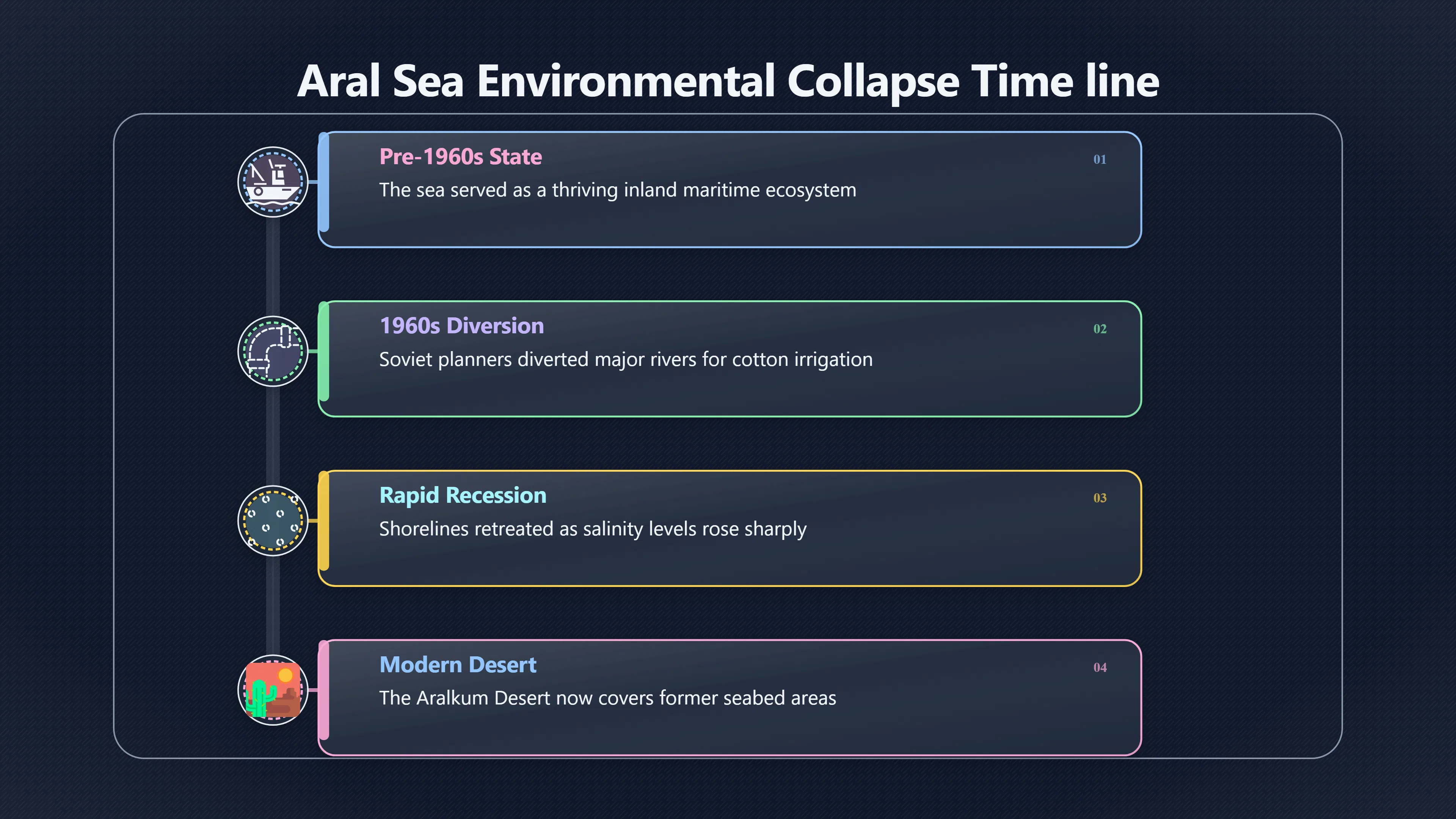
The Aral Sea once ranked among the largest lakes on Earth, shared today between Uzbekistan and Kazakhstan. During the 1960s, Soviet planners diverted the Amu Darya and Syr Darya rivers to irrigate vast cotton-growing projects across Central Asia. The irrigation schemes succeeded in expanding agriculture, but they also removed the overwhelming majority of the water flowing into the lake.
The result was astonishingly rapid. Year after year, the shoreline retreated, salinity increased and fish populations collapsed. By the early twenty-first century, the Aral had fragmented into isolated basins, while enormous stretches of former seabed had become the new Aralkum Desert. NASA estimates that the lake lost around 90 per cent of its volume over roughly half a century, transforming what had once been a thriving inland sea into one of the world’s clearest examples of environmental collapse.[NASA Science]science.nasa.govScience The Aral Sea, Before the Streams Ran DryNASA ScienceThe Aral Sea, Before the Streams Ran Dry - NASA ScienceFebruary 24, 2012…
This transformation altered far more than the scenery. The sea had moderated local temperatures, supported fishing communities and influenced regional weather. As it disappeared, summers became hotter, winters colder and dust storms increasingly common. What visitors now see as an eerie landscape of rusting vessels and empty horizons is the visible aftermath of decisions made decades earlier.[NASA Science]science.nasa.govScience The Aral Sea, Before the Streams Ran DryNASA ScienceThe Aral Sea, Before the Streams Ran Dry - NASA ScienceFebruary 24, 2012…
Ship graveyards, toxic dust and ruined fisheries
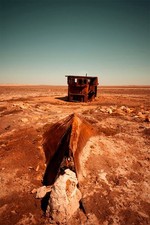
Perhaps the Aral Sea’s most iconic image is the fleet of abandoned fishing vessels lying on dry ground, sometimes many kilometres from the nearest water. Former ports such as Moynaq in western Uzbekistan became famous not for maritime trade but for ships stranded in the desert.
These wrecks are often presented as mysterious relics, yet their story is entirely understandable. Fishing once supported thousands of jobs around the Aral. As rising salinity killed commercial fish stocks, canneries closed, ports emptied and vessels were simply abandoned where the shoreline had once been.
The exposed lakebed created another, less visible danger. Wind now lifts vast quantities of salty dust mixed with residues from decades of agricultural chemicals, including pesticides and fertilisers that accumulated in the sediments. These dust storms can travel hundreds of kilometres, affecting agriculture and contributing to respiratory and other health problems. The haunting photographs of ships resting in sand therefore represent not merely an unusual tourist attraction but the physical remains of a wider ecological disaster.[NASA Science]science.nasa.govScience The Aral Sea, Before the Streams Ran DryNASA ScienceThe Aral Sea, Before the Streams Ran Dry - NASA ScienceFebruary 24, 2012…
Vozrozhdeniye Island and the Cold War’s hidden laboratory
If the abandoned ships provide the Aral Sea’s most famous image, Vozrozhdeniye Island supplies its darkest chapter.
During the Cold War, the Soviet Union selected the isolated island as the site of Aralsk-7, a highly secret biological weapons testing complex. Its location in the middle of the Aral Sea offered natural isolation from populated areas and made outside observation extremely difficult.
From the late 1940s onwards, scientists tested numerous dangerous pathogens there, including anthrax, plague, tularemia and smallpox. Much of the programme remained hidden until after the collapse of the Soviet Union, when defectors and newly available documents revealed the scale of the research.[Wikipedia]WikipediaVozrozhdeniya IslandVozrozhdeniya Island
The island supported a complete military settlement, including laboratories, housing, airfields and support facilities. When the Soviet programme ended, the personnel departed quickly, leaving behind abandoned buildings that have since become one of Central Asia’s most unsettling Cold War ghost towns.
Unlike many Fortean stories, the horror here requires no embellishment. The laboratories genuinely existed, dangerous pathogens were genuinely tested, and much of the infrastructure was genuinely abandoned.

The island that stopped being an island
The drying of the Aral Sea created an unexpected new problem.
As water levels continued to fall, Vozrozhdeniye gradually became connected to the mainland, first by a narrow land bridge and eventually as part of the surrounding desert. What had once required boats or aircraft could now be reached overland.
This raised obvious concerns about abandoned biological material and buried waste. In 2002, a joint United States-Uzbekistan operation decontaminated known anthrax burial sites on the former island after fears that remaining spores might present future risks. Although specialists consider those known burial grounds to have been treated, the secrecy surrounding the Soviet programme means not every historical detail is perfectly documented, and historians continue to reconstruct exactly what occurred there.[nasa.gov]science.nasa.govScience The Aral Sea, Before the Streams Ran DryNASA ScienceThe Aral Sea, Before the Streams Ran Dry - NASA ScienceFebruary 24, 2012…
The 1971 smallpox incident
One event associated with Vozrozhdeniye has attracted particular attention.
Evidence released after the Soviet period indicates that a 1971 outbreak of smallpox in the nearby city of Aralsk may have originated from testing conducted on the island after a research vessel passed unusually close to the facility. Ten people became infected and three died before an extensive vaccination campaign halted the outbreak.
Although historians continue to debate every detail of transmission, the incident illustrates why the island occupies such an important place in Cold War history. The concern was never paranormal contagion but the very real possibility that experimental pathogens escaped their intended containment.[Wikipedia]WikipediaVozrozhdeniya IslandVozrozhdeniya Island
Why the Aral Sea became part of Uzbekistan’s weird history
The Aral Sea occupies an unusual position within Fortean culture because it demonstrates how extraordinary reality can become.
Visitors encounter:
- Ships apparently sailing across a desert.
- A vanished coastline visible from space.
- Ghost towns abandoned almost overnight.
- A former island that physically merged with the mainland.
- Secret military laboratories hidden for decades.
Each element resembles the setting of speculative fiction, yet each is supported by historical documentation.
That combination has encouraged myths to flourish alongside established history. Online stories sometimes exaggerate the remaining biological danger or suggest hidden experiments continue beneath the sands. The available evidence does not support such claims. The documented story—a catastrophic environmental collapse exposing one of the Soviet Union’s most secret biological weapons facilities—is already remarkable enough without adding conspiracy theories.[nasa.gov]science.nasa.govScience The Aral Sea, Before the Streams Ran DryNASA ScienceThe Aral Sea, Before the Streams Ran Dry - NASA ScienceFebruary 24, 2012…
Why the story still fascinates
Many famous Fortean locations rely on uncertain witnesses or unexplained events. The Aral Sea is different. Its enduring fascination comes from the collision of verified history with landscapes that appear almost impossible.
The stranded ships are real. The shrinking sea is visible in decades of satellite imagery. The biological weapons programme has been confirmed through historical investigation, declassified material and post-Soviet disclosures. The abandoned settlement of Kantubek still stands as a monument to Cold War secrecy.[NASA Science]science.nasa.govScience The Aral Sea, Before the Streams Ran DryNASA ScienceThe Aral Sea, Before the Streams Ran Dry - NASA ScienceFebruary 24, 2012…
Within Uzbekistan’s broader catalogue of strange places—from legendary curses to sacred springs—the Aral Sea stands apart because its central mystery is not whether extraordinary things happened, but how human decisions transformed an entire inland sea into one of the world’s most haunting historical landscapes.
Amazon book picks
Further Reading
Books and field guides related to The Aral Sea Nightmare Was Real. Use these as the next step if you want deeper reading beyond the article.


Chernobyl History of a Tragedy By Serhii Plokhy & Midnight in...
First published 2020.
eBay marketplace picks
Marketplace Samples
Live-tested eBay searches with available results related to this page.
Endnotes
1.
Source: science.nasa.gov
Title: Science The Aral Sea, Before the Streams Ran Dry
Link:https://science.nasa.gov/earth/earth-observatory/the-aral-sea-before-the-streams-ran-dry-77193/
Source snippet
NASA ScienceThe Aral Sea, Before the Streams Ran Dry - NASA ScienceFebruary 24, 2012...
Published: February 24, 2012
2.
Source: Wikipedia
Title: Aral Sea
Link:https://en.wikipedia.org/wiki/Aral_Sea
3.
Source: Wikipedia
Title: Vozrozhdeniya Island
Link:https://en.wikipedia.org/wiki/Vozrozhdeniya_Island
4.
Source: science.nasa.gov
Title: dust storm over the aral sea 19747
Link:https://science.nasa.gov/earth/earth-observatory/dust-storm-over-the-aral-sea-19747/
Source snippet
Storm over the Aral Sea - NASA ScienceApril 2, 2008 — Earth Observatory 2 min read DUST STORM OVER THE ARAL SEA NASA Earth Observatory Ap...
Published: April 2, 2008
5.
Source: science.nasa.gov
Title: aral sea 3730
Link:https://science.nasa.gov/earth/earth-observatory/aral-sea-3730/
Source snippet
Sea - NASA ScienceAugust 25, 2003 — Earth Observatory 3 min read ARAL SEA Image of the Day for August 25, 2003 NASA Earth Observatory Aug...
Published: August 25, 2003
6.
Source: jpl.nasa.gov
Link:https://www.jpl.nasa.gov/images/pia04324-windswept-shores-of-the-aral-sea/
Source snippet
Shores of the Aral Sea | NASA Jet Propulsion Laboratory (JPL)March 26, 2003 — Image: JPL Logo Image WINDSWEPT SHORES OF THE ARAL SEA Marc...
Published: March 26, 2003
7.
Source: naturalhazards.nasa.gov
Title: the aral sea before the streams ran dry
Link:https://www.naturalhazards.nasa.gov/images/77193/the-aral-sea-before-the-streams-ran-dry
Source snippet
At the time of publication, it represented the best available science. August 22, 1964JP...
8.
Source: npifund.com
Title: Aral Sea
Link:https://npifund.com/article/aral-sea-new-world-encyclopedia
Source snippet
New World Encyclopedia (2026)Yesterday — BIOWEAPONS FACILITY ON VOZROZHDENYA ISLAND In 1948, a top-secret Soviet bioweapons laboratory wa...
9.
Source: military-history.fandom.com
Title: Vozrozhdeniya island
Link:https://military-history.fandom.com/wiki/Vozrozhdeniya_island
Source snippet
island | Military Wiki | FandomVOZROZHDENIYA ISLAND Sign In to Save Save Edit * History * Purge * Talk (0) iframe Vozrozhdeniya Native na...
10.
Source: newworldencyclopedia.org
Link:https://www.newworldencyclopedia.org/entry/Aral_Sea
Source snippet
Aral Sea - New World EncyclopediaECOLOGICAL PROBLEMS Aral Sea from space, August 1964 Aral Sea from space, August 1985 The ecological cat...
Published: August 1964
11.
Source: dlab.epfl.ch
Title: Aral Sea
Link:https://dlab.epfl.ch/wikispeedia/wpcd/wp/a/Aral_Sea.htm
Source snippet
SeaBIOWEAPONS FACILITY ON THE VOZROZHDENIYA ISLAND In 1948, a top-secret Soviet bioweapons laboratory was established on the island in th...
12.
Source: encyclopedia.com
Title: The island was used as
Link:https://www.encyclopedia.com/science/encyclopedias-almanacs-transcripts-and-maps/vozrozhdeniye-island
Source snippet
Vozrozhdeniye Island | Encyclopedia.comVOZROZHDENIYE ISLAND views 2,850,611 updated VOZROZHDENIYE ISLAND Vozrozhdeniye island is located...
Additional References
13.
Source: youtube.com
Title: Nurota Discover The Silk Road Oasis in the Uzbekistan Desert
Link:https://www.youtube.com/watch?v=LBB3VetSYns
Source snippet
The tranquility of a sleepy town | Nurata – a destination few tourists visit in Uzbekistan...
14.
Source: youtube.com
Title: The mystery of the sacred fishes of the Chashma complex in Nurata 4K
Link:https://www.youtube.com/watch?v=_kVLPyJsGmU
Source snippet
Nurota Discover The Silk Road Oasis in the Uzbekistan Desert...
15.
Source: eros.usgs.gov
Link:https://eros.usgs.gov/earthshots/islands
Source snippet
Earth Resources Observation and Science (EROS) Center Search Earthshots The name Aral means Island. The sea did once have many islands. H...
16.
Source: youtube.com
Link:https://www.youtube.com/watch?v=Z9UDbq_ThF4
Source snippet
Chashma Ayub, Bukhara...
17.
Source: youtube.com
Title: Chashma. Lost in Nurota
Link:https://www.youtube.com/watch?v=EVjGsN4u5jc
Source snippet
You stopped this response...
18.
Source: youtube.com
Title: Chashma Ayub, Bukhara
Link:https://www.youtube.com/watch?v=oh7103hMvds
Source snippet
Chashma. Lost in Nurota...
Topic Tree