Where Antigua's Weird Stories Stick to Places
Antigua and Barbuda does not have one neat “great mystery” that dominates its strange-history record.
Page outline Jump by section
Introduction
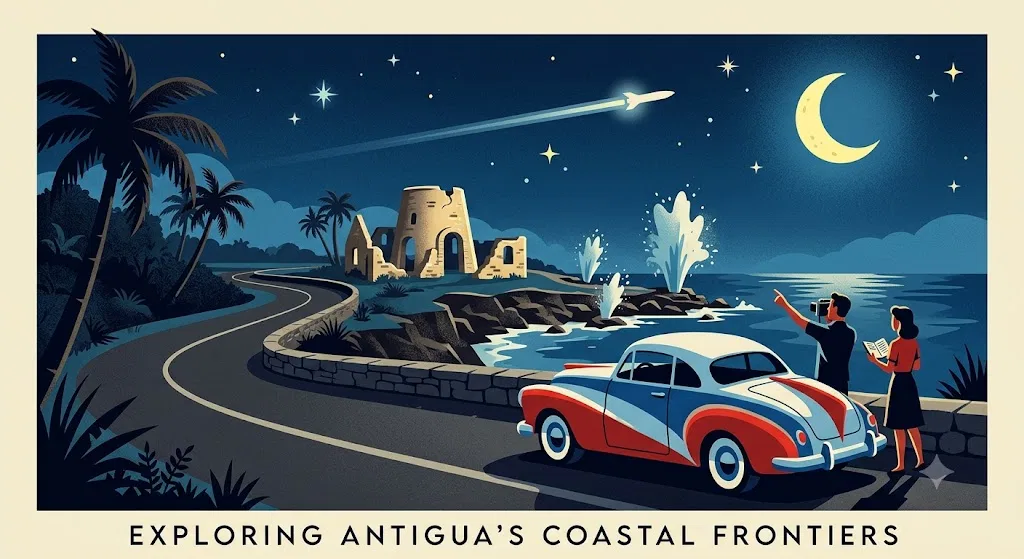
The best-known examples include the grim legend of Ding-a-Ding Nook, the haunted reputation of Duers Corner, the jumbie as a living figure in Antiguan folk memory, the “devil” stories attached to Devil’s Bridge, and a widely reported strange light over Antigua and other Caribbean islands in December 2019. Some accounts are rooted in named historical episodes; others survive as oral tradition, literary retelling, local humour or modern media. Read together, they show a country where the uncanny is rarely separate from history. It clings to roads, estates, mountains, trees, blowholes and the night sky.
The island where legends stick to places
Antiguan and Barbudan strange lore is unusually place-based. A beach, a bend in the road or a ruined estate can carry a story long after the original event has become hard to verify. That matters because the country’s uncanny material is not just a list of “ghosts”; it is a map of remembered danger.
A useful early source is the 1844 work Antigua and the Antiguans, published as a colonial history “interspersed with anecdotes and legends”. Its language and assumptions belong to its time, so it needs careful reading, but it preserves several traditions that later writers and local memory kept alive. One of its clearest examples is Ding-a-Ding Nook, a legend attached to a 1640 Kalinago attack in which the wife and children of Antigua’s governor were reportedly carried off. The text itself says that a tradition “still extant in Antigua” related to that catastrophe, before turning it into a dramatic midnight tale near Falmouth Bay.[Project Gutenberg]gutenberg.orgProject Gutenberg Antigua and the Antiguans, Volume 1Project Gutenberg Antigua and the Antiguans, Volume 1
The same book shows why Antiguan Forteana must be read with a double lens. On one level, these are eerie stories: night raids, ravines, omens, Obeah rites, abandoned places. On another, they are colonial texts shaped by fear of Indigenous resistance, enslaved African resistance and African-derived spirituality. In the chapter on the 1736 uprising associated with Klaas, the author explicitly introduces “A Legend of the Ravine”, blending documented political revolt with Gothic storytelling.[Project Gutenberg]gutenberg.orgProject Gutenberg Antigua and the Antiguans, Volume 1Project Gutenberg Antigua and the Antiguans, Volume 1
That blend is the key. Antigua’s weird history is often not about inexplicable monsters or spectacular apparitions. It is about places where historical violence was converted into stories that could be repeated, feared, moralised, joked about or used as warnings.
Ding-a-Ding Nook: massacre story, ghost village, or colonial legend?
Ding-a-Ding Nook is one of Antigua’s most striking examples of a legend becoming geography. The story is usually linked to the early English settlement period, when Kalinago raids threatened the small colony. In Antigua and the Antiguans, the relevant historical frame is a 1640 attack in which settlers were killed and the governor’s wife and children were taken; the author says local tradition connected the catastrophe with the place later known through the legend.[Project Gutenberg]gutenberg.orgProject Gutenberg Antigua and the Antiguans, Volume 1Project Gutenberg Antigua and the Antiguans, Volume 1
Later summaries describe Ding-a-Dong Nook, also rendered Ding-a-Ding Nook, as a former village near Rendezvous Bay in the south of Antigua. The associated legend says that after the raid, one kidnapped child would not stop crying and was killed against a rock; the nearby rock was reportedly pointed out to visitors. The settlement itself was small: one account notes a population of 18 in the 1856 census.[Wikipedia]WikipediaOpen source on wikipedia.org.
For a Fortean reader, the important question is not “did every detail happen exactly as told?” The stronger question is why the story endured. Ding-a-Ding Nook works like a ghost story even when no ghost appears. It takes a violent, poorly documented frontier event and gives it a scene, a sound, a rock, a family tragedy and a name. The result is a memory-site: part history, part colonial melodrama, part local landmark.
A sceptical reading would separate three layers. First, there was real conflict between European settlers and Kalinago people during Antigua’s early colonisation. Second, later colonial writers narrated that conflict through their own fears and prejudices. Third, the named place gathered folklore around itself, so that the landscape became easier to remember through the story than through archival uncertainty. That is classic country-level Forteana: not a proven apparition, but a legend that fixes trauma to a particular patch of ground.
Jumbies, trees and the Antiguan afterlife of folklore
The jumbie is central to the wider English-speaking Caribbean supernatural imagination, and Antigua and Barbuda belongs firmly within that tradition. A jumbie is usually understood as a spirit or ghostly being, often troublesome or dangerous, though the meaning varies across islands and families. Modern summaries of Caribbean folklore note that jumbie belief is found across former British Caribbean societies, including Antigua and Barbuda.[Wikipedia]WikipediaOpen source on wikipedia.org.
Local material confirms that jumbies are not just imported “Caribbean folklore” pasted onto Antigua. The Antigua Stories folklore section describes itself as a place for stories handed down about “jumbies, ghosts, and other pieces of folklore”, which is exactly the register in which these accounts often survive: family stories, village memories, warnings, jokes and claims that someone once saw or heard something.[Antigua Stories]antiguastories.wordpress.comAntigua Stories Folklore | Antigua StoriesAntigua Stories Folklore | Antigua Stories
One reason jumbies matter in Antigua and Barbuda is that they keep moving between folklore and art. Mali A. Olatunji’s essay “African Aesthetics in Motion: The Probability of a Third Jumbie Aesthetic in Antigua and Barbuda” treats the jumbie not merely as a frightening spirit but as part of a way of seeing. Searchable summaries of the essay connect the idea to Antiguan visual culture and to “jumbie vision”, while later reviews describe a woodist or jumbie aesthetic in which trees become spiritually and artistically charged.[JSTOR]jstor.orgOpen source on jstor.org.
That is a useful correction to the tourist version of ghost lore. In Antiguan contexts, the jumbie is not only a scare for children or a Halloween figure. It can be a language for memory, ancestry, hidden presence and the feeling that the landscape is inhabited by more than the living. Believers may treat such stories as spiritual reality; sceptics may read them as folklore and cultural psychology. Either way, the jumbie remains one of the country’s most important uncanny figures.
Duers Corner and the ghost that explains accidents
One of the most vivid modern local ghost traditions concerns Duers Corner and the alleged spirit of Overseer Brown. The story is preserved by Antiguan writer and cultural chronicler Joy Lawrence on Antigua Stories. Lawrence links the tale back to Mrs Lanaghan’s nineteenth-century Antigua and the Antiguans, then adds later community memory about accidents, ghosts and frightening incidents near Bethesda, Christian Hill, Newfield, St Philip and Freetown.[Antigua Stories]antiguastories.wordpress.comAntigua Stories Joy Lawrence | Antigua StoriesAntigua Stories Joy Lawrence | Antigua Stories
The account has all the ingredients of a durable road ghost: a named dead man, a dangerous bend or area, repeated accidents, and witnesses who insist coincidence is not enough. In Lawrence’s telling, a ghost at Yeamans Estate throws stones on roofs, burns clothes and makes enough mischief that one manager asks for a transfer. Later, bus and truck accidents around Duers Corner are folded into the same pattern of explanation.[Antigua Stories]antiguastories.wordpress.comAntigua Stories Joy Lawrence | Antigua StoriesAntigua Stories Joy Lawrence | Antigua Stories
As evidence for a literal haunting, the story is thin: it is anecdotal, retrospective and shaped by local storytelling. As evidence for how Antiguan ghost traditions work, it is rich. A cluster of real accidents becomes a moral and supernatural landscape. The ghost provides a narrative link between otherwise separate events. It also turns a road into a place where people remember to be cautious.
This is where Forteana becomes socially useful. A sceptic can say: dangerous roads, bad vehicles, darkness, speed and chance explain accidents better than an overseer’s spirit. A believer can reply: the pattern itself is the sign. The story survives because both readings do something. One explains the mechanics; the other explains the dread.
Obeah: feared power, colonial law and misunderstood practice
No account of Antigua and Barbuda’s strange-history record can ignore Obeah, though it must be handled carefully. Obeah is not a parlour trick or a simple “witchcraft” label. It is a broad term for African diasporic spiritual, healing, protective and harmful practices, especially in former British Caribbean societies. Scholars and cultural historians often stress that colonial sources used the word in hostile and racialised ways, grouping many practices under a single threatening category.[Wikipedia]WikipediaOpen source on wikipedia.org.
In Antigua’s archival record, Obeah appears most sharply where colonial authorities feared rebellion, poisoning and invisible power. Antigua and the Antiguans describes an “old Obeah woman” named Morah in the legend of Klaas’s planned 1736 uprising, giving her a Gothic role in rites involving buried materials, signs, a night bird and a snake. The same source later says that in 1809 Antigua legislated harshly against those said to communicate with evil spirits or prepare harmful mixtures.[Project Gutenberg]gutenberg.orgProject Gutenberg Antigua and the Antiguans, Volume 1Project Gutenberg Antigua and the Antiguans, Volume 1
That passage is valuable, but also revealingly biased. It tells us as much about planter fear as about African-derived belief. Modern scholarship on Caribbean Obeah laws argues that colonial anti-Obeah legislation frequently treated Obeah as a racialised crime and a threat to plantation authority. Diana Paton’s work, for example, connects anti-Obeah lawmaking across the British Caribbean to anxieties after slave uprisings and to changing colonial definitions of spiritual practice, fraud and danger.[Edinburgh Research]research.ed.ac.ukwitchcraft poison law and atlantic slaverywitchcraft poison law and atlantic slavery
For a Fortean page, Obeah sits at the uneasy border between “the occult” and political history. Believers may describe real spiritual force, healing or harm. Sceptics may see social fear, herbal knowledge, fraud, poisoning accusations and colonial panic. The honest answer is that Obeah in Antigua’s record is not one thing. It is a living cultural category, a colonial legal target, a spiritual practice, a feared rumour-system and a way enslaved and marginalised people were accused of possessing power outside official control.
Devil’s Bridge: natural wonder, death legend and the power of a name
Devil’s Bridge, on Antigua’s Atlantic coast near Indian Town Point, is one of the country’s most visually dramatic uncanny sites. Geologically, it is a natural limestone arch cut by Atlantic waves, with blowholes that throw up spray when the sea is rough. Modern visitor accounts and park descriptions consistently stress the same physical facts: jagged limestone, wave erosion, violent surf and a setting that feels dangerous even before any legend is added.[Wikipedia]WikipediaDevil's Bridge (Antigua and BarbudaDevil's Bridge (Antigua and Barbuda
The legend attached to it is darker. Many modern accounts say the name comes from stories that enslaved Africans went there to die, either to escape bondage or in despair. The Times, in a travel feature, summarised two common explanations: that the devil lives beneath the bridge, or that enslaved Africans threw themselves into the water there.[The Times]thetimes.co.ukThe Times23 of the best things to do in AntiguaThe Times23 of the best things to do in Antigua
This is a case where careful wording matters. The site is real; the Atlantic danger is real; Antigua’s history of slavery is real. But the specific suicide tradition is most often reported as local legend rather than as a well-documented series of named historical cases. It should not be dismissed, because legends can preserve emotional truths about places of suffering. It should also not be inflated into a proven statistic without evidence.
The “devil” in Devil’s Bridge works on several levels. It names a place where the sea behaves violently. It translates the terror of slavery into landscape. It gives visitors a story they can feel in their bodies when the blowholes roar. In Fortean terms, it is not a monster story but a charged place: geology, grief and folklore meeting at the edge of the island.
Boggy Peak and the monster used to police movement
Boggy Peak, Antigua’s highest point in the Shekerley Mountains, has its own uncanny footnote. Modern summaries of the mountain’s history connect the name “Boggy” or “bogey” with stories told by slaveholders about a frightening being in the mountains, used to discourage enslaved people from escaping into the uplands.[Wikipedia]WikipediaBoggy PeakBoggy Peak
This is one of the clearest examples of folklore as social control. The bogeyman is not merely a campfire creature. In this reading, the monster protects property and plantation discipline by making the hills feel supernaturally dangerous. The story also complicates any simple distinction between “folk belief” and “elite manipulation”. A warning invented or amplified by those in power can still enter local imagination and place memory.
Sceptically, the Boggy Peak tradition can be read as a practical deterrent dressed in supernatural clothing. The mountains were physically difficult, sparsely populated and potentially risky for fugitives; adding a monster made them more frightening. Believers or tradition-bearers might not separate the practical from the supernatural so neatly. In many folk systems, danger has a face.
The later renaming of Boggy Peak as Mount Obama in 2009, and the restoration of the older name in 2016, shows how place-names remain politically alive.[Wikipedia]WikipediaBoggy PeakBoggy Peak Even when the monster is no longer the main point, the name still carries a layered history of fear, memory and identity.
Strange lights over Antigua: the 2019 sky report
Antigua and Barbuda’s most modern Fortean-style case is the strange light reported in the sky on 17–18 December 2019. Antigua News Room reported that people across Antigua and Barbuda saw and recorded a lighted object, with one sighting near Heritage Quay and other reports from residents who saw it in the early hours. The same article noted similar sightings from Guyana, Suriname and St Martin.[Antigua News Room]antiguanewsroom.comAntigua News Room Residents Concerned Over Strange Lighted Object In SkyAntigua News Room Residents Concerned Over Strange Lighted Object In Sky
The report is valuable because it captures the social life of a sky anomaly in real time. Witnesses described a moving light, changing brightness and a beam-like appearance. Some commenters interpreted it spiritually or conspiratorially; others argued for a rocket explanation. The article itself mentioned that pilots believed it might be the contrail of a rocket connected with a pre-dawn launch from French Guiana.[Antigua News Room]antiguanewsroom.comAntigua News Room Residents Concerned Over Strange Lighted Object In SkyAntigua News Room Residents Concerned Over Strange Lighted Object In Sky
The rocket explanation is strong. The European Space Agency confirms that CHEOPS launched as a secondary passenger on a Soyuz-Fregat rocket from Europe’s Spaceport in Kourou, French Guiana, on 18 December 2019. Spaceflight Now’s live coverage and other spaceflight records also identify a Soyuz launch from French Guiana carrying CHEOPS, COSMO-SkyMed and other satellites at that time.[European Space Agency]esa.intEuropean Space Agency ESAEuropean Space Agency ESA
That does not make the Antiguan report uninteresting. Quite the opposite. It is a textbook example of how a genuinely unusual sight can be widely witnessed, sincerely described and temporarily framed as mysterious before a prosaic explanation becomes more convincing. Rocket exhaust and high-altitude contrails can look astonishing, especially around dawn or dusk when sunlight catches material high above a darker ground-level sky. The Fortean value lies in the reporting chain: awe first, explanation second, debate immediately after.
The article also refers to an earlier, less well-documented memory from 1999 or 2000, when “strange objects” described as UFOs were reportedly seen by many people in Antigua and Barbuda and neighbouring islands, including a claim of three lights hovering near Government House.[Antigua News Room]antiguanewsroom.comAntigua News Room Residents Concerned Over Strange Lighted Object In SkyAntigua News Room Residents Concerned Over Strange Lighted Object In Sky That older case remains harder to assess because the accessible report is retrospective and does not provide the original evidence. It belongs in the record as a remembered UFO flap, not as a solved or proven event.
Why Antigua and Barbuda’s weird record is sparse but strong
Compared with larger countries, Antigua and Barbuda has a relatively thin public archive of Fortean cases. There are fewer digitised newspapers, fewer specialist investigations and fewer widely cited “classic” paranormal files. That thinness should not be mistaken for an absence of strange material. It means the material often survives in different containers: folklore pages, local books, family memory, place-names, tourist retellings, old colonial histories and occasional news reports.
The country’s strongest Fortean themes are therefore not random oddities but recurring patterns:
Places remember violence. Ding-a-Ding Nook, Devil’s Bridge, Duers Corner and Boggy Peak all attach fear to location. The story is not floating free; it belongs to a beach, road, ravine, estate, mountain or arch.
The supernatural often explains danger. Ghosts explain accidents; devils explain lethal surf; bogeymen explain feared mountains; Obeah explains hidden harm or hidden power.
Colonial sources need caution. Early written accounts preserve important legends, but they often frame Indigenous people, enslaved Africans and African-derived practices through hostile European assumptions.[Project Gutenberg]gutenberg.orgProject Gutenberg Antigua and the Antiguans, Volume 1Project Gutenberg Antigua and the Antiguans, Volume 1
Modern mysteries can be real sightings without being paranormal. The 2019 sky light was not “nothing”; it was a real observed phenomenon. The best explanation, however, points to a rocket launch rather than alien craft.[Antigua News Room]antiguanewsroom.comAntigua News Room Residents Concerned Over Strange Lighted Object In SkyAntigua News Room Residents Concerned Over Strange Lighted Object In Sky
This is what makes Antigua and Barbuda rewarding for strange-history readers. The country does not need inflated monster claims or imported paranormal filler. Its own material is already distinctive: small-island geography, plantation history, African-Caribbean spirituality, oral storytelling and sudden sky wonders all packed into a compact landscape.
What remains genuinely unresolved?
The most honest answer is that Antigua and Barbuda’s Forteana is less about unsolved scientific anomalies than unresolved interpretation. Ding-a-Ding Nook is not fully recoverable as a clean historical event; it is a colonial legend wrapped around a violent early-settlement episode. Duers Corner is not documented as a haunting in any rigorous sense; it is a powerful local ghost tradition used to make sense of accidents. Devil’s Bridge is geologically clear but emotionally ambiguous, because its death legend speaks to real slavery-era suffering even where specific evidence is difficult to pin down. Obeah is not “debunked” by calling it superstition, because the category includes religion, healing, fear, accusation, fraud, resistance and colonial criminalisation all at once.
The 2019 light is the closest thing to a modern test case. There, the evidence favours a rocket-related explanation, supported by the timing of the Soyuz launch from French Guiana. Yet the public reaction still belongs in Antigua and Barbuda’s weird-history record because it shows how quickly the sky can become a screen for wonder, prophecy, scepticism, humour and suspicion.[antiguanewsroom.com]antiguanewsroom.comAntigua News Room Residents Concerned Over Strange Lighted Object In SkyAntigua News Room Residents Concerned Over Strange Lighted Object In Sky
In the end, the country’s strange archive is not a cabinet of proven supernatural facts. It is a set of stories that show how people live with uncertainty, danger and memory. Antigua and Barbuda’s Forteana is strongest when treated neither as gullible ghost-hunting nor as material to be laughed away, but as a record of how the uncanny helps a place remember what ordinary history often fails to hold.
Amazon book picks
Further Reading
Books and field guides related to Where Antigua's Weird Stories Stick to Places. Use these as the next step if you want deeper reading beyond the article.

Wide Sargasso Sea
First published 1966. Subjects: stream of consciousness, Creoles, postcolonial literature, race, colonialism.

The Golden Bough
First published 1890. Subjects: Mythology, Magic, Superstition, Religion, Primitive Religion.
eBay marketplace picks
Marketplace Samples
Live-tested eBay searches with available results related to this page.


Endnotes
1.
Source: gutenberg.org
Title: Project Gutenberg Antigua and the Antiguans, Volume 1
Link:https://www.gutenberg.org/files/38788/38788-h/38788-h.htm
2.
Source: Wikipedia
Link:https://en.wikipedia.org/wiki/Ding-a-Dong-Nook
3.
Source: Wikipedia
Link:https://en.wikipedia.org/wiki/Jumbee
4.
Source: antiguastories.wordpress.com
Title: Antigua Stories Folklore | Antigua Stories
Link:https://antiguastories.wordpress.com/folklore/
5.
Source: jstor.org
Link:https://www.jstor.org/stable/26758902
6.
Source: Wikipedia
Link:https://en.wikipedia.org/wiki/Obeah
7.
Source: Wikipedia
Title: Devil’s Bridge (Antigua and Barbuda)
Link:https://en.wikipedia.org/wiki/Devil%27s_Bridge_%28Antigua_and_Barbuda%29
8.
Source: Wikipedia
Title: Boggy Peak
Link:https://en.wikipedia.org/wiki/Boggy_Peak
9.
Source: Wikipedia
Title: Shekerley Mountains
Link:https://en.wikipedia.org/wiki/Shekerley_Mountains
10.
Source: Wikipedia
Title: Folklore of Antigua and Barbuda
Link:https://en.wikipedia.org/wiki/Folklore_of_Antigua_and_Barbuda
11.
Source: Wikipedia
Title: Sea monster
Link:https://en.wikipedia.org/wiki/Sea_monster
12.
Source: Wikipedia
Title: La Llorona
Link:https://en.wikipedia.org/wiki/La_Llorona
13.
Source: Wikipedia
Title: Mythology of Antigua and Barbuda
Link:https://en.wikipedia.org/wiki/Mythology_of_Antigua_and_Barbuda
14.
Source: Wikipedia
Title: Devil’s Bridge
Link:https://en.wikipedia.org/wiki/Devil%27s_Bridge
15.
Source: Wikipedia
Title: Betty’s Hope
Link:https://en.wikipedia.org/wiki/Betty%27s_Hope
16.
Source: Wikipedia
Title: Nelson’s Dockyard
Link:https://en.wikipedia.org/wiki/Nelson%27s_Dockyard
17.
Source: Wikipedia
Title: Soyuz at the Guiana Space Centre
Link:https://en.wikipedia.org/wiki/Soyuz_at_the_Guiana_Space_Centre
18.
Source: jstor.org
Link:https://www.jstor.org/stable/26758900
19.
Source: jstor.org
Link:https://www.jstor.org/stable/j.ctvwvr3cf
20.
Source: jstor.org
Title: Vol. 34, No. 131, Jan
Link:https://www.jstor.org/stable/i223469
21.
Source: jstor.org
Link:https://www.jstor.org/stable/26855622
22.
Source: jstor.org
Link:https://www.jstor.org/stable/pdf/534907.pdf
23.
Source: space.com
Title: europe launches cheops alien planet satellite
Link:https://www.space.com/europe-launches-cheops-alien-planet-satellite.html
24.
Source: wadadlipen.wordpress.com
Title: antiguan and barbudan non fiction writers
Link:https://wadadlipen.wordpress.com/2014/06/17/antiguan-and-barbudan-non-fiction-writers/
25.
Source: antiguastories.wordpress.com
Title: Antigua Stories Joy Lawrence | Antigua Stories
Link:https://antiguastories.wordpress.com/village-life/joy-lawrence/
26.
Source: research.ed.ac.uk
Title: witchcraft poison law and atlantic slavery
Link:https://www.research.ed.ac.uk/en/publications/witchcraft-poison-law-and-atlantic-slavery/
27.
Source: thetimes.co.uk
Title: The Times23 of the best things to do in Antigua
Link:https://www.thetimes.co.uk/article/best-things-to-do-on-antigua-ppxj0tls0
28.
Source: antiguanewsroom.com
Title: Antigua News Room Residents Concerned Over Strange Lighted Object In Sky
Link:https://antiguanewsroom.com/residents-concerned-over-strange-lighted-object-in-sky/
29.
Source: esa.int
Title: European Space Agency ESA
Link:https://www.esa.int/Science_Exploration/Space_Science/Cheops/Launch_and_orbit
30.
Source: spaceflightnow.com
Title: soyuz vs 23 mission status center
Link:https://spaceflightnow.com/2019/12/17/soyuz-vs-23-mission-status-center/
31.
Source: whc.unesco.org
Link:https://whc.unesco.org/en/list/1499/
32.
Source: spaceflightnow.com
Title: soyuz launch from french guiana delayed to friday
Link:https://spaceflightnow.com/2018/03/05/soyuz-launch-from-french-guiana-delayed-to-friday/
33.
Source: esa.int
Link:https://www.esa.int/ESA_Multimedia/Videos/2019/12/Europe_s_Spaceport_in_French_Guiana
34.
Source: esa.int
Title: ES A Television
Link:https://www.esa.int/esatv/Videos/2019/12/Launch_highlights_Cheops_and_OPS-SAT
35.
Source: esa.int
Link:https://www.esa.int/About_Us/50_years_of_ESA/Ten_years_of_Soyuz_at_Europe_s_Spaceport
36.
Source: sugarmills.blogs.bucknell.edu
Link:https://sugarmills.blogs.bucknell.edu/culture/
37.
Source: caribbeanauthors.wordpress.com
Title: a little about caribbean folklore
Link:https://caribbeanauthors.wordpress.com/2021/10/01/a-little-about-caribbean-folklore/
38.
Source: thenyceffect.wordpress.com
Title: a compilation of scary folklore from the caribbean
Link:https://thenyceffect.wordpress.com/2017/08/22/a-compilation-of-scary-folklore-from-the-caribbean/
39.
Source: wadadlipen.wordpress.com
Link:https://wadadlipen.wordpress.com/2014/07/30/antiguanandbarbudanwriting/
40.
Source: caribbeanauthors.wordpress.com
Title: anansi and jumbie
Link:https://caribbeanauthors.wordpress.com/2022/10/24/anansi-and-jumbie/
41.
Source: wadadlipen.wordpress.com
Title: blogger on books
Link:https://wadadlipen.wordpress.com/2012/11/01/blogger-on-books/
42.
Source: wadadlipen.wordpress.com
Title: comreviews | Wadadli Pen | Page 2
Link:https://wadadlipen.wordpress.com/tag/reviews/page/2/
43.
Source: jeromehandler.com
Link:https://jeromehandler.com/wp-content/uploads/Obeah_healing_Bilby-04.pdf
44.
Source: lure.asklioness.com
Title: the jumbie
Link:https://lure.asklioness.com/2020/12/13/the-jumbie/
45.
Source: genies.fandom.com
Link:https://genies.fandom.com/wiki/Jumbee
46.
Source: ch.pinterest.com
Link:https://ch.pinterest.com/pin/602075043908054239/
Additional References
47.
Source: youtube.com
Title: History of Antigua and Barbuda: The Islands Britain Feared Would Rise
Link:https://www.youtube.com/watch?v=cWRXd8zOEOI
Source snippet
Devil's Bridge, Antigua: A Wild and Breathtaking Coastal Wonder...
48.
Source: youtube.com
Title: Devil’s Bridge, Antigua: A Wild and Breathtaking Coastal Wonder
Link:https://www.youtube.com/watch?v=zXoF0BSCgvQ
Source snippet
Taking risks at the Devil's Bridge. super Dangerous Crossing...
49.
Source: academia.edu
Link:https://www.academia.edu/12016368/ANTIGUA_AND_BARBUDA_A_critical_bibliography
50.
Source: instagram.com
Link:https://www.instagram.com/p/DV1GRZHlKdC/
51.
Source: funag.gov.br
Link:https://funag.gov.br/loja/download/800-Heranca_Africana_no_Brasil_e_no_Caribe_A.pdf
52.
Source: facebook.com
Link:https://www.facebook.com/ExpressNewspapers/posts/an-east-coast-mysteryyou-can-read-all-about-it-here/599551655536376/
53.
Source: immaterieelerfgoed.nl
Link:https://www.immaterieelerfgoed.nl/en/anansiverteltraditie
54.
Source: oas.org
Link:https://www.oas.org/en/sedi/DSD/Biodiversity/Sustainable_Cities/Sustainable_Communities/Events/SC%20Course%20Antigua%20and%20Barbuda%202016/Module%20VI/Presentations/Murphy%20Heritage%20of%20Antigua%20and%20Barbuda.pdf
55.
Source: facebook.com
Link:https://www.facebook.com/groups/269202760462518/posts/1313952365987547/
56.
Source: facebook.com
Link:https://www.facebook.com/BeautifulBarbados/posts/anyone-saw-this-unidentified-object-in-our-skies-earlier%EF%B8%8F-bajannews_updates246/1302147152068298/
Topic Tree
Follow this branch
Related pages 192
- Afghan Forteana
- Bosnian Mysteries
- Botswana Weird
- Brazil Strange
- Cameroon Mysteries
- +187 more in sidebar