What Makes Syria's Weird History So Layered?
Syria’s strange-history record is not dominated by one famous monster or one tidy “haunting”.
Page outline Jump by section
The sacred fish of Hierapolis
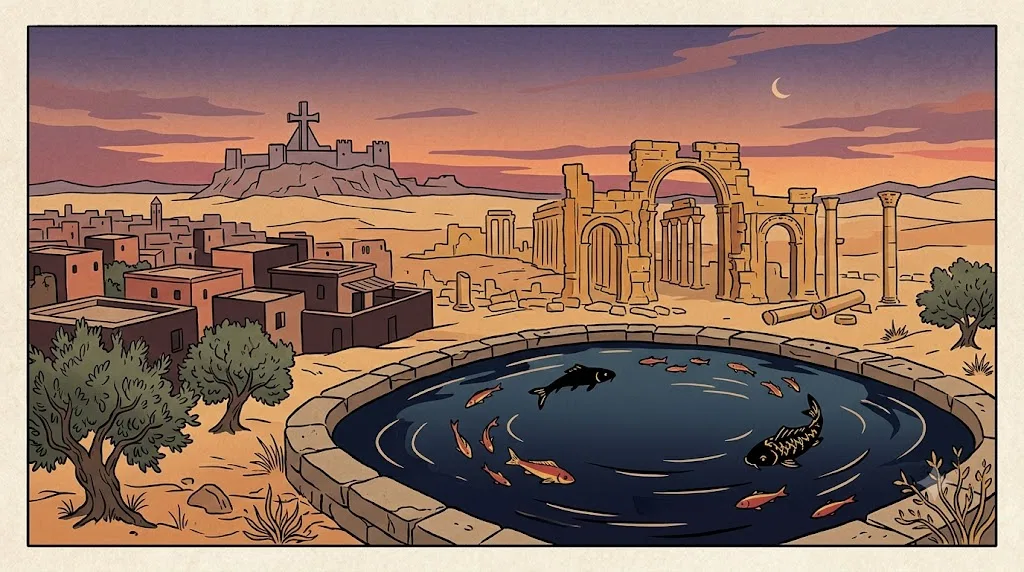
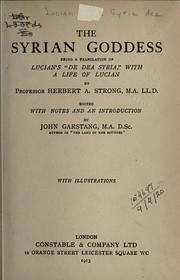
One of the strongest Syrian Fortean anchors is not a modern ghost story but a second-century description of Hierapolis, the ancient sacred city usually identified with modern Manbij, north-east of Aleppo. Lucian of Samosata’s account of the Syrian Goddess describes a temple complex associated with Atargatis, a northern Syrian goddess whom Greek writers linked with Hera, Derceto and other divine figures. The source is valuable because Lucian presents himself not as a distant rumour-collector but as someone familiar with Syrian religious life, even while he retells traditions that are clearly layered, competing and sometimes sceptically handled.[Philip Harland]philipharland.comOpen source on philipharland.com.
The most memorable material is aquatic. Lucian reports that the temple had a lake containing sacred fish, some of them large enough to be individually named and called. He says he saw one fish marked with gold, and describes a stone altar in the middle of the lake that appeared to float or move on the water. He then immediately gives a more practical explanation: it probably rested on a column rising from the lake-bed. That is exactly the kind of passage that makes ancient Syrian weirdness interesting. The marvel is allowed to appear, but the narrator also tests it against ordinary mechanics.[Philip Harland]philipharland.comOpen source on philipharland.com.
The fish stories connect with a wider mythic pattern around Atargatis. Lucian says some people linked the shrine to Derceto, a figure represented elsewhere as part woman and part fish, and explains that fish and pigeons were treated as holy in this religious setting. Later readers have often treated Atargatis as a “mermaid goddess”, which is catchy but too simple. The primary sources suggest something richer: a Syrian cult in which water, fertility, taboo, divine presence and animal sanctity overlapped.[Philip Harland]philipharland.comOpen source on philipharland.com.
For a modern Fortean reader, the Hierapolis material is useful because it is not just “ancient people believed odd things”. It is a case study in how marvels were staged, witnessed, interpreted and doubted within the same text. The sacred fish may not be cryptids, but they do belong to the same imaginative territory as lake monsters and holy animals: creatures made uncanny because a community agrees that they are not merely animals.
Saydnaya and the miracle that became a geography
If Hierapolis gives Syria an ancient sacred-fish tradition, Saydnaya gives it a Christian miracle tradition with unusually strong historical roots. The Greek Orthodox Patriarchate of Antioch describes the Monastery of Our Lady of Saydnaya, north of Damascus, as a major Marian shrine centred on a revered icon of the Virgin. Its official account notes that the convent was rebuilt in 1762 after a major earthquake damaged many churches and mosques in Damascus, and that one altar was reserved for Syriac Orthodox pilgrims who came to venerate the miraculous icon.[Antioch Patriarchate]antiochpatriarchate.orgAntioch Patriarchate Our Lady of Saydnaya Patriarchal MonasteryAntioch Patriarchate Our Lady of Saydnaya Patriarchal Monastery
The icon’s Fortean pull lies in the stories of physical miracle. A scholarly study of the shrine describes medieval and later accounts in which the icon was hidden behind veils and an iron grille, while miraculous oil was said to flow from the Virgin’s surface into a marble basin. Pilgrims were anointed with this oil, making the marvel tactile rather than merely visual. Some traditions went further, claiming that the image had become flesh-like, with the shrine space arranged almost as if the icon were a living sacred body.[Sonar]sonar.chA Sacred Space for a Holy Icon: The Shrine of Our Lady of SaydnayaA Sacred Space for a Holy Icon: The Shrine of Our Lady of Saydnaya
This is not evidence that an object literally became flesh or produced supernatural oil. It is evidence that Saydnaya functioned for centuries as a miracle-centred pilgrimage site where matter, devotion and story reinforced each other. The detail that matters for Syrian Forteana is the bodily quality of the claim. Many miracle legends are vague: someone prayed, something improved. Saydnaya’s stories are more concrete: veils, grilles, oil, a basin, pilgrims’ foreheads, gifts hung before the niche.
There is also a cross-cultural element. Saydnaya’s reputation spread through Eastern and Western Christian pilgrimage networks, and the scholarly account notes that reliquaries of the miraculous oil circulated in Europe in the thirteenth and fourteenth centuries. That turns a local Syrian shrine into an international weird-history node: a place where a mountain monastery near Damascus became part of a much wider map of holy matter and miraculous images.[Sonar]sonar.chA Sacred Space for a Holy Icon: The Shrine of Our Lady of SaydnayaA Sacred Space for a Holy Icon: The Shrine of Our Lady of Saydnaya
Jinn, haunted houses and the Syrian city
Modern Syrian ghost material is harder to source cleanly than ancient temple descriptions or monastery histories. Much of it lives in oral storytelling, family memory, fiction and informal online testimony. That does not make it worthless, but it does change how it should be read. A claim about a haunted house in Aleppo is not the same kind of evidence as an excavation report. It tells us less about a proven apparition and more about how fear, architecture, family history and religious language become a haunting.
One recurring motif is the old urban house: courtyards, cellars, high rooms, locked spaces and inherited family names for chambers. A published personal account from Aleppo, for example, describes a child seeing an elderly man in white praying at night in an old family house, after which relatives calmly identify the figure as a holy presence attached to a particular room. The story is unverifiable as an event, but culturally revealing as a haunting in which the apparition is not a horror-film invader. It is folded into household memory and treated as part of the moral atmosphere of the building.[ما وراء الطبيعة - PARANORMAL ARABIA]paranormalarabia.comما وراء الطبيعةما وراء الطبيعة
A more sociological source, writing about Syrian jinn beliefs, links tales of jinn habitation to old quarters in Damascus and Aleppo, especially abandoned buildings whose noises and atmospheres are interpreted through collective suggestion. It also notes that such beliefs can become harmful when exploited by charlatans or politicised during crisis. The source itself should be read cautiously, especially where it gives survey-like figures without broad independent confirmation, but its central point is sound: jinn beliefs in Syria sit at the junction of folklore, mental health, religion, poverty, family pressure and social stress.[تيار المستقبل السوري]sfuturem.orgOpen source on sfuturem.org.
This is where sceptical and believer readings sharply diverge. A believer may see a jinn-haunted house as a real place of unseen presence. A sceptic may point to sleep paralysis, grief, pareidolia, suggestibility, creaking buildings, carbon monoxide, family storytelling and the power of expectation. A humane reading keeps both the cultural meaning and the risks in view. The stories matter because people act on them: avoiding rooms, moving house, seeking religious help, consulting healers, or retelling the event as proof that the old city is not spiritually empty.
Palmyra, Solomon and the desert imagination
Palmyra is not usually marketed as a ghost site, yet it has exactly the landscape that attracts Fortean interpretation: a monumental ruin rising from the Syrian desert, tied to ancient trade, imperial ambition and later legends. UNESCO describes Palmyra as an oasis north-east of Damascus and one of the ancient world’s major cultural centres, especially in the first and second centuries CE, where Graeco-Roman, local and Persian influences met.[UNESCO World Heritage Centre]whc.unesco.orgWorld Heritage Centre Site of PalmyraWorld Heritage Centre Site of Palmyra
The “strange” layer comes from later storytelling. Traditions outside strict archaeology have associated Palmyra, or Tadmor, with Solomon, and some later Arabic traditions credit jinn with helping to build great ancient works. Such tales are not reliable construction history, but they are meaningful folklore. Ruins that seem too grand, too remote or too technically impressive often attract supernatural builders. In Britain it might be giants or the Devil; in parts of the Middle East it may be Solomon’s commanded spirits.
The sceptical interpretation is straightforward: Palmyra was a wealthy caravan city whose position between empires funded large-scale architecture and funerary monuments. The legendary interpretation answers a different emotional question: how can a place so silent, vast and improbable have been made by ordinary people? In that sense, the Solomonic-jinn motif is not just fantasy. It is a way of expressing awe before human engineering once the original political and economic context has faded.
Desert kites: the aerial mystery that became archaeology
Some of Syria’s most dramatic “mystery” material is now largely archaeological rather than paranormal. Desert kites are vast stone structures made of low walls, often with long guiding lines leading towards an enclosure. They were named by early aircraft pilots because their shape was easier to recognise from the air than from the ground. Oxford archaeologists describe them as structures likely used to guide gazelles and other game into capture or killing areas, with some evidence suggesting examples may date back as far as 8,000 BCE.[Oxford University]ox.ac.ukOpen source on ox.ac.uk.
Southern Syria is part of the core distribution of these structures, alongside eastern Jordan and wider desert regions. Their Fortean flavour comes from the mismatch between scale and visibility. On the ground, the walls may look like low, broken stone lines. From above, they become deliberate geometry. That “hidden pattern revealed from the sky” quality has often encouraged fringe readings of ancient landscapes, but in this case the practical explanation is strong: prehistoric hunters and herders understood animal movement, terrain and mass cooperation with impressive sophistication.[Oxford University]ox.ac.ukOpen source on ox.ac.uk.
The best Fortean lesson here is not “ancient aliens built hunting traps”. It is almost the opposite. Desert kites show how easily modern observers can underestimate people of the deep past. Something can be mysterious, huge and only fully legible from the air without requiring a paranormal explanation. The strangeness survives, but it changes category: from impossible object to evidence of planning, labour and ecological knowledge on a scale that still feels uncanny.

Damascus lights, meteors and the problem of sky testimony
Syria’s modern sky reports are difficult to handle because the country’s recent history makes the night sky unusually noisy: aircraft, missiles, drones, air-defence activity, flares, satellites, meteors and rumours can all overlap. A responsible Syria Forteana page should therefore avoid treating every “mystery light” as a UFO case. The same sighting can be emotionally extraordinary to a witness and physically ordinary in origin.
A useful small example is a 2025 fireball report from the Damascus area logged with the American Meteor Society. The observer described a very brief, fast-moving object near Jaramana, with green, blue, orange and red colours, no sound, no smoke trail and no fragments seen. The report itself estimates a small to medium fireball that likely disintegrated in the atmosphere, with low likelihood of ground damage.[American Meteor Society]amsmeteors.orgAmerican Meteor Society Fireball reportAmerican Meteor Society Fireball report
The famous “road to Damascus” story has also attracted naturalistic speculation. Planetary scientist William Hartmann proposed that Paul’s conversion experience might have involved a bolide or meteor-like event, but Vatican Observatory astronomer Guy Consolmagno sharply criticised the argument, noting that flash-and-noise similarity does not prove a meteor and that the kind of evidence available for confirmed bolides, such as widespread independent accounts, damage patterns and recovered stones, is missing for the Damascus story.[Vatican Observatory]vaticanobservatory.orgVatican Observatory Was St. Paul Converted by a Meteorite Fall?Vatican Observatory Was St. Paul Converted by a Meteorite Fall?
That debate is a useful model for all Syrian sky Forteana. A bright light can be religiously meaningful, psychologically transformative or socially memorable without being a recoverable astronomical event. Conversely, a meteor can look supernatural to a witness who has never seen one. The honest position is not to flatten every report into “just a meteor”, but to ask what evidence would distinguish a meteor, aircraft, weapon, satellite re-entry, optical illusion, visionary experience or later literary shaping.
The Euphrates prophecy and modern water anxiety
The Euphrates is not only a river in Syria; it is a religious, ecological and apocalyptic symbol. In Islamic eschatological traditions, a well-known hadith says the Euphrates will uncover a mountain or treasure of gold, leading people to fight over it. Versions appear in major hadith collections, including Sahih Muslim and Sahih al-Bukhari, and the warning is often retold online whenever drought images or low river levels circulate.[Sunnah]sunnah.comOpen source on sunnah.com.[Sunnah]sunnah.comEuphrates gold (page 1Euphrates gold (page 1
This is a classic modern Fortean pattern: an old prophecy meets a real environmental crisis. NASA reported in 2013 that GRACE satellite data showed an alarming decrease in total water storage in the Tigris-Euphrates basin, with groundwater loss especially striking after the 2007 drought. More recent policy analysis has also warned that the Euphrates faces severe pressure from climate change, upstream damming, reduced rainfall and governance failures, including in north-eastern Syria.[NASA Science]science.nasa.govScience Freshwater Stores Shrank in Tigris-Euphrates BasinScience Freshwater Stores Shrank in Tigris-Euphrates Basin[CSIS Features]features.csis.orgFeatures The Future of the Euphrates RiverFeatures The Future of the Euphrates River
The careful distinction is this: the river’s stress is real, but a dry riverbed is not automatically proof that a specific end-times scenario is unfolding. Believers may read the hydrology through prophecy; sceptics may read the prophecy through the long history of rivers exposing objects, sediments, ruins and resources during drought. Both readings explain why the story keeps returning. It fuses a visible environmental change with a moral warning about greed, violence and the collapse of ordinary order.
For Syria’s strange-history map, the Euphrates prophecy matters because it is not merely “weird religion”. It is a living example of how folklore and scripture become interpretive tools during climate stress. When water recedes, people do not only ask where the irrigation will come from. They also ask what the river is revealing.
Why Syrian Forteana feels different
Syria’s Fortean material often has a heavier historical charge than the light-hearted oddity pages of some countries. War, displacement, damaged archives and the destruction or looting of heritage sites make evidence harder to gather and interpretation more ethically delicate. A ghost story from an old Aleppo house, a miracle claim at Saydnaya, a ruined desert city or a strange light over Damascus cannot be separated entirely from the lived pressures around them.
The strongest Syrian cases also tend to blur categories. Hierapolis is ancient religion, animal taboo and proto-ethnography. Saydnaya is pilgrimage, miracle, material devotion and medieval travel writing. Jinn hauntings are folklore, family memory and social psychology. Desert kites are archaeological puzzles that look supernatural only until their hunting logic becomes visible. Damascus lights sit between astronomy and conflict-zone misidentification. The Euphrates prophecy is religious tradition entangled with modern environmental fear.
That mixture is precisely what gives Syria its strange pull. The country’s weird record is not a cabinet of isolated curiosities. It is a set of recurring questions: What counts as evidence when a story is old? How does a sacred place make matter feel alive? Why do abandoned buildings attract unseen residents? When does awe at ancient engineering turn into supernatural explanation? How do people interpret lights in a sky already full of danger? And what happens when a river from prophecy begins, for ordinary physical reasons, to run low?
What is genuinely unexplained?
Very little in Syria’s Fortean record should be presented as “unexplained” in the lazy sense of “therefore paranormal”. The sacred fish of Hierapolis are explained well as religious animals within a temple cult, though the details remain wonderfully odd. Saydnaya’s oil-producing icon is historically important as a miracle tradition, not scientifically demonstrated as a miracle. Jinn-haunted houses are meaningful testimony and folklore, but weak evidence for external entities. Desert kites were long mysterious to outsiders, yet now sit within a strong archaeological interpretation as mass hunting structures. Fireballs over Damascus are usually best approached through meteor science before stranger claims are entertained.
The unresolved part is cultural rather than supernatural. Syria’s strange reports endure because they answer human needs that plain explanation does not erase: reverence, fear, grief, awe, warning, identity and the sense that old places retain a will of their own. A sceptic can explain the mechanism and still miss the story’s social life. A believer can cherish the story and still benefit from asking what evidence exists. The best reading keeps both habits alive: curiosity without gullibility, scepticism without sneering.
Amazon book picks
Further Reading
Books and field guides related to What Makes Syria's Weird History So Layered?. Use these as the next step if you want deeper reading beyond the article.
A history of the Arab peoples
Provides broad historical context for Syria and the Levant.
Oxford History of the Ancient near East
Covers the deep historical setting behind many Syrian traditions.
eBay marketplace picks
Marketplace Samples
Live-tested eBay searches with available results related to this page.




Endnotes
1.
Source: sonar.ch
Title: A Sacred Space for a Holy Icon: The Shrine of Our Lady of Saydnaya
Link:https://sonar.ch/global/documents/306146
2.
Source: paranormalarabia.com
Title: ما وراء الطبيعة
Link:https://www.paranormalarabia.com/en/real-stories/2010/01/my-grandfathers-haunted-house
3.
Source: whc.unesco.org
Title: World Heritage Centre Site of Palmyra
Link:https://whc.unesco.org/en/list/23/
4.
Source: sunnah.com
Link:https://sunnah.com/muslim%3A2894a
5.
Source: sunnah.com
Title: Euphrates gold (page 1)
Link:https://sunnah.com/search?q=Euphrates+gold
6.
Source: science.nasa.gov
Title: Science Freshwater Stores Shrank in Tigris-Euphrates Basin
Link:https://science.nasa.gov/earth/earth-observatory/freshwater-stores-shrank-in-tigris-euphrates-basin-80613/
7.
Source: features.csis.org
Title: Features The Future of the Euphrates River
Link:https://features.csis.org/the-future-of-the-Euphrates-River/
8.
Source: sunnah.com
Link:https://sunnah.com/riyadussalihin%3A1822
9.
Source: sunnah.com
Title: Search Results
Link:https://sunnah.com/search?q=Euphrates
10.
Source: sunnah.com
Link:https://sunnah.com/bukhari%3A7119
11.
Source: medium.com
Link:https://medium.com/%40tariqpatanam/jinn-stories-bca19744418a
12.
Source: medium.com
Link:https://medium.com/%40prairieprogressive/did-a-meteorite-change-christianity-120f8def8b98
13.
Source: nightsky.jpl.nasa.gov
Link:https://nightsky.jpl.nasa.gov/news/39/
14.
Source: cneos.jpl.nasa.gov
Link:https://cneos.jpl.nasa.gov/fireballs/
15.
Source: space.com
Title: comet debris destroyed ancient syrian town
Link:https://www.space.com/comet-debris-destroyed-ancient-syrian-town.html
16.
Source: philipharland.com
Link:https://www.philipharland.com/Blog/2022/07/syrian-perspectives-lucian-of-samosata-on-the-syrian-goddess-in-full-mid-second-century-ce/
17.
Source: antiochpatriarchate.org
Title: Antioch Patriarchate Our Lady of Saydnaya Patriarchal Monastery
Link:https://antiochpatriarchate.org/en/page/our-lady-of-saydnaya-patriarchal-monastery/146/
18.
Source: sfuturem.org
Link:https://sfuturem.org/en/2025/06/the-impact-of-paranormal-phenomena-on-individuals-and-groups-jinn/
19.
Source: ox.ac.uk
Link:https://www.ox.ac.uk/news/2022-09-02-oxford-archaeologists-discover-monumental-evidence-prehistoric-hunting-across
20.
Source: amsmeteors.org
Title: American Meteor Society Fireball report
Link:https://amsmeteors.org/members/imo_view/report/384795
21.
Source: vaticanobservatory.org
Title: Vatican Observatory Was St. Paul Converted by a Meteorite Fall?
Link:https://www.vaticanobservatory.org/sacred-space-astronomy/was-st-paul-converted-by-a-meteorite-fall-2/
22.
Source: Wikipedia
Link:https://en.wikipedia.org/wiki/Syria
23.
Source: Wikipedia
Link:https://en.wikipedia.org/wiki/Atargatis
24.
Source: Wikipedia
Link:https://en.wikipedia.org/wiki/Palmyra
25.
Source: Wikipedia
Link:https://en.wikipedia.org/wiki/Jinn
26.
Source: Wikipedia
Link:https://en.wikipedia.org/wiki/Euphrates
27.
Source: amsmeteors.org
Title: fireball report
Link:https://www.amsmeteors.org/fireballs/fireball-report/
28.
Source: russianicons.wordpress.com
Link:https://russianicons.wordpress.com/tag/marian-icons/page/3/
29.
Source: biblicalcyclopedia.com
Link:https://www.biblicalcyclopedia.com/A/atargatis.html
30.
Source: aljazeera.com
Link:https://www.aljazeera.com/where/syria/
31.
Source: antioch-on-the-orontes.blogspot.com
Link:https://antioch-on-the-orontes.blogspot.com/2013/07/fish-and-goddesses.html
32.
Source: dictionary.cambridge.org
Link:https://dictionary.cambridge.org/dictionary/english/syrian
33.
Source: tureng.com
Link:https://tureng.com/en/turkish-english/syrian
34.
Source: GOV.UK
Link:https://www.gov.uk/world/syria/news
35.
Source: hrw.org
Link:https://www.hrw.org/middle-east/n-africa/syria
Additional References
36.
Source: youtube.com
Title: The Arcane Ritual Complex Unearthed in Unprecedented Discovery
Link:https://www.youtube.com/watch?v=VTHTU2-wb5I
Source snippet
Desert Kites: Giant Archaeological Traps of Ancient Arabia | Dr. Rémy Crassard...
37.
Source: youtube.com
Title: Desert Kites: Giant Archaeological Traps of Ancient Arabia | Dr. Rémy Crassard
Link:https://www.youtube.com/watch?v=BIxS5ounVVI
Source snippet
A Great Miracle of the Virgin Mary (Panagia) in Syria...
38.
Source: loc.gov
Link:https://www.loc.gov/everyday-mysteries/browse-all-questions/item/can-it-rain-frogs-fish-and-other-objects/
39.
Source: palmyrany.gov
Link:https://www.palmyrany.gov/
40.
Source: youtube.com
Link:https://www.youtube.com/watch?v=IY-BOTULhRQ
Source snippet
The Arcane Ritual Complex Unearthed in Unprecedented Discovery...
41.
Source: cpo.noaa.gov
Title: climate drivers of declining water resources in the tigris euphrates river basin
Link:https://cpo.noaa.gov/climate-drivers-of-declining-water-resources-in-the-tigris-euphrates-river-basin/
42.
Source: youtube.com
Title: Goddess Atargatis | Meaning & Significance Explained
Link:https://www.youtube.com/watch?v=dY8evMQGOrc
Source snippet
Athtart - also Atargatis (Semetic) – the first Mermaid...
43.
Source: academia.edu
Link:https://www.academia.edu/8319696/Monster_Bashing_Myths_The_Fifth_Day_of_Creation_in_Ancient_Syrian_and_Neo_Hittite_Art
44.
Source: academia.edu
Link:https://www.academia.edu/18864700/The_Monastery_of_Our_Lady_of_Saydnaya_and_Its_Icon
45.
Source: researchgate.net
Link:https://www.researchgate.net/publication/236666508_Groundwater_depletion_in_the_Middle_East_from_GRACE_with_implications_for_transboundary_water_management_in_the_Tigris-Euphrates-Western_Iran_region
Topic Tree
Follow this branch
Related pages 192
- Afghan Forteana
- Antigua Uncanny
- Bosnian Mysteries
- Botswana Weird
- Brazil Strange
- +187 more in sidebar