Within Nepal Uncanny
Why Does Nepal Still Crown a Living Goddess?
The Kumari tradition turns dreams, selection signs, childhood, sovereignty and public ritual into one of Nepal's strangest visible institutions.
On this page
- The Taleju Legend and Selection Signs
- Childhood, Ritual Power and Public Appearance
- From Royal Blessing to Republican Heritage
Page outline Jump by section
Introduction
Few traditions blur the line between religion, public ritual and political symbolism as strikingly as Nepal’s Living Goddess, the Kumari. To believers, the Kumari is not simply a symbolic figure but the temporary earthly presence of the goddess Taleju, whose blessings once helped legitimise kings and today continue to draw thousands of devotees. To outsiders, however, the institution can seem almost uncanny: a small child whose expressions are scrutinised for signs of national fortune, whose rare public appearances become moments of intense anticipation, and whose transition back to ordinary life has inspired fascination as well as debate.
From a Fortean perspective, the Kumari tradition is unusual because it transforms omens into a visible public institution. Rather than private prophecy or hidden mysticism, interpretations of the Kumari’s gestures have long been woven into Nepal’s political and ceremonial life. Whether viewed as genuine divine signs, symbolic ritual or cultural theatre, the tradition occupies a unique place in the country’s strange historical record.[Nepal Tourism Board]ntb.gov.npNepal Tourism BoardLIVING GODDESS KUMARIKumari, the living goddess, represents Taleju Bhawani and is said to be the living incarnation of…
Why Does Nepal Still Crown a Living Goddess?
The institution is centred in Kathmandu, although several communities in the Kathmandu Valley maintain their own Kumaris. The best known is the Royal Kumari, who lives in the Kumari Ghar overlooking Kathmandu Durbar Square.
According to the best-known legend, the royal goddess Taleju regularly visited King Jayaprakash Malla to play a nightly game of dice. Their meetings depended upon strict secrecy. When the king violated this condition—different versions say through curiosity, allowing another person to witness the encounter, or developing improper thoughts—the goddess disappeared. She later appeared in a dream, declaring that she would henceforth inhabit the body of a young girl chosen from the Newar Shakya community. This legend remains the traditional explanation for why Nepal venerates a living child as a goddess.[ntb.gov.np]ntb.gov.npNepal Tourism BoardLIVING GODDESS KUMARIKumari, the living goddess, represents Taleju Bhawani and is said to be the living incarnation of…
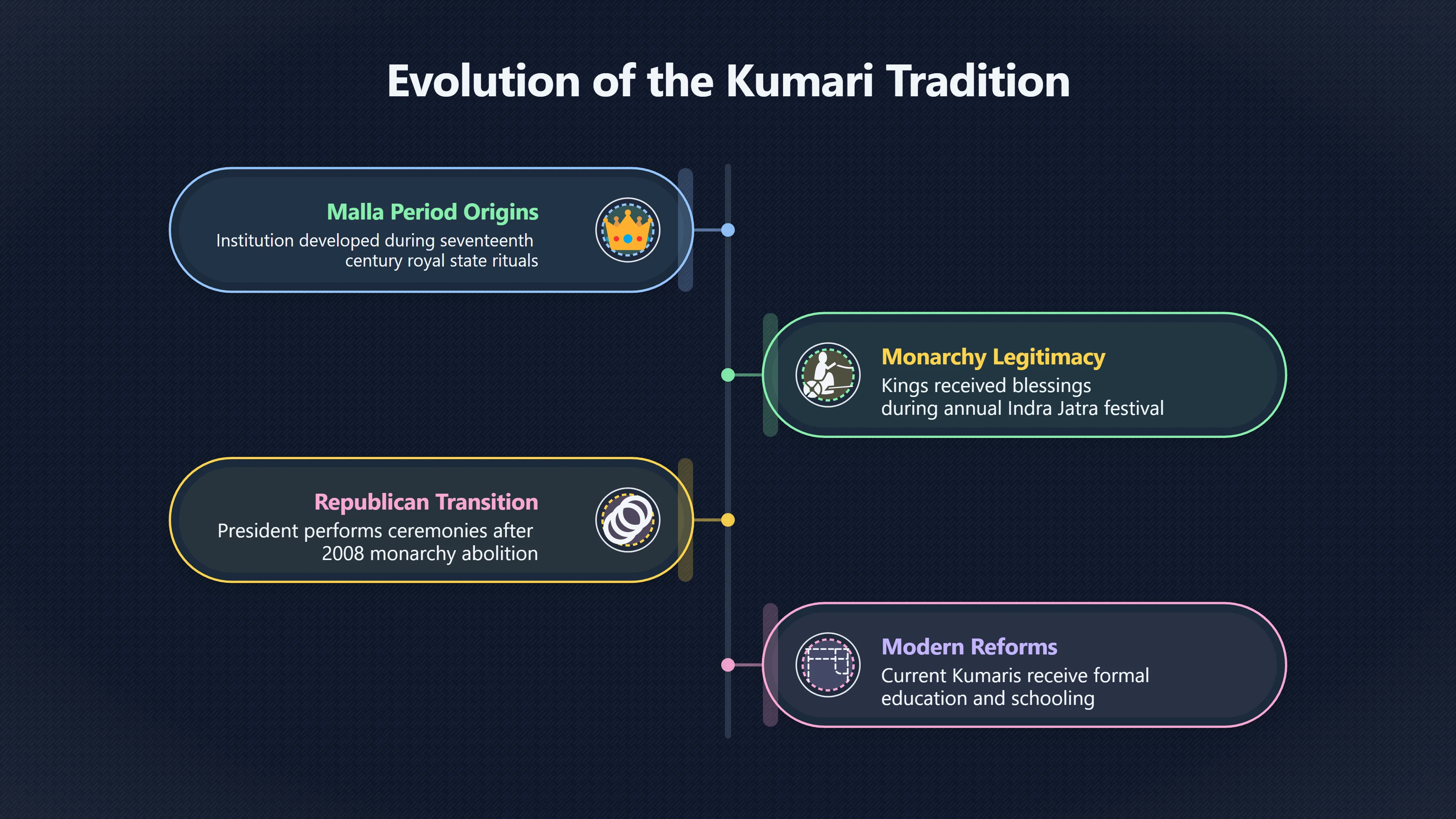
Although historians regard the story as sacred tradition rather than verifiable history, most agree that the royal Kumari institution developed during the Malla period in roughly the seventeenth century. It combined older traditions of virgin worship with royal state ritual, creating a remarkable fusion of Hindu and Buddhist practice that still survives today.[Wikipedia]WikipediaKumari (goddessKumari (goddess
The Taleju Legend and Selection Signs
Selection has always been surrounded by an atmosphere that outsiders often describe as mysterious. Candidates come from specific Newar Buddhist families, traditionally the Shakya community, and are assessed according to religious and ritual criteria rather than popularity or family ambition.
Traditional descriptions refer to the thirty-two physical perfections, a list of auspicious characteristics associated with divine beauty and purity. Candidates must also be healthy, have shed no blood and satisfy astrological requirements. Once selected, priests perform consecration rituals in which Taleju is believed to enter the child.[Nepal Tourism Board]ntb.gov.npNepal Tourism BoardLIVING GODDESS KUMARIKumari, the living goddess, represents Taleju Bhawani and is said to be the living incarnation of…
Stories about terrifying initiation tests have become one of the best-known elements of the Kumari legend. Popular accounts often describe children being left alone among sacrificed buffalo heads and masked dancers to prove fearlessness. However, former Royal Kumari Rashmila Shakya has publicly disputed the common version, explaining that the dramatic ceremony occurs after installation as part of ritual observance rather than serving as the decisive selection test. Her account illustrates how tourist folklore has sometimes exaggerated the institution’s more theatrical aspects.[Wikipedia]WikipediaKumari (goddessKumari (goddess
Another traditional sign concerns dreams. Some accounts maintain that a mother’s dream of a red serpent may foretell that her daughter will one day become the Royal Kumari. Such beliefs belong to Nepal’s wider world of auspicious dreams and symbolic omens rather than documented prediction.[Wikipedia]WikipediaKumari (goddessKumari (goddess
Why Are the Kumari’s Expressions Treated as Omens?
The aspect that most clearly places the Kumari within Nepal’s Fortean traditions is the long-standing belief that her behaviour reveals future events.
During audiences, devotees have traditionally interpreted seemingly ordinary actions as messages from the goddess. Various manuals and ethnographic studies record interpretations including:
- Remaining calm and expressionless is generally considered highly favourable.
- Crying or weeping may foreshadow serious illness, tragedy or death.
- Loud laughter can be interpreted as a warning of coming misfortune.
- Clapping or restless movements have been associated with conflict involving authority.
- Picking at food offerings is sometimes said to predict financial loss.
- Trembling has traditionally been linked with imprisonment or political trouble.[Wikipedia]WikipediaKumari (goddessKumari (goddess
These interpretations are not predictions issued verbally by the Kumari herself. Instead, they belong to an established symbolic system through which worshippers read meaning into ritual behaviour. Much like interpreting eclipses or unusual celestial events in earlier societies, the significance comes from shared cultural expectations rather than measurable forecasting.
Because audiences with the Kumari are infrequent and highly ceremonial, even minor gestures naturally attract extraordinary attention. This has helped preserve the tradition’s reputation for public omens across centuries.

Childhood, Ritual Power and Public Appearance
The Kumari spends much of her time away from public view. Historically, she appeared mainly during major religious festivals, especially Indra Jatra, when she was carried through Kathmandu in an elaborately decorated chariot while enormous crowds gathered for blessings.
Outside these occasions, devotees traditionally sought brief audiences in the Kumari Ghar. The encounter itself was often silent. Visitors presented offerings, bowed at her feet and watched carefully for any movement that might be interpreted as favourable or ominous. Her apparent stillness became part of her sacred authority; silence itself could be understood as a blessing.[Nepal Tourism Board]ntb.gov.npNepal Tourism BoardLIVING GODDESS KUMARIKumari, the living goddess, represents Taleju Bhawani and is said to be the living incarnation of…
For believers, this is not fortune-telling in the modern sense but evidence that divine power manifests through ritual presence. Anthropologists instead describe the practice as a symbolic language through which communities express hopes, anxieties and political uncertainty.
When Omens Seem to Match History
Several dramatic events have retrospectively been linked to the Kumari’s behaviour, although these associations are almost always made after the fact rather than beforehand.
One of the most frequently repeated stories concerns reports that the Royal Kumari cried repeatedly shortly before the 2001 Nepalese royal massacre, in which King Birendra and numerous members of the royal family were killed. The coincidence has become one of the most famous examples cited by believers who see the Kumari’s behaviour as prophetic.[The Times]thetimes.co.ukThe Times'Our daughter was divine, then they made her a living goddessOfficially appointed during the Dashain festival, Aryatara is worshipped as the reincarnation of the warrior goddess Taleju by Hindus and…
However, contemporary evidence is limited, and historians treat these stories cautiously. Like many famous omens throughout history, the accounts gained prominence largely because an extraordinary event followed. Human beings naturally search for meaningful warning signs after traumatic national events, making retrospective interpretation difficult to separate from genuine contemporary expectation.
This pattern resembles many other famous prophetic traditions worldwide, where ambiguous observations acquire significance only once history appears to validate them.
From Royal Blessing to Republican Heritage
For centuries, Nepal’s monarchy publicly reinforced its legitimacy by receiving the Kumari’s blessing during the annual Indra Jatra festival. The king bowed before a child regarded as the earthly embodiment of Taleju, symbolising that royal authority ultimately depended upon divine favour rather than merely political power.[Nepal Tourism Board]ntb.gov.npNepal Tourism BoardLIVING GODDESS KUMARIKumari, the living goddess, represents Taleju Bhawani and is said to be the living incarnation of…
When Nepal abolished the monarchy in 2008, observers wondered whether the institution would disappear. Instead, it adapted. Today the president performs the principal state ceremony once reserved for the king, demonstrating that the Kumari has become less a symbol of monarchy than of national cultural heritage.[Wikipedia]WikipediaKumari (goddessKumari (goddess
At the same time, debates about children’s rights, education and life after serving as Kumari have encouraged gradual reforms. Former Kumaris have spoken publicly about their experiences, challenging sensational myths while advocating improved schooling and easier reintegration into ordinary life. Modern Kumaris typically receive formal education alongside their ceremonial responsibilities, illustrating how an ancient institution continues to evolve rather than remaining frozen in time.[Wikipedia]WikipediaKumari (goddessKumari (goddess
Why the Kumari Remains Part of Nepal’s Strange History
The Kumari tradition occupies an unusual place within Nepal’s catalogue of extraordinary beliefs because it does not depend upon hidden miracles, mysterious creatures or disputed sightings. Its strangeness is entirely public.
Every year, thousands witness ceremonies centred on a child whose silence, composure and gestures are believed by many to carry meaning beyond the ordinary. Sceptics explain the practice through symbolism, psychology, tradition and retrospective interpretation. Believers see the living presence of the goddess Taleju and regard the Kumari’s public appearances as genuine moments of divine communication.
Whatever one’s perspective, the institution demonstrates how folklore, governance and religious ritual can merge into a living system of public omens. Rather than surviving only in old stories, Nepal’s Living Goddess continues to embody one of the world’s rare examples of a prophetic tradition enacted in full view of the modern world.

Amazon book picks
Further Reading
Books and field guides related to Why Does Nepal Still Crown a Living Goddess?. Use these as the next step if you want deeper reading beyond the article.


Lonely Planet Nepal 12
Includes practical background on Kathmandu and Kumari heritage.

Myths and Symbols in Indian Art and Civilization (Works by He...
First published 2017. Subjects: Symbolism in art, Art, indic.
From goddess to mortal
Directly explains the Living Goddess institution from personal experience.
eBay marketplace picks
Marketplace Samples
Live-tested eBay searches with available results related to this page.

Endnotes
1.
Source: Wikipedia
Title: Kumari (goddess)
Link:https://en.wikipedia.org/wiki/Kumari_%28goddess%29
2.
Source: Wikipedia
Title: Taleju Bhawani
Link:https://en.wikipedia.org/wiki/Taleju_Bhawani
3.
Source: ntb.gov.np
Link:https://ntb.gov.np/living-goddess-kumari
Source snippet
Nepal Tourism BoardLIVING GODDESS KUMARIKumari, the living goddess, represents Taleju Bhawani and is said to be the living incarnation of...
4.
Source: thetimes.co.uk
Title: The Times’Our daughter was divine, then they made her a living goddess’
Link:https://www.thetimes.co.uk/article/daughter-living-goddess-deity-kumari-lvmvts8v5
Source snippet
Officially appointed during the Dashain festival, Aryatara is worshipped as the reincarnation of the warrior goddess Taleju by Hindus and...
Additional References
5.
Source: papers.ssrn.com
Link:https://papers.ssrn.com/sol3/Delivery.cfm/SSRN_ID3855279_code4511280.pdf?abstractid=3855279
Source snippet
goddess: kumari culture in nepalThe legend behind establishing the Kumari tradition is King Jaya Prakash Malla used to go the Goddess Tal...
6.
Source: researchgate.net
Link:https://www.researchgate.net/publication/324847901_A_Study_of_Living_Godess_Kumari_The_Source_of_Cultural_Tourism_in_Nepal
Source snippet
A Study of Living Godess Kumārī: The Source of Cultural...5 Jun 2026 — The Kumārī is commonly called "Mother Deity or Kumārī ma and beli...
7.
Source: facebook.com
Link:https://www.facebook.com/birdwatchernepal/posts/the-living-goddess-kumari-a-unique-cultural-treasure-of-nepal-nepal-is-blessed-w/10245314813784354/
Source snippet
s Taleju, and is worshipped by both Hindus and Buddhists in Nepal...Read more...
8.
Source: thewondernepal.com
Title: kumari tradition the living goddess of nepal
Link:https://thewondernepal.com/articles/kumari-tradition-the-living-goddess-of-nepal/
Source snippet
Kumari Tradition: The Living Goddess of Nepal3 Jan 2026 — The Kumari, or the Living Goddess, is not merely a cultural figure; she embodie...
9.
Source: youtube.com
Link:https://www.youtube.com/watch?v=1vWGoinqk7E
Source snippet
Kumari: Nepal's Divine Child Goddesses (1980s Documentary)...
10.
Source: youtube.com
Title: Living Goddesses of Nepal: The Enigmatic World of Child Kumari
Link:https://www.youtube.com/watch?v=fqB2_2VZ-qE
Source snippet
Nepal's LIVING GODDESS: The Ancient Tradition of the Kumari That Defies Belief | AI Animated...
11.
Source: allnepalhiking.com
Link:https://allnepalhiking.com/blog/kumari-living-goddess-nepal
Source snippet
Kumari: The Living Goddess of Nepal | History, Rituals &...21 Jan 2026 — Known as the Kumari, this divine figure is believed to be the e...
12.
Source: bestheritagetour.com
Link:https://www.bestheritagetour.com/blog/the-living-goddesses-of-nepal-exploring-kumari-traditions-in-kathmandu
Source snippet
Kumari of Nepal: The Living Goddess of Kathmandu's...16 Jun 2025 — The Kumari embodies the goddess Taleju, the patron deity of the Malla...
13.
Source: youtube.com
Link:https://www.youtube.com/watch?v=SB4cvvNZrY0
Source snippet
The Living Goddess of Nepal: The Story of Kumari...
14.
Source: youtube.com
Title: The Living Goddess of Nepal: The Story of Kumari
Link:https://www.youtube.com/watch?v=FzhYMNFteEI
Source snippet
Living Goddesses of Nepal: The Enigmatic World of Child Kumari...
Topic Tree