Within Senegal Mysteries
The Yumboes: Senegal's Mysterious Night Creatures
The Yumboes are mysterious fairy-like figures from Senegalese tradition that show how landscapes become homes for imagined beings.
On this page
- The Gorée Island traditions
- European retellings and folklore comparisons
- Why hidden beings survive in stories
Page outline Jump by section
Introduction
The Yumboes are among the most distinctive supernatural beings connected with Senegalese folklore: small, mysterious night creatures said to live beneath the landscape around Gorée Island and emerge after dark to feast, dance, and interact with humans. They are not documented as physical beings, but as part of a tradition associated with Wolof and Lebou cultural memory around Gorée and the nearby coast. Their importance lies in the way they turn a real place into an imagined hidden world — one where hills, moonlight, food, ancestors, and the unknown become part of a single story.[Wikipedia]WikipediaOpen source on wikipedia.org.

The Yumboes are also unusual because their story travelled beyond Senegal. A 19th-century European folklore writer, Thomas Keightley, included an account of them in The Fairy Mythology, presenting them alongside European fairy traditions. That written version helped transform a local legend into an international curiosity, while also creating questions about how much of the surviving description reflects Senegalese tradition and how much reflects a European comparison with familiar fairy lore.[Project Gutenberg]gutenberg.orgProject Gutenberg The Fairy Mythology by Thomas Keightley | Project GutenbergProject GutenbergThe Fairy Mythology by Thomas Keightley | Project GutenbergOctober 9, 2012…
From a Fortean perspective, the Yumboes are fascinating not because there is evidence that they exist, but because they show how communities create “hidden worlds” within ordinary landscapes — and how those stories can survive for centuries.
The Gorée Island traditions
Creatures beneath the Paps
Traditional accounts place the Yumboes around Gorée Island, a small island off the coast of Dakar with a history shaped by trade, colonial rivalry, and the Atlantic slave trade. Today Gorée is best known as a UNESCO World Heritage site and a place of historical memory, but its landscape has also carried older layers of storytelling and belief.[UNESCO World Heritage Centre]whc.unesco.orgWorld Heritage Centre Island of GoréeUNESCO World Heritage CentreIsland of Gorée - UNESCO World Heritage Centre…
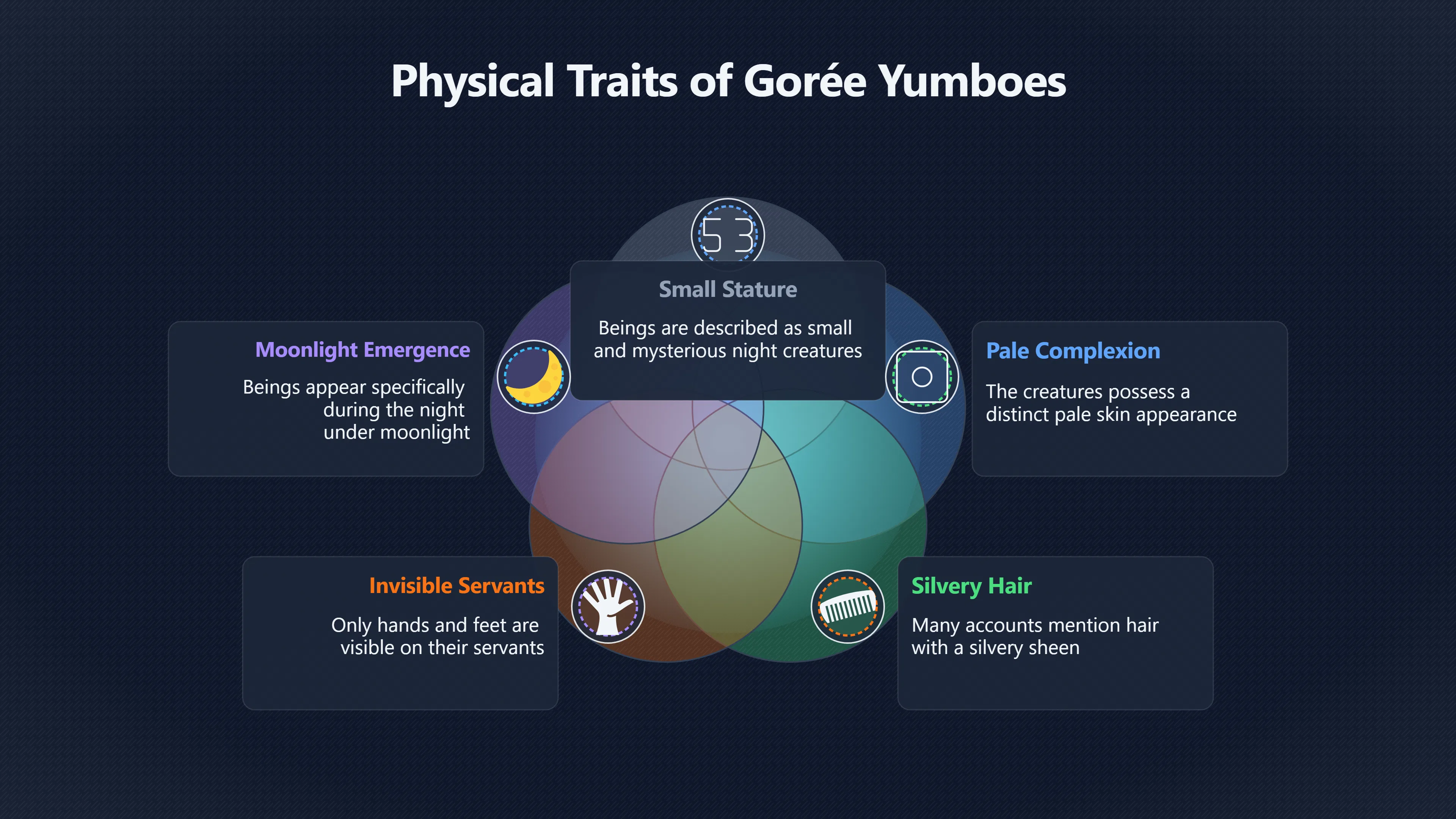
The Yumboes are described as small, pale beings, sometimes with silvery hair, who live beneath hills known as the Paps. According to the best-known written account, they emerge at night, especially in moonlight, and hold elaborate feasts. They eat food associated with human life, including grain and fish, and are said to have invisible servants whose hands and feet are the only visible parts.[Wikipedia]WikipediaOpen source on wikipedia.org.
These details give the legend its strange character. The Yumboes are not simply monsters hiding in the wilderness. They resemble a hidden version of human society. They have homes, meals, celebrations, and social relationships. Their underground world mirrors the visible one, suggesting that the boundary between ordinary life and the unseen world is thinner than people might assume.
The idea of beings living beneath hills or inside landscapes is common in many folklore traditions worldwide. What makes the Yumboes distinctive is the way the story is tied to a very specific Senegalese setting. The island itself becomes part of the mythology: the hills are not just geological features, but possible entrances to another realm.
A legend shaped by oral tradition
The surviving written record of the Yumboes is unusual. Much of what is commonly repeated today comes through Thomas Keightley’s The Fairy Mythology, where he described information received from a woman who had spent time on Gorée Island as a child and had heard the story from a local Wolof servant.[Wikipedia]WikipediaOpen source on wikipedia.org.
This means the famous account is not a direct transcript of a traditional storyteller from Gorée. It is a chain of transmission: a local belief passed through oral storytelling, remembered by an outsider, recorded by a European folklorist, and later compared with fairy traditions from Europe. That does not make the tradition unreliable, but it does mean historians need to separate the original cultural story from later interpretations.
The Yumboes therefore sit in an interesting middle ground. They are a Senegalese tradition with a relatively small written archive, yet they became widely known because they fitted into a 19th-century European fascination with fairies, elves, and supernatural “little people”.[Wikipedia]WikipediaThomas KeightleyThomas Keightley
European retellings and folklore comparisons
Why Europeans saw “fairies” in the Yumboes
When Keightley wrote about the Yumboes, he placed them in a broader search for similarities between supernatural traditions around the world. His work compared folklore from different cultures and looked for patterns between stories of spirits, fairies, elves, and other mysterious beings.[Wikipedia]WikipediaThomas KeightleyThomas Keightley
The resemblance was obvious: small magical beings, hidden homes, night-time appearances, unusual food, and a relationship with humans. To Victorian readers, the Yumboes sounded similar to European fairy folklore.
However, comparison can also create misunderstandings. Calling the Yumboes “African fairies” may help a modern audience understand the type of creature being described, but it can also flatten the tradition by forcing it into a European category. The Yumboes belong to Senegalese cultural landscapes, not simply to a worldwide catalogue of fairy creatures.
The comparison is most useful when it highlights a shared human habit: people in many societies imagine unseen neighbours living alongside them. These beings often explain mysteries, preserve memories, and give personality to places that might otherwise seem ordinary.
The problem of the single famous source
One of the strangest aspects of Yumboes folklore is that its international fame rests on a narrow documentary foundation. Modern summaries frequently repeat the same description because Keightley’s account became the main route by which the story entered printed folklore collections.[Wikipedia]WikipediaOpen source on wikipedia.org.
For researchers, this creates both interest and caution. The story is valuable evidence of a belief tradition, but it is not the same as a modern field study showing how all Wolof or Lebou communities understand the Yumboes today.
The limited documentation also explains why the Yumboes remain mysterious. Many folklore traditions exist primarily through spoken transmission, family stories, and local memory rather than extensive written records. A lack of documents does not prove that a tradition was insignificant; it often shows that it belonged to everyday cultural life rather than formal literature.
Why hidden beings survive in stories
Landscapes become places of imagination
The Yumboes endure because they transform geography into storytelling. A hill becomes a doorway. A quiet night becomes a possible encounter. A familiar coastline becomes a place with another population hidden just beyond human sight.
This relationship between landscape and legend is especially powerful on islands. Gorée is physically small, separated from the mainland by the sea, and historically marked by isolation and movement between cultures. UNESCO describes the island as a place whose history has been shaped by its strategic position between Africa, Europe, and the Atlantic world.[UNESCO World Heritage Centre]whc.unesco.orgWorld Heritage Centre Island of GoréeUNESCO World Heritage CentreIsland of Gorée - UNESCO World Heritage Centre…
Stories like the Yumboes add another layer to that identity. They remind us that places carry more than political and economic histories. They also hold imagined histories: stories of spirits, ancestors, dangers, and wonders.
Folklore as a way of explaining the unseen
The Yumboes can be understood as part of a wider human tendency to create stories for things that cannot be easily seen or explained. Night-time sounds, unusual natural features, hidden spaces, and the uncertainty of unfamiliar places have often inspired tales of invisible neighbours.
A Fortean reading does not require choosing between “real creatures” and “mere fantasy”. The more important question is why the story developed and why people continued telling it. The Yumboes offer a way to think about relationships between humans and their surroundings: the belief that landscapes contain memories, personalities, and unseen possibilities.
From local legend to global curiosity
Today, the Yumboes are remembered as one of Senegal’s most unusual folklore traditions. Their appeal comes from the combination of a real location, a vivid supernatural description, and a complicated history of cultural translation. They are neither a proven mystery creature nor simply a borrowed fairy tale. They are a surviving example of how folklore moves between communities, languages, and centuries.
The hidden world beneath Gorée’s hills may belong to legend, but the idea behind it remains very real: people everywhere imagine that familiar places contain more than what can be immediately observed. The Yumboes survive because they give that feeling a shape — small, silver-haired, and waiting in the moonlight.
Amazon book picks
Further Reading
Books and field guides related to The Yumboes: Senegal's Mysterious Night Creatures. Use these as the next step if you want deeper reading beyond the article.


The Book of Mythical Beasts and Magical Creatures
Directly matches mysterious creatures and hidden beings.

eBay marketplace picks
Marketplace Samples
Live-tested eBay searches with available results related to this page.
Endnotes
1.
Source: Wikipedia
Link:https://en.wikipedia.org/wiki/Yumboes
2.
Source: whc.unesco.org
Title: World Heritage Centre Island of Gorée
Link:https://whc.unesco.org/en/list/26
Source snippet
UNESCO World Heritage CentreIsland of Gorée - UNESCO World Heritage Centre...
3.
Source: gutenberg.org
Title: Project Gutenberg The Fairy Mythology by Thomas Keightley | Project Gutenberg
Link:https://www.gutenberg.org/ebooks/41006
Source snippet
Project GutenbergThe Fairy Mythology by Thomas Keightley | Project GutenbergOctober 9, 2012...
Published: October 9, 2012
4.
Source: Wikipedia
Title: Thomas Keightley
Link:https://en.wikipedia.org/wiki/Thomas_Keightley
5.
Source: unesco.org
Link:https://www.unesco.org/en/articles/goree-island-memory
Source snippet
July 3, 2024 — GORÉE, ISLAND OF MEMORY A symbol of the tragedy engendered by the transatlantic slave trade, the Senegalese island of Goré...
Published: July 3, 2024
7.
Source: unesco.org
Title: L’île de Gorée | World Heritage
Link:https://www.unesco.org/archives/multimedia/document-188
Source snippet
UNESCO Multimedia ArchivesSubjects: Patrimoine mondial | Lieux historiques L'ÎLE DE GORÉE * * * Langue: Français Analogue only: English...
8.
Source: whc.unesco.org
Link:https://whc.unesco.org/en/list/26/documents
Source snippet
of Gorée - Documents - UNESCO World Heritage CentreISLAND OF GORÉE Advisory Bodies Evaluations --- 1978 | Advisory Body Evaluation (ICOMO...
9.
Source: unesco.org
Title: The Portuguese renamed it Ila de Palma. The name was changed to Goo
Link:https://www.unesco.org/archives/multimedia/document-32
Source snippet
Goree, the Slave Island | World Heritage - UNESCO Multimedia ArchivesSubjects: World heritage | Historic places GOREE, THE SLAVE ISLAND *...
10.
Source: folktales.africa
Title: by Ayomide Adekilekun
Link:https://folktales.africa/the-yumboes-spirits-of-the-jaloff-people-an-african-folktale/
Source snippet
The Yumboes | Spirits of the Paps Hills (African Folktale)September 16, 2025 — THE YUMBOES: SPIRITS OF THE JALOFF PEOPLE | AN AFRICAN FOL...
Published: September 16, 2025
11.
Source: offbeat.fandom.com
Link:https://offbeat.fandom.com/wiki/Yumboes
Source snippet
Offbeat Folklore Wiki | FandomYUMBOES Sign In to Save Save Edit * History * Purge * Talk (0) iframe YUMBOES OTHER NAMES Unknown ORIGIN...
12.
Source: cipdh.gob.ar
Title: Gorée Island
Link:https://www.cipdh.gob.ar/memorias-situadas/en/lugar-de-memoria/isla-de-gorea/
Source snippet
UNESCOGORÉE ISLAND Image: Site SITE Museum THEME: SLAVERY Address Country Senegal City City of Dakar – Gorée District Continent A...
Additional References
13.
Source: cambridge.org
Link:https://www.cambridge.org/core/journals/advances-in-archaeological-practice/article/abs/presenting-archaeology-and-heritage-at-a-unesco-world-heritage-site-goree-island-senegal/DF03D257871224539DA233798BE0BE1D
Source snippet
dge CoreJuly 5, 2018 — PRESENTING ARCHAEOLOGY AND HERITAGE AT A UNESCO WORLD HERITAGE SITE: GORÉE ISLAND, SENEGAL Published online by Cam...
Published: July 5, 2018
14.
Source: sacred-texts.com
Link:https://sacred-texts.com/neu/celt/tfm/tfm185.htm
Source snippet
The Fairy Mythology: Africans, Jews, etc.: Africans | Internet Sacred Text ArchiveAFRICANS > > When evening's shades o'er Goree's Isle ex...
15.
Source: folktales.africa
Link:https://folktales.africa/the-tale-of-the-yumboes-and-the-curious-farmer-a-senegal-folktale-retold/
Source snippet
The Tale of the Yumboes and the Curious Farmer (A Senegal Folktale Retold) | FolktalesAfrica.comJuly 24, 2025 — THE TALE OF THE YUMBOES A...
Published: July 24, 2025
16.
Source: eerieworlds.com
Link:https://www.eerieworlds.com/eerie-world-cards/yumboes
Source snippet
YumboesImage YUMBOES Image: RivinRivin Image: YumboesWest African Yumboes are a kind of silver fairy reported by the Wolof people of Sene...
17.
Source: doi.org
Link:https://doi.org/10.5871/bacad/9780197264782.003.0008
Source snippet
Expand Front Matter 2. 1 Introduction: Slavery, Social Revolutions and Enduring Memories 3. Expand Part I Slave Systems of Production in...
18.
Source: library.si.edu
Title: Smithsonian Libraries The fairy mythology | Smithsonian Libraries
Link:https://library.si.edu/digital-library/book/fairymythology00keig
Source snippet
Bell & Sons, London, 1889 Internet Archive Book Reader CC0 — Creative Commons (CC0 1.0) This content is in the public domain (free of copyri...
19.
Source: theillustrationist.com
Title: Mythological African Creatures: Yumboes – The Illustrationist
Link:https://theillustrationist.com/2013/01/16/yumboes-african-creatures-myths/
Source snippet
January 16, 2013 — MYTHOLOGICAL AFRICAN CREATURES: YUMBOES Yumboes, are a type of fairies in Wolof mythology (Senegal, West Africa).Legen...
Published: January 16, 2013
20.
Source: radioiulm.it
Title: Piccoli spiriti, grandi segreti: gli Yumboes
Link:https://www.radioiulm.it/2026/02/28/piccoli-spiriti-grandi-segreti-gli-yumboes/
Source snippet
Radio IULMFebruary 28, 2026 — 28 Febbraio 2026 0Comments 6Likes Gabriella Silvestri 28 Febbraio 2026 0Comments 6Likes Gabriella Silvestri...
Published: February 28, 2026
21.
Source: pursiful.com
Title: Yumboes: Senegalese Little Folk « Darrell J
Link:https://pursiful.com/2014/03/14/yumboes-senegalese-little-folk/
Source snippet
March 14, 2014 — YUMBOES: SENEGALESE LITTLE FOLK Wolof type by Edouard Riou Yumboes are part of the Wolof folklore of Senegal. Th...
Published: March 14, 2014
22.
Source: fichier-pdf.fr
Title: DOSSIERCOMMUNICATIONYUMBOESFINA L
Link:https://www.fichier-pdf.fr/2014/08/04/dossiercommunicationyumboesfinal/
Source snippet
DOSSIERCOMMUNICATIONYUMBOESFINAL - Fichier PDFAugust 4, 2014 — DOSSIERCOMMUNICATIONYUMBOESFINAL * * * À propos / Télécharger Lire le docu...
Published: August 4, 2014
Topic Tree