What Makes Turkmenistan's Weird History Burn?
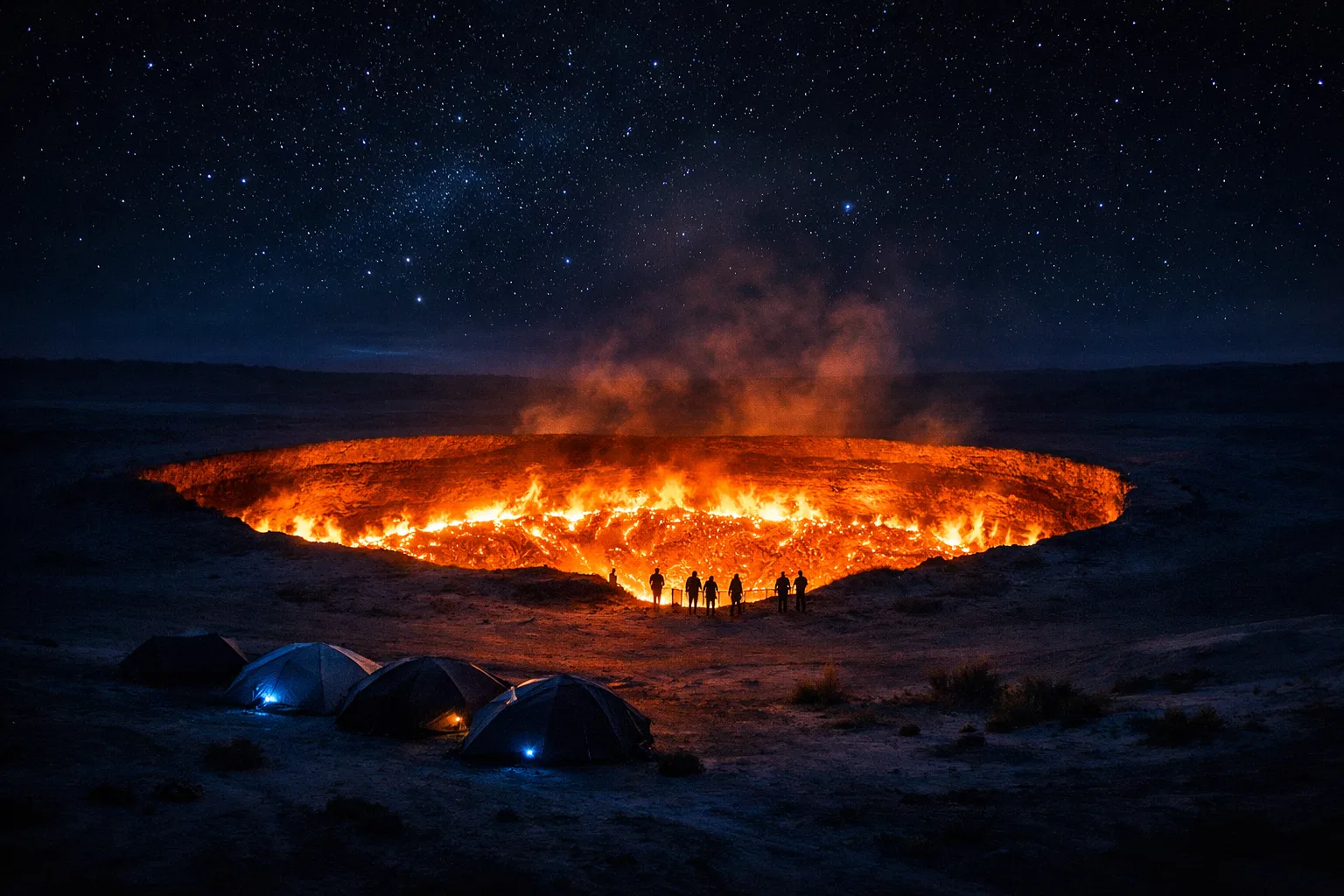
Turkmenistan’s strange-history record is dominated by one extraordinary real place: the burning Darvaza gas crater in the Karakum Desert, better known abroad as the “Door to Hell”.
Page outline Jump by section
Introduction
Turkmenistan’s strange-history record is dominated by one extraordinary real place: the burning Darvaza gas crater in the Karakum Desert, better known abroad as the “Door to Hell”. It is not a proven supernatural site, but it has exactly the right ingredients for country-level Forteana: uncertain origin stories, Soviet-era obscurity, a landscape that looks mythic at night, tourist retellings, environmental controversy, and a name that has almost swallowed the facts. Beyond Darvaza, Turkmenistan’s weird material is quieter but still rich: fossil footprints once explained as sacred elephants, caves tied to wish-making and rescue legends, ancient fire-cult archaeology, and the odd afterlife of prophetic and apocalyptic stories around Merv. The strongest conclusion is that Turkmenistan is less a country of well-documented UFO waves or lake monsters than a place where geology, desert remoteness, religious memory and sparse archives turn real sites into uncanny national legends.
Why Turkmenistan’s weird record is unusually hard to pin down
Turkmenistan is not short of strange material, but much of it sits in a difficult evidence zone. The country has strict controls on information, limited independent reporting, and relatively low internet penetration; a 2023 technical study of web censorship described Turkmenistan as a hard country to measure from the outside and found extensive blocking across DNS, HTTP and HTTPS systems. That matters for Forteana because modern strange reports often depend on local newspapers, witness forums, regional archives and open debate — exactly the kinds of channels that can be patchy or inaccessible.[arXiv]arxiv.orgOpen source on arxiv.org.
The result is a lopsided record. Darvaza is internationally famous because travellers, photographers, satellite analysts, state announcements and news outlets have all returned to it. By contrast, claims of Soviet-era desert lights or UFO reports in Turkmenistan tend to appear in weakly sourced retellings, social media posts or paranormal compilations rather than in robust archives. A Fortean page on Turkmenistan therefore has to treat silence carefully: lack of evidence does not prove nothing was ever reported, but it does mean that only a few cases can be responsibly developed.
This makes the country interesting in a different way. Its best strange stories are not “monsters in the mist” but places where natural evidence and legendary interpretation overlap: a crater that looks infernal but is industrial; dinosaur tracks that became elephant folklore; a cave whose ribbons and prayers turn geology into pilgrimage; and ancient ruins where fire, prophecy and political revolt have been repeatedly reimagined.
The Door to Hell: an industrial accident that became a national omen
The Darvaza gas crater is the obvious centrepiece. It lies in the Karakum Desert, near the village of Darvaza, and is widely described as a collapsed gas field whose floor and rim burned for decades after escaping gas was ignited. The basic explanation is earthly: drilling hit a gas-bearing cavity, the ground collapsed, and the gas was set alight to stop methane or other gases spreading. The Fortean quality lies in the uncertainty around the exact date and circumstances. Common accounts place the accident in 1971, but even relatively careful summaries note that the early history is poorly documented, with some local geological claims putting the collapse or ignition in different decades.[Wikipedia]WikipediaDarvaza gas craterDarvaza gas crater
That uncertainty is not just trivia. It is the gap through which legend enters. A crater burning in the desert for more than half a century would be strange enough with a perfect file of engineering reports; without one, it becomes a modern folktale about Soviet overconfidence, hidden archives and a mistake that refused to end. National Geographic’s account of George Kourounis’s expedition described him entering the crater to collect samples, while later educational material reported that bacteria were found in soil from the crater floor, giving the site a scientific as well as theatrical afterlife.[National Geographic]nationalgeographic.com140716 door to hell darvaza crater george kourounis expedition140716 door to hell darvaza crater george kourounis expedition
The “hell” branding is powerful because it is visually honest even when metaphysically misleading. At night, Darvaza really does look like a mouth of fire in a black desert. Yet the best explanation is neither demonic nor mysterious in the paranormal sense. It is a methane-rich industrial hazard, made uncanny by scale, isolation and duration. Guinness World Records credits Kourounis as the first person to explore the crater floor, noting the protective equipment and later laboratory finding of bacteria on collected rocks; that is a better strange fact than any invented ghost story because it joins spectacle to measurable risk.[Guinness World Records]guinnessworldrecords.comGuinness World Records First person to explore the Darvaza CraterGuinness World Records First person to explore the Darvaza Crater
Is the Door to Hell going out?
Recent evidence suggests that Darvaza’s famous blaze has been diminishing. Turkmenistan’s official state news agency reported in June 2025 that emissions at the Darvaza crater had been significantly reduced after work around the site, including efforts connected to nearby gas management. Independent flare-monitoring analysis from Capterio also reported a marked reduction in thermal intensity, using satellite observation rather than tourist impression alone.[Altyn Asyr]turkmenistan.gov.tmturkmenistans achievements reducing methane emissions announced tesc 2025turkmenistans achievements reducing methane emissions announced tesc 2025
This has made the crater stranger, not less strange. The simple tourist story says: “The Door to Hell is closing.” The environmental story is more complicated. A 2026 satellite-based assessment in Geophysical Research Letters described Darvaza as a long-running methane source and estimated that emissions over its lifetime exceeded 900 kilotonnes. Separate conference material and satellite work have detected methane plumes from Darvaza in the range of roughly tonnes per hour, depending on the instrument and observation.[wiley.com]agupubs.onlinelibrary.wiley.comOpen source on wiley.com.
The unsettling possibility is that weaker flames are not automatically good news. Burning methane converts it mostly into carbon dioxide and water vapour; unburned methane is a more potent warming gas over the short term. So a dimmer crater may mean less spectacle but not necessarily less climate concern. The old Fortean question — “What is that fire in the desert?” — has become a modern one: “What is escaping when the fire fades?”
Darvaza also shows how a strange place can shift categories over time. In the 1970s story it is an engineering mishap. In travel media it becomes an infernal wonder. In state policy it becomes a resource and environmental problem. In satellite science it becomes a measurable methane source. The anomaly has not vanished; it has changed instruments.
Dinosaur tracks, sacred elephants and the problem of old explanations
In eastern Turkmenistan, the Koytendag area offers a different kind of Forteana: not an unexplained phenomenon, but an explained phenomenon with a legendary pre-scientific life. UNESCO’s tentative listing for the “Dinosaurs and Caves of Koytendag” describes a landscape of caves, karst features, rare species and important dinosaur tracks. Turkmenistan’s own state account says the Dinosaur Plateau near Khojapil contains more than 2,000 fossilised footprints, many of them large three-toed impressions.[UNESCO World Heritage Centre]whc.unesco.orgOpen source on unesco.org.
The scientific explanation is straightforward: these are dinosaur trackways preserved in ancient sediment, later exposed and tilted by geological processes. The folkloric explanation is more memorable. Local tradition associated the huge prints with elephants, often linked to Alexander the Great’s army; tourist and local-history accounts point out that the nearby place name is commonly interpreted in relation to “holy elephants”.[Centralasia Adventures]centralasia-adventures.comCentralasia Adventures Plateau of DinosaursCentralasia Adventures Plateau of Dinosaurs
This is exactly the sort of material that belongs in a grounded Fortean survey. No one needs to claim that ghostly elephants still dance on the plateau. The interest is in how people made sense of impossible-looking marks before palaeontology supplied a better answer. A line of huge footprints on a mountain slope demands a story. In one era, that story is sacred animals or ancient conquerors; in another, it is Jurassic trackmakers crossing a shallow lagoon.
The case also warns against treating folklore as failed science. The elephant legend preserved attention to the tracks. It kept the place meaningful long before modern heritage language arrived. In Fortean terms, Koytendag is a solved mystery that still matters because the old explanation reveals how landscape, memory and wonder work together.

Kyrk Gyz Cave and the cave that grants wishes
Koytendag also contains one of Turkmenistan’s most striking living legend sites: Kyrk Gyz Cave, usually explained in English as the “Forty Girls” cave. Atlas Obscura summarises the core legend as a story of forty girls fleeing violence and finding miraculous protection in the cave; travel accounts describe a ritual in which visitors throw clay-wrapped ribbons or cloth towards the cave roof, with success interpreted as a sign that a wish may be granted.[Atlas Obscura]atlasobscura.comAtlas Obscura Kyrk Gyz Cave in KoytendagAtlas Obscura Kyrk Gyz Cave in Koytendag
This is not Forteana in the laboratory sense. It is not a testable haunting or a creature report. Its strangeness is social and devotional: a physical place where story, fear, rescue, female vulnerability, mountain shelter and wish-making have fused. The ribbons matter because they make belief visible. They turn the cave ceiling into a record of private hopes.
Different retellings vary in detail. Some say the girls were hidden by divine intervention; others emphasise the mountains closing or a hidden escape through the caverns. That variation is typical of living folklore rather than a flaw to be “corrected”. What remains stable is the emotional shape of the tale: danger enters the canyon, the vulnerable pray, the mountain protects them, and the cave becomes a place where ordinary visitors can still ask for help.
For a reader of strange history, Kyrk Gyz Cave is a useful counterweight to Darvaza. One is a modern industrial fire mistaken for hell; the other is an old sacred landscape still used for wishes. Together they show two paths by which places become uncanny: spectacular physics and repeated human ritual.
Ancient Merv, fire, prophecy and the Veiled Prophet
Turkmenistan’s ancient ruins add a deeper historical layer to the country’s weird record. UNESCO describes Ancient Merv as the oldest and best-preserved of the oasis cities along the Silk Roads of Central Asia, with a protected state historical and cultural park created in 1987. Merv’s long religious history included Zoroastrian, Buddhist, Christian and Islamic phases, making it a natural magnet for later stories about fire, revelation, ruin and holy authority.[UNESCO World Heritage Centre]whc.unesco.orgOpen source on unesco.org.
Nearby Bronze Age sites such as Gonur Depe have also attracted interest because archaeologists found monumental architecture, ritual areas and fire-related structures. Some interpretations have linked these to early Indo-Iranian or proto-Zoroastrian religious practice, though such claims need care because the archaeology predates the firmly documented historical forms of Zoroastrianism.[Wikipedia]WikipediaGonur DepeGonur Depe
The most Fortean historical figure connected with the wider Merv world is al-Muqanna, the “Veiled Prophet”, an eighth-century rebel leader remembered in medieval sources as wearing a veil and claiming extraordinary spiritual status. Modern summaries note that hostile chroniclers attributed magical or deceptive claims to him, while later literature turned him into a romantic and sinister figure.[Wikipedia]WikipediaOpen source on wikipedia.org.
This is not evidence of literal miracles. It is evidence of how political revolt becomes supernaturalised. A masked or veiled leader in a religiously mixed frontier region is almost guaranteed to attract stories: divine light, hidden deformity, miracle-working, fraud, martyrdom, heresy. In Fortean terms, al-Muqanna belongs beside other prophetic scares and visionary movements where charisma, secrecy and crisis produce stories that outlive the archive.

What about UFOs, monsters and classic paranormal cases?
Compared with some countries, Turkmenistan has a thin public record for classic modern Forteana. Searches for well-documented UFO waves, named lake monsters, mass poltergeist cases or newspaper-backed anomalous falls produce little that is strong enough to treat as a major national case. Claims of Soviet-era lights over the Karakum Desert do circulate online, but the accessible examples are typically weakly sourced and lack the basic evidential features a reader should expect: named witnesses, dates, locations, original reports and independent follow-up.[Reddit]reddit.comLittle-known UFO reports from Soviet-era TurkmenistanLittle-known UFO reports from Soviet-era Turkmenistan
That does not make the country uninteresting. It changes the emphasis. Turkmenistan’s strongest weird-history material is place-based rather than witness-report based. The key archive is the landscape: burning crater, fossil plateau, cave shrine, ancient oasis city, desert gas fields, ruins associated with fire cults and prophetic revolt.
There are also practical reasons why modern anomalous reports may be hard to trace. Turkmenistan’s controlled media environment, restricted travel and limited independent online infrastructure make it less likely that local oddities will develop the same public paper trail as, for example, UFO flaps in the United States, Britain or France. The responsible stance is to say that the public evidence is sparse, not to fill the gap with imported paranormal boilerplate.
Why these stories still have cultural pull
Turkmenistan’s strange record works because each major case has a double reading. Darvaza is both a gas accident and a mythic furnace. Koytendag’s footprints are both dinosaur tracks and sacred elephant marks. Kyrk Gyz is both a cave and a wish-making refuge. Merv is both archaeology and a stage for fire, prophecy and vanished greatness.
That double reading is the heart of good country-level Forteana. The aim is not to prove that the supernatural is hiding in Turkmenistan’s deserts and mountains. It is to notice how real places become charged with more meaning than their physical explanations can exhaust. Darvaza can be fully explained by methane and still feel like a warning. Dinosaur tracks can be fully explained by palaeontology and still preserve the older wonder of people seeing giant marks and asking what kind of being made them.
The most honest summary is therefore also the most interesting one: Turkmenistan’s Forteana is not a catalogue of monsters. It is a set of uncanny landscapes where geology, sparse records, sacred tradition and modern media have made the factual world feel briefly legendary.
Amazon book picks
Further Reading
Books and field guides related to What Makes Turkmenistan's Weird History Burn?. Use these as the next step if you want deeper reading beyond the article.


Lonely Planet Central Asia Phrasebook and Dictionary
First published 2019. Subjects: Asia, languages.
eBay marketplace picks
Marketplace Samples
Live-tested eBay searches with available results related to this page.

Endnotes
1.
Source: arxiv.org
Link:https://arxiv.org/abs/2304.04835
2.
Source: Wikipedia
Title: Darvaza gas crater
Link:https://en.wikipedia.org/wiki/Darvaza_gas_crater
3.
Source: agupubs.onlinelibrary.wiley.com
Link:https://agupubs.onlinelibrary.wiley.com/doi/full/10.1029/2025GL120321
4.
Source: whc.unesco.org
Link:https://whc.unesco.org/en/tentativelists/5434/
5.
Source: centralasia-adventures.com
Title: Centralasia Adventures Plateau of Dinosaurs
Link:https://centralasia-adventures.com/en/turkmenistan/nature-of-turkmenistan/plateau_of_dinosaur.html
6.
Source: whc.unesco.org
Link:https://whc.unesco.org/en/list/886/
7.
Source: Wikipedia
Link:https://en.wikipedia.org/wiki/Merv
8.
Source: Wikipedia
Title: Gonur Depe
Link:https://en.wikipedia.org/wiki/Gonur_Depe
9.
Source: Wikipedia
Link:https://en.wikipedia.org/wiki/Al-Muqanna
10.
Source: reddit.com
Title: Little-known UFO reports from Soviet-era Turkmenistan
Link:https://www.reddit.com/r/aliens/comments/1pzm4fa/littleknown_ufo_reports_from_sovietera/
11.
Source: Wikipedia
Title: Caspian Sea Monster
Link:https://en.wikipedia.org/wiki/Caspian_Sea_Monster
12.
Source: Wikipedia
Title: List of dragons in mythology and folklore
Link:https://en.wikipedia.org/wiki/List_of_dragons_in_mythology_and_folklore
13.
Source: Wikipedia
Title: Dinosaur Plateau
Link:https://en.wikipedia.org/wiki/Dinosaur_Plateau
14.
Source: Wikipedia
Link:https://en.wikipedia.org/wiki/Jinn
15.
Source: Wikipedia
Title: List of World Heritage Sites in Turkmenistan
Link:https://en.wikipedia.org/wiki/List_of_World_Heritage_Sites_in_Turkmenistan
16.
Source: reddit.com
Link:https://www.reddit.com/r/interestingasfuck/comments/5ehblm/the_caspian_sea_monster_this_one_of_a_kind/
17.
Source: reddit.com
Link:https://www.reddit.com/r/WeirdWings/comments/jg9jmy/the_caspian_sea_monster_rises_from_the_grave/
18.
Source: reddit.com
Title: turkmenistan reduces 50year fire dubbed gateway
Link:https://www.reddit.com/r/climatechange/comments/1l4iv3b/turkmenistan_reduces_50year_fire_dubbed_gateway/
19.
Source: central-asia.guide
Title: koytendag natural reserve
Link:https://central-asia.guide/turkmenistan/destinations-tr/koytendag-natural-reserve/
20.
Source: whc.unesco.org
Link:https://whc.unesco.org/en/list/886/maps/
21.
Source: turkmenistan.gov.tm
Title: turkmenistans achievements reducing methane emissions announced tesc 2025
Link:https://turkmenistan.gov.tm/en/post/95714/turkmenistans-achievements-reducing-methane-emissions-announced-tesc-2025
22.
Source: nationalgeographic.com
Title: 140716 door to hell darvaza crater george kourounis expedition
Link:https://www.nationalgeographic.com/adventure/article/140716-door-to-hell-darvaza-crater-george-kourounis-expedition
23.
Source: education.nationalgeographic.org
Title: entering door hell
Link:https://education.nationalgeographic.org/resource/entering-door-hell/
24.
Source: guinnessworldrecords.com
Title: Guinness World Records First person to explore the Darvaza Crater
Link:https://www.guinnessworldrecords.com/world-records/410517-first-person-to-explore-the-darvaza-crater
25.
Source: meetingorganizer.copernicus.org
Title: CO Meeting Organizer
Link:https://meetingorganizer.copernicus.org/EGU25/EGU25-11171.html
26.
Source: turkmenistan.gov.tm
Title: koytendag a journey to the realm of gorges and underground labyrinths
Link:https://turkmenistan.gov.tm/index.php/en/post/15727/koytendag-a-journey-to-the-realm-of-gorges-and-underground-labyrinths
27.
Source: atlasobscura.com
Title: Atlas Obscura Kyrk Gyz Cave in Koytendag
Link:https://www.atlasobscura.com/places/kyrk-gyz-cave
28.
Source: facebook.com
Link:https://www.facebook.com/100090372200308/posts/darvaza-gas-crater-the-door-to-hellreels-history-mystery-geology/246831695005902/
29.
Source: turkmenistan.gov.tm
Title: turkmenistan showcases key energy events london energy forum
Link:https://www.turkmenistan.gov.tm/en/post/92473/turkmenistan-showcases-key-energy-events-london-energy-forum
30.
Source: turkmenistan.gov.tm
Link:https://www.turkmenistan.gov.tm/index.php/en/post/95563/international-scientific-and-practical-conference-environmental-aspects-implementing-innovative-technologies-development-hydrocarbon-fields
31.
Source: amusingplanet.com
Title: The Door to Hell
Link:https://www.amusingplanet.com/2011/06/door-to-hell-burning-gas-crater-in.html
32.
Source: johnhendersontravel.com
Link:https://johnhendersontravel.com/turkmenistan/
33.
Source: mfa.gov.tm
Title: TURKMENISTA N
Link:https://mfa.gov.tm/en/unesco-tkm
34.
Source: nationalgeographic.com
Title: gate hell darvaza gas crater turkmenistan extinguish
Link:https://www.nationalgeographic.com/premium/article/gate-hell-darvaza-gas-crater-turkmenistan-extinguish
35.
Source: afghanistan.tmembassy.gov.tm
Link:https://afghanistan.tmembassy.gov.tm/en/news/82304
Additional References
36.
Source: academia.edu
Link:https://www.academia.edu/48932432/THE_VEILED_PROPHET_OF_KHORASSAN_H%C4%B0SHAM_B_HAKIM_EL_MUQANNA_MUKANNA_
37.
Source: researchgate.net
Link:https://www.researchgate.net/publication/342303469_The_Veiled_Prophet_of_Khorassan_Horasan%27in_Maskeli_Peygamberi_Hisam_B_Hakim_el-Mukanna
38.
Source: researchgate.net
Link:https://www.researchgate.net/publication/341091113_Excavations_at_Gonur_Depe_A_BMAC_Bronze_Age_Site_in_Turkmenistan_in_2014-2015_Necropolis_and_Residential_Areas_in_the_South-West
39.
Source: instagram.com
Link:https://www.instagram.com/p/DVtCGQxggKk/?hl=en
40.
Source: facebook.com
Link:https://www.facebook.com/Reuters/videos/reclusive-turkmenistan-shows-signs-of-opening-up/2092233868363471/
41.
Source: blainebonham.com
Link:https://blainebonham.com/all-hell-breaks-loose-at-turkmenistans-darvaza-gas-crater/
42.
Source: lps25.esa.int
Link:https://lps25.esa.int/lps25-presentations/presentations/607/_607.pdf
43.
Source: facebook.com
Link:https://www.facebook.com/groups/archeologyandcivilizations/posts/8914027978690647/
44.
Source: facebook.com
Link:https://www.facebook.com/YoungPioneerTours/posts/are-the-gates-of-hell-facing-their-final-daysanother-unforgettable-moment-with-o/1261713645989232/
45.
Source: facebook.com
Link:https://www.facebook.com/bbcworldservice/posts/turkmenistan-has-ordered-the-extinguishing-of-the-countrys-mysterious-gateway-to/5153018818050536/
Topic Tree
Follow this branch
Related pages 192
- Afghan Forteana
- Antigua Uncanny
- Bosnian Mysteries
- Botswana Weird
- Brazil Strange
- +187 more in sidebar