Within Djibouti Weird
Did Cousteau Find a Monster in Djibouti?
The alleged Cousteau monster story is best read as a modern cryptid rumour built from famous names, deep water and missing proof.
On this page
- What the rumour claims
- Why the source trail is weak
- Known marine life and mistaken monsters
Page outline Jump by section
Introduction
The story that Jacques Cousteau discovered a giant sea monster in Djibouti is one of the country’s best-known modern cryptid rumours, but it is also one of its weakest as a piece of evidence. The legend centres on Ghoubbet al-Kharab, the dramatic “Gulf of the Demons”, a deep volcanic inlet connected to the Gulf of Tadjoura by a narrow, fast-flowing channel. Its steep underwater terrain, powerful currents and reputation for dangerous waters make it an ideal setting for mysterious tales. Yet when the rumour is traced back to its sources, the evidence becomes surprisingly thin. Rather than revealing a hidden monster, the story illustrates how famous explorers, local folklore and dramatic landscapes can combine to produce a legend that outlives the facts.[Wikipedia]WikipediaOpen source on wikipedia.org.
What the rumour claims
Several versions of the story circulate online and in travel lore, but they follow the same basic pattern.
The most common claims are that Jacques Cousteau visited Ghoubbet in the 1960s or 1980s, detected an enormous unidentified creature in the depths, and either refused to discuss what he had seen or ordered that the evidence remain secret. Another popular version says his team lowered a dead camel inside a steel cage to the seabed, only to recover the cage crushed and empty, implying that an immense predator had destroyed it. Other retellings replace the camel with vague references to “bait” or simply claim that divers encountered a huge shadow before abandoning the expedition.[Save Our Seas Magazine]saveourseasmagazine.comSave Our Seas MagazineArabia's SeasFor centuries the Afar people of Djibouti have told stories of a sea monster that lives in Goubet al-K…
These stories have obvious narrative appeal. They combine several familiar ingredients of modern cryptid folklore:
- a celebrated explorer whose reputation lends authority;
- an isolated and unusually deep body of water;
- a local tradition about a mysterious creature;
- supposedly missing or suppressed evidence;
- contradictory eyewitness accounts that cannot easily be checked.
As a piece of storytelling, the formula is remarkably effective. As historical evidence, it proves much less convincing.
Why the source trail is weak
The strongest indication that the monster story is folklore rather than documented history is that its details change dramatically from one retelling to another.
The camel-in-a-cage episode appears repeatedly on travel websites, blogs and social media, but no contemporary expedition report, film archive, scientific publication or authenticated Cousteau record has been found describing such an experiment. The tale generally appears decades after the supposed event and is usually introduced with phrases such as “reportedly” or “according to local newspapers”, without identifying the newspapers themselves.[Save Our Seas Magazine]saveourseasmagazine.comSave Our Seas MagazineArabia's SeasFor centuries the Afar people of Djibouti have told stories of a sea monster that lives in Goubet al-K…
Even more significant is the existence of Cousteau’s own published account. During an expedition to the Ghoubbet, he described hearing local stories that monsters inhabited the gulf and that he himself had supposedly fled from them on an earlier visit. Curious about the rumour, his team explored the area using both divers and their diving saucer.
According to Cousteau’s published description, they found no giant creature. Instead, he remarked that they saw little beyond large sea urchins and relatively sparse fish life. He suggested that reports of a “monster” may have originated from sightings of manta rays entering the gulf, viewed from a distance by people unfamiliar with the animals.[karlshuker.blogspot.com]karlshuker.blogspot.comthe curious case of jacques cousteausTHE CURIOUS CASE OF JACQUES COUSTEAU'S…4 Mar 2020 — It is my guess that the "Goubet monster" of Arab legend was originally a manta ray…
That contemporary statement directly contradicts later internet claims that Cousteau secretly confirmed the existence of a monster.
The rumour also resembles several unrelated legends attached to Cousteau elsewhere in the world, in which he is said to have witnessed something too frightening or shocking to reveal publicly. Similar stories have circulated around other lakes and seas, suggesting a reusable folklore template rather than multiple independent discoveries.[karlshuker.blogspot.com]karlshuker.blogspot.comthe curious case of jacques cousteausTHE CURIOUS CASE OF JACQUES COUSTEAU'S…4 Mar 2020 — It is my guess that the "Goubet monster" of Arab legend was originally a manta ray…
Known marine life and mistaken monsters
Rejecting the monster story does not mean Ghoubbet is an ordinary stretch of water.
The bay is exceptionally dramatic. It reaches depths of around 200 metres, experiences strong tidal exchange through its narrow entrance and lies within a volcanically active rift landscape. These conditions support abundant marine life and create striking underwater scenery that attracts experienced divers.[Wikipedia]WikipediaOpen source on wikipedia.org.
Several real animals could contribute to reports of something enormous or unfamiliar.
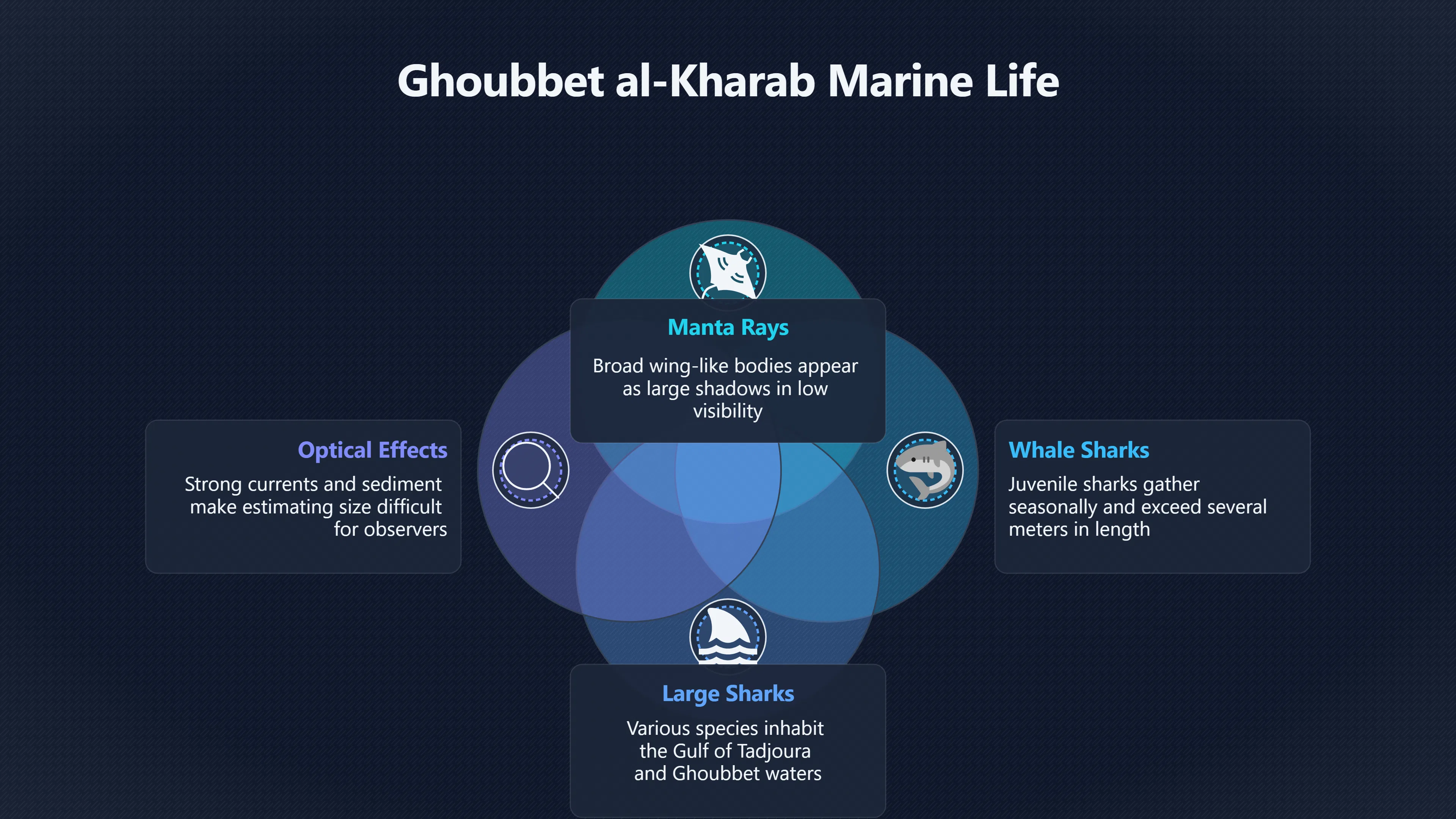
Manta rays. Their broad, wing-like bodies can appear surprisingly large from above or in poor visibility. Seen against dark water, they easily become featureless moving shadows.
Whale sharks. Djibouti is internationally famous for seasonal gatherings of juvenile whale sharks. Although these animals are harmless filter feeders, even young individuals can exceed several metres in length and appear startling when emerging from deep water.[Save Our Seas Magazine]saveourseasmagazine.comSave Our Seas MagazineArabia's SeasFor centuries the Afar people of Djibouti have told stories of a sea monster that lives in Goubet al-K…
Large sharks. Ghoubbet and the Gulf of Tadjoura support a variety of shark species, and sudden glimpses beneath the surface can be difficult to judge accurately.
Optical effects. Strong currents, suspended sediment, changing light and abrupt underwater drop-offs all make estimating size and distance unusually difficult, especially for divers or observers viewing the water from cliffs.
Taken together, these factors provide straightforward mechanisms for sincere but mistaken reports without requiring an undiscovered giant predator.
Why the legend persists
The Cousteau monster rumour survives because it links an internationally recognised explorer with one of the most visually dramatic marine locations in East Africa.
Ghoubbet already carries an evocative name—often translated as the “Gulf of the Demons”—and is surrounded by volcanic cliffs and dangerous currents. Local traditions about unusual creatures long predate the internet, giving later storytellers a ready-made foundation on which to build. Once Cousteau’s name became attached to the location, the legend gained instant credibility in popular retellings, even though the documentary record points in the opposite direction.[Wikipedia]WikipediaOpen source on wikipedia.org.
For students of Fortean history, that makes the story valuable in a different way. Rather than demonstrating the existence of an unknown animal, it shows how modern myths evolve: an authentic expedition, a famous scientist, an atmospheric landscape, fragments of local folklore and repeated retellings gradually merge into a compelling narrative that becomes more familiar than the original evidence.
In Djibouti’s catalogue of strange stories, the Cousteau monster remains memorable not because it is well supported, but because it perfectly illustrates how mystery can grow in the deep water between fact and folklore.
Amazon book picks
Further Reading
Books and field guides related to Did Cousteau Find a Monster in Djibouti?. Use these as the next step if you want deeper reading beyond the article.

The Ends of the World
‘A book about one apocalypse – much less five – could have been a daunting read, were it not for the wit, lyricism, and clarity that Pete...

Origins
First published 2019. Subjects: Human evolution, Human beings, origin, Human beings, Origin, Effect of environment on.
eBay marketplace picks
Marketplace Samples
Live-tested eBay searches with available results related to this page.




Endnotes
1.
Source: Wikipedia
Link:https://en.wikipedia.org/wiki/Ghoubbet-el-Kharab
2.
Source: saveourseasmagazine.com
Link:https://saveourseasmagazine.com/arabias-seas/
Source snippet
Save Our Seas MagazineArabia's SeasFor centuries the Afar people of Djibouti have told stories of a sea monster that lives in Goubet al-K...
3.
Source: karlshuker.blogspot.com
Title: the curious case of jacques cousteaus
Link:https://karlshuker.blogspot.com/2020/03/the-curious-case-of-jacques-cousteaus.html
Source snippet
THE CURIOUS CASE OF JACQUES COUSTEAU'S...4 Mar 2020 — It is my guess that the "Goubet monster" of Arab legend was originally a manta ray...
Additional References
4.
Source: youtube.com
Title: Djibouti Awaits: 15 Places You Can’t Miss
Link:https://www.youtube.com/watch?v=PL3-hYPJTcM
Source snippet
The Undersea World of Jacques Cousteau - E01 - Sharks...
5.
Source: youtube.com
Title: LE MONSTRE DU GHOUBBET
Link:https://www.youtube.com/watch?v=mPD75gjGf7A
Source snippet
Djibouti Awaits: 15 Places You Can't Miss...
6.
Source: youtube.com
Title: The Undersea World of Jacques Cousteau
Link:https://www.youtube.com/watch?v=a_SIVWBm57E
Source snippet
Lake Goubet Dive Site in Djibouti...
7.
Source: youtube.com
Title: Lake Goubet Dive Site in Djibouti
Link:https://www.youtube.com/watch?v=1GLU8XF_2P0
Source snippet
Africa is splitting apart RIGHT NOW...
8.
Source: youtube.com
Title: Africa is splitting apart RIGHT NOW
Link:https://www.youtube.com/watch?v=p9ik-GTh63o
Topic Tree