Why Austria's Weird Stories Still Haunt
Austria’s strange-history record is strongest where folklore, landscape and documented curiosity overlap: Alpine winter demons, dragon legends tied to fossils, haunted wells in old Vienna, treasure rumours in cold mountain lakes, meteorites once described as “stones from the air”, and a remarkably well-documented interwar mediumship controversy.
Page outline Jump by section
Introduction
The result is a distinctive Austrian Fortean texture: theatrical rather than merely spooky, mountain-haunted rather than gothic in the English sense, and often balanced between sincere belief, civic myth-making, scientific explanation and tourism. Some stories have credible physical anchors, such as a woolly rhinoceros skull behind a dragon legend or recovered counterfeit banknotes behind a Nazi treasure rumour. Others survive mainly as ritual, warning tale or urban legend. The best approach is to enjoy the strangeness without pretending that legend is the same thing as proof.
Why Austria’s weird stories cling to mountains, masks and old streets
Austria’s Fortean material often begins with geography. Alpine terrain creates isolation, sudden weather, dangerous caves, echoing valleys and dramatic seasonal changes. Those conditions are good at producing both genuine odd experiences and memorable explanations for them. A strange light on a ridge, a disappearance in a cave system, a rumour of a creature in a marsh, or a winter procession of masked figures all feel more powerful when the landscape already looks capable of hiding things.
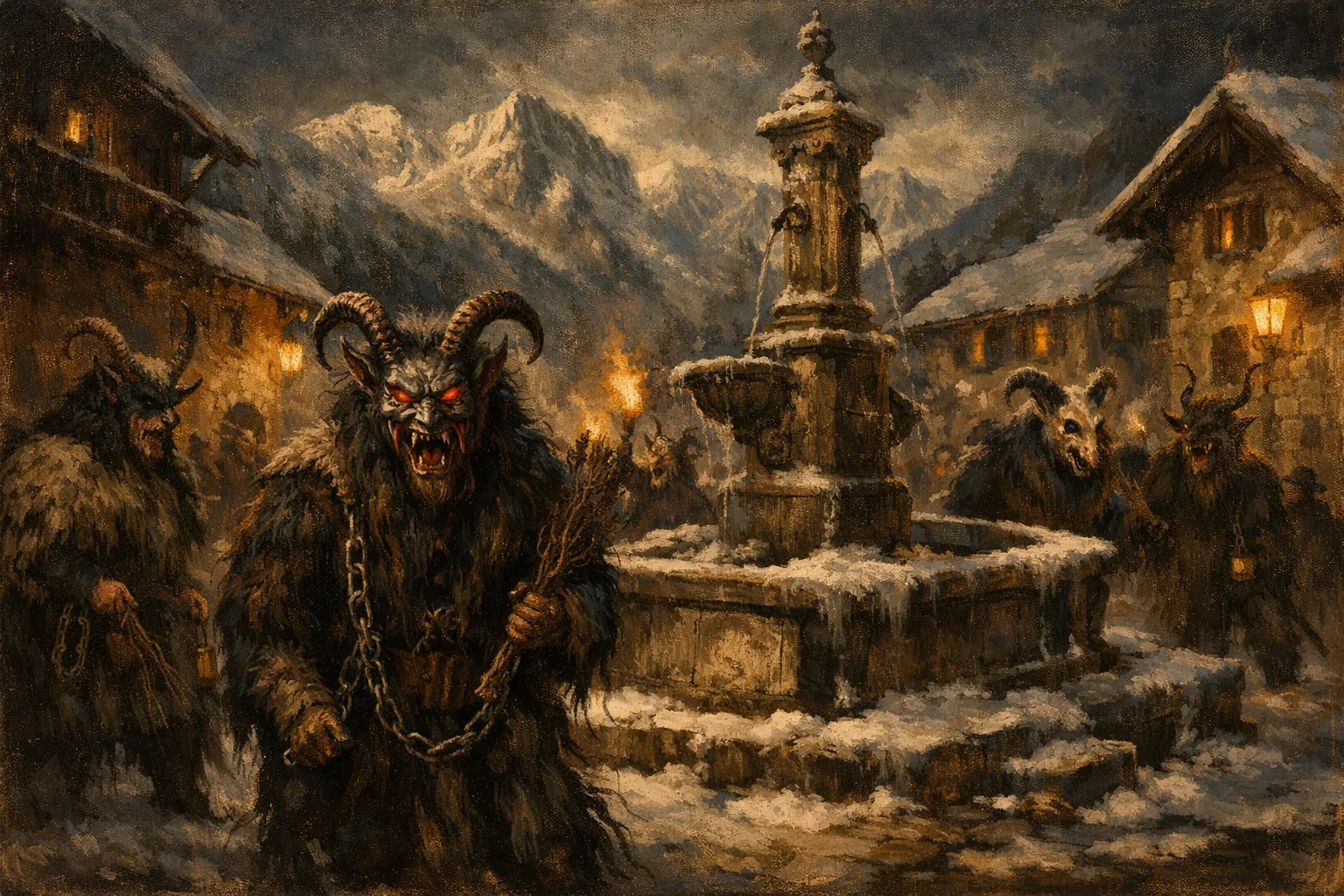
The country’s ritual culture matters just as much. Krampus and Perchten customs are not obscure internet folklore; they are public, repeated, locally organised winter traditions. Salzburg’s tourism office describes Krampus and Perchten parades around Saint Nicholas’ Day as events with hand-carved masks, shaggy pelts and heavy bells, traditionally understood as driving away dark winter spirits. Austria’s official tourism site similarly presents Krampus runs as long-standing Advent customs involving masks, bells and chains, linking spectacle with the symbolic expulsion of evil spirits.[Salzburg]salzburg.infoOpen source on salzburg.info.
This is important because it shows why Austrian weirdness is not only about alleged “incidents”. It is also performed, inherited and refreshed. A Krampus run may look demonic to an outsider, but locally it sits at the border of folk theatre, seasonal discipline, craftsmanship, carnival and controlled fright. The Öblarn Krampus play, listed by the Austrian UNESCO Commission, is described as religious folk theatre shaped especially during Austria’s Re-Catholicisation and the eighteenth century, with its lines only written down in 1989 during a field research project.[unesco.at]unesco.atOpen source on unesco.at.
For Fortean readers, that makes Austria a useful corrective to a common mistake. “Strange” does not have to mean “unexplained in a laboratory”. It may mean a living tradition in which monsters are socially useful: they scare children, mark winter’s turning point, keep craft skills alive, and give a village one night a year when the uncanny has permission to walk down the street.
Dragons with bones: Klagenfurt’s Lindwurm
Klagenfurt’s Lindwurm is one of Austria’s best examples of a legend that became civic identity. The local story tells of a dragon haunting a marshy crossing of the River Glan, making travel dangerous until it was killed by a baited bull, chain and hook. The dragon and tower then became symbols of the city, and the Lindwurm fountain still stands in Klagenfurt’s central square.[Austria in USA]austria.orgOpen source on austria.org.
What makes the case unusually satisfying is the fossil connection. A cranium of a woolly rhinoceros, reportedly found near Klagenfurt, was interpreted as the skull of a dragon. A University of Klagenfurt page on the Lindwurm story states that the fossil, still exhibited at the Landesmuseum für Kärnten, served as the model for the head of the monument, erected by Ulrich Vogelsang in 1590.[OEMG 2005]oemg2005.aau.atlindwurm storylindwurm story
That does not “prove” a dragon, of course. It does something better for weird history: it shows how a real object can steer imagination. Before modern palaeontology, large fossil bones did not arrive with explanatory labels. A skull from an extinct Ice Age mammal could be folded into the creature-language people already had. In Klagenfurt, the result was not merely a mistaken identification but a durable civic monster.
The sceptical reading is straightforward: the Lindwurm is a marsh-dragon legend later reinforced by a fossil misread through pre-scientific categories. The believer-friendly or folklore-sensitive reading is not that the dragon was zoologically real, but that the story preserved a community’s attempt to make sense of danger, flooding, landscape and uncanny remains. That is why it still works. It has a monster, a trophy, a monument and a scientific afterlife.
The Vienna basilisk: a monster in the well
Vienna’s basilisk legend belongs to a different setting: not the mountains, but the old city. At Schönlaterngasse 7, the so-called Basiliskenhaus is associated with a story that a basilisk lurked in a courtyard well. In one common version, the creature’s gaze was fatal, and a baker’s apprentice killed it by making it see its own reflection in a mirror. The house façade preserves the tale; accounts note that a later inscription used wording from an older 1577 text.[Wikipedia]WikipediaOpen source on wikipedia.org.
The basilisk is a classic European fear-creature: part serpent, part cockerel, part toad in later medieval imagination, deadly by breath or gaze. Google Arts & Culture’s short account of the Viennese basilisk notes the wider tradition that basilisks were believed to lurk in cellars, wells and shafts, places already associated with bad air, darkness and danger.[Google Arts & Culture]artsandculture.google.comOpen source on google.com.
That last point matters. A well-monster may encode ordinary urban fears: foul smells, contaminated water, suffocation, disease and the unseen hazards of a dense medieval town. The mirror motif gives the story its fairy-tale neatness, but the setting gives it its credibility. People did not need a literal basilisk to know that a dark well could kill.
As Austrian Forteana, the Vienna basilisk is valuable because it is not a remote rural tale. It shows that the uncanny also lived in the city’s infrastructure. Monsters were not only on peaks and in forests; they were under the house, in the water supply, close enough to smell.
The Tatzelwurm and the Alpine animal that never quite appears
Austria shares with other Alpine regions the legend of the Tatzelwurm: a short, serpent-like or lizard-like creature, sometimes described with a cat-like head and stubby legs. The tradition crosses borders into Bavaria, Switzerland, Italy and beyond, but Austrian names and regions are part of the wider complex. Summaries of the lore note Austrian variants such as Bergstutz or related “mountain-stump” forms in Styria, Tyrol, Salzburg and the Salzkammergut.[Wikipedia]WikipediaOpen source on wikipedia.org.
The Tatzelwurm is a classic cryptozoological border-creature. It is small enough to be almost plausible, dragon-like enough to be memorable, and vague enough to survive changes in natural history. Some reports make it venomous; some give it a shriek or hiss; some turn it into a cat-faced reptile. The more precise it becomes, the more zoologically awkward it looks. The more general it remains, the easier it is to imagine as a misidentified animal glimpsed in bad conditions.
Sceptical explanations range from snakes, lizards and otters to exaggerated stories of known animals seen briefly in steep terrain. One summary of the literature notes that an Austrian Ministry of Forestry and Environmental Protection report explained Tatzelwurm sightings as stray otters.[Wikipedia]WikipediaOpen source on wikipedia.org. That kind of explanation will not satisfy everyone, but it fits a pattern: Alpine animal legends often grow from brief encounters, fear, local naming and retelling rather than from preserved bodies.
The Tatzelwurm’s cultural role is clearer than its biological status. It keeps the old dragon tradition small and local. Unlike the grand Lindwurm of Klagenfurt, this is the dragon you nearly step on in the grass, the creature that vanishes before anyone can prove it.
Untersberg: sleeping emperors, strange time and mountain myth
The Untersberg massif, on the border near Salzburg and Berchtesgaden, is one of the most legend-heavy mountains in the Austrian orbit. Its stories include hidden caverns, dwarf-like guardians, treasures, wild beings and sleeping emperors. A widely repeated version says Emperor Frederick Barbarossa sleeps inside the mountain until a final awakening; another attaches the story to Charlemagne, guarded by small mountain beings and waiting while birds still circle outside.[Wikipedia]WikipediaOpen source on wikipedia.org.
The basic motif is older and wider than Austria: the “sleeping king in the mountain” appears in several European traditions. What makes Untersberg significant here is its density of local retelling. The mountain becomes a storage place for unresolved history. Kings do not die; they wait. Treasure is not lost; it is hidden. Time does not pass normally; it folds inside the rock.
Modern internet retellings often add stronger claims about missing time, portals and disappearances. Those should be treated carefully. Some pages claim large numbers of disappearances or dramatic modern incidents, but such claims often circulate without solid primary documentation. The evidence is much stronger for Untersberg as a long-lived legend complex than for it as a proven site of paranormal events.
Still, that distinction need not make the mountain less interesting. Untersberg’s Fortean power comes from the way it gathers motifs: caves, sleep, prophecy, treasure, missing time, returning rulers and the Wild Hunt. It is a place where folklore gives the landscape a second interior.
Lake Toplitz: when the treasure rumour had real debris behind it
Lake Toplitz in the Salzkammergut is one of Austria’s most persistent modern mystery sites. It is often framed as a Nazi treasure lake, a place where gold, documents or secret weapons might have been dumped at the end of the Second World War. The reason the story has lasted is that part of it is grounded in fact. The lake was used as a Nazi naval testing station in 1943 and 1944, and accounts record that counterfeit British banknotes from Operation Bernhard were recovered there after the war.[Wikipedia]WikipediaLake ToplitzLake Toplitz
The setting intensifies the rumour. Lake Toplitz is deep, remote and physically difficult. Its lower water layers are oxygen-poor, and submerged logs make diving dangerous. Those features have helped turn a historically explicable dumping site into a more glamorous mystery.[Wikipedia]WikipediaLake ToplitzLake Toplitz
The Guardian reported in 2005 that the Austrian government had licensed a high-tech American treasure hunter for another attempt to examine the lake, showing how the story continued to attract serious logistical effort as well as popular speculation.[The Guardian]theguardian.comThe Guardian Last dive for Lake Toplitz's Nazi gold | World newsThe Guardian Last dive for Lake Toplitz's Nazi gold | World news Yet the difference between recovered counterfeit currency and legendary “Nazi gold” remains crucial. One is documented; the other is rumour, inflated by films, television and treasure-hunting imagination.
Lake Toplitz is therefore not a paranormal case in the narrow sense. It belongs in Austria’s Fortean record because it shows how modern history can behave like folklore. A real wartime lake, real secret activity, real recovered banknotes and real diving hazards became the seedbed for stories that keep promising one more hidden layer.

Stones from the sky: Austrian meteorites before and after explanation
Meteorites are a useful reminder that some “impossible” reports become science. The Mauerkirchen meteorite fell on 20 November 1768 in what is now Upper Austria. The Meteoritical Bulletin records it as an observed fall in Austria with a mass of 19 kilograms, while a Bavarian geological source notes eyewitness observation and the historical complexity that the area was then Bavarian but is now Austrian.[LPI]lpi.usra.eduOpen source on usra.edu.
For eighteenth-century observers, a stone falling from the sky was not a mundane event. Such reports once sat close to the Fortean category of anomalous falls: things allegedly descending from above in ways respectable opinion struggled to accept. Meteorites became less “impossible” as evidence accumulated, collections formed and scientific explanation improved.
Austria is also important to meteorite culture because Vienna’s Natural History Museum houses one of the world’s great meteorite displays. The museum states that Hall 5 contains about 1,100 meteorites on display, including hundreds of falls and finds.[Naturhistorisches Museum Wien]nhm.atOpen source on nhm.at. The International Union of Geological Sciences likewise describes the Vienna Meteorite Hall as one of the museum’s highlights and among the largest meteorite displays in the world.[IUGS]iugs-geoheritage.orgOpen source on iugs-geoheritage.org.
A recent Austrian case adds a modern twist. A 2024 study connected the Ischgl meteorite, found in 1976 and later classified as a well-preserved LL6 chondrite, with a photographed European fireball from November 1970, arguing that the match effectively established it as a confirmed meteorite fall.[arXiv]arxiv.orgOpen source on arxiv.org. Here the strange report becomes reconstructable: cameras, trajectory modelling and radionuclide data replace wonder with a more precise kind of wonder.
Rudi Schneider: Austria’s laboratory ghost story
Austria’s strongest psychical-research case is not a castle haunting but the mediumship of Rudi Schneider, born in Braunau am Inn in 1908. Schneider became one of Europe’s most discussed physical mediums, investigated by figures including Harry Price, Albert von Schrenck-Notzing and others. Nature’s 1930 review of Price’s work described Schneider as a young Austrian medium associated with alleged psychic physical phenomena, alongside his brother Willi.[Nature]nature.comOpen source on nature.com.
The case is valuable because it shows the paranormal being pulled into experimental culture. Schneider’s sittings involved controls, darkness, alleged movements, disputed observations and later accusations. Summaries of the investigations note that physicists Stefan Meyer and Karl Przibram at Vienna’s Radium Institute accused Schneider of evading controls in 1924, after which the institute concluded that the phenomena were probably due to trickery and lost interest.[Wikipedia]WikipediaRudi SchneiderRudi Schneider
Yet the story did not end there. Schneider continued to be tested elsewhere, sometimes with positive claims, sometimes with negative sittings, and sometimes with suspicions of fraud or family confederacy. Encyclopedia.com notes that in one 1932 series at the National Laboratory of Psychical Research, many sittings were negative, though some investigators still considered particular results significant.[Encyclopedia.com]encyclopedia.comschneider brothers willi 1903 1971 and rudischneider brothers willi 1903 1971 and rudi
For believers, Schneider remains an example of a medium who seemed to produce effects under increasingly elaborate observation. For sceptics, he is a lesson in why darkness, expectation, weak controls and repeated failure matter. For Austrian Forteana, he is a bridge between folk ghost stories and twentieth-century laboratory controversy: less picturesque than a basilisk, but much harder to dismiss as merely a fairy tale.
Hoaxes, misreadings and the Austrian lesson
Austrian strange history repeatedly shows the same pattern: something real sits under the legend, but not always the thing the legend claims. A fossil skull helped sustain a dragon. A dangerous well helped sustain a basilisk. A wartime testing lake and counterfeit notes helped sustain treasure rumours. A real meteorite fall once sounded impossible. A real mediumship controversy produced both elaborate tests and serious accusations of trickery.
That pattern is healthier than either credulity or blanket debunking. It allows several things to be true at once:
- A story can be culturally important without being literally true.
- A physical object can be misidentified and still become historically meaningful.
- A sceptical explanation can solve the mechanism while leaving the social power of the story intact.
- A rumour can grow from a documented event and then outrun the evidence.
- A ritual monster can be “unreal” as biology and very real as public culture.
This is why Austria is such a rich country for strange-but-grounded material. Its Forteana is not a single mystery waiting for one final answer. It is a set of encounters between landscape, fear, science, religion, theatre, tourism and memory.
What Austria contributes to country-level Forteana
Austria’s weird-history record is strongest when read through place. Klagenfurt gives the dragon a fossil and a fountain. Vienna gives the basilisk a street address. Salzburg and Tyrol give winter demons a public season. Untersberg gives imperial myth a mountain interior. Lake Toplitz gives treasure legend a real wartime bottom. Vienna’s museum gives fallen stones a scientific home. Braunau gives psychical research one of its more contested European mediums.
The sceptical conclusion is not that Austria’s monsters and mysteries are “nothing”. It is that they are rarely only one thing. They are explanations, entertainments, warnings, identity markers, tourist magnets, scientific puzzles and misread evidence. Their value lies in the movement between those categories.
That makes Austria’s Forteana unusually legible. The strangeness is not hidden in a remote archive alone; it is carved into fountains, painted on façades, worn in winter processions, displayed in museums and retold around mountains and lakes. The supernatural claim may fade under scrutiny, but the weird history remains.
Amazon book picks
Further Reading
Books and field guides related to Why Austria's Weird Stories Still Haunt. Use these as the next step if you want deeper reading beyond the article.
The Mammoth Book of Unexplained Phenomena
Covers European mysteries comparable to Austrian cases.

The Rough Guide to Unexplained Phenomena 2
Adds wider Fortean perspective for Austrian stories.


eBay marketplace picks
Marketplace Samples
Live-tested eBay searches with available results related to this page.



Endnotes
1.
Source: salzburg.info
Link:https://www.salzburg.info/en/salzburg/advent/krampus-percht
2.
Source: austria.info
Link:https://www.austria.info/nl-nl/hoogtepunten/traditional-festivals/
3.
Source: unesco.at
Link:https://www.unesco.at/en/culture/intangible-cultural-heritage/inventory/element/the-oeblarner-krampusspiel-krampus-play-in-oeblarn
4.
Source: austria.org
Link:https://www.austria.org/wahrzeichen/klagenfurt
5.
Source: Wikipedia
Link:https://en.wikipedia.org/wiki/Sch%C3%B6nlaterngasse
6.
Source: Wikipedia
Title: Basilisk (Mythologie)
Link:https://de.wikipedia.org/wiki/Basilisk_%28Mythologie%29
7.
Source: artsandculture.google.com
Link:https://artsandculture.google.com/asset/viennese-basilisk/kgHoySm4wE88AA?hl=en
8.
Source: Wikipedia
Link:https://en.wikipedia.org/wiki/Tatzelwurm
9.
Source: Wikipedia
Link:https://en.wikipedia.org/wiki/Untersberg
10.
Source: Wikipedia
Title: Lake Toplitz
Link:https://en.wikipedia.org/wiki/Lake_Toplitz
11.
Source: lpi.usra.edu
Link:https://www.lpi.usra.edu/meteor/metbull.cfm?code=15446
12.
Source: iugs-geoheritage.org
Link:https://iugs-geoheritage.org/geo-collections/the-meteorite-collection-of-the-natural-history-museum-vienna/
13.
Source: arxiv.org
Link:https://arxiv.org/abs/2404.11989
14.
Source: nature.com
Link:https://www.nature.com/articles/126756a0
15.
Source: Wikipedia
Title: Rudi Schneider
Link:https://en.wikipedia.org/wiki/Rudi_Schneider
16.
Source: encyclopedia.com
Title: schneider brothers willi 1903 1971 and rudi 1908 1957
Link:https://www.encyclopedia.com/science/encyclopedias-almanacs-transcripts-and-maps/schneider-brothers-willi-1903-1971-and-rudi
17.
Source: history.com
Title: Sunken Nazi Gold and 4 Other Never-Found Treasures
Link:https://www.history.com/articles/sunken-nazi-gold-lake-toplitz-lost-legendary-treasures
18.
Source: Wikipedia
Title: Hessdalen lights
Link:https://en.wikipedia.org/wiki/Hessdalen_lights
19.
Source: Wikipedia
Link:https://en.wikipedia.org/wiki/Perchta
20.
Source: Wikipedia
Title: List of reported UFO sightings
Link:https://en.wikipedia.org/wiki/List_of_reported_UFO_sightings
21.
Source: Wikipedia
Title: Nazi UFOs
Link:https://en.wikipedia.org/wiki/Nazi_UFOs
22.
Source: Wikipedia
Title: Eusapia Palladino
Link:https://en.wikipedia.org/wiki/Eusapia_Palladino
23.
Source: Wikipedia
Title: List of Intangible Cultural Heritage elements in Austria
Link:https://en.wikipedia.org/wiki/List_of_Intangible_Cultural_Heritage_elements_in_Austria
24.
Source: Wikipedia
Title: Mauerkirchen (Meteorit)
Link:https://de.wikipedia.org/wiki/Mauerkirchen_%28Meteorit%29
25.
Source: Wikipedia
Title: Meteorite fall
Link:https://en.wikipedia.org/wiki/Meteorite_fall
26.
Source: Wikipedia
Link:https://de.wikipedia.org/wiki/Sch%C3%B6nlaterngasse
27.
Source: Wikipedia
Link:https://en.wikipedia.org/wiki/Lindworm
28.
Source: Wikipedia
Link:https://en.wikipedia.org/wiki/Traunsee
29.
Source: unesco.at
Link:https://www.unesco.at/en/culture/intangible-cultural-heritage/inventory
30.
Source: salzburg.info
Link:https://www.salzburg.info/de/salzburg/advent-stille-nacht/krampus-perchten
31.
Source: ich.unesco.org
Link:https://ich.unesco.org/en/state/austria-AT
32.
Source: ich.unesco.org
Title: schemenlaufen the carnival of imst austria 00726
Link:https://ich.unesco.org/en/RL/schemenlaufen-the-carnival-of-imst-austria-00726
33.
Source: ich.unesco.org
Link:https://ich.unesco.org/en/state/austria-AT?info=periodic-reporting
34.
Source: ich.unesco.org
Link:https://ich.unesco.org/en-state/austria-AT?call=film&id=36750&include=film_inc.php&width=700
35.
Source: history.com
Title: of UFOs
Link:https://www.history.com/articles/history-of-ufos
36.
Source: war.gov
Title: 65 hs1 834228961 62 hq 83894 section 10
Link:https://www.war.gov/medialink/ufo/release_1/65_hs1-834228961_62-hq-83894_section_10.pdf
37.
Source: austria.info
Link:https://www.austria.info/en-gb/inspiration/raucous-traditions/
38.
Source: time.com
Title: science ghost hunter
Link:https://time.com/archive/6767830/science-ghost-hunter/
39.
Source: ia801301.us.archive.org
Title: Fortean Times Christmas 2015
Link:https://ia801301.us.archive.org/24/items/Fortean_Times_Christmas_2015/Fortean_Times_Christmas_2015.pdf
40.
Source: ia800105.us.archive.org
Link:https://ia800105.us.archive.org/33/items/LifeEnergiesPhysicsOfParanormalPhenomena1977/LifeEnergiesPhysicsOfParanormalPhenomena1977.pdf
41.
Source: tyrol.com
Link:https://www.tyrol.com/activities/events/krampus-processions
42.
Source: encyclopedia.com
Title: palladino eusapia 1854 1918
Link:https://www.encyclopedia.com/science/encyclopedias-almanacs-transcripts-and-maps/palladino-eusapia
43.
Source: salzkammergut.at
Link:https://www.salzkammergut.at/en/things-to-do/worth-visiting/unesco-intangible-cultural-heritage-in-the-salzkammergut.html
44.
Source: oemg2005.aau.at
Title: lindwurm story
Link:https://oemg2005.aau.at/lindwurm_story.html
45.
Source: theguardian.com
Title: The Guardian Last dive for Lake Toplitz’s Nazi gold | World news
Link:https://www.theguardian.com/world/2005/apr/06/austria.secondworldwar
46.
Source: lfu.bayern.de
Link:https://www.lfu.bayern.de/geologie/meteorite/bayern/doc/mauerkirchen.pdf
47.
Source: nhm.at
Link:https://www.nhm.at/en/research/mineralogy__petrography/collections/the_meteorite_collection
48.
Source: cryptidz.fandom.com
Link:https://cryptidz.fandom.com/wiki/Tatzelwurm
49.
Source: cryptozoologycryptids.fandom.com
Link:https://cryptozoologycryptids.fandom.com/wiki/Tatzelwurm
50.
Source: cryptidarchives.fandom.com
Link:https://cryptidarchives.fandom.com/wiki/Tatzelwurm
51.
Source: viennawurstelstand.com
Link:https://viennawurstelstand.com/location/basilisk-historical-spots-in-vienna/
52.
Source: astonishinglegends.com
Link:https://astonishinglegends.com/astonishing-legends/2018/9/24/tatzelwurm
53.
Source: salzburgerland.com
Title: Krampusläufe im Salzburger Land
Link:https://www.salzburgerland.com/de/magazin/krampuslaeufe-im-salzburgerland/
54.
Source: hou.usra.edu
Link:https://www.hou.usra.edu/meetings/lpsc2026/pdf/1216.pdf
55.
Source: salzburginfo.or.at
Link:https://salzburginfo.or.at/en/salzburg/advent/krampus-percht
56.
Source: tripadvisor.com
Title: Naturhistorisches Museum Wien
Link:https://www.tripadvisor.com/Attraction_Review-g190454-d191373-Reviews-Naturhistorisches_Museum_Wien-Vienna.html
57.
Source: sites.pitt.edu
Link:https://sites.pitt.edu/~dash/sleep.html
58.
Source: nhm.at
Link:https://www.nhm.at/en/press/__428
59.
Source: icq.eps.harvard.edu
Link:https://www.icq.eps.harvard.edu/meteorites.html
60.
Source: hauntedvienna.blogspot.com
Link:https://hauntedvienna.blogspot.com/2020/10/untersberg-mystery-mountain.html
61.
Source: austria-forum.org
Title: Rudi Schneider
Link:https://austria-forum.org/af/AustriaWiki/Rudi_Schneider
62.
Source: kandlus.net
Link:https://kandlus.net/blog/single.html?id=The-Mysteries-of-Untersberg-Mountain
Additional References
63.
Source: youtube.com
Title: KRAMPUS: The History of the Christmas Demon
Link:https://www.youtube.com/watch?v=xMHq0wfgtuY
Source snippet
Natural History museum Vienna Austria | Dinosaur skeleton, fossils, meteors and meteorites, wildlife...
64.
Source: youtube.com
Title: Is There Sunken Nazi Treasure At The Bottom Of Lake Toplitz?
Link:https://www.youtube.com/watch?v=kVBdqMdUQnk
Source snippet
Krampus: The Christmas Demon & Santa's Shadow | Alpine Folklore History...
65.
Source: youtube.com
Title: Krampus: The Christmas Demon & Santa’s Shadow | Alpine Folklore History
Link:https://www.youtube.com/watch?v=ffkHiZJ23gY
Source snippet
Klagenfurt Dragon: Austria's Monster Beneath the City...
66.
Source: academia.edu
Link:https://www.academia.edu/119234093/Moral_Meteorologies_The_interpretation_of_celestial_phenomena_and_climate_anomalies_in_the_global_Middle_Ages_De_Medio_Aevo_131
67.
Source: researchgate.net
Link:https://www.researchgate.net/publication/350939886_The_Braunau_Trance_Mediums_and_their_Spiritualist_Circle_Between_the_Two_World_Wars_A_Local_Study
68.
Source: researchgate.net
Link:https://www.researchgate.net/publication/317754928_Anomalous_phenomena_the_scientific_mind_Some_Insights_from_Psychologist_Louis_Favre
69.
Source: researchgate.net
Link:https://www.researchgate.net/publication/350939971_The_Return_of_the_Controversy_Testing_Psychics_in_the_1970s_and_its_Consequences_for_German_Parapsychology
70.
Source: spr.ac.uk
Link:https://www.spr.ac.uk/9-hauntings-and-poltergeists
71.
Source: facebook.com
Link:https://www.facebook.com/DonegalWeatherC/posts/a-bright-meteor-fireball-was-captured-streaking-across-the-sky-over-western-germ/1593561039021882/
72.
Source: reddit.com
Link:https://www.reddit.com/r/Cryptozoology/comments/1221huo/a_early_report_on_the_tatzelwurm_or_alpine/
Topic Tree
Follow this branch
Related pages 192
- Afghan Forteana
- Antigua Uncanny
- Bosnian Mysteries
- Botswana Weird
- Brazil Strange
- +187 more in sidebar