Within Timor Leste Strange
When the National Ancestor Has Teeth
Timor-Leste's crocodile lore turns a dangerous predator into ancestor, warning sign and national origin figure.
On this page
- The boy, the crocodile and the island
- Why attacks became a modern crisis
- Belief, conservation and public safety
Page outline Jump by section
Introduction
Timor-Leste’s best-known strange tradition is not about an imaginary monster but a very real predator. Across much of the country, the saltwater crocodile is revered as “Grandfather Crocodile”, an ancestral being linked to the national creation story in which a grateful crocodile transforms into the island itself. That belief has become inseparable from one of the country’s most difficult modern problems: a sharp rise in crocodile attacks on people. The result is an unusual collision between folklore, conservation and public safety. A creature regarded as kin can also be one of the world’s most dangerous reptiles, forcing communities and officials to balance respect for tradition with the need to reduce fatal encounters.[Cambridge University Press & Assessment]cambridge.orgCambridge University Press & AssessmentWildlife conservation through traditional values: alarming numbers of crocodile attacks reported f…
The boy, the crocodile and the island
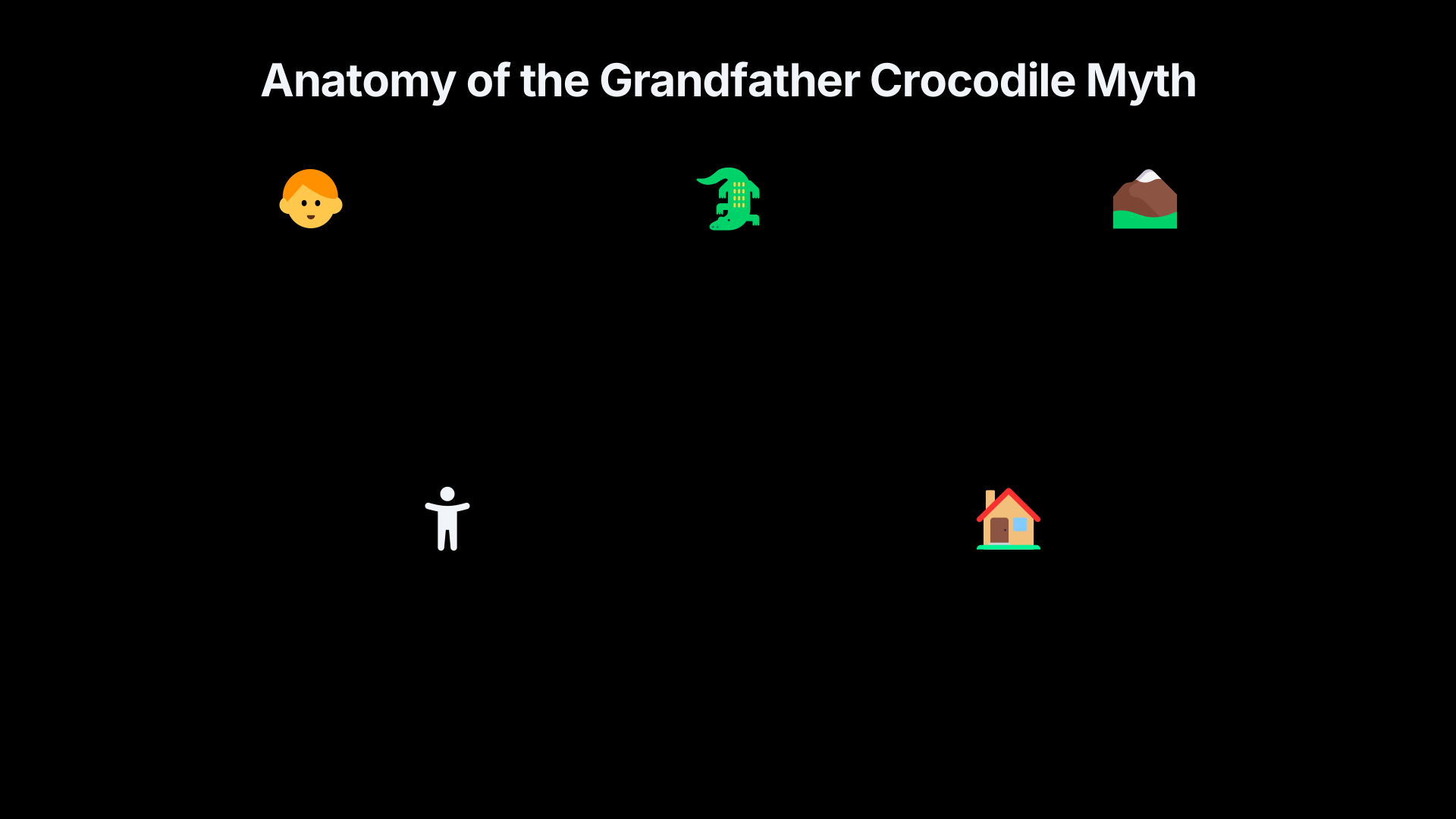
The foundation story tells of a lonely boy who befriends a young crocodile. After the boy helps the animal, the crocodile later repays the kindness by carrying him across the sea before finally becoming the island of Timor. Mountains form its spine, and the island itself is imagined as the resting body of the transformed animal.
Unlike many legendary beasts, this ancestor has a living counterpart. Saltwater crocodiles inhabit Timor-Leste’s rivers, estuaries and coastal waters, so the myth is reinforced by daily experience. The crocodile is therefore not simply a symbol of national identity but a presence in the landscape.
This has profound consequences. In many communities crocodiles are understood as ancestors capable of rewarding respect and punishing wrongdoing. The idea is woven into the traditional belief system rather than existing as a detached folktale. Researchers found that many Timorese distinguish between local “ancestor” crocodiles, which belong spiritually to a place, and other crocodiles that are regarded as outsiders or “troublemakers”. That distinction becomes important whenever officials consider removing dangerous animals.[Taylor & Francis Online]tandfonline.comTaylor & Francis OnlineCrocodile management in Timor-Leste: Drawing upon traditional ecological knowledge and cultural beliefs: Human Dim…
Why attacks became a modern crisis
For centuries people and crocodiles shared the same rivers, but documented attacks have increased dramatically since independence.
Researchers compiling historical records found a 23-fold rise in reported attacks between 2007 and 2014, identifying more than one hundred documented incidents during that period alone. Follow-up fieldwork in 2022 showed that attacks had continued at worrying levels in several districts rather than fading away.[Cambridge University Press & Assessment]cambridge.orgCambridge University Press & AssessmentWildlife conservation through traditional values: alarming numbers of crocodile attacks reported f…
Several factors appear to overlap:
- Recovering crocodile populations. Colonial-era hunting had greatly reduced crocodile numbers, but legal protection and reduced hunting after independence allowed populations to recover.[Cambridge University Press & Assessment]cambridge.orgCambridge University Press & AssessmentWildlife conservation through traditional values: alarming numbers of crocodile attacks reported f…
- People’s dependence on waterways. Fishing, washing, collecting shellfish and crossing rivers place many rural residents in crocodile habitat every day.[Taylor & Francis Online]tandfonline.comTaylor & Francis OnlineCrocodile management in Timor-Leste: Drawing upon traditional ecological knowledge and cultural beliefs: Human Dim…
- Cultural reluctance to kill crocodiles. Even after fatal attacks, many communities reject retaliation because harming an ancestor crocodile is considered spiritually dangerous or morally wrong.[Cambridge University Press & Assessment]cambridge.orgCambridge University Press & AssessmentWildlife conservation through traditional values: alarming numbers of crocodile attacks reported f…
- Under-reporting. Researchers argue that some attacks are never officially recorded because victims or relatives may believe the incident reflects moral failure or spiritual punishment, making it shameful to discuss publicly.[Conservation International]conservation.orgConservation InternationalOn island nation, ‘ancestral bond’ to crocodiles is tested | Conservation InternationalJune 1, 2026…
These interacting causes make Timor-Leste unusual. The challenge is not simply ecological but cultural.
Why “Grandfather” is not just a metaphor
Outside observers sometimes assume “Grandfather Crocodile” is merely an affectionate nickname. Field research suggests something much deeper.
Interviews with village leaders, traditional authorities and government specialists found that ceremonies remain important in many districts before activities involving crocodiles or crocodile habitat. Some communities maintain dedicated crocodile houses and recognise traditional crocodile custodians responsible for rituals intended to preserve harmony between people and the animals.[Cambridge University Press & Assessment]cambridge.orgCambridge University Press & AssessmentWildlife conservation through traditional values: alarming numbers of crocodile attacks reported f…
Researchers also documented striking differences between regions. In parts of Lautém, Viqueque and Cova Lima, crocodiles retain strong sacred status and retaliation after attacks is widely rejected. In contrast, some communities in Manufahí have historically regarded crocodiles more as wildlife than as ancestors, and hunting has occurred there for food or safety. This regional variation shows that there is no single Timorese attitude towards crocodiles, even though the national creation story is widely recognised.[Cambridge University Press & Assessment]cambridge.orgCambridge University Press & AssessmentWildlife conservation through traditional values: alarming numbers of crocodile attacks reported f…
The ancestral interpretation also shapes how attacks are explained. A fatal encounter may be viewed not as random bad luck but as evidence that social obligations, rituals or moral rules have somehow been broken. Such interpretations coexist alongside scientific explanations based on crocodile behaviour rather than replacing them entirely.
Belief, conservation and public safety
Conservation presents an unusual dilemma. From a biological perspective, recovering saltwater crocodile populations represent a conservation success after decades of depletion. From the perspective of riverside communities, however, recovery has brought increased danger.
Researchers argue that standard wildlife-management approaches developed elsewhere cannot simply be transplanted into Timor-Leste. Large-scale culling would conflict with deeply held beliefs in many districts and could undermine trust between conservation agencies and local communities. Equally, relying only on spiritual traditions does little to reduce the real risk faced by fishermen, children and people using rivers every day.[Taylor & Francis Online]tandfonline.comTaylor & Francis OnlineCrocodile management in Timor-Leste: Drawing upon traditional ecological knowledge and cultural beliefs: Human Dim…
Instead, many specialists advocate combining scientific management with traditional ecological knowledge. Suggested measures include:
- involving respected traditional elders alongside government wildlife authorities;
- identifying habitual high-risk crocodiles where culturally acceptable;
- improving reporting of attacks;
- mapping dangerous waterways;
- increasing public awareness of crocodile behaviour while respecting ancestral beliefs rather than dismissing them.[Taylor & Francis Online]tandfonline.comTaylor & Francis OnlineCrocodile management in Timor-Leste: Drawing upon traditional ecological knowledge and cultural beliefs: Human Dim…
This approach treats local belief as part of the solution rather than simply an obstacle.
Why this story belongs in Timor-Leste’s strange history
Grandfather Crocodile occupies an unusual place in Fortean-style folklore because nothing supernatural needs to be proven for the story to be remarkable. The strange element lies in the way myth shapes everyday reality.
A dangerous apex predator becomes simultaneously ancestor, national founder, moral judge and protected wildlife. People may knowingly fish beside animals capable of killing them because they believe those crocodiles recognise kinship or distinguish between respectful and disrespectful behaviour. At the same time, conservation biologists document measurable increases in attacks and search for practical ways to reduce them without destroying the beliefs that have helped preserve crocodiles in the first place.[conservation.org]conservation.orgConservation InternationalOn island nation, ‘ancestral bond’ to crocodiles is tested | Conservation InternationalJune 1, 2026…
The result is one of the clearest examples in world folklore of a national origin myth continuing to influence real decisions about life, death and wildlife management. In Timor-Leste, the country’s legendary ancestor still has teeth.
Amazon book picks
Further Reading
Books and field guides related to When the National Ancestor Has Teeth. Use these as the next step if you want deeper reading beyond the article.


The Crocodile: Evolution's Greatest Survivor
Explains the biology of crocodiles alongside mythic interest.
eBay marketplace picks
Marketplace Samples
Live-tested eBay searches with available results related to this page.




Endnotes
1.
Source: cambridge.org
Link:https://www.cambridge.org/core/journals/oryx/article/wildlife-conservation-through-traditional-values-alarming-numbers-of-crocodile-attacks-reported-from-timorleste/F87981A26E058E5A48B72B326358B08D
Source snippet
Cambridge University Press & AssessmentWildlife conservation through traditional values: alarming numbers of crocodile attacks reported f...
2.
Source: conservation.org
Link:https://www.conservation.org/news/on-island-nation-ancestral-bond-to-crocodiles-is-tested
Source snippet
Conservation InternationalOn island nation, ‘ancestral bond’ to crocodiles is tested | Conservation InternationalJune 1, 2026...
Published: June 1, 2026
3.
Source: cambridge.org
Title: Most incidents were in the evening, mostly involving
Link:https://www.cambridge.org/core/journals/oryx/special-sections/herpetofauna-conservation
Source snippet
Herpetofauna conservationWe used a questionnaire to capture the details of incidents that occurred during 2000–2020 in the villages of Du...
4.
Source: tandfonline.com
Link:https://www.tandfonline.com/doi/abs/10.1080/10871209.2019.1614240
Source snippet
Taylor & Francis OnlineCrocodile management in Timor-Leste: Drawing upon traditional ecological knowledge and cultural beliefs: Human Dim...
Additional References
5.
Source: researchgate.net
Link:https://www.researchgate.net/publication/333220611_Crocodile_management_in_Timor-Leste_Drawing_upon_traditional_ecological_knowledge_and_cultural_beliefs
Source snippet
May 20, 2019 — CROCODILE MANAGEMENT IN TIMOR-LESTE: DRAWING UPON TRADITIONAL ECOLOGICAL KNOWLEDGE AND CULTURAL BELIEFS * May 2019 * Human...
Published: May 20, 2019
6.
Source: doaj.org
Link:https://doaj.org/article/eb39f7b9fbcd414d9e8b22b1664a1a0a
Source snippet
ate for Environment, Biodiversity Directorate, Dili, Timor-Leste Marcal Gusmao Centre for Climate Change and Biodiversity, National Unive...
7.
Source: researchers.cdu.edu.au
Title: Sideleau, Karen S. Edyvane, Adam R.C. Britton Resea
Link:https://researchers.cdu.edu.au/en/publications/an-analysis-of-recent-saltwater-crocodile-icrocodylus-porosusi-at/
Source snippet
analysis of recent saltwater crocodile (>Crocodylus porosus>) attacks in Timor-Leste and consequences for management and conservation - C...
8.
Source: researchers.cdu.edu.au
Title: Xavier, Josh Trindade, Marcal Gusmao, Peter P
Link:https://researchers.cdu.edu.au/en/publications/crocodile-management-in-timor-leste-drawing-upon-traditional-ecol/
Source snippet
management in Timor-Leste: Drawing upon traditional ecological knowledge and cultural beliefs - Charles Darwin UniversityMay 20, 2019 — C...
Published: May 20, 2019
9.
Source: agris.fao.org
Title: E. | Trindade, Josh | Gusmao,
Link:https://agris.fao.org/search/en/providers/122535/records/65dfa7820f3e94b9e5daf63f
Source snippet
management in Timor-Leste: Drawing upon traditional ecological knowledge and cultural beliefsCROCODILE MANAGEMENT IN TIMOR-LESTE: DRAWING...
10.
Source: kommunikation.uni-freiburg.de
Title: Photo: Yusuke Fukuda
Link:https://kommunikation.uni-freiburg.de/pm-en/press-releases-2019/holy-crocodiles
Source snippet
Crocodiles — Archive of the Office of University and Science Communications (until 08/2024)July 2, 2019 — HOLY CROCODILES Sebastian Brack...
Published: July 2, 2019
11.
Source: youtube.com
Title: Crocodiles as ancestors: Why Timor-Leste treats man-eaters with reverence
Link:https://www.youtube.com/watch?v=R9_mD4b-B-A
Source snippet
Grandfather Crocodile: The Sacred Animal of Timor-Leste...
12.
Source: youtube.com
Title: In Timor-Leste, crocodiles are sacred ancestors—and a growing threat
Link:https://www.youtube.com/watch?v=680DInE_fWc
Source snippet
East Timor's sacred crocodiles and the increasing attacks...
13.
Source: youtube.com
Title: Grandfather Crocodile: The Sacred Animal of Timor-Leste
Link:https://www.youtube.com/watch?v=F07D4Q63V-A
Source snippet
In Timor-Leste, crocodiles are sacred ancestors—and a growing threat...
14.
Source: youtube.com
Title: East Timor’s sacred crocodiles and the increasing attacks
Link:https://www.youtube.com/watch?v=ZpDbyy94f8M
Source snippet
Understanding Timor-Leste's Crocodile Cult and Conservation...
Topic Tree