What Makes Belize's Weird Stories Endure?
Belize’s strange-history record is less a catalogue of tidy “cases” than a living mixture of forest warnings, river ghosts, cave ritual, jaguar rumours, tourist retellings and the occasional newspaper report of odd lights in the sky.
Page outline Jump by section
Why Belize’s strange stories cluster around bush, water and caves
Many countries have ghost stories; Belize’s most distinctive material often starts with landscape. A child is warned not to stray too deep into the bush. A man hears a woman near a tree at night. A traveller meets a dog-like thing on a lonely road. A diver looks into a perfect dark circle in the reef. A visitor enters a cave where Maya ritual objects and human remains are still visible. The settings matter because they are not stage dressing: they are the hazards and thresholds around which the stories make sense.
Belize is small, but ecologically and culturally layered. The national tourism board describes Mestizo heritage as rooted in Maya and Spanish ancestry, with northern Belize especially associated with Mestizo descendants, while other Belizean identities include Creole, Maya, Garifuna and more recent communities.[Travel Belize]travelbelize.orgTravel Belizebelizean cultureTravel Belizebelizean culture NICH, Belize’s National Institute of Culture and History, frames its work around cultural heritage, archaeology, museums and social research, a useful reminder that Belizean “weird” material sits inside broader questions of heritage rather than outside respectable culture.[nichbelize.org]nichbelize.orgOpen source on nichbelize.org.
That is why the most convincing reading of Belizean Forteana is double-edged. On one side are supernatural claims: spirits, goblins, shape-shifters and monstrous animals. On the other are social functions: keeping children away from rivers and forest, discouraging drunken wandering, explaining uncanny animal behaviour, marking sacred places, or giving a memorable face to danger. A sceptical reader does not have to treat Tata Duende as a literal forest being to see why a small, backward-footed guardian of the bush remains a powerful story.
Tata Duende: the little forest guardian with no thumbs
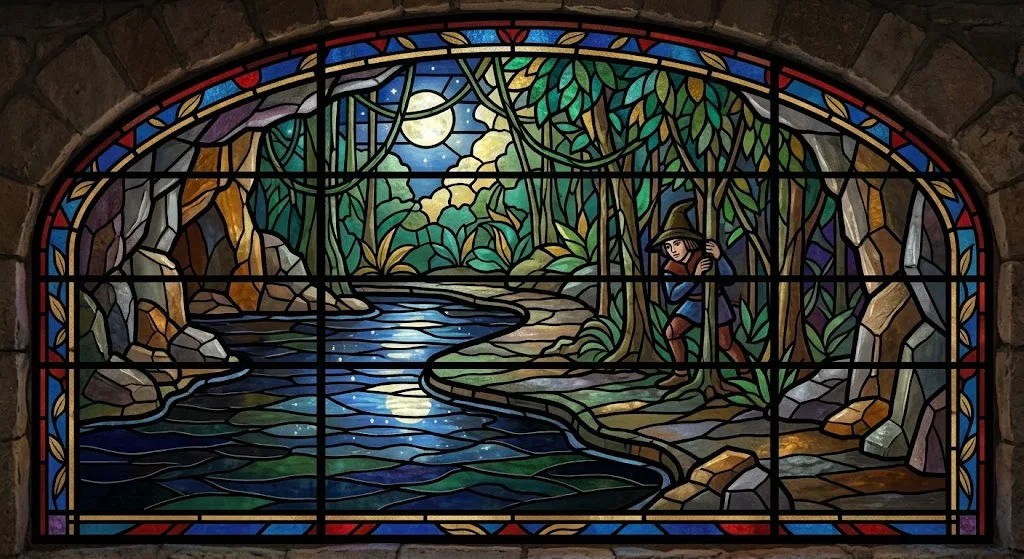
Tata Duende is probably Belize’s best-known strange figure: a short, old, hat-wearing forest being, often described with backward-facing feet and missing thumbs. In popular Belizean retellings he may lure children into the jungle, braid horses’ manes, whistle, punish greedy hunters or protect animals. Belize Hub’s folklore summary presents him as a bogeyman used to frighten misbehaving children, while other local retellings emphasise his role as guardian of animals and people in the forest.[Belize Hub]belizehub.comOpen source on belizehub.com.
The thumb detail is the bit readers remember. Children are warned that if they meet Tata Duende they should hide their thumbs, because he lacks them and may remove theirs. That is classic folklore logic: grotesque, simple, portable, and easy to act out. The backwards feet also do useful narrative work. They make tracking him impossible and turn the forest itself into a trickster space, where ordinary signs cannot be trusted.
Believers tend to treat Tata Duende as more than a mere scare story: a real bush presence, especially in rural memory. Sceptics are more likely to see him as a composite figure, blending Maya, Mestizo and wider Latin American “little people” motifs with practical child-safety warnings. There is also an obvious natural-history angle. Belize’s forests contain monkeys, nocturnal animals, strange calls and fleeting movement in dense vegetation. A partial glimpse in poor light can become more impressive in the telling, especially when the listener already knows what shape the story is supposed to take.
Tata Duende’s cultural status is not just an internet invention. Several secondary summaries note that he has appeared in Belizean folklore stamp culture, and travel and heritage-facing sources continue to present him as one of the country’s signature legends.[Wikipedia]WikipediaTata DuendeTata Duende That does not prove sightings; it proves something more durable for Fortean purposes: the figure has become public folklore, recognised beyond a single village or family.
La Xtabai and La Llorona: dangerous beauty, water and warning
Belize’s female apparition stories often turn on a familiar but potent contrast: beauty at a distance, danger up close. La Xtabai is commonly described as a beautiful woman who appears to men at night, sometimes near a ceiba tree, and lures them towards death, sickness or madness. Belize’s tourism site describes her as an enchanting seductress with long dark hair, used as a warning for misbehaving children or husbands, and notes variations in which she has an animal-like foot or can change form.[Travel Belize]travelbelize.orgTravel Belize Get to know Belize's FolkloreTravel Belize Get to know Belize's Folklore
A more personal rural-folklore account collected in a cultural journal-style blog gives the story a sharper uncanny detail: the Xtabai may appear human until one notices her feet, which can be described as bird-like, hoofed or otherwise wrong. The same account stresses a taboo on speaking of the encounter afterwards, linking sight, secrecy and illness.[Cardiff University SHARE eJournal]cushareejournal.wordpress.comOpen source on wordpress.com. For a Fortean reader, the interest lies in the story’s precision. It is not merely “a ghost woman”; it is a test of perception. The witness sees beauty first, then notices the flaw.
La Llorona, the Weeping Woman, is broader than Belize and appears across Latin America in many versions. In Belizean summaries she is usually associated with mourning, drowned or lost children, night cries and danger near water or the bush. Belize Hub describes her as a beautiful woman with long black hair whose face is hidden or deformed, while Belizean popular accounts connect her to riverside crying and warnings to children.[Belize Hub]belizehub.comOpen source on belizehub.com.
The sceptical reading is not dismissive; it is functional. These stories warn people away from risky places and risky behaviour: rivers after dark, drunken wandering, sexual temptation, lonely paths, and the assumption that beauty is harmless. The believer’s reading gives those warnings a supernatural enforcer. Either way, the stories endure because they are emotionally efficient. A parent can say “do not go near the river”; a legend makes the river answer back.
El Cadejo and the Sisimite: road beasts and ape-men
El Cadejo belongs to the family of night-road creatures known across Central America: a shaggy, dog-like or goat-like being that appears to travellers. Belizean retellings describe it as a hairy animal or large dog, often tied to moral danger, night travel and the uneasy journey home.[mybeautifulbelize.com]mybeautifulbelize.combelizean folktales el cadejobelizean folktales el cadejo Some regional versions divide the creature into a protective white Cadejo and a dangerous black Cadejo, though local tellings vary, and Belizean summaries often focus on the frightening encounter rather than a neat moral taxonomy.[Wikipedia]WikipediaOpen source on wikipedia.org.
What makes the Cadejo Fortean is its closeness to ordinary experience. A person walking at night really may hear claws, smell an animal, glimpse eyeshine or be followed by a dog. The story turns a frightening but plausible encounter into a moralised apparition. It lives in the gap between “there was something on the road” and “the road itself was warning me”.
The Sisimite, sometimes rendered Sisimito or Sisimita in regional traditions, is stranger in a cryptozoological sense: a hairy, human-like or ape-like being associated with caves, wild country and abduction motifs. Belizean tourist-facing summaries describe Sisemites as short, fur-covered beings living in deep caves, closer to apes than humans.[Laru Beya]larubeya.comLaru Beya Get to know Belize's FolkloreLaru Beya Get to know Belize's Folklore Wider summaries of the Central American figure describe a bipedal, gorilla-like monster known in Belize and neighbouring countries, with variations including long fur, human-like features and backward-facing feet.[Wikipedia]WikipediaOpen source on wikipedia.org.
There is no strong zoological evidence for an unknown ape-man in Belize. The Sisimite’s value is as a regional “wild man” figure: a way of imagining the bush as inhabited by something almost human but not safely human. Like many mystery-animal traditions, it borrows from real fear — isolation, caves, animal calls, getting lost — and gives it a body.
Black jaguars: where real wildlife feeds mystery
Belize’s most grounded “mystery animal” is not an impossible beast but a rare form of a real one. Jaguars live in Belize, and their presence near farms or settlements can produce fear, rumours and dramatic night sightings. The Belize Forest Department links human-jaguar conflict to population growth, land-use change and deforestation, and notes that problem jaguars are often old, sick or injured animals less able to hunt wild prey.[Belize Forest Dept]forest.gov.bzBelize Forest Dept Living with WildlifeBelize Forest Dept Living with Wildlife The Belize Zoo similarly explains that conflict jaguars repeatedly prey on livestock or domestic animals and are often older, injured or sick.[Belize Zoo]belizezoo.orgOpen source on belizezoo.org.
The black jaguar adds an extra Fortean charge. “Black panther” stories are famous in many countries, often involving animals that are real in one region and rumoured in another. Belize is different because jaguars are genuinely present, and melanistic jaguars are biologically real. The Belize Zoo states that black jaguars are extremely rare in the wild and that, despite many reported sightings in Belize, one has not been officially documented there; the animal would not be a separate species, but a jaguar whose dark coat still hides the normal rosette pattern underneath.[Belize Zoo]belizezoo.orgOpen source on belizezoo.org.
That makes Belize’s black-jaguar lore a perfect example of grounded Forteana. The claim is not absurd: black jaguars exist. The local evidence, however, is more slippery: reports, rumours, occasional captive or rescued animals, but no official wild documentation according to the zoo’s public account. It is exactly the sort of claim that can remain culturally alive because it is neither fully impossible nor fully confirmed.
The 2008 Belmopan lights: a small UFO flap in the hills
Belize has fewer well-documented UFO stories than countries with large UFO subcultures, but one useful example appeared in Amandala in March 2008. Residents of Belmopan and nearby areas reportedly saw a mass of bright, circular lights south of the capital, over uninhabited mountains. The lights were said to appear and disappear repeatedly between about 8:15 pm and 10:50 pm, without the sound expected from aircraft.[Amandala]amandala.com.bzAmandala Strange night sightings in 'Pan!Amandala Strange night sightings in 'Pan!
As a Fortean case, this is modest but interesting. It has a named area, a time window, multiple local witnesses according to the report, and a specific visual description. It also has the classic weakness of many UFO reports: no firm distance, altitude, size, trajectory, instrument record or recovered evidence. Bright lights over mountains can be aircraft seen at unusual angles, flares, balloons, astronomical objects, drones in more recent cases, atmospheric effects or misperceived ground lights. The lack of sound may be meaningful, or it may simply mean the objects were farther away than assumed.
The case matters because it shows how quickly Belizean weirdness can shift from inherited folklore to modern sky mystery. The language changes — “UFO” rather than forest spirit — but the structure is familiar: witnesses see something in a liminal place, ordinary explanation is not immediately satisfying, and the story becomes part of local memory.

The Great Blue Hole: real geology, tourist mystery and monster talk
The Great Blue Hole is one of Belize’s most visually uncanny places: a near-circular dark sinkhole in Lighthouse Reef, far offshore from the mainland. Its strangeness is real before any legend is added. UNESCO lists the Belize Barrier Reef Reserve System as a World Heritage Site, and standard geological accounts describe the Blue Hole as a marine sinkhole formed during periods when sea levels were lower, later flooded as the ocean rose.[Wikipedia]WikipediaGreat Blue HoleGreat Blue Hole
Modern exploration has made the site less mysterious in one sense and more eerie in another. Accounts of the 2018 submarine mapping expedition describe a deep hydrogen sulphide layer and anoxic water near the bottom, where most marine life cannot survive; reporting on the expedition also noted that bodies of missing divers were found and left undisturbed out of respect.[Live Science]livescience.comLive Science The whale-shaped island in Belize with a 'great blue blowholeThe Great Blue Hole is a massive underwater sinkhole, 1,043 feet wide and 407 feet deep, originally formed as an above-water cave system… This is not supernatural, but it is powerfully Gothic: a beautiful blue circle, a dead zone below, and preserved human remains at depth.
Monster rumours attach easily to such places. A local Ambergris Caye-hosted story preserves a “Blue Hole Monster” legend involving a snake-like head and red eyes, but this sits much closer to folklore and entertainment than to documented zoology.[ambergriscaye.com]ambergriscaye.comOpen source on ambergriscaye.com. ScienceAlert’s discussion of supposed “mysterious tracks” at the bottom of the Blue Hole is a useful corrective: even when a place is marketed as a mystery, many odd-looking features can have ordinary explanations once mapped or examined.[ScienceAlert]sciencealert.comScience Alert The 'Mysterious Tracks' on The Bottom of Belize's BlueScience Alert The 'Mysterious Tracks' on The Bottom of Belize's Blue
The Blue Hole’s Fortean pull comes from scale and symbolism. It looks like an opening into another world. In reality, it is a geological archive, a dive hazard, a tourism icon and a rumour magnet all at once.
Actun Tunichil Muknal: when archaeology feels paranormal
Actun Tunichil Muknal, often called ATM Cave, is not a ghost story in itself; it is an archaeological site. Yet few places in Belize are more likely to be described in uncanny language. The Belize Tourism Board describes it as one of the country’s impressive Maya sites, reached by swimming into a cave and walking through passages containing ceramics, stoneware and skeletons, including the calcified remains popularly called the Crystal Maiden.[Travel Belize]travelbelize.orgOpen source on travelbelize.org. NICH’s Institute of Archaeology lists Actun Tunichil Muknal Cave among Belize’s archaeological reserves in the Cayo District.[nichbelize.org]nichbelize.orgOpen source on nichbelize.org.
Archaeology Magazine’s feature on Maya caves in west-central Belize gives the stronger evidential frame: fourteen burials have been found in Actun Tunichil Muknal, along with slate stelae, bloodletting evidence and large broken pottery encased by calcite from dripwater over centuries.[Archaeology Magazine]archive.archaeology.orgOpen source on archaeology.org. A 2025 digital documentation paper describes ATM as an unlooted ancient Maya cave site in western Belize, on a tributary of Roaring Creek near Teakettle village, and discusses work to document the cave and its contents for research and public interpretation.[eScholarship]escholarship.orge Scholarship Multimodal Digital Documentation of Actun Tunichil Mucnale Scholarship Multimodal Digital Documentation of Actun Tunichil Mucnal
This is where a careful Fortean page must avoid a common mistake. The cave does not need invented ghosts to be strange. Its power comes from documented ritual use, human remains, mineral accretion, darkness, water and the survival of objects in place. Paranormal television has used the “Crystal Maiden” atmosphere, but the more responsible reading is archaeological and cultural: the cave was a sacred, dangerous and symbolically charged environment long before modern visitors arrived.[Wikipedia]WikipediaActun Tunichil MuknalActun Tunichil Muknal
What sceptics and believers are really disagreeing about
Belizean strange material rarely turns on a single laboratory-style question. The dispute is usually not “can this one photograph prove a monster?” but “what kind of truth does this story carry?” A believer may treat Tata Duende, La Xtabai or Cadejo as beings that still inhabit the bush, roads and rivers. A sceptic may treat them as cautionary tales, inherited motifs, misidentified animals, sleep-deprived perception, or stories sharpened by repetition. Both readings can explain part of the record.
The strongest sceptical explanations are not crude debunking. They include:
- Misidentification: jaguars, dogs, monkeys, birds, lights on hillsides, aircraft and reflections can become stranger in darkness or fear.
- Landscape danger: rivers, caves, forests and lonely roads are genuinely risky, so stories that personify them are memorable and useful.
- Cultural blending: Belize’s Maya, Mestizo, Creole, Garifuna and wider Central American contexts allow figures such as La Llorona, Cadejo and Xtabai to circulate in local forms rather than fixed canonical versions.
- Tourism retelling: places such as the Blue Hole and ATM Cave attract dramatic language, which can blur the line between interpretation, marketing and legend.
- Witness sincerity without certainty: a person can honestly report lights, cries or a creature without the report identifying what was physically present.
The believer’s strongest point is that folklore should not be dismissed merely because it lacks modern instrumentation. These stories encode local memory, environmental ethics and social boundaries. Tata Duende punishes wasteful hunting; La Llorona keeps children away from water; Cadejo makes night roads morally charged; the Sisimite gives wild caves a human-shaped danger. Even if none is literally proven, each reveals what Belizean communities have found worth warning about.
Why Belize belongs in a country-level Forteana map
Belize’s Fortean identity is not built around one spectacular unsolved case. It is built around recurrence: forest guardians, fatal seductresses, weeping women, road beasts, ape-men, rare cats, deep holes, sacred caves and anomalous lights. The pattern is more important than any single claim. Again and again, Belizean weirdness gathers at thresholds — between village and bush, road and darkness, reef and abyss, archaeology and the underworld, animal and apparition.
That makes Belize especially valuable for a grounded strange-history project. It shows how Forteana can be culturally rich without being evidentially extravagant. The 2008 Belmopan lights remain an unresolved local sky report, not proof of alien visitation. The black jaguar is a biologically plausible animal wrapped in rumour, not a separate mystery species. The Great Blue Hole is explained geology that still behaves like a mythic image. ATM Cave is archaeology so atmospheric that paranormal framings can seem tempting, even when the real evidence is already extraordinary. Tata Duende, La Xtabai, La Llorona, El Cadejo and the Sisimite are not random monsters; they are Belizean ways of making danger memorable.
The result is a country file where the best question is not “which of these stories is true?” but “what kind of truth is each story asking for?” Some ask for wildlife evidence. Some ask for meteorology or astronomy. Some ask for archaeology. Some ask for folklore. Belize’s strange record becomes clearest when each claim is allowed to be what it is: a sighting, a warning, a sacred place, a rumour, a tourist mystery, a misidentification, or a story that survived because it still knows exactly where people feel uneasy.
Amazon book picks
Further Reading
Books and field guides related to What Makes Belize's Weird Stories Endure?. Use these as the next step if you want deeper reading beyond the article.

eBay marketplace picks
Marketplace Samples
Live-tested eBay searches with available results related to this page.




Endnotes
1.
Source: nichbelize.org
Link:https://nichbelize.org/
2.
Source: Wikipedia
Title: Tata Duende
Link:https://en.wikipedia.org/wiki/Tata_Duende
3.
Source: mybeautifulbelize.com
Title: passed one generation next belizean folklore
Link:https://mybeautifulbelize.com/passed-one-generation-next-belizean-folklore/
4.
Source: mybeautifulbelize.com
Title: belizean folktales el cadejo
Link:https://mybeautifulbelize.com/belizean-folktales-el-cadejo/
5.
Source: Wikipedia
Link:https://en.wikipedia.org/wiki/Cadejo
6.
Source: Wikipedia
Link:https://en.wikipedia.org/wiki/Sisimito
7.
Source: Wikipedia
Title: Great Blue Hole
Link:https://en.wikipedia.org/wiki/Great_Blue_Hole
8.
Source: ambergriscaye.com
Link:https://ambergriscaye.com/photogallery/200416.html
9.
Source: sciencealert.com
Title: Science Alert The ‘Mysterious Tracks’ on The Bottom of Belize’s Blue
Link:https://www.sciencealert.com/the-mystery-tracks-on-the-bottom-of-belize-s-blue-hole-are-not-that-mysterious
10.
Source: nichbelize.org
Link:https://nichbelize.org/institute-of-archaeology/
11.
Source: archive.archaeology.org
Link:https://archive.archaeology.org/online/features/belize/tunichil.html
12.
Source: escholarship.org
Title: e Scholarship Multimodal Digital Documentation of Actun Tunichil Mucnal
Link:https://escholarship.org/content/qt4kd7b7ts/qt4kd7b7ts.pdf
13.
Source: Wikipedia
Title: Actun Tunichil Muknal
Link:https://en.wikipedia.org/wiki/Actun_Tunichil_Muknal
14.
Source: Wikipedia
Title: La Llorona
Link:https://en.wikipedia.org/wiki/La_Llorona
15.
Source: Wikipedia
Link:https://en.wikipedia.org/wiki/Xtabay
16.
Source: Wikipedia
Title: Culture of Belize
Link:https://en.wikipedia.org/wiki/Culture_of_Belize
17.
Source: Wikipedia
Title: Actun Tunichil Muknal
Link:https://de.wikipedia.org/wiki/Actun_Tunichil_Muknal
18.
Source: mybeautifulbelize.com
Title: celebrate halloween with stories of these eerie belizean folklores
Link:https://mybeautifulbelize.com/celebrate-halloween-with-stories-of-these-eerie-belizean-folklores/
19.
Source: nichbelize.org
Link:https://nichbelize.org/about-us/
20.
Source: belize.com
Title: actun tunichil muknal
Link:https://belize.com/actun-tunichil-muknal/
21.
Source: archive.org
Title: wholeearthreview00unse 1
Link:https://archive.org/download/wholeearthreview00unse_1/wholeearthreview00unse_1.pdf
22.
Source: ambergriscaye.com
Link:https://ambergriscaye.com/25years/laxtabai.html
23.
Source: ambergriscaye.com
Title: CAVE ARCHAEOLOGY OF BELIZE
Link:https://ambergriscaye.com/caving/CAVE_ARCHAEOLOGY_OF_BELIZE.pdf
24.
Source: travelbelize.org
Title: Travel Belizebelizean culture
Link:https://www.travelbelize.org/culture/
25.
Source: belizehub.com
Link:https://www.belizehub.com/belizean-folklore-legends-belize/
26.
Source: ldfieldjournal.wordpress.com
Title: belize folklore tata duende
Link:https://ldfieldjournal.wordpress.com/2011/11/09/belize-folklore-tata-duende/
27.
Source: travelbelize.org
Title: Travel Belize Get to know Belize’s Folklore
Link:https://www.travelbelize.org/blog/get-know-belizes-folklore/
28.
Source: cushareejournal.wordpress.com
Link:https://cushareejournal.wordpress.com/2018/10/31/if-you-see-her-you-must-never-tell-ghost-stories-and-folk-legends-from-rural-belize/
29.
Source: larubeya.com
Title: Laru Beya Get to know Belize’s Folklore
Link:https://www.larubeya.com/the-legends-belize-folklore-myths-broken/
30.
Source: forest.gov.bz
Title: Belize Forest Dept Living with Wildlife
Link:https://forest.gov.bz/living-with-wildlife/
31.
Source: belizezoo.org
Link:https://www.belizezoo.org/human-jaguar-conflict-program/
32.
Source: belizezoo.org
Link:https://www.belizezoo.org/jaguar/
33.
Source: amandala.com.bz
Title: Amandala Strange night sightings in ‘Pan!
Link:https://amandala.com.bz/news/strange-night-sightings-in-pan/
34.
Source: livescience.com
Title: Live Science The whale-shaped island in Belize with a ‘great blue blowhole’
Link:https://www.livescience.com/planet-earth/rivers-oceans/the-whale-shaped-island-in-belize-with-a-great-blue-blowhole-earth-from-space
Source snippet
The Great Blue Hole is a massive underwater sinkhole, 1,043 feet wide and 407 feet deep, originally formed as an above-water cave system...
35.
Source: travelbelize.org
Link:https://www.travelbelize.org/attraction/actun-tunichil-muknal-atm/
36.
Source: amandala.com.bz
Link:https://amandala.com.bz/news/2008/page/85/
37.
Source: amandala.com.bz
Link:https://amandala.com.bz/news/author/vicky/page/401/
38.
Source: amandala.com.bz
Link:https://amandala.com.bz/news/2008/03/page/2/
39.
Source: amandala.com.bz
Link:https://amandala.com.bz/news/category/general/page/551/
40.
Source: belizewithalvin.com
Title: actun tunichil muknal
Link:https://belizewithalvin.com/actun-tunichil-muknal/
41.
Source: facebook.com
Title: Belizean folklore
Link:https://www.facebook.com/groups/BelizeBestKeptSecret/posts/10157669250367248/
42.
Source: facebook.com
Title: The Belize
Link:https://www.facebook.com/BelizeZoo/photos/yesterday-tbz-officials-working-in-concert-with-the-forest-department-successful/501881119827436/
43.
Source: facebook.com
Link:https://www.facebook.com/nich.bz/
44.
Source: cryptidz.fandom.com
Title: El Cadejo
Link:https://cryptidz.fandom.com/wiki/El_Cadejo
45.
Source: restless-viking.com
Title: The Crystal Maiden
Link:https://restless-viking.com/2024/05/07/the-crystal-maiden-sacrificial-maya-cave/
46.
Source: wwf.org.uk
Link:https://www.wwf.org.uk/learn/wildlife/jaguars
47.
Source: belizeadventure.ca
Link:https://www.belizeadventure.ca/culture/
48.
Source: ihearthula.wordpress.com
Title: folktale friday lusca and the blue holes
Link:https://ihearthula.wordpress.com/2021/03/26/folktale-friday-lusca-and-the-blue-holes/
49.
Source: belizehub.com
Title: capturing the wild jaguars in belize
Link:https://www.belizehub.com/capturing-the-wild-jaguars-in-belize/
50.
Source: nationalassembly.gov.bz
Title: Act No. 27 of 2024 National Institute of Culture and History Amendment Act 2024
Link:https://www.nationalassembly.gov.bz/wp-content/uploads/2024/12/Act-No.-27-of-2024-National-Institute-of-Culture-and-History-Amendment-Act-2024.pdf
Additional References
51.
Source: fws.gov
Link:https://www.fws.gov/species/jaguar-panthera-onca
52.
Source: youtube.com
Title: A Giant Ocean Hole in Belize Just Gave Us a Big Warning
Link:https://www.youtube.com/watch?v=MDdKd_jnCDA
Source snippet
Mysterious Holes Discovered In The Bottom Of The Ocean...
53.
Source: researchgate.net
Link:https://www.researchgate.net/publication/376891986_A_global_picture_of_unidentified_anomalous_phenomena_Towards_a_cross-cultural_understanding_of_a_potentially_universal_issue
54.
Source: facebook.com
Link:https://www.facebook.com/belizelivenews/posts/a-benque-viejo-resident-captured-a-supernatural-phenomenon-on-camera-todaywhat-a/1364730642341383/
55.
Source: wildlifeworldwide.com
Link:https://www.wildlifeworldwide.com/trip-ideas/quest-for-brazils-black-panther
56.
Source: facebook.com
Link:https://www.facebook.com/AcesWildlifeRescue/posts/steeped-in-cultural-significance-and-mystery-this-elusive-jaguar-was-captured-on/1362437975923519/
57.
Source: islandexpeditions.com
Link:https://www.islandexpeditions.com/incredible-belize/venture-inland/actun-tunichil-muknal
58.
Source: blackrocklodge.com
Link:https://www.blackrocklodge.com/belize-atm-tour/
59.
Source: mayawalk.com
Link:https://www.mayawalk.com/belize-atm-cave-tour/
60.
Source: sdgacademy.org
Link:https://sdgacademy.org/institutions/belize-national-institute-of-culture-and-history/
Topic Tree
Follow this branch
Related pages 192
- Afghan Forteana
- Antigua Uncanny
- Bosnian Mysteries
- Botswana Weird
- Brazil Strange
- +187 more in sidebar