Within Luxembourg Weird
When Did Luxembourg's Folklore Turn Dangerous?
Luxembourg's witches, werewolves, and ghostly hunters reveal where folklore meets fear, punishment, hunger, and social suspicion.
On this page
- Witchcraft accusations and executions
- Werewolves, wolf straps, and hunger
- Haunted hunters in the forest night
Page outline Jump by section
Introduction
Luxembourg’s darkest folklore sits where documented history and traditional storytelling overlap. Tales of witches, werewolves and ghostly hunters were not simply fireside entertainment: they reflected genuine periods of fear, hunger, religious conflict and legal persecution. Between the sixteenth and seventeenth centuries, the Duchy of Luxembourg became one of the more active centres of witch-hunting in the southern Low Countries, while the forests and borderlands accumulated legends of spectral riders, cursed wolves and phantom hunts that survived long after the executions ended. Understanding these traditions means separating verifiable history from folklore without stripping either of its cultural significance. The trials reveal how ordinary neighbours could become enemies, while the legends show how dangerous landscapes and uncertain times became populated with supernatural figures.
When witchcraft accusations became deadly
Unlike some European countries where witch trials remained relatively limited, the Duchy of Luxembourg experienced sustained persecution during the late sixteenth and seventeenth centuries. Modern historians place the most intense period roughly between 1560 and 1683, although local outbreaks varied from one jurisdiction to another. Contemporary research shows that Luxembourg, alongside neighbouring Namur, became one of the most active witch-hunting regions in the southern Low Countries, influenced by religious upheaval, famine, plague, local judicial practices and the nearby mass persecutions in the Archbishopric of Trier.[kuleuven.be]lirias.kuleuven.be8 WITCH HUNTS IN THE LOW COUNTRIES (1450–1685)October 26, 2019 — by D Vanysacker · Cited by 4 — Namur and Luxembourg – with respect…
The exact numbers remain debated because many records have been lost. Conservative archival counts identify hundreds of legal proceedings and several hundred executions, while some historians argue that the true number of prosecutions across the duchy may have reached several thousand. What is not disputed is that Luxembourg’s persecution rate was exceptionally high for its population.[kuleuven.be]lirias.kuleuven.be8 WITCH HUNTS IN THE LOW COUNTRIES (1450–1685)October 26, 2019 — by D Vanysacker · Cited by 4 — Namur and Luxembourg – with respect…
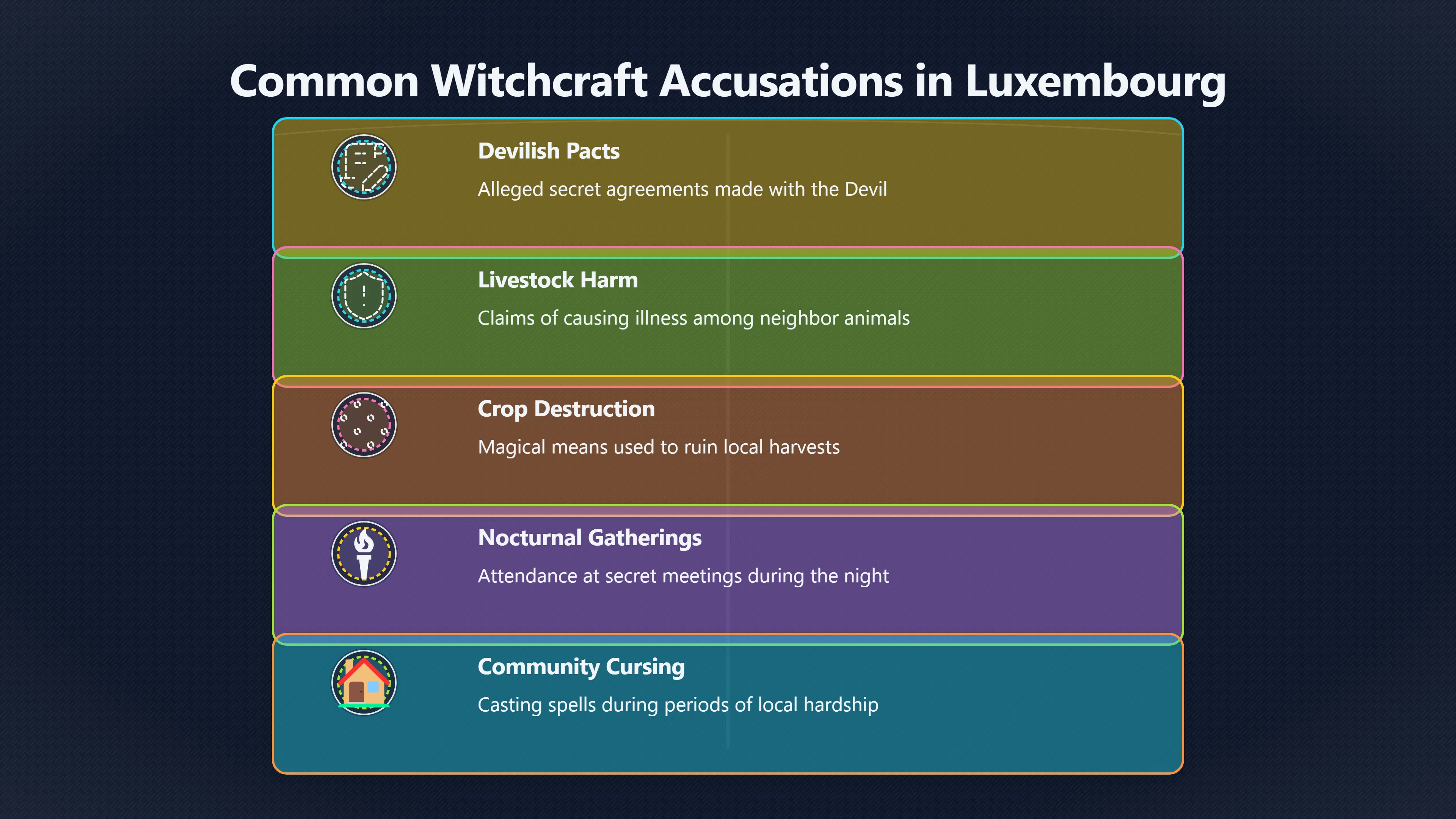
The accusations themselves followed familiar European patterns:
- Alleged pacts with the Devil.
- Causing illness among neighbours or livestock.
- Destroying crops through magical means.
- Attending secret nocturnal gatherings.
- Cursing communities during periods of hardship.
Most accusations emerged from ordinary village disputes rather than dramatic supernatural encounters. Failed harvests, unexplained deaths, epidemics or family feuds could all become evidence in an atmosphere where misfortune demanded a human cause.
Witchcraft accusations and executions
The surviving court records paint a picture far removed from later fairy tales. Suspects were frequently denounced by neighbours or relatives. Once arrested, many faced torture intended to secure confessions, after which further names were often extracted, allowing investigations to spread rapidly through neighbouring communities. Judicial procedures reinforced fear instead of testing evidence by modern standards.[Visit Luxembourg]visitluxembourg.comVisit LuxembourgBourscheid Hougeriicht – High justiceIn the 15th or 16th century, a witch trial in Bourscheid unfolded with accusations o…
A well-known local example survives at the former high court site of Bourscheid. Historical records describe six people accused of conspiring with the Devil and plotting against both God and the local lordship. Following interrogation under torture, two women were condemned and burned. The site today serves as a reminder that the picturesque landscape once witnessed judicial killings rather than legendary magic.[Visit Luxembourg]visitluxembourg.comVisit LuxembourgBourscheid Hougeriicht – High justiceIn the 15th or 16th century, a witch trial in Bourscheid unfolded with accusations o…
Late prosecutions around Echternach also stand out because they occurred when witch-hunting had already begun declining elsewhere in Europe. Historians studying the Echternach trials note that healers, widows, socially isolated women and people regarded as mentally ill or otherwise different were especially vulnerable. Rumour could be enough to begin legal proceedings.[RTL Today]today.rtl.luRTL TodayDouble, double toil and trouble: Witchcraft in Luxembourg18 Feb 2025 — According to Sonja Kmec' "Witchcraft trials in the Duchy…
From a modern perspective, these trials reveal far more about early modern society than about supernatural beliefs. Economic instability, religious conflict after the Reformation, poor harvests and endemic disease created an environment in which invisible enemies seemed plausible and judicial systems accepted forced confessions as evidence.
Werewolves, wolf fears and hunger
Luxembourg’s werewolf traditions belong to a wider cultural zone stretching across the Ardennes, Lorraine, the Rhineland and the German-speaking borderlands. Real wolves remained a genuine danger well into the early modern period, particularly during harsh winters or periods of famine. Folklore transformed this fear into stories of people crossing the boundary between humanity and beast.
Unlike Hollywood werewolves, Luxembourgish traditions usually portrayed the wolf-man less as an immortal monster than as someone cursed, bewitched or morally corrupted. Tales often warned that greed, violence or dealings with dark forces could reduce a person to an animal. Hunger also played a symbolic role. During years of scarcity, wolves became powerful images of desperate survival, and stories of human transformation reflected anxieties about civilisation collapsing under extreme conditions.
Although Luxembourg itself produced few documented werewolf trials compared with neighbouring regions, belief in lycanthropy formed part of the same intellectual world as witchcraft. Across western Europe, accusations of becoming a wolf, riding with wolves or using wolf magic occasionally appeared alongside charges of sorcery, especially in German-speaking territories close to Luxembourg.[Wikipedia]WikipediaWerewolf witch trialsWerewolf witch trials
The result is a folklore in which wolves represent more than dangerous animals. They embody the fear that ordinary people, under sufficient pressure, might become something frightening themselves.
Haunted hunters in the forest night
The forests of northern Luxembourg have long supported stories of spectral hunts moving through the darkness. Travellers described hearing distant horns, barking dogs or pounding hooves with no visible riders. Those who followed the sounds were said to become lost until dawn or return home deeply shaken.
These stories belong to the widespread European tradition often called the Wild Hunt. In Luxembourg’s border forests, however, the emphasis falls less on heroic mythology than on haunted landscapes. Phantom hunters appear as restless souls condemned to wander because of excessive pride, cruelty or sacrilege committed during life. Rather than rewarding courage, these tales warn against arrogance and reckless travel after nightfall.
The borderland setting strengthened their appeal. Dense woodland, uncertain frontiers and isolated farms naturally encouraged stories explaining strange noises, unexpected lights or disappearances in bad weather. A hunter glimpsed through mist could easily become a ghost in later retellings, while echoes carrying across valleys transformed ordinary sounds into supernatural processions.
Unlike documented witch trials, haunted hunts leave almost no contemporary legal record. Their history survives through oral tradition, nineteenth-century folklore collections and local storytelling rather than court archives. That makes them culturally revealing even when they cannot be verified as historical events.
Why these stories endured
Luxembourg’s dangerous folklore persisted because it served different purposes across different periods.
During the witch persecutions, stories reinforced social suspicion by identifying hidden enemies supposedly responsible for communal suffering. After the persecutions ended, the same landscape became a place of memory. Gallows hills, ruined castles and forest tracks retained reputations that gradually shifted from legal terror to supernatural legend.
The werewolf stories likewise changed meaning over time. Once connected to genuine fears of wolves and accusations of sorcery, they eventually became cautionary tales about human behaviour, isolation and moral collapse rather than literal transformations.
Today these traditions are interpreted quite differently. Historians study the witch trials as examples of judicial injustice, social panic and the consequences of religious conflict. Folklorists examine the haunted hunters and wolf legends as expressions of landscape, memory and border culture. Paranormal enthusiasts may still enjoy the ghost stories, but there is no credible evidence that the legends describe genuine supernatural events.
That combination of documented tragedy and enduring folklore gives Luxembourg’s dark legends their distinctive place within the country’s strange history. The executions were painfully real; the haunted forests and spectral hunters belong to cultural memory. Together they show how fear can leave marks on both history and imagination long after the original dangers have disappeared.


eBay marketplace picks
Marketplace Samples
Live-tested eBay searches with available results related to this page.


Endnotes
1.
Source: Wikipedia
Title: Witch trials in the Spanish Netherlands
Link:https://en.wikipedia.org/wiki/Witch_trials_in_the_Spanish_Netherlands
2.
Source: atusyd.dk
Link:https://atusyd.dk/sites/default/files/media/activity/voltmer_ew_witch_hunts.pdf
Source snippet
ABC-CLIO eBook CollectionOn its western edges, persecution of witches was very severe in the Catholic duchies of Lorraine and Luxembourg...
3.
Source: today.rtl.lu
Link:https://today.rtl.lu/luxembourg-insider/history/double-double-toil-and-trouble-witchcraft-in-luxembourg-1997152
Source snippet
RTL TodayDouble, double toil and trouble: Witchcraft in Luxembourg18 Feb 2025 — According to Sonja Kmec' "Witchcraft trials in the Duchy...
4.
Source: Wikipedia
Title: Werewolf witch trials
Link:https://en.wikipedia.org/wiki/Werewolf_witch_trials
5.
Source: lirias.kuleuven.be
Link:https://lirias.kuleuven.be/retrieve/562021
Source snippet
8 WITCH HUNTS IN THE LOW COUNTRIES (1450–1685)October 26, 2019 — by D Vanysacker · Cited by 4 — Namur and Luxembourg – with respect...
Published: October 26, 2019
6.
Source: visitluxembourg.com
Link:https://www.visitluxembourg.com/place/bourscheid-hougeriicht-high-justice
Source snippet
Visit LuxembourgBourscheid Hougeriicht – High justiceIn the 15th or 16th century, a witch trial in Bourscheid unfolded with accusations o...
Additional References
7.
Source: facebook.com
Link:https://www.facebook.com/groups/113480959325980/posts/1901043577236367/
Source snippet
Historical witch hunts in Luxembourg regionWolves have sometimes been associated with witchcraft in both northern European and some Nativ...
8.
Source: guides.loc.gov
Title: witch trials witchcraft
Link:https://guides.loc.gov/feminism-french-women-history/witch-trials-witchcraft
Source snippet
Trials & Witchcraft - French Women & Feminists in...8 Jun 2026 — Concentrating on English source material, the author shows how witch-hu...
9.
Source: podcasts.apple.com
Link:https://podcasts.apple.com/us/podcast/werewolf-for-god-the-turbulent-trial-of/id1535448107?i=1000583478061
Source snippet
For God: The Turbulent Trial of Thiess...21 Oct 2022 — Werewolf trials reached Livonia in the 17th century, and would become the most co...
10.
Source: youtube.com
Title: The Truth Behind the Bogeyman That Terrified Children for Centuries
Link:https://www.youtube.com/watch?v=QG8WF576Tx8
Source snippet
GRINDYLOW: The Demon Beneath the Water Explained...
11.
Source: youtube.com
Title: GRINDYLOW: The Demon Beneath the Water Explained
Link:https://www.youtube.com/watch?v=CxtpJ5jEm3I
Source snippet
Grindylow: The Water Demons of British Folklore...
12.
Source: epub.ub.uni-greifswald.de
Title: Dissertation Byl
Link:https://epub.ub.uni-greifswald.de/files/10399/Dissertation_Byl.pdf
Source snippet
Devastating wars, social upheavals and various disasters...Read more...
13.
Source: youtube.com
Title: Grindylow: The Water Demons of British Folklore
Link:https://www.youtube.com/watch?v=HDtVB9eNBSA
Source snippet
Scared to Death | Jenny Greenteeth...
14.
Source: youtube.com
Title: Scared to Death | Jenny Greenteeth
Link:https://www.youtube.com/watch?v=qlJYqyQ3SgU
Source snippet
The Boogeyman | Embodiment of Fear...
15.
Source: youtube.com
Title: The Boogeyman | Embodiment of Fear
Link:https://www.youtube.com/watch?v=OMSI4TdKGRE
Topic Tree