Within Strange Iraq
When The Sky Was A Warning
Ancient Iraq treated eclipses, dreams, births and demons as readable signs within a learned system of fear, warning and protection.
On this page
- How Mesopotamian omen logic worked
- Eclipses, kings and political dread
- Pazuzu, Lamashtu and protective fear
Page outline Jump by section
Introduction
Ancient Mesopotamia, centred on much of modern Iraq, left behind one of the world’s oldest surviving systems for interpreting strange events. Eclipses, unusual births, disturbing dreams and unexpected behaviour in the natural world were not seen as random curiosities. They were treated as signs that could warn rulers, predict danger or indicate divine favour. Crucially, these signs were not simply accepted with fatalism. Mesopotamian scholars also developed elaborate rituals, prayers and protective figures intended to reduce or redirect the danger that an omen appeared to announce. This combination of prediction and protection makes Mesopotamian omen culture one of Iraq’s oldest and most enduring contributions to the history of the strange.
For modern readers, the interest lies less in whether the omens “worked” than in the remarkable intellectual system behind them. Thousands of clay tablets preserve attempts to classify unusual events, compare them with earlier cases and prescribe practical responses. Rather than isolated superstitions, they formed a learned tradition that influenced politics, religion and everyday life for well over a thousand years.[Wikipedia]WikipediaEnuma Anu EnlilEnuma Anu Enlil
When the sky was a warning
How Mesopotamian omen logic worked
Mesopotamian divination rested on the idea that the gods communicated through observable events. The heavens were especially important because celestial phenomena occurred beyond human control and therefore carried exceptional authority.
Instead of making broad predictions, scholars relied on long collections of conditional statements. A typical tablet followed a simple structure: if a particular sign appeared, then a particular consequence might follow. These collections accumulated observations across generations, creating something resembling a reference library rather than a book of prophecy.
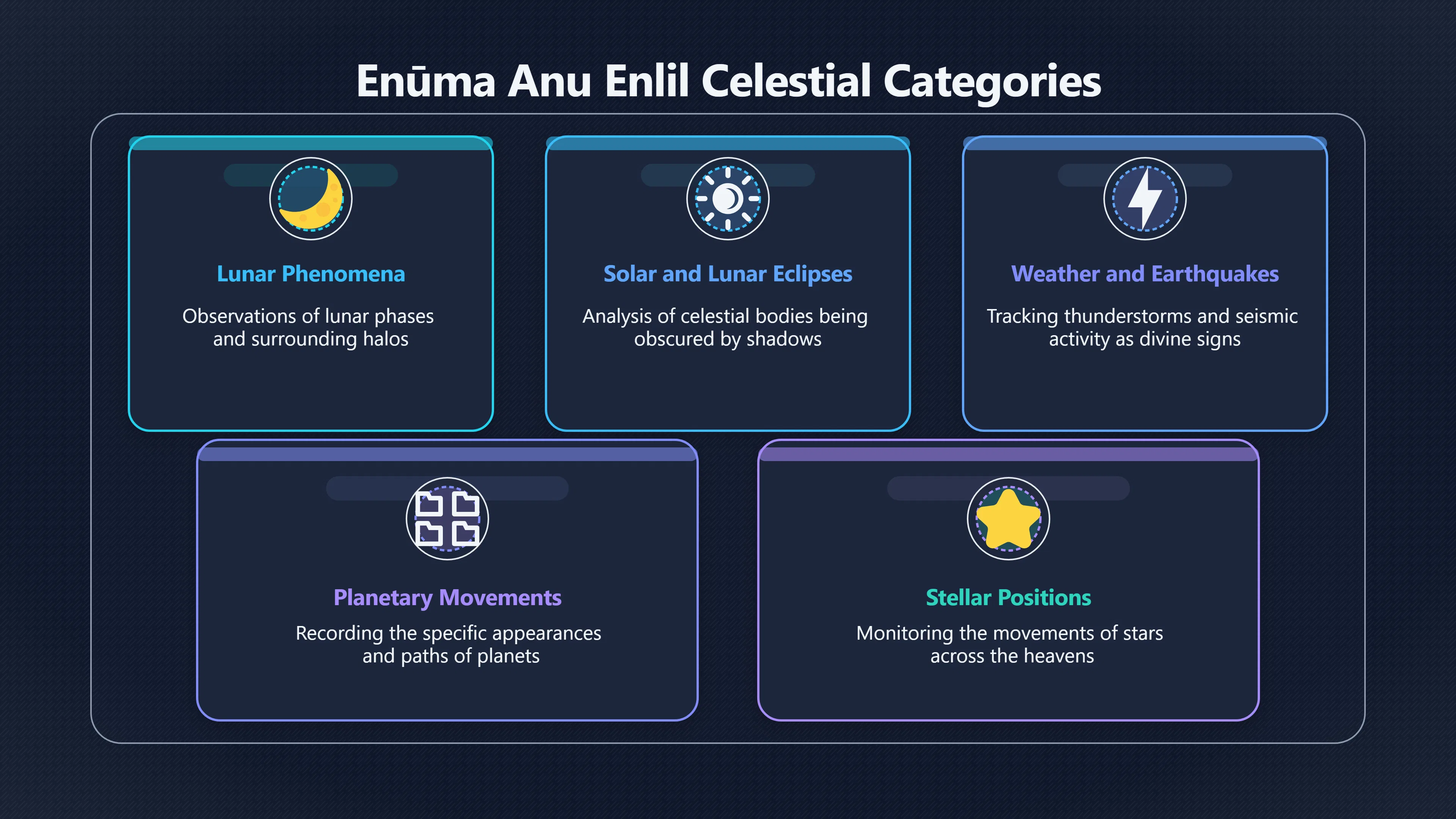
The best-known celestial omen series, Enūma Anu Enlil, eventually comprised around seventy tablets containing thousands of omens. It covered:
- lunar phases and halos;
- solar and lunar eclipses;[academia.edu]academia.edustern Perception that I conducted in 2013-14 at the School of Oriental and…Read more…
- unusual weather;
- thunderstorms and earthquakes;
- planetary appearances;
- the movements of stars.
Many omens focused on the welfare of the king because the monarch was regarded as representing the stability of the entire state. A threatening sign in the sky therefore became a matter of national security rather than private fortune. Royal scholars regularly sent written reports interpreting recent celestial events and advising the Assyrian court how to respond.[Wikipedia]WikipediaEnuma Anu EnlilEnuma Anu Enlil
The system also recognised that not every unusual event meant the same thing. Details mattered. The direction of an eclipse, the month in which it occurred, which part of the Moon darkened first and which planets were nearby could all alter the interpretation. Modern historians often note that this represents a surprisingly systematic attempt to classify evidence, even though its underlying assumptions differ fundamentally from modern science. Istituto e Museo di Storia della Scienza[brunelleschi.imss.fi.it]brunelleschi.imss.fi.itGiven that the Babylonian calendar is based on lunar months…Read more…
Eclipses, kings and political dread
Among all celestial signs, eclipses inspired particular anxiety. They appeared to interrupt the normal order of the heavens and therefore suggested that political order on Earth might also be under threat.
The omen texts did not treat every eclipse identically. Scholars analysed:
- the date within the lunar calendar;
- the time of night or day;
- which quadrant of the Moon or Sun was obscured;
- whether particular planets were visible alongside the eclipse.
These details determined which kingdom, city or ruler was believed to be endangered. Some eclipse combinations threatened Assyria itself, while others supposedly pointed towards neighbouring states. Other configurations were interpreted more favourably, suggesting that danger would instead fall upon a senior official or rival kingdom.[Wikipedia]WikipediaSubstitute king ritualSubstitute king ritual
One remarkable response to especially threatening eclipse omens was the substitute king ritual. If court scholars concluded that an eclipse foretold the monarch’s death, a temporary stand-in could be installed on the throne. This substitute performed the symbolic role of king while the real ruler withdrew from public life until the dangerous period had passed. After the predicted danger had expired, the genuine king resumed his position.
From a modern perspective this may seem extraordinary, but within Mesopotamian logic it made sense. If the omen predicted that “the king” would die, replacing the king temporarily offered a ritual means of satisfying or diverting the prophecy without endangering the dynasty itself. Whether this genuinely reflected widespread belief or served partly as political theatre remains debated, but historical records show that Assyrian courts occasionally employed the ritual during periods of ominous celestial activity.[Wikipedia]WikipediaSubstitute king ritualSubstitute king ritual
Why demons were feared—and deliberately invoked
Modern horror fiction often treats Mesopotamian demons simply as monsters. The archaeological evidence paints a more complicated picture.
Many supernatural beings represented specific forms of danger: disease, infant mortality, nightmares or unexplained illness. Rather than existing as vague creatures of folklore, they were carefully described in ritual texts, illustrated on amulets and incorporated into formal ceremonies intended to counter their influence.
This practical approach explains one of the most surprising features of Mesopotamian religion: frightening images could themselves become protective.
Pazuzu, Lamashtu and protective fear
The best-known example is Pazuzu. Today he is widely recognised through modern popular culture, but ancient Mesopotamians understood him quite differently.
Pazuzu was depicted as a terrifying hybrid with animal features, wings, claws and a scorpion-like tail. Yet his fearsome appearance made him useful. Small heads or figurines of Pazuzu were worn or displayed because he was believed to repel an even more dangerous supernatural threat associated with attacks on pregnant women and infants. Archaeological finds from Assyria and Babylonia show that these protective objects were genuine parts of household ritual rather than purely artistic creations.[Wikipedia]WikipediaBabylonian astronomyBabylonian astronomy
The contrast between Pazuzu and Lamashtu illustrates how protective magic worked.
- Lamashtu represented dangers surrounding pregnancy, childbirth and newborn children.
- Pazuzu could be invoked to drive Lamashtu away.
- Amulets frequently paired frightening imagery with protective incantations.
- Ritual specialists combined spoken prayers, symbolic objects and prescribed actions into a complete protective ceremony.
Rather than encouraging people to seek encounters with demons, these rituals acknowledged fear while attempting to contain it. The frightening image itself became part of the defence.
This distinction matters when interpreting Iraq’s strange-history traditions. Surviving demon figures are not evidence that ancient Mesopotamians claimed monsters routinely walked the countryside. Instead, they reveal an organised ritual technology for managing uncertainty, illness and vulnerability through symbolic protection.
Why these traditions still matter
Mesopotamian omen literature occupies an unusual place within the history of Fortean material because so much of it survives in written form. Instead of relying solely on later folklore or oral legend, historians can examine thousands of original clay tablets that record how ancient scholars classified extraordinary events and recommended responses.
That surviving archive allows modern researchers to distinguish several different layers:
- genuine historical documents recording observations;
- learned interpretations based on established omen traditions;
- ritual responses intended to avert danger;
- later retellings that transformed these practices into legends about demons and supernatural powers.
Believers may regard the texts as evidence that ancient people recognised meaningful patterns in the cosmos. Sceptics usually interpret them as sophisticated examples of pattern recognition, political risk management and attempts to impose order on uncertain events. Either way, they remain among the oldest continuous records of humanity trying to understand strange experiences through systematic observation.
Within Iraq’s wider strange-history landscape, Mesopotamian omens and protective demons form the foundation upon which many later traditions were built. They remind us that some of the country’s oldest mysteries were not hidden in haunted ruins or unexplained sightings, but carefully written onto clay tablets by scholars convinced that the heavens were constantly speaking—and that wise people could learn both to read their warnings and to defend themselves against them.
Amazon book picks
Further Reading
Books and field guides related to When The Sky Was A Warning. Use these as the next step if you want deeper reading beyond the article.
The Demon-Haunted World
Offers a modern framework for evaluating ancient extraordinary claims.

eBay marketplace picks
Marketplace Samples
Live-tested eBay searches with available results related to this page.



Endnotes
1.
Source: Wikipedia
Title: Enuma Anu Enlil
Link:https://en.wikipedia.org/wiki/Enuma_Anu_Enlil
2.
Source: Wikipedia
Title: Babylonian astrology
Link:https://en.wikipedia.org/wiki/Babylonian_astrology
3.
Source: Wikipedia
Title: Babylonian astronomy
Link:https://en.wikipedia.org/wiki/Babylonian_astronomy
4.
Source: Wikipedia
Title: Substitute king ritual
Link:https://en.wikipedia.org/wiki/Substitute_king_ritual
5.
Source: Wikipedia
Title: Akkadian literature
Link:https://en.wikipedia.org/wiki/Akkadian_literature
6.
Source: youtube.com
Title: ‘Speaking To Ancient Ghosts’ With Irving Finkel
Link:https://www.youtube.com/watch?v=8Uug4–RcsU
Source snippet
Pazuzu - The Mysterious Demon of Sumerian Mythology...
7.
Source: youtube.com
Link:https://www.youtube.com/watch?v=tEBDm2g7k2c
Source snippet
The Babylonian mind with Irving Finkel...
8.
Source: brunelleschi.imss.fi.it
Link:https://brunelleschi.imss.fi.it/galileopalazzostrozzi/object/OmensBasedOnEclipses.html
Source snippet
Given that the Babylonian calendar is based on lunar months...Read more...
Additional References
9.
Source: ebl.lmu.de
Link:https://www.ebl.lmu.de/corpus/D/1/4
Source snippet
lmu.deI.4 Enūma Anu Enlil Ištar (EAE 50–68)Although not every omen is reconstructed in its entirety, a sequence of 110 omens has been suc...
10.
Source: dergipark.org.tr
Link:https://dergipark.org.tr/en/pub/collan/article/919738
Source snippet
f the Arabic and Turkish malhama texts with the respective omens in Enuma Anu Enlil may suggest that the...Read more...
11.
Source: scribd.com
Link:https://www.scribd.com/document/354356028/Enuma-Anu-Enlil
Source snippet
Overview of Enuma Anu Enlil TabletsThis document provides an overview of the Enuma Anu Enlil (EAE), a vast collection of Babylonian omens...
12.
Source: researchgate.net
Title: The Catalogues of Enuma Anu Enlil Medicine Magic and Divination
Link:https://www.researchgate.net/publication/325725239_The_Catalogues_of_Enuma_Anu_Enlil_Medicine_Magic_and_Divination/fulltext/5b207056aca272277fa820a8/The-Catalogues-of-Enuma-Anu-Enlil-Medicine-Magic-and-Divination.pdf
Source snippet
The Catalogues of Enūma Anu Enlil13 Jun 2018 — The celestial omen series Enūma Anu Enlil (henceforth EAE) is the subject of two extant ca...
13.
Source: academia.edu
Link:https://www.academia.edu/26651329/The_Oldest_Mesopotamian_Astronomical_Treatise_en%C5%ABma_anu_enlil
Source snippet
stern Perception that I conducted in 2013-14 at the School of Oriental and...Read more...
14.
Source: ccp.yale.edu
Link:https://ccp.yale.edu/P461268
Source snippet
3.1.1.C - Enūma Anu Enlil 1 CThis series opens with a short bilingual introduction referring to how Anu, Enlil, and Ea appointed Sîn (or...
15.
Source: youtube.com
Title: Demons and Monsters of Ancient Mesopotamia
Link:https://www.youtube.com/watch?v=AXO7bUvVFoI
Source snippet
'Speaking To Ancient Ghosts' With Irving Finkel...
16.
Source: youtube.com
Title: Ancient Magic Rituals with Irving Finkel
Link:https://www.youtube.com/watch?v=uhbd01lKdZk
Source snippet
Demons and Monsters of Ancient Mesopotamia...
17.
Source: youtube.com
Title: The Babylonian mind with Irving Finkel
Link:https://www.youtube.com/watch?v=G37qpVUzB1g
Topic Tree