Within Strange Iraq
Why Iraq's Wild Places Grow Ghosts
Iraq's marshes and burial grounds turn hard places to navigate, mourn and survive into stories of spirits, monsters and moving lights.
On this page
- The Tantal and shape shifting marsh folklore
- Serpents, lost islands and moving lights
- Najaf ghosts and war torn haunting
Page outline Jump by section
Introduction
Southern Iraq’s marshes and burial landscapes have produced some of the country’s most enduring ghost stories because they are places where navigation, death and memory overlap. Vast reed beds can conceal waterways, floating islands shift position, strange lights appear over wetlands, and the world’s largest cemetery at Najaf is a landscape built around remembrance and pilgrimage. In such settings, folklore has naturally filled the gaps left by darkness, isolation and uncertainty.
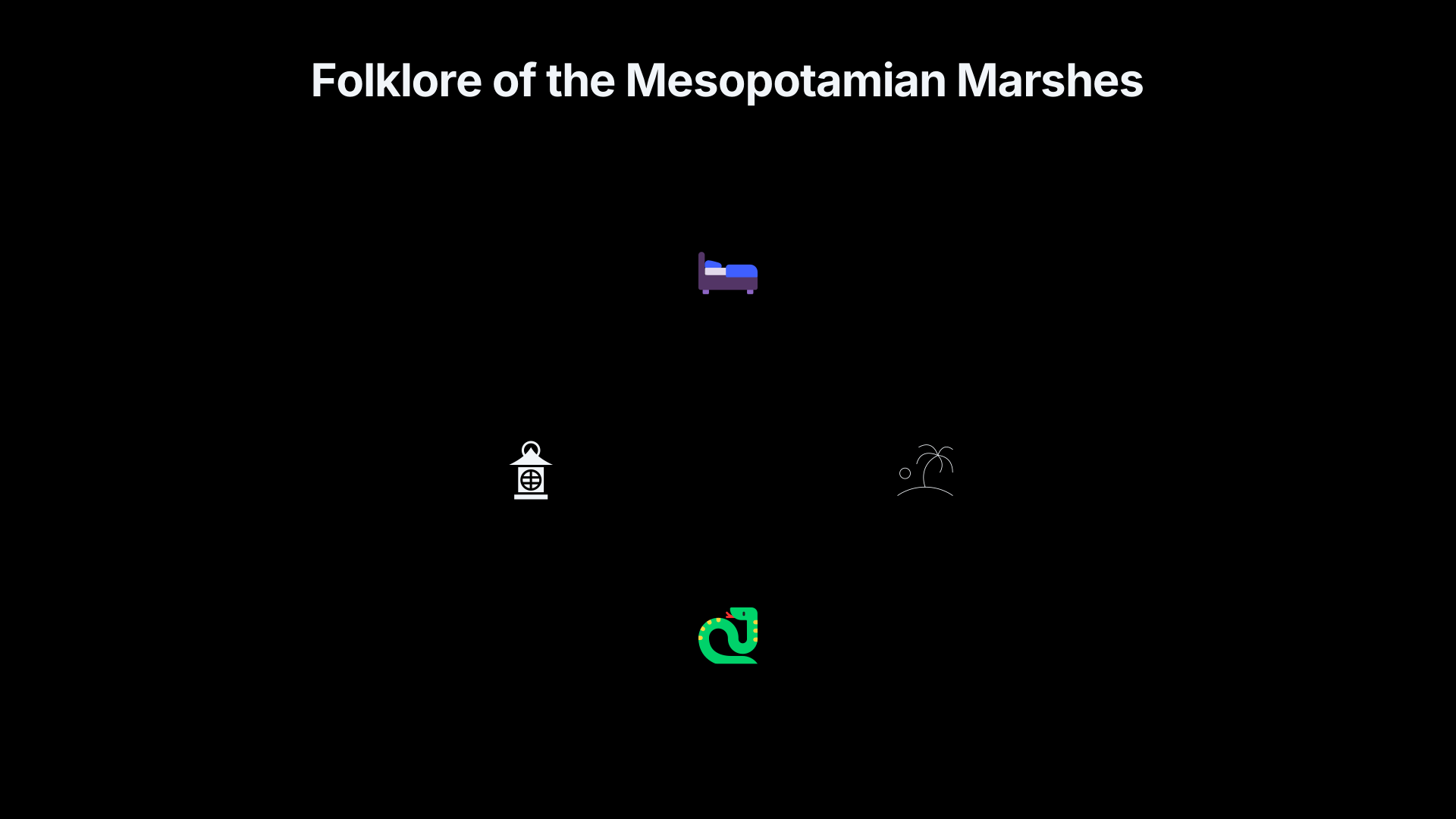
Unlike stories about ancient Mesopotamian demons or religious miracle traditions, these tales are rooted in particular landscapes. They are less about proving the supernatural than explaining dangerous places where people disappear, become lost, mourn loved ones or encounter unfamiliar natural phenomena. The result is a body of local tradition in which shape-shifting beings, mysterious islands, glowing lights and restless spirits all become part of Iraq’s wider strange-history record.
The Tantal and shape-shifting marsh folklore
The Mesopotamian Marshes are among the most distinctive environments in the Middle East. Until the twentieth century they formed one of western Eurasia’s largest wetland systems, with villages built among reeds, waterways that constantly shifted, and extensive areas difficult for outsiders to navigate. Even today, despite partial ecological recovery, they remain an environment where visibility is limited and familiar landmarks can vanish behind reeds or seasonal flooding.[Wikipedia]WikipediaMesopotamian MarshesMay 13, 2007 — The Mesopotamian Marshes, also known as the Iraqi Marshes, are a wetland area located in Southern Iraq and southwestern Ir…
Within this setting, Marsh Arab folklore developed stories about uncanny beings collectively remembered as marsh spirits or monsters. One recurring figure is the Tantal, usually described not as a single fixed creature but as a dangerous shape-shifter associated with isolated waterways and reed beds. Different local tellings vary considerably, but common themes include:
- appearing as a human before revealing a monstrous form;
- imitating familiar voices to lure travellers;
- stalking fishermen or buffalo herders;
- inhabiting stretches of marsh best avoided after dark.
The variability is significant. Rather than functioning like a creature in modern cryptozoology, the Tantal behaves more like a traditional warning tale. The uncertainty surrounding its appearance allows it to represent any unknown danger hidden within the marshes.
Anthropologists and folklorists generally interpret such stories as practical folklore. Before modern navigation, unfamiliar channels, deep mud, concealed water and sudden weather changes made the marshes genuinely hazardous. A supernatural predator provided a memorable way of teaching children and newcomers where not to wander alone.
War and environmental destruction also changed how these traditions were remembered. The draining of much of the marsh system during the late twentieth century displaced large numbers of Marsh Arabs, breaking communities in which many oral traditions had been preserved. Since restoration began after 2003, some folklore has survived mainly through memory rather than continuous local practice.[Wikipedia]WikipediaMesopotamian MarshesMay 13, 2007 — The Mesopotamian Marshes, also known as the Iraqi Marshes, are a wetland area located in Southern Iraq and southwestern Ir…
Serpents, lost islands and moving lights
Not every mystery in the marshes involves monsters. Some revolve around landscapes that refuse to stay still.
Perhaps the best-known example is Hufaidh, a legendary island said to appear and disappear among the reeds. British explorer Wilfred Thesiger recorded local accounts during the 1950s. Marsh dwellers described an island of extraordinary beauty that sometimes shone with an eerie light, seemed to shift location, and repeatedly escaped those attempting to reach it. Some traditions associated it with jinn, while others imagined hidden palaces or even echoes of the Garden of Eden.[Wikipedia]WikipediaOpen source on wikipedia.org.
The persistence of the legend becomes easier to understand once the geography is considered. The marshes naturally produce floating reed islands, changing channels and distorted horizons. At night, reflected moonlight, mist and distant fires can create deceptive visual effects. A landmark seen one evening may genuinely appear to have vanished by the next.
Stories of enormous serpents also appear sporadically in local tradition. These are usually presented as creatures inhabiting remote waterways rather than as documented animals. The region certainly supports large snakes, and occasional encounters with unusually big specimens may have reinforced tales that gradually acquired supernatural elements. Unlike famous lake-monster traditions elsewhere, however, Iraq’s marsh serpent stories remain largely oral and lack sustained historical investigation.
Even more widespread are reports of mysterious moving lights. Marshes around the world generate legends of wandering flames, and southern Iraq is no exception. Witnesses have described lights apparently floating over reeds or water before disappearing into the darkness.
Several natural explanations have been proposed:
- reflections from distant settlements or boats;
- atmospheric refraction across flat wetland landscapes;
- combustion or luminescence associated with gases released by decaying vegetation;
- simple navigational misjudgements in an environment with few fixed reference points.
These explanations do not necessarily account for every reported sighting, but they demonstrate why wetlands repeatedly produce similar ghost-light traditions in many different cultures. Iraq’s marsh folklore fits a broader global pattern while retaining its own local identity.[Wikipedia]WikipediaOpen source on wikipedia.org.
Najaf ghosts and war-torn haunting
If the marshes inspire stories through isolation, Najaf does so through scale.
The city’s Wadi al-Salam (“Valley of Peace”) cemetery is widely regarded as the largest cemetery on Earth, containing millions of graves accumulated over many centuries. Pilgrims travel there because burial near the shrine of Imam Ali carries profound religious significance within Shia Islam. The cemetery is therefore simultaneously a sacred landscape, a historical archive and an active place of mourning.
Its immense size has naturally generated ghost stories. Local traditions speak of unexplained voices after dark, shadowy figures among the tombs and encounters with spirits wandering the narrow passages between graves. These accounts are generally circulated as folklore rather than documented paranormal cases, reflecting the cemetery’s emotional and religious importance more than claims of objectively verified hauntings.
The cemetery’s atmosphere has also been shaped by modern history. During periods of conflict, including fighting after 2003, parts of Wadi al-Salam became battlegrounds. News reports showed combat taking place among centuries-old tombs, adding fresh layers of trauma to an already powerful landscape of remembrance. Unsurprisingly, later stories sometimes merged wartime memory with older ghost traditions.
Many Iraqi haunting narratives therefore involve not only supernatural belief but grief itself. Families returning repeatedly to burial sites, veterans recalling conflict, and communities living alongside enormous cemeteries all contribute to stories in which the dead seem unusually close to the living.
Why these landscapes continue to generate strange stories
The marshes and cemeteries of southern Iraq illustrate an important feature of Fortean traditions: unusual landscapes often create unusual narratives without requiring supernatural events to be objectively demonstrated.
Several mechanisms repeatedly appear:
- Isolation: Reed beds and waterways make people vulnerable to becoming lost.
- Changing geography: Floating vegetation and seasonal flooding alter familiar routes.
- Optical effects: Flat wetlands encourage reflections, mirages and deceptive lights.
- Collective memory: Cemeteries preserve stories across generations through continual visitation.
- Trauma: War, displacement and environmental destruction encourage communities to reinterpret familiar places through folklore.
Believers may see the Tantal, ghost lights or cemetery apparitions as evidence that some places remain spiritually charged. Sceptical interpretations instead emphasise environmental hazards, psychology, memory and natural optical phenomena. Neither perspective removes the cultural value of the stories themselves.
Together, Iraq’s haunted marshes and burial grounds demonstrate how environment shapes folklore. Dangerous wetlands produce monsters that warn against wandering, mysterious lights become signs of unseen forces, disappearing islands express the instability of the landscape, and vast cemeteries transform grief into enduring ghost traditions. Whether understood as supernatural encounters or powerful cultural metaphors, these stories remain among the country’s most distinctive contributions to the wider literature of strange places.


eBay marketplace picks
Marketplace Samples
Live-tested eBay searches with available results related to this page.



Endnotes
1.
Source: Wikipedia
Title: Mesopotamian Marshes
Link:https://en.wikipedia.org/wiki/Mesopotamian_Marshes
Source snippet
May 13, 2007 — The Mesopotamian Marshes, also known as the Iraqi Marshes, are a wetland area located in Southern Iraq and southwestern Ir...
Published: May 13, 2007
2.
Source: Wikipedia
Link:https://en.wikipedia.org/wiki/Hufaidh
3.
Source: Wikipedia
Link:https://en.wikipedia.org/wiki/Will-o%27-the-wisp
Additional References
4.
Source: youtube.com
Link:https://www.youtube.com/watch?v=pDBFDHkucxY
Source snippet
Traveling in southern Iraq Najaf, the Marshlands and UrTraveling in southern Iraq Najaf, the Marshlands and Ur... Wadi Al Salam -Walking...
5.
Source: facebook.com
Link:https://www.facebook.com/IRAQPLACESOFFICIAL/posts/the-marshes-of-southern-iraq-a-hidden-paradisethe-mesopotamian-marshes-in-southe/1440347574130893/
6.
Source: nhbs.com
Link:https://www.nhbs.com/the-ghosts-of-iraqs-marshes-book?srsltid=AfmBOorKtTlfDHAS8WyFOog9H4Zv5ZXdJnMKFvq-Gwz72LfPbyxkZzR3
Source snippet
arsh Arabs and the Mesopotamian Marshes is a guidepost for environmental renewal.Read more...
7.
Source: nativethreads.co
Link:https://nativethreads.co/blogs/blog/the-marshlands-of-iraq-the-vanishing-world-of-the-marsh-arabs-and-mandaeans?srsltid=AfmBOoplsvb3v66NgZ5k6NJfgumJXvulOhh53Ri-hid7qonXPfbZ-Pog
Source snippet
g islands — have sustained human civilization for more than five thousand years.Read more...
8.
Source: beyondthebucketlist.co
Link:https://beyondthebucketlist.co/iraqi-marshes/
Source snippet
Our Visit to the Iraqi Marshes: Deep in the Heart of Ancient...4 Jun 2022 — The Iraqi marshes are thought to be the real-world location...
9.
Source: instagram.com
Title: Have you heard of Iraq’s Marshes?
Link:https://www.instagram.com/p/Caz1Ja5O1xC/
Source snippet
🇮🇶 Iraq's marshlands...Iraq's marshlands, a UNESCO World Heritage Site, are inhabited by Marsh Arabs also known as Madan people and des...
10.
Source: reliefweb.int
Title: forgotten people marsh arabs iraq
Link:https://reliefweb.int/report/iraq/forgotten-people-marsh-arabs-iraq
Source snippet
Forgotten people: The Marsh Arabs of Iraq13 Jun 2003 — Fifteen years ago, 250,000 Marsh Arabs lived on 20,000 square kilometers of waterw...
11.
Source: youtube.com
Title: Arabic Folklore’s Most Terrifying Creature: The Ghoul
Link:https://www.youtube.com/watch?v=ZdljTiX4aNk
Source snippet
Demons and Monsters of Ancient Mesopotamia...
12.
Source: youtube.com
Title: The Garden of Eden and its people
Link:https://www.youtube.com/watch?v=QfCO3Zr-1A0
Source snippet
The Afa | The Lost Giants of Mesopotamia...
13.
Source: youtube.com
Title: The Afa | The Lost Giants of Mesopotamia
Link:https://www.youtube.com/watch?v=qbx01HXY9fM
Source snippet
Arabic Folklore's Most Terrifying Creature: The Ghoul...
Topic Tree