Within Monaco Uncanny
Monaco's Real Monster Was an Aquarium Alga
The Caulerpa taxifolia case shows how an aquarium alga became Monaco's strangest science-based monster story.
On this page
- How the alga entered Monaco's strange record
- Why it became a Mediterranean ecological scare
- Science, blame and the modern sea monster reading
Page outline Jump by section
Introduction
Monaco’s closest equivalent to a sea monster was not an unknown creature lurking beneath the waves but a bright green aquarium alga that escaped into the Mediterranean and became one of the world’s most infamous invasive marine species. Caulerpa taxifolia, widely nicknamed the “killer alga”, was never dangerous to humans, yet it acquired an almost mythical reputation because of its astonishing spread, its suspected escape from Monaco’s famous Oceanographic Museum, and the fear that it could smother native marine life across the Mediterranean. The story sits comfortably within Monaco’s strange history because it combines scientific mystery, public alarm, disputed responsibility and a modern ecological horror that seemed to emerge from a laboratory rather than from folklore.[si.edu]invasions.si.eduCaulerpa taxifolia (invasive genotype)by FN East — In 1984, Caulerpa taxifolia was first found growing in waters adjacent to the…
How the alga entered Monaco’s strange record
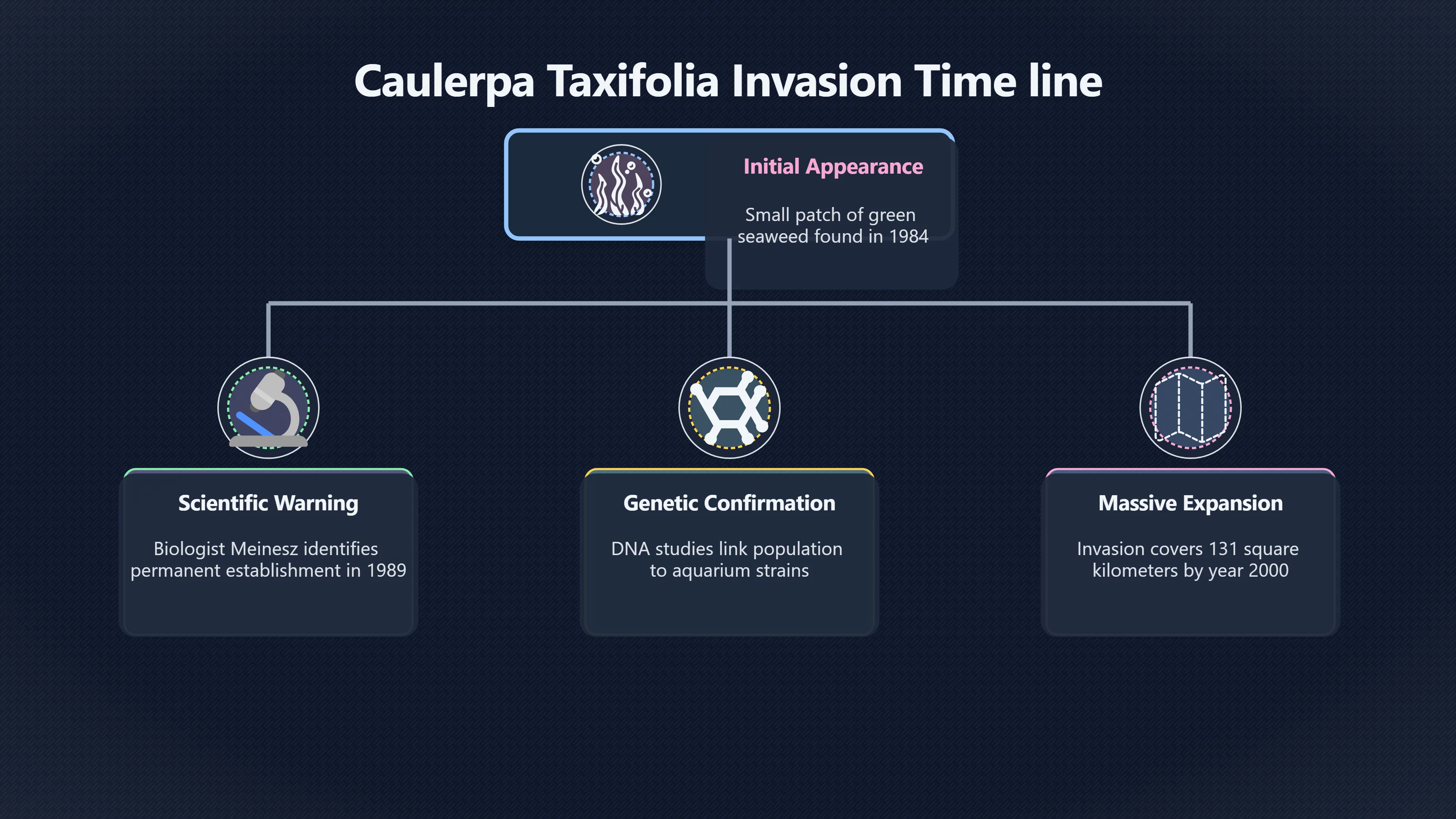
The defining moment came in 1984, when an unusual patch of tropical-looking green seaweed appeared on the seabed immediately below the Oceanographic Museum in Monaco. At first it occupied only about one square metre and attracted little attention. Over the following years, however, the patch expanded dramatically. Marine biologist Alexandre Meinesz recognised the significance of the outbreak in 1989 and warned the museum, Monaco’s authorities and neighbouring governments that an exotic species appeared to be establishing itself permanently in the Mediterranean.[Invasions]invasions.si.eduCaulerpa taxifolia (invasive genotype)by FN East — In 1984, Caulerpa taxifolia was first found growing in waters adjacent to the…
The location immediately invited suspicion. The Oceanographic Museum maintained tropical aquaria that displayed Caulerpa taxifolia, a decorative seaweed prized for its attractive fern-like appearance. The simplest explanation was that fragments had accidentally entered the sea through aquarium waste or maintenance activities before taking hold in nearby coastal waters. Genetic studies published during the following decade strongly supported the conclusion that the Mediterranean population was closely related to the aquarium strain rather than to naturally occurring Mediterranean algae.[wikipedia.org]WikipediaCaulerpa taxifoliaCaulerpa taxifolia
The museum and Monaco resisted early claims that they were responsible, and alternative explanations—including transport on ship hulls or naturally occurring mutations—were proposed. Although debate continued over the precise route of release, molecular evidence increasingly favoured an aquarium origin, leaving Monaco permanently associated with one of marine biology’s most notorious accidental introductions.[wikipedia.org]WikipediaCaulerpa taxifoliaCaulerpa taxifolia
Why it became a Mediterranean ecological scare
Unlike legendary sea monsters, Caulerpa taxifolia inspired fear because people could measure its advance.
The aquarium strain had been selected for hardiness and could tolerate cooler water than its tropical relatives. It spread mainly by fragmentation: even small broken pieces could establish new colonies. Anchors, fishing gear and boat traffic helped carry fragments along the coast, allowing the plant to leap from bay to bay.[Center for Invasive Species Research]cisr.ucr.eduCaulerpa.Read moreCenter for Invasive Species ResearchCaulerpa Taxifolia or Killer AlgaBy 1984, this coldwater strain of Caulerpa had been released into th…
Its reputation as the “killer alga” came from several characteristics:
- It formed dense carpets over the seabed, replacing a wide variety of native habitats.
- It produced toxic compounds that discouraged many Mediterranean grazing animals.
- It expanded rapidly across international coastlines, making eradication increasingly difficult once established.
- It threatened valuable seagrass meadows, fisheries and coastal ecosystems, although the severity of impacts varied between locations.[state.gov]2001-2009.state.govU.S. Department of StateCase Study: Caulerpa TaxifoliaIt produces high levels of toxic metabolites, which make it distasteful to herbivor…
By the end of 2000, the invasion had spread to more than one hundred separate sites across six Mediterranean countries, covering roughly 131 square kilometres of seabed. What began as a tiny patch beneath Monaco had become an international environmental problem.[ResearchGate]researchgate.netAt the end of 2000, approximately 131km2…Read more…
For the public, the story possessed all the ingredients of a monster narrative. Newspapers described an unstoppable green invader. Television documentaries portrayed it engulfing the seabed. The phrase “killer alga” proved irresistible, despite the fact that the organism neither attacked people nor behaved like a predator. The monster existed through ecological transformation rather than physical menace.

Science, blame and the modern sea-monster reading
One reason the case remains fascinating is that it blurred the boundary between scientific fact and dramatic storytelling.
There is little doubt that the Mediterranean invasion was real. What proved harder to establish was the exact chain of responsibility. The museum denied deliberately releasing the alga, while critics argued that inadequate aquarium disposal practices were sufficient to explain the outbreak. Over time, DNA fingerprinting and other genetic analyses greatly strengthened the aquarium-origin hypothesis, but debate over institutional responsibility lingered in public discussion long after the biological evidence became clearer.[Wikipedia]WikipediaCaulerpa taxifoliaCaulerpa taxifolia
The ecological picture also became more nuanced than early headlines suggested. Initial forecasts often implied that the Mediterranean might be permanently overwhelmed. Later research showed that impacts varied between habitats, with some native communities proving more resilient than expected and some invaded areas supporting more biodiversity than the earliest predictions had implied. That did not mean the invasion was harmless, but it demonstrated that ecological systems were more complicated than the simple “killer weed destroys everything” narrative suggested.[Wikipedia]WikipediaCaulerpa taxifoliaCaulerpa taxifolia
This evolution from panic to careful reassessment mirrors many classic Fortean stories. An apparently unstoppable mystery provoked alarming headlines, generated competing explanations and eventually settled into a more evidence-based understanding without losing its cultural power.
Why it belongs in Monaco’s weird history
Monaco has few traditional monster legends, yet Caulerpa taxifolia occupies much the same cultural role.
Instead of a dragon emerging from the sea, Monaco became associated with an organism that genuinely transformed part of the Mediterranean. Instead of frightened eyewitnesses describing an unknown beast, divers photographed an expanding green carpet whose scale seemed almost unbelievable. Instead of folklore passed through generations, the story unfolded through scientific papers, newspaper campaigns, environmental policy and public debate.
It is therefore an unusually modern form of Forteana: a case where the “monster” is entirely real, but the language surrounding it borrowed heavily from myth. The nickname “killer alga”, the disputed origin at a famous museum, and the spectacle of an apparently unstoppable invasion gave Monaco a strange tale unlike any ghost story or cryptid legend. It remains a reminder that some of the most memorable modern monsters are created not by imagination alone, but by unexpected encounters between science, ecology and human error.

Amazon book picks
Further Reading
Books and field guides related to Monaco's Real Monster Was an Aquarium Alga. Use these as the next step if you want deeper reading beyond the article.


Invasive Species What Everyone Needs to Know
First published 2013. Subjects: Plants, Conservation biology, Evolution, Introduced organisms, Evolution (Biology).
eBay marketplace picks
Marketplace Samples
Live-tested eBay searches with available results related to this page.



Endnotes
1.
Source: Wikipedia
Title: Caulerpa taxifolia
Link:https://en.wikipedia.org/wiki/Caulerpa_taxifolia
2.
Source: researchgate.net
Link:https://www.researchgate.net/publication/225639507_The_Introduced_Green_Alga_Caulerpa_Taxifolia_Continues_to_Spread_in_the_Mediterranean
Source snippet
At the end of 2000, approximately 131km2...Read more...
3.
Source: 2001-2009.state.gov
Link:https://2001-2009.state.gov/g/oes/ocns/inv/cs/2326.htm
Source snippet
U.S. Department of StateCase Study: Caulerpa TaxifoliaIt produces high levels of toxic metabolites, which make it distasteful to herbivor...
4.
Source: youtube.com
Title: Killer algae spotlight
Link:https://www.youtube.com/watch?v=3ImXIpWO2Ng
Source snippet
Caulerpa Taxifolia...
5.
Source: youtube.com
Title: Caulerpa Taxifolia
Link:https://www.youtube.com/watch?v=UEk9s8utrPo
6.
Source: invasions.si.edu
Link:https://invasions.si.edu/nemesis/species_summary/6974
Source snippet
Caulerpa taxifolia (invasive genotype)by FN East — In 1984, Caulerpa taxifolia was first found growing in waters adjacent to the...
7.
Source: cisr.ucr.edu
Title: Caulerpa.Read more
Link:https://cisr.ucr.edu/invasive-species/caulerpa-taxifolia-or-killer-alga
Source snippet
Center for Invasive Species ResearchCaulerpa Taxifolia or Killer AlgaBy 1984, this coldwater strain of Caulerpa had been released into th...
8.
Source: waterboards.ca.gov
Title: killer algae article.shtml
Link:https://www.waterboards.ca.gov/losangeles/water_issues/programs/water_quality_issues/killer_algae_article.shtml
Source snippet
Algae | Los Angeles Regional Water Quality Control BoardAug 23, 2018 — Following its escape from the Oceanographic Museum of Monaco aroun...
Additional References
9.
Source: pbs.org
Link:https://www.pbs.org/wgbh/nova/algae/chronology.html
Source snippet
NOVA | Deep Sea Invasion | Chronology of an InvasionCaulerpa taxifolia, a bright green seaweed decorate saltwater aquariums, "escaped" fr...
10.
Source: reddit.com
Link:https://www.reddit.com/r/todayilearned/comments/18yaazj/til_the_oceanographic_museum_at_monaco_flushed/
Source snippet
TIL the Oceanographic Museum at Monaco flushed...Oceanographic Museum at Monaco flushed decorative algae into the Mediterranean Sea, cre...
11.
Source: press.uchicago.edu
Link:https://press.uchicago.edu/Misc/Chicago/519228.hunl
Source snippet
University of Chicago PressMeinesz, Killer Algae, excerptNo one has ever been killed by Caulerpa taxifolia, known as the "killer alga." t...
12.
Source: youtube.com
Title: Caulerpa taxifolia: une algue invasive en voie de disparition?
Link:https://www.youtube.com/watch?v=jr5iahVV50k
Source snippet
Caulerpa taxifolia est en train de disparaitre du littoral de la Côte d'Azur. Sans connaître les véritables raisons de cette extinction, des...
13.
Source: psmag.com
Title: ‘Spreader’ alter ego: Killer Algae
Link:https://psmag.com/social-justice/spreader-alter-ego-killer-algae-3707/
Source snippet
May 19, 2009 — In 1984, killer algae — a mutant strain of the tropical seaweed Caulerpa taxifolia — allegedly escaped from Monaco's Ocean...
Published: May 19, 2009
14.
Source: facebook.com
Title: species has been banned in many
Link:https://www.facebook.com/deepmarinescenesofficial/videos/facts-killer-algae/1734160423855467/
Source snippet
Quick facts about this popular aquarium species that became...At some point, whether intentionally or accidentally, the hybrid was relea...
15.
Source: sciencedirect.com
Link:https://www.sciencedirect.com/science/article/abs/pii/S0272771407002065
Source snippet
First report of Caulerpa taxifolia (Bryopsidales, Chlorophyta...by C Cevik · 2007 · Cited by 65 — Since its first accidental introductio...
16.
Source: pmc.ncbi.nlm.nih.gov
Link:https://pmc.ncbi.nlm.nih.gov/articles/PMC3478284/
Source snippet
by E Varela-Álvarez · 2012 · Cited by 44 — Caulerpa species are marine green algae, which often act as invasive species with rapid clo...
17.
Source: youtube.com
Title: Attack of the killer algae
Link:https://www.youtube.com/watch?v=Vd4rgN6MYtg
Source snippet
Facts: Killer Algae...
18.
Source: youtube.com
Title: Oceans and Killer Algae
Link:https://www.youtube.com/watch?v=_0lAh5nbB98
Source snippet
Killer algae spotlight...
Topic Tree