Within Malawi Forteana
What Lurks In Lake Malawi's Weird Lore?
Lake Malawi's strange reputation mixes thin lake-monster claims with richer ritual imagery and a genuinely remarkable natural setting.
On this page
- Why deep lakes attract monster stories
- The weak trail of Lake Malawi monster claims
- Ritual creatures, masks and real ecological strangeness
Page outline Jump by section
Introduction
Lake Malawi has all the ingredients that encourage monster stories. It is one of the world’s deepest freshwater lakes, stretches for almost 600 kilometres, and its dark, shifting waters conceal extraordinary biodiversity. Yet unlike famous lakes such as Loch Ness or Okanagan Lake, Malawi has produced remarkably few well-documented traditions about giant unknown creatures. Instead, its genuinely distinctive “monster” heritage lies where folklore, ritual performance and the landscape meet.

That distinction matters. The evidence for a Lake Malawi monster in the cryptozoological sense is weak and mostly confined to later compilations and scattered retellings. By contrast, the lakeshore is home to one of southern Africa’s richest ritual traditions, in which masked performers embody spirits, wild animals and uncanny beings. For anyone exploring Malawi’s Fortean heritage, the more interesting question is not whether a giant beast lurks beneath the water, but why such a dramatic landscape has inspired powerful symbolic creatures rather than a flourishing lake-monster mythology.
Why deep lakes invite monster legends
Across the world, deep lakes often accumulate stories about mysterious inhabitants. Folklorists have long noted that large bodies of water encourage tales of serpents, giant fish or supernatural guardians because they combine genuine danger with limited visibility. Vast expanses of dark water naturally leave room for speculation.
Lake Malawi certainly possesses the physical qualities that could support such traditions. It is the third-deepest freshwater lake on Earth and contains between 800 and 1,000 fish species, most found nowhere else. For centuries the lake has provided food, transport and livelihoods while also presenting storms, hidden reefs and sudden changes in weather that can be frightening even to experienced fishermen.[African Aquatic Research Center]agl-acare.orgThe basin is densely populated and has a high prevalence of water borne diseases.Read more…
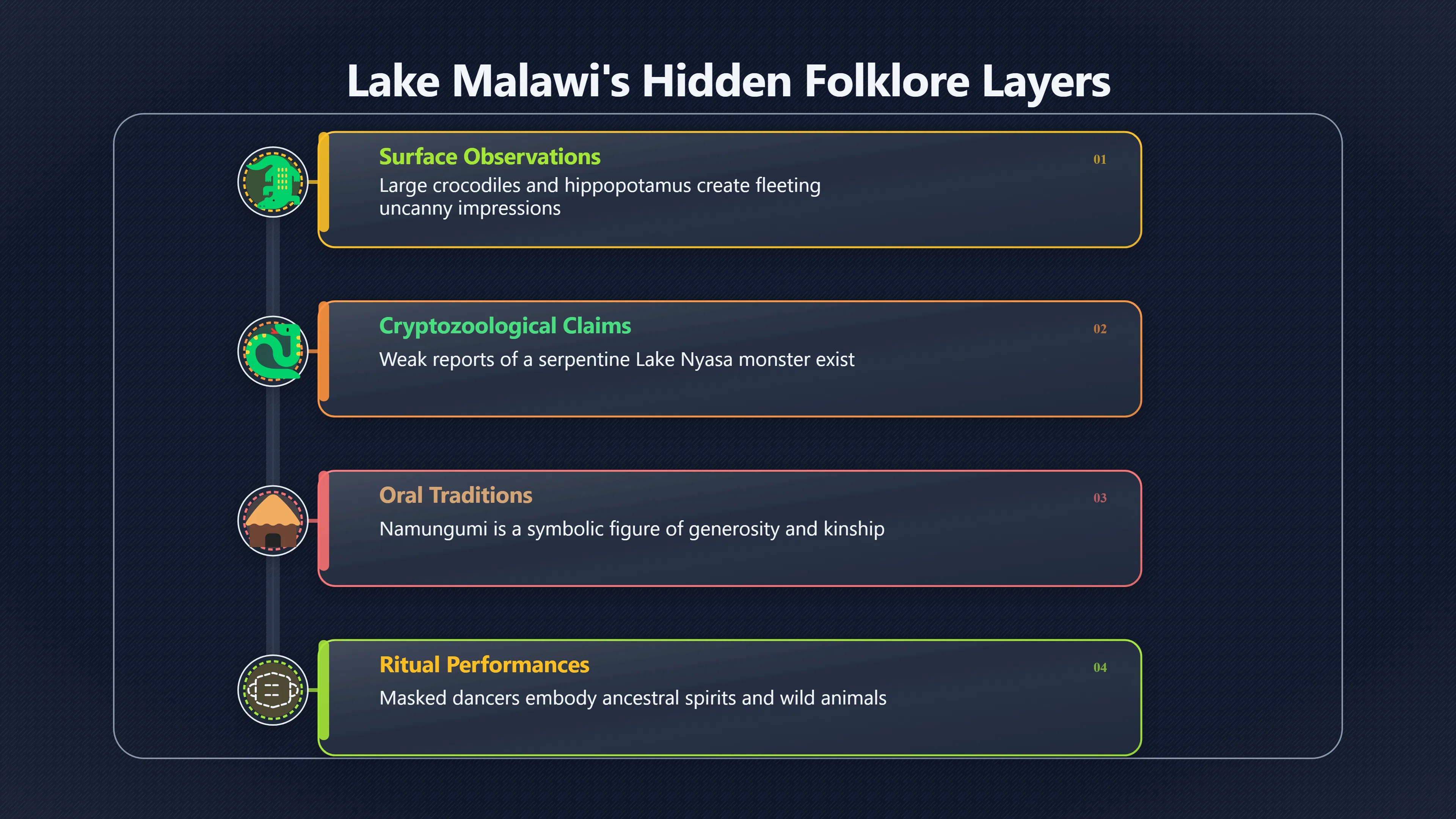
Its ecology can also surprise visitors. Enormous schools of brightly coloured cichlids, large catfish, crocodiles, hippopotamus and dramatic underwater rock formations make the lake seem more mysterious than many freshwater environments. In practice, however, these real natural wonders appear to have overshadowed the need for elaborate monster traditions.
The surprisingly weak trail of Lake Malawi monster claims
Readers expecting a local equivalent of the Loch Ness Monster may be surprised by how little reliable material exists.
Modern cryptozoological catalogues occasionally mention a supposed “Lake Nyasa monster”, usually describing a large serpentine animal allegedly reported from the lake. Some versions apply the name “dzimwé” to the creature. However, these accounts rarely cite contemporary witnesses, newspaper reports or ethnographic fieldwork. Instead, they largely repeat one another through later compilations, making it difficult to trace the tradition back to primary evidence.[cryptidarchives.fandom.com]cryptidarchives.fandom.comLake Nyasa monsterEncyclopaedia of CryptozoologyLake monsters have been reported from Lake Nyasa, an African Great Lake located in Malawi, Mozambique, and…
This absence is significant. Malawi possesses extensive collections of oral traditions recorded by missionaries, anthropologists and local scholars during the colonial and post-colonial periods. Those collections discuss spirits, ancestors, ritual societies and dangerous animals in considerable detail, yet they do not reveal a strong indigenous tradition centred on a giant unknown lake animal.
That does not mean unusual sightings have never occurred. A lake as large as Malawi naturally produces occasional reports of strange shapes on the water, distant animals, floating vegetation or unusual wave patterns. Such isolated observations are common on major lakes worldwide. What is missing is the consistent chain of named witnesses, repeated local traditions and historical documentation that characterises better-known lake-monster legends.
From a Fortean perspective, Lake Malawi therefore represents an interesting contrast. It has all the environmental ingredients for a famous monster, but almost none of the historical reporting needed to sustain one.
Ritual creatures matter more than literal monsters
The lake’s genuine contribution to strange folklore comes through ritual performance rather than cryptozoology.
Among Chewa communities around parts of Lake Malawi, the Gule Wamkulu (“Great Dance”) forms part of the Nyau tradition, recognised by UNESCO as Intangible Cultural Heritage. During ceremonies including funerals, initiations and memorial events, initiated dancers wear elaborate masks and full-body costumes representing ancestral spirits, wild animals and symbolic figures. These are not theatrical costumes in the modern sense. Within the ritual itself, the masked figures are understood to embody spiritual presences rather than simply portray them.[UNESCO ICH]ich.unesco.orgUNESCO ICHGule WamkuluOn these occasions, the Nyau dancers wear costumes and masks made of wood and straw, representing a great variety o…
To an outsider encountering the procession unexpectedly, the effect can be startling. Large straw-covered figures emerge from woodland, animal-headed beings dance through villages, and masked characters behave in ways intended to instruct, satirise or command respect. Early European observers occasionally described these performances in language that blurred the line between ritual participants and mysterious creatures, contributing to later misunderstandings.
The masks represent a remarkable variety of beings:
- Wild animals including elephants, antelope, lions and hyenas.
- Ancestors returning symbolically to interact with the living.
- Moral characters illustrating greed, vanity, sorcery or social behaviour.
- Hybrid or exaggerated figures that appear deliberately uncanny rather than naturalistic.[Wikipedia]WikipediaOpen source on wikipedia.org.
For Fortean readers, these traditions illustrate how reports of “monsters” can emerge when unfamiliar ritual symbolism is interpreted literally instead of culturally.

The importance of animal imagery
Animal costumes occupy a particularly important place in the Nyau tradition.
Rather than celebrating fantastic beasts, many costumes exaggerate familiar wildlife into imposing spiritual forms. Full-body woven structures can transform performers into enormous elephants or other powerful animals whose appearance is designed to inspire awe. These figures communicate ideas about death, authority, danger and renewal rather than claiming that supernatural beasts physically inhabit the countryside.[Wikipedia]WikipediaOpen source on wikipedia.org.
This symbolic use of animals helps explain why Malawi’s folklore often feels “monster-rich” despite producing relatively few legends about undiscovered biological creatures.
Curious lake beings in oral tradition
Lake Malawi is not entirely without unusual aquatic beings, although they belong more comfortably within folklore than cryptozoology.
Some collections of central African folklore mention the Namungumi, a gigantic creature associated with Lake Malawi that peacefully allows people to cut meat from its body, after which the wounds heal again. Rather than behaving as a predatory monster, the being functions as a symbolic figure connected with generosity, water and kinship. It resembles a mythic provider far more than an unknown animal awaiting scientific discovery.[A Book of Creatures]abookofcreatures.comA Book of CreaturesMalawiJun 25, 2021 — The namungumi lives in Lake Malawi. It would surface near a village, and the people could come an…
Stories of this kind are common in many oral traditions, where extraordinary animals express ideas about abundance, reciprocity or the relationship between people and the natural world. Their purpose is usually moral or ceremonial rather than descriptive.
Real wildlife often explains the uncanny
The lake’s ecology also offers straightforward explanations for experiences that might otherwise acquire supernatural interpretations.
Large crocodiles, hippopotamus surfacing unexpectedly, floating logs, schools of fish disturbing the surface and dramatic weather changes can all produce fleeting impressions of something enormous moving through the water. Strong reflections and heat haze may further distort distant objects.
Equally important is the sheer scale of the lake. Viewed from shore, waves can resemble ocean swells, storms appear suddenly over the horizon, and unfamiliar sounds carry across open water. Such conditions naturally encourage storytelling even without requiring an unknown species.
Unlike many famous cryptid cases, however, there has been no sustained pattern of photographs, physical evidence or independently corroborated sightings that has convinced zoologists to investigate the existence of a distinct Lake Malawi monster.
Why the lake still feels mysterious
Lake Malawi occupies an unusual place in African Forteana because its reputation rests less on hidden beasts than on the interaction between landscape, culture and imagination.
Its immense depth and remarkable biodiversity make it genuinely awe-inspiring. Around its shores survive ritual traditions in which masked spirits and animal beings remain culturally significant rather than merely legendary. Those traditions are sometimes mistaken for monster lore by outsiders, even though they belong to a sophisticated religious and social system.
The result is a quieter but arguably richer form of mystery. Instead of asking whether a giant serpent swims beneath the surface, Lake Malawi invites a broader question: how do extraordinary landscapes shape the creatures that people imagine? In Malawi, the strongest answer lies not in elusive cryptids but in ritual masks, symbolic animals and the enduring power of one of Africa’s most remarkable lakes.
Amazon book picks
Further Reading
Books and field guides related to What Lurks In Lake Malawi's Weird Lore?. Use these as the next step if you want deeper reading beyond the article.

The anthropology of religion, magic, and witchcraft
Useful for understanding ritual creatures and symbolic traditions.


The book of barely imagined beings
Celebrates remarkable real creatures that rival mythical monsters.
eBay marketplace picks
Marketplace Samples
Live-tested eBay searches with available results related to this page.
Endnotes
1.
Source: cryptidarchives.fandom.com
Title: Lake Nyasa monster
Link:https://cryptidarchives.fandom.com/wiki/Lake_Nyasa_monster
Source snippet
Encyclopaedia of CryptozoologyLake monsters have been reported from Lake Nyasa, an African Great Lake located in Malawi, Mozambique, and...
2.
Source: ich.unesco.org
Link:https://ich.unesco.org/en/RL/gule-wamkulu-00142
Source snippet
UNESCO ICHGule WamkuluOn these occasions, the Nyau dancers wear costumes and masks made of wood and straw, representing a great variety o...
3.
Source: ich.unesco.org
Link:https://ich.unesco.org/en/projects/safeguarding-of-the-gulu-wamkulu-the-great-dance-of-the-chewa-people-00027
Source snippet
UNESCO ICHProjects for the safeguarding of intangible cultural heritagePerformed by the Chewa people of Malawi, Mozambique and Zambia, th...
4.
Source: Wikipedia
Link:https://en.wikipedia.org/wiki/Nyau
5.
Source: Wikipedia
Link:https://en.wikipedia.org/wiki/Ogopogo
Source snippet
OgopogoThe Ogopogo is a lake monster said to inhabit Okanagan Lake in British Columbia, Canada in Canadian folklore. Some scholars hav...
6.
Source: Wikipedia
Title: List of lake monsters
Link:https://en.wikipedia.org/wiki/List_of_lake_monsters
Source snippet
List of lake monstersThe list of lake and river monsters attested in worldwide folklore. Contents. 1 The list; 2 Gallery; 3 See also...
7.
Source: Wikipedia
Link:https://en.wikipedia.org/wiki/Gulewamkulu
Source snippet
GulewamkuluPerformers use full-body costumes and masks carved from wood and straw to represent a diverse range of figures, including a...
8.
Source: ich.unesco.org
Link:https://ich.unesco.org/en/video/41676
Source snippet
unesco.orgVideo: Gule WamkuluVideo: Gule Wamkulu. Gule Wamkulu (Malawi, Mozambique and Zambia) Representative List - 2008. Tap to unmute...
9.
Source: ich.unesco.org
Title: 26206 EN
Link:https://ich.unesco.org/doc/src/26206-EN.pdf
Source snippet
unesco.org11111111111111111111111111 Ill 00999000185.9 Gule Wamkulu. Also known as 'the Great Dance', Gule Wamkulu is performed at the re...
10.
Source: unesco.org
Title: document 634
Link:https://www.unesco.org/archives/multimedia/document-634
Source snippet
the People Chewa: Gule Wamkulu/ Chew Nyan15 May 2010 — Gule Wamkulu was a secret cult, involving a ritual dance, practiced among the Chew...
Published: May 2010
11.
Source: cryptidz.fandom.com
Title: Lake Monsters
Link:https://cryptidz.fandom.com/wiki/Lake_Monsters
Source snippet
Monsters - Cryptid Wiki - FandomLake monsters are a purported form of fresh-water or saltwater dwelling megafauna appearing in mythology...
12.
Source: agl-acare.org
Link:https://www.agl-acare.org/resources/the-african-great-lakes/lake-malawi-niassa-nyasa/
Source snippet
The basin is densely populated and has a high prevalence of water borne diseases.Read more...
13.
Source: abookofcreatures.com
Link:https://abookofcreatures.com/category/malawi/
Source snippet
A Book of CreaturesMalawiJun 25, 2021 — The namungumi lives in Lake Malawi. It would surface near a village, and the people could come an...
14.
Source: abookofcreatures.com
Title: lake monsters
Link:https://abookofcreatures.com/category/lake-monsters/
Source snippet
21 Jun 2021 — They described the monster as a strange creature with two humps, like a snake's coils, each three feet in height, three fee...
15.
Source: abookofcreatures.com
Link:https://abookofcreatures.com/tag/african-folklore/
Source snippet
African folkloreThe namungumi lives in Lake Malawi. It would surface near a village, and the people could come and carve off chunks of me...
Additional References
16.
Source: soas-repository.worktribe.com
Link:https://soas-repository.worktribe.com/output/387869/inscribing-the-mask-nyau-masks-ritual-and-performance-among-the-chewa-of-central-malawi
Source snippet
SOAS Research OnlineNyau Masks, Ritual and Performance Among the Chewa of...by LB Aguilar · 1996 · Cited by 2 — In the thesis masks are...
17.
Source: devilslakewisconsin.com
Title: Monsters of the Lake
Link:https://devilslakewisconsin.com/learning-center/devils-lake-ghosts-monsters/monsters-of-the-lake/
Source snippet
Devil's Lake State Park Area...Devil's Lake has had a long history of lake monster lore going back to old stories supposedly passed on b...
18.
Source: emkp.org
Link:https://www.emkp.org/documenting-the-endangered-mask-making-craft-of-the-gule-wamkulu-cultural-dance-among-the-nyau-secret-societies-of-malawi/
Source snippet
Documenting the endangered mask-making craft of...3 Sept 2024 — This project therefore seeks to ethnographically and digitally document...
19.
Source: facebook.com
Link:https://www.facebook.com/100069807941475/posts/-the-secret-culture-of-nyau-gule-wamkulu-part-1not-everything-in-africa-is-meant/1262543919415861/
Source snippet
is recognized by UNESCO as part of the Intangible...
20.
Source: instagram.com
Link:https://www.instagram.com/reel/DQHkeFFCHLr/
Source snippet
the Great Dance of the Chewa people - is one of Malawi's most powerful cultural traditions, recognised by UNESCO as an Intangible...
21.
Source: instagram.com
Link:https://www.instagram.com/p/DWVxZ4FDeBf/
Source snippet
he village at funerals and initiation ceremonies — half-human...
22.
Source: spiritspodcast.com
Title: Episode 119: Lake Monsters
Link:https://spiritspodcast.com/episodes/lake-monsters
Source snippet
Spirits Podcast6 Mar 2019 — Julia: The creature that they reported seeing was said to be dark, multi-humped, and either green, black, bro...
23.
Source: tetzoo.com
Title: the lake dakataua migo lake monster footage of 1994
Link:https://tetzoo.com/blog/2021/2/16/the-lake-dakataua-migo-lake-monster-footage-of-1994
Source snippet
The Lake Dakataua 'Migo' Lake Monster Footage of 199417 Feb 2021 — It's an alleged mystery creature of New Britain's Lake Dakataua, said...
24.
Source: wepa.unima.org
Link:https://wepa.unima.org/en/malawi/
Source snippet
World Encyclopedia of Puppetry ArtsGule Wamkulu (“great dance”) is a performance of the area which was recognized as a UNESCO Intangibl...
25.
Source: commons.wikimedia.org
Title: File:Gule Wamkulu mask.jpg
Link:https://commons.wikimedia.org/wiki/File%3AGule_Wamkulu_mask.jpg
Source snippet
wikimedia.orgFile:Gule Wamkulu mask.jpg - Wikimedia CommonsDescriptionGule Wamkulu mask.jpg, Gule Wamkulu mask; Chewa people; Malawi. Exh...
Topic Tree