Within Greek Forteana
Why Did Lightning Leave Magic Stones Behind?
Greek thunderstone traditions turn lightning, odd stones and storm fear into protective objects with ritual meaning.
On this page
- Stones said to fall with lightning
- Protection, healing and village belief
- Fulgurites, misidentification and meaning
Page outline Jump by section
Introduction
Across Greece, lightning has long been feared as both a destructive force and a sign of divine power. One of the most enduring responses to that fear was the belief in “thunderstones” – unusual stones thought to have fallen from the sky with a lightning strike or to have been driven deep into the ground by the bolt before re-emerging years later. Although similar traditions are found across Europe, the Greek version is especially significant because it connects ancient religious ideas about Zeus, archaeological discoveries of prehistoric stone tools, and village practices intended to protect homes, livestock and families from storms.

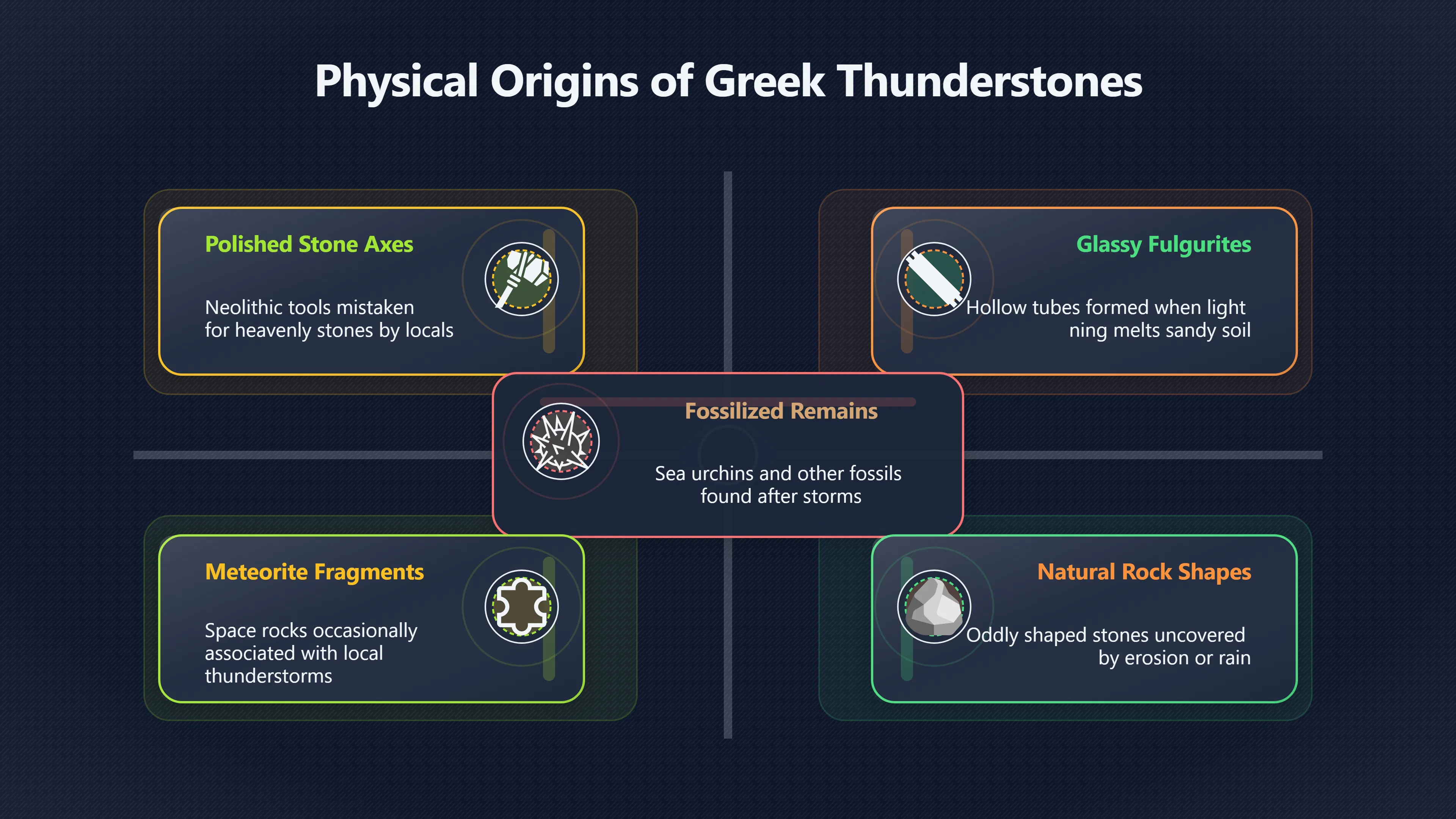
Modern archaeology and geology have transformed how these objects are understood. Most so-called thunderstones prove to be prehistoric polished stone axes, fossil objects or, more rarely, naturally formed glassy tubes created when lightning melts sand. Yet their folkloric importance lies less in what they actually were than in what they represented: visible proof that the dangerous power of lightning could be captured, carried and turned into protection rather than destruction.
Why did people believe lightning left stones behind?
The idea seems simple enough. Lightning tears trees apart, blasts holes into the ground and shatters rock. Before scientific explanations became available, it was natural to imagine that such violent effects were caused by a physical object hurled from the heavens.
The ancient Greek word keraunos referred to a thunderbolt, and from the Hellenistic period onward the related Latin term ceraunia came to describe mysterious stone objects believed to have fallen with lightning. Ancient writers treated these stones as naturally occurring wonders with unusual powers rather than ordinary rocks. Over time, prehistoric polished axeheads, long forgotten as human-made tools, became the most common objects identified as thunderstones.[OpenEdition Journals]journals.openedition.orgOpenEdition JournalsInscribed Greek Thunderstones as House- and Body…by CA Faraone · 2014 · Cited by 19 — they were believed to be “na…
This misunderstanding actually reflects an important moment in intellectual history. By the eighteenth and nineteenth centuries, antiquarians realised that these “heavenly stones” were in fact Neolithic tools thousands of years old. The discovery helped establish archaeology as a science while showing how easily ancient artefacts could be reinterpreted through folklore.[Wikipedia]WikipediaThunderstone (folkloreThunderstone (folklore
Stones said to fall with lightning
Greek thunderstone traditions rarely focus on dramatic individual incidents. Instead, they describe a recurring mechanism by which lightning supposedly created magical objects.
Several recurring beliefs appear in both Greek and wider Balkan traditions:
- A lightning bolt carried a stone from the sky.
- The stone buried itself deep underground before slowly rising back to the surface over several years.
- Anyone who recovered it gained protection from future lightning.
- Because lightning never struck the same sacred stone twice, keeping one in a house reduced the risk of another destructive strike.
The association with Zeus was particularly strong. In Greek religion Zeus was not merely a weather god but the divine wielder of the thunderbolt itself. Places struck by lightning could therefore become ritually significant. Ancient Greek and Roman custom sometimes treated lightning-struck ground as sacred, marking or enclosing the site because it had been touched by divine power.[Scribd]scribd.comThe Thunderweapon in Mythology | PDF | Greekspopular belief in ancient Greece associated the stone axe with the idea of the descent…
Rather than separating religion and natural events, these traditions blended them. A thunderstone was simultaneously evidence of a storm, a reminder of divine intervention and a practical charm against future danger.
Protection, healing and village belief
For rural communities, thunderstones were valued less as curiosities than as working protective objects.
A stone believed to have descended with lightning might be placed:
- beneath a house threshold;
- inside roof spaces;
- near fireplaces or chimneys;
- in barns to protect livestock;
- among family possessions as a household amulet.
These uses reflected the practical dangers of Greek life before modern lightning conductors. A single strike could destroy a timber roof, ignite stored grain or kill valuable animals. Possessing a thunderstone offered psychological reassurance even when it could not physically prevent disaster.
Healing traditions also developed around these objects. Across southern Europe, including regions influenced by Greek and Byzantine culture, thunderstones were credited with easing pain, protecting pregnancies, preventing illness and countering the evil eye. Such beliefs varied from village to village but shared the underlying idea that the overwhelming force of lightning could be redirected into beneficial power.[RCIN]rcin.org.plMay 15, 2022 — by K Kurasiński · 2021 · Cited by 8 — To those who found them, thunderstones appeared as unusual creations, to be used pri…
These practices illustrate a broader feature of Greek folk religion. Protective objects rarely existed in isolation. Thunderstones could sit alongside crosses, saints’ icons, blessed water or other household charms without any perceived contradiction. Village belief was often practical rather than doctrinal, combining Christian devotion with much older ideas about landscape and natural forces.

From prehistoric axes to magical amulets
One of the most intriguing discoveries is that some prehistoric stone axes were deliberately modified during the Greek and Roman periods.
Archaeologists have found polished Neolithic axes engraved with magical inscriptions, pierced for suspension or otherwise adapted to be worn as personal amulets. These were no longer treated as ancient tools. Their original purpose had been forgotten, and they were instead regarded as naturally formed thunderstones possessing protective properties.
Some examples appear to have been worn on cords around the neck or incorporated into magical equipment intended to ward off illness or misfortune. Their value lay not in craftsmanship but in the belief that they had been created or delivered by lightning itself.[OpenEdition Journals]journals.openedition.orgOpenEdition JournalsInscribed Greek Thunderstones as House- and Body…by CA Faraone · 2014 · Cited by 19 — they were believed to be “na…
This provides unusually direct archaeological evidence that thunderstone folklore was not merely an oral tradition. It influenced the physical treatment of objects that survive in museums today.

Fulgurites, misidentification and natural explanations
Not every supposed thunderstone was actually an ancient axe.
Lightning really can create unusual mineral formations. When a powerful bolt strikes sandy ground, temperatures can exceed those needed to melt silica. As the molten material cools, it forms hollow glassy tubes known as fulgurites. These twisted structures genuinely owe their existence to lightning, although they look very different from the polished stone axes commonly called thunderstones.
Other supposed thunderstones turned out to be:
- prehistoric flint or stone tools;
- fossil sea urchins and other fossils;
- oddly shaped natural rocks;
- occasionally meteorites that became associated with thunderstorms after the fact.
Modern geology therefore explains the physical objects without dismissing the folklore that surrounded them. The beliefs arose because unusual stones really were found after storms, whether exposed by heavy rain, uncovered by erosion or simply noticed more carefully in the aftermath of frightening weather. The storm became linked with the discovery even when it had not created the object itself.[Wikipedia]WikipediaThunderstone (folkloreThunderstone (folklore
Why thunderstone folklore still matters
Thunderstones occupy an unusual place in Greek strange history because they connect several otherwise separate worlds. They belong simultaneously to archaeology, meteorology, folk religion and ancient mythology.
Unlike tales of monsters or ghosts, thunderstones emerged from ordinary experience. Every community knew destructive storms. People genuinely found mysterious stone objects in fields. The leap from observation to explanation was culturally meaningful rather than irrational.
For Fortean readers, thunderstones are a reminder that many enduring mysteries began not with invented legends but with real objects whose origins had been forgotten. Long before archaeologists recognised prehistoric stone tools or geologists explained fulgurites, these enigmatic finds offered a convincing answer to an obvious question: if lightning could split an oak or blast open the earth, surely it must have left something behind. That simple idea proved remarkably durable, surviving from the ancient Greek world into village folklore well into the modern era.
Amazon book picks
Further Reading
Books and field guides related to Why Did Lightning Leave Magic Stones Behind?. Use these as the next step if you want deeper reading beyond the article.

The Golden Bough
Covers widespread traditional beliefs including sacred objects and ritual.

The Greeks and the irrational
Discusses ancient beliefs about divine power and natural phenomena.
The Oxford companion to world mythology
Places thunderstone traditions within wider mythological patterns.
eBay marketplace picks
Marketplace Samples
Live-tested eBay searches with available results related to this page.


Endnotes
1.
Source: journals.openedition.org
Link:https://journals.openedition.org/kernos/2283
Source snippet
OpenEdition JournalsInscribed Greek Thunderstones as House- and Body...by CA Faraone · 2014 · Cited by 19 — they were believed to be “na...
2.
Source: Wikipedia
Title: Thunderstone (folklore)
Link:https://en.wikipedia.org/wiki/Thunderstone_%28folklore%29
3.
Source: scribd.com
Link:https://www.scribd.com/document/600653213/The-Thunderweapon-in-Religion-and-Folklore-Christian-Blinkenberg
Source snippet
The Thunderweapon in Mythology | PDF | Greekspopular belief in ancient Greece associated the stone axe with the idea of the descent...
4.
Source: folklore.ee
Link:https://www.folklore.ee/folklore/vol42/johanson.pdf
5.
Source: rcin.org.pl
Link:https://rcin.org.pl/Content/235552/270522.pdf
Source snippet
May 15, 2022 — by K Kurasiński · 2021 · Cited by 8 — To those who found them, thunderstones appeared as unusual creations, to be used pri...
Published: May 15, 2022
Additional References
6.
Source: facebook.com
Link:https://www.facebook.com/GeomorphologyRules/posts/have-you-ever-heard-this-word-thunderstone-before-palta-might-not-be-hidden-from/2102211736502743/
Source snippet
urther lightning strikes for buildings, trees, animals...Read more...
7.
Source: bookeofsecretes.blogspot.com
Link:https://bookeofsecretes.blogspot.com/2016/12/pin-down-your-dead-historic-use-of.html
Source snippet
Pin Down Your Dead!7 Dec 2016 — Thunderstones were believed to be the physical remains of thunderbolts or lightning strikes endowed with...
8.
Source: assets.cambridge.org
Link:https://assets.cambridge.org/97811076/70068/excerpt/9781107670068_excerpt.pdf
Source snippet
belief in thunderstones, which has been common at...It is a protection against lightning, that not only among the peoples of Indo-Europe...
9.
Source: youtube.com
Title: I Made a Stone Axe and Used it to Fell a Tree
Link:https://www.youtube.com/watch?v=GEb1bkRi7EE
Source snippet
The Full Story of Zeus | Greek Mythology Explained...
10.
Source: youtube.com
Title: Caryn Wiegand Neidhold
Link:https://www.youtube.com/watch?v=y_pMlJYMl8g
Source snippet
Why thunderstorm gods ruled the ancient world | Documentary...
11.
Source: youtube.com
Title: Video Glossary: Fulgurite
Link:https://www.youtube.com/watch?v=GaD4ZmOGUaA
Source snippet
I Made a Stone Axe and Used it to Fell a Tree...
12.
Source: youtube.com
Title: Why thunderstorm gods ruled the ancient world | Documentary
Link:https://www.youtube.com/watch?v=OXvF_XbyGRI
Source snippet
Video Glossary: Fulgurite...
13.
Source: youtube.com
Title: The Full Story of Zeus | Greek Mythology Explained
Link:https://www.youtube.com/watch?v=quf5USfn06E
Topic Tree