Within Burkina Faso Forteana
Why Do Burkina Faso Villages Revere Crocodiles?
Bazoule and Sabou turn dangerous reptiles into revered neighbours, ancestral symbols and living conservation partners.
On this page
- Bazoule and Sabou as living shrines
- Ancestor stories, warnings and visitor encounters
- Ecology, tourism and crocodile conservation
Page outline Jump by section
Introduction
Among Burkina Faso’s most remarkable traditions are the sacred crocodile ponds of Bazoulé and Sabou, where reptiles normally regarded as dangerous predators are instead treated as trusted neighbours, ancestral symbols and protected members of the community. Visitors often arrive expecting a stunt or tourist performance, only to discover that the unusual relationship rests on long-standing local beliefs rather than on the idea that crocodiles have somehow become tame.
For anyone interested in Fortean traditions, these ponds are compelling because they blur the boundary between folklore and observable reality. The crocodiles are unquestionably real, and people genuinely approach, feed and sometimes even touch them. The mystery lies not in whether the animals exist, but in how centuries of custom, ritual and careful human behaviour have created a relationship that appears astonishing to outsiders while remaining meaningful to the communities that maintain it.
Why are the crocodiles considered sacred?
According to local oral tradition, the crocodiles earned their protected status by helping the ancestors of today’s villagers during a time of crisis. Although the stories differ between communities, they share a common theme: crocodiles acted as helpers rather than enemies.
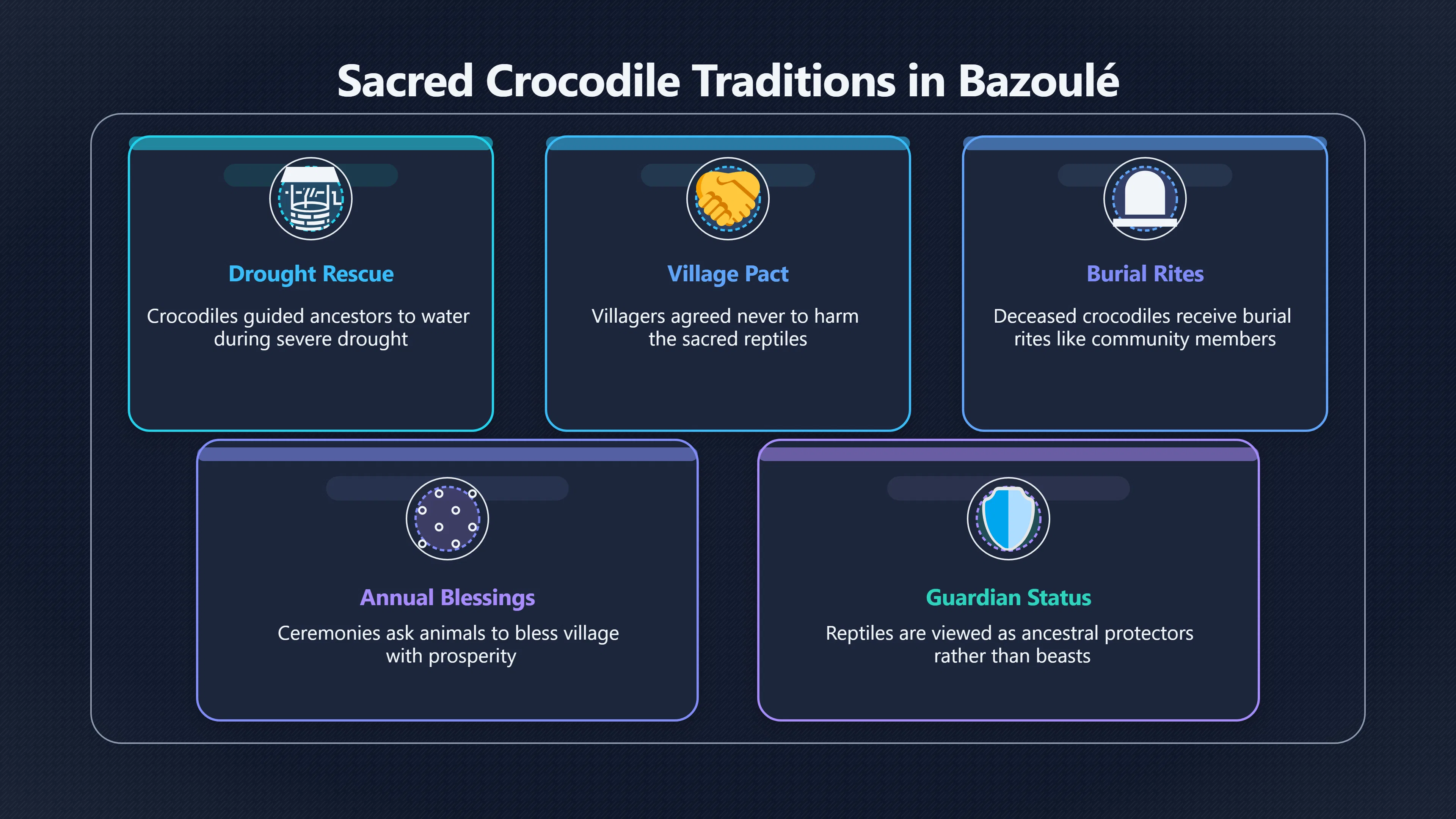
In Bazoulé, around 30 kilometres west of Ouagadougou, the best-known account says the village suffered a severe drought centuries ago. The ancestors were reportedly guided by crocodiles to a reliable source of water, allowing the settlement to survive. In gratitude, the villagers entered into a lasting pact never to harm the animals, while the crocodiles, in return, ceased attacking local people. The tradition is usually dated in local memory to around the fifteenth century, although no contemporary written record survives to confirm its age.[www.ndtv.com]ndtv.comwww.ndtv.com Sacred Snappers: In This African Village, People Sit, LieSnappers: In This African Village, People Sit, Lie…June 19, 2018 — 19 Jun 2018 — People in Bazoule, around 30 kilometres (20 miles) fr…
Sabou preserves a similar but distinct tradition. Here, local stories describe a crocodile saving an ancestral hunter from the Kaboré family. The descendants therefore became custodians of the sacred pond, and the crocodiles came to represent ancestral protectors rather than wild beasts.[ChicFaso]chicfaso.comThe Sacred Crocodile Pond of Sabou: Ancestral Harmony…For centuries, more than a hundred crocodiles have lived here in harmony…
These stories are impossible to verify historically, but they continue to shape everyday behaviour. The important fact is not whether the legends happened exactly as described, but that they define how successive generations understand their relationship with the animals.
Bazoulé and Sabou as living shrines
Unlike many legendary sites that exist mainly in stories, the crocodile ponds remain active places where tradition, tourism and daily life intersect.
At Bazoulé, local guides traditionally attract crocodiles from the water by offering a chicken. Once a crocodile has emerged and appears calm, visitors may be invited to kneel beside it or briefly sit on its back under close supervision. Images of these encounters have made the village internationally famous.[www.ndtv.com]ndtv.comwww.ndtv.com Sacred Snappers: In This African Village, People Sit, LieSnappers: In This African Village, People Sit, Lie…June 19, 2018 — 19 Jun 2018 — People in Bazoule, around 30 kilometres (20 miles) fr…
To outsiders, the photographs can suggest that the reptiles have become domesticated. In reality, guides emphasise that these remain wild crocodiles whose cooperation depends upon familiar routines, respectful handling and predictable feeding. The apparent trust is therefore cultural as much as biological.
Sabou receives fewer international visitors but follows similar principles. The crocodiles are not regarded simply as wildlife; they occupy a respected place within the community’s spiritual landscape. Certain families traditionally act as custodians, preserving rituals connected with the pond while also managing visiting tourists.[ChicFaso]chicfaso.comThe Sacred Crocodile Pond of Sabou: Ancestral Harmony…For centuries, more than a hundred crocodiles have lived here in harmony…
In both villages, the ponds function much like living shrines. Respect shown to the crocodiles is simultaneously respect shown to the ancestors believed to be connected with them.
Ancestor stories, warnings and remarkable encounters
Perhaps the most striking belief is that the crocodiles embody, accompany or symbolise ancestral spirits. In Bazoulé, local residents interviewed by journalists have explained that when one of the sacred crocodiles dies, it may receive burial rites comparable to those given to respected members of the community. Annual ceremonies also ask the animals to bless the village with health, prosperity and successful harvests.[Arab News PK]arabnews.pkArab News PKMystical connection: The African village where crocodiles…19 Jun 2018 — Far from being considered a threat, the crocodiles…
These beliefs naturally encourage stories about extraordinary encounters.
Visitors frequently report standing within touching distance of animals that elsewhere would be considered highly dangerous. Some describe the experience as almost supernatural because the crocodiles appear unexpectedly calm despite the proximity of humans. Yet there is no evidence that the reptiles are incapable of aggression. Instead, local knowledge governs when people approach, which crocodiles are accustomed to human presence and how encounters are managed.
This distinction matters. Believers may see the relationship as proof of a sacred covenant between humans and animals. More sceptical observers point to generations of predictable interaction, selective feeding and experienced local handlers. Neither explanation denies the reality of the encounters themselves; they differ only in how that remarkable behaviour is interpreted.
Why do the crocodiles rarely attack?
There is no scientific evidence that the crocodiles possess unusual biological traits or supernatural restraint.
Several practical factors probably contribute:
- The ponds are home primarily to the West African crocodile (Crocodylus suchus), now recognised as a separate species from the larger Nile crocodile. Although still capable of inflicting fatal injuries, this species generally has a reputation for being less aggressive towards humans than large populations of Nile crocodiles elsewhere in Africa.[Wikipedia]WikipediaWest African crocodileWest African crocodile
- Individual crocodiles become accustomed to regular human presence over many years.
- Experienced local guides understand animal behaviour and carefully choose suitable moments for demonstrations.
- Ritual respect discourages harassment, hunting or provoking the reptiles, reducing conflict between humans and crocodiles.
Even so, wildlife specialists caution against assuming complete safety. These are powerful predators, and the apparent harmony depends upon maintaining traditions that minimise confrontation rather than eliminating natural risk altogether.

Ecology, tourism and crocodile conservation
The sacred status of the ponds has produced an unintended conservation success. Because killing the crocodiles is forbidden by custom, the animals have survived in places where crocodile populations elsewhere have often declined through hunting or habitat loss.
Researchers studying sacred natural sites across West Africa have repeatedly found that religious rules can protect habitats and wildlife more effectively than formal legislation alone. Sacred groves, ponds and ritual landscapes often preserve biodiversity precisely because local communities attach spiritual significance to them.[hal.science]hal.scienceA case study from the Bwaba cultural area (West3 Dec 2010 — Local concepts of natural sacred sites and their ritual administration wer…
Tourism has added another layer. Bazoulé in particular became one of Burkina Faso’s best-known attractions before the country’s recent security crisis reduced international visitor numbers. Income from guided visits has helped support local livelihoods while reinforcing the value of protecting the crocodiles. At the same time, local reports have warned that environmental pressures, including silting, changing water levels and human activity around the pond, threaten the long-term health of the habitat.[Wikipedia]WikipediaMare aux crocodiles sacrés de BazouléMare aux crocodiles sacrés de Bazoulé
The villages therefore illustrate a broader lesson: cultural traditions can sometimes achieve conservation goals that modern wildlife programmes later seek to reproduce.
Why the sacred ponds remain a Fortean landmark
For readers interested in strange traditions, the crocodile ponds occupy an unusual middle ground. Nothing supernatural has been demonstrated, yet the scenes witnessed at Bazoulé and Sabou are extraordinary enough to seem almost impossible at first glance.
The real mystery is social rather than biological. Across centuries, local belief, careful observation of animal behaviour and communal rules have created a relationship that outsiders often interpret as miraculous. Whether viewed as evidence of ancestral protection or as a remarkable example of cultural coexistence with dangerous wildlife, the sacred crocodile ponds remain one of Burkina Faso’s most distinctive examples of living Fortean heritage, where folklore is not merely remembered but continues to shape everyday encounters between people and one of Africa’s most formidable reptiles.
Amazon book picks
Further Reading
Books and field guides related to Why Do Burkina Faso Villages Revere Crocodiles?. Use these as the next step if you want deeper reading beyond the article.

African religions & philosophy
Explains ancestor beliefs and sacred animals in African traditions.

Crocodiles of Australia
First published 1998. Subjects: Crocodiles, Wild animals, Australia, Reptiles & Amphibians, Nature.
Meteorites
An account of the present knowledge about meteorites, and a discussion of what they tell us about the evolution of the solar system and l...
eBay marketplace picks
Marketplace Samples
Live-tested eBay searches with available results related to this page.


Endnotes
1.
Source: ndtv.com
Title: www.ndtv.com Sacred Snappers: In This African Village, People Sit, Lie
Link:https://www.ndtv.com/world-news/sacred-snappers-in-bazoule-a-burkina-faso-village-people-sit-lie-on-crocodiles-1869627
Source snippet
Snappers: In This African Village, People Sit, Lie...June 19, 2018 — 19 Jun 2018 — People in Bazoule, around 30 kilometres (20 miles) fr...
Published: June 19, 2018
2.
Source: chicfaso.com
Link:https://www.chicfaso.com/en/post/la-mare-aux-crocodiles-sacres-de-sabou
Source snippet
The Sacred Crocodile Pond of Sabou: Ancestral Harmony...For centuries, more than a hundred crocodiles have lived here in harmony...
3.
Source: Wikipedia
Title: Sabou (Sabou)
Link:https://fr.wikipedia.org/wiki/Sabou_%28Sabou%29
4.
Source: arabnews.pk
Link:https://www.arabnews.pk/node/1323861/offbeat
Source snippet
Arab News PKMystical connection: The African village where crocodiles...19 Jun 2018 — Far from being considered a threat, the crocodiles...
5.
Source: Wikipedia
Title: West African crocodile
Link:https://en.wikipedia.org/wiki/West_African_crocodile
6.
Source: hal.science
Link:https://hal.science/hal-00542627v1/document
Source snippet
A case study from the Bwaba cultural area (West3 Dec 2010 — Local concepts of natural sacred sites and their ritual administration wer...
7.
Source: silene.ong
Link:https://www.silene.ong/en/documentation-centre/management-documents/consequences-of-wooded-shrine-rituals-on-vegetation-conservation-in-west-africa-case-study-from-the-bwaba-cultural-area-west-burkina-faso
Source snippet
a case study from the Bwaba cultural area (West Burkina...25 Oct 2018 — This paper aims at filling this gap of anthropological contribut...
8.
Source: Wikipedia
Title: Mare aux crocodiles sacrés de Bazoulé
Link:https://fr.wikipedia.org/wiki/Mare_aux_crocodiles_sacr%C3%A9s_de_Bazoul%C3%A9
9.
Source: Wikipedia
Link:https://fr.wikipedia.org/wiki/Bazoul%C3%A9
10.
Source: youtube.com
Title: Sacred snappers: The village where crocodiles are welcome
Link:http://www.youtube.com/watch?v=0UhznlAhyD4
Source snippet
Burkina Faso - The Sacred Crocodiles Of Bazoule...
11.
Source: youtube.com
Title: Burkina Faso
Link:http://www.youtube.com/watch?v=ZftqnY6ISdE
Source snippet
The Sacred Crocodiles of Burkina Faso: The Village Where Humans and Crocodiles Live in Peace...
Additional References
12.
Source: facebook.com
Link:https://www.facebook.com/groups/2585177111576712/posts/4933859816708418/
Source snippet
Sacred crocodiles in Burkina Faso and GhanaCrocodiles in Bazoul, Burkina Faso aren't harmful and are sacred creatures. Children play with...
13.
Source: wanderingnorth.ca
Link:https://www.wanderingnorth.ca/the-bazoule-crocodiles/
Source snippet
The Bazoule CrocodilesBazoule, which is about 30 km outside of Ouagadougou and is notable for its small lake teeming with sacred crocodil...
14.
Source: researchgate.net
Link:https://www.researchgate.net/publication/225327240_Consequences_of_wooded_shrine_rituals_on_vegetation_conservation_in_West_Africa_A_case_study_from_the_Bwaba_cultural_area_West_Burkina_Faso
Source snippet
A case study from the Bwaba cultural area (West Burkina...2 May 2026 — Consequences of wooded shrine rituals on vegetation conservation...
Published: May 2026
15.
Source: untamedtravelling.com
Link:https://www.untamedtravelling.com/en/destinations/africa/burkina-faso/sacred-crocodiles
16.
Source: scmp.com
Title: where reptiles rule african village where crocodiles roam free
Link:https://www.scmp.com/news/world/africa/article/2151500/where-reptiles-rule-african-village-where-crocodiles-roam-free
Source snippet
South China Morning PostWhere reptiles rule: the village where crocodiles roam free19 Jun 2018 — Visitors to Bazoule in Burkina Faso can...
17.
Source: instagram.com
Title: Centuries ago, a village in Burkina Faso was dying of thirst
Link:https://www.instagram.com/p/DVYoG2tiekP/?hl=en-gb
Source snippet
Welcome to Bazoule! Where crocs co exist in perfect harmony with humans after they led them to a water source during a drought hundreds o...
18.
Source: violencepreventionwales.co.uk
Title: the sacred crocodiles of bazoule burkina faso 1767647869
Link:https://violencepreventionwales.co.uk/violencepreventionwales-news/the-sacred-crocodiles-of-bazoule-burkina-faso-1767647869
Source snippet
Safety Net: The Sacred Crocodiles Of Bazoulé, Burkina Faso5 Jan 2026 — The pond itself is considered a holy site, and its waters are beli...
19.
Source: youtube.com
Link:http://www.youtube.com/watch?v=udULCYqRDcc
Source snippet
Bazoule sacred crocodiles Burkina Faso Sacred snappers: The village where crocodiles are welcome AFP News Agency...
20.
Source: facebook.com
Link:https://www.facebook.com/groups/275114380263865/posts/1003998604042102/
Source snippet
Children play with them. They are buried like humans when they die...
21.
Source: instagram.com
Link:https://www.instagram.com/p/DMfH-DQI_DY/
Source snippet
erefore revered by the community. Country 136/197: Burkina Faso...
Topic Tree