Where Folklore Meets Strange History
Trinidad and Tobago’s strange-history record is less a catalogue of laboratory-defying “proof” than a lively meeting place between folklore, landscape, colonial history, rumour, science and social memory.
Page outline Jump by section
Introduction
What makes Trinidad and Tobago especially rich for Fortean reading is not that its marvels demand paranormal belief. It is that many stories sit exactly on the boundary where an ordinary event becomes culturally charged: a forest noise becomes a warning, a lonely road becomes a moral test, a strange light becomes a flying witch, and an asphalt lake becomes both a geological wonder and a remembered punishment myth.
Why Trinidad and Tobago’s weird stories feel unusually rooted
The country’s folklore is not a decorative add-on to its history. NALIS, the National Library and Information System Authority, describes Caribbean folklore as traditional belief, story, history, legend and myth passed down largely through oral tradition, shaped by the region’s multi-ethnic inheritance from Indigenous peoples and later African, Indian, European, Middle Eastern and wider Asian influences.[Nalis]nalis.gov.ttOpen source on nalis.gov.tt. That mixed inheritance matters because Trinidad and Tobago’s uncanny figures rarely belong to a single neat category. They are part ghost story, part cautionary tale, part environmental code, part colonial memory, and part entertainment.
This is why a “strange reports” page for Trinidad and Tobago cannot simply ask whether a creature was real. A better question is: what work did the story do? A tale about a child-luring douen warns children away from the bush. A story about La Diablesse punishes reckless desire and late-night wandering. Papa Bois turns the forest itself into a moral presence. Jumbie stories keep ancestors, graveyards, old trees and plantation landscapes inside everyday conversation rather than sealed away in archives.
The evidence base is therefore uneven by design. Some items, such as the Pitch Lake or Chacachacare’s quarantine history, are tied to physical sites and official heritage records. Others are traditions preserved in libraries, newspapers, family storytelling, performance, tourism and local memory. The right approach is to treat them as claims, traditions and cultural records, not as proven supernatural events.
Fireballs, witches and the soucouyant problem
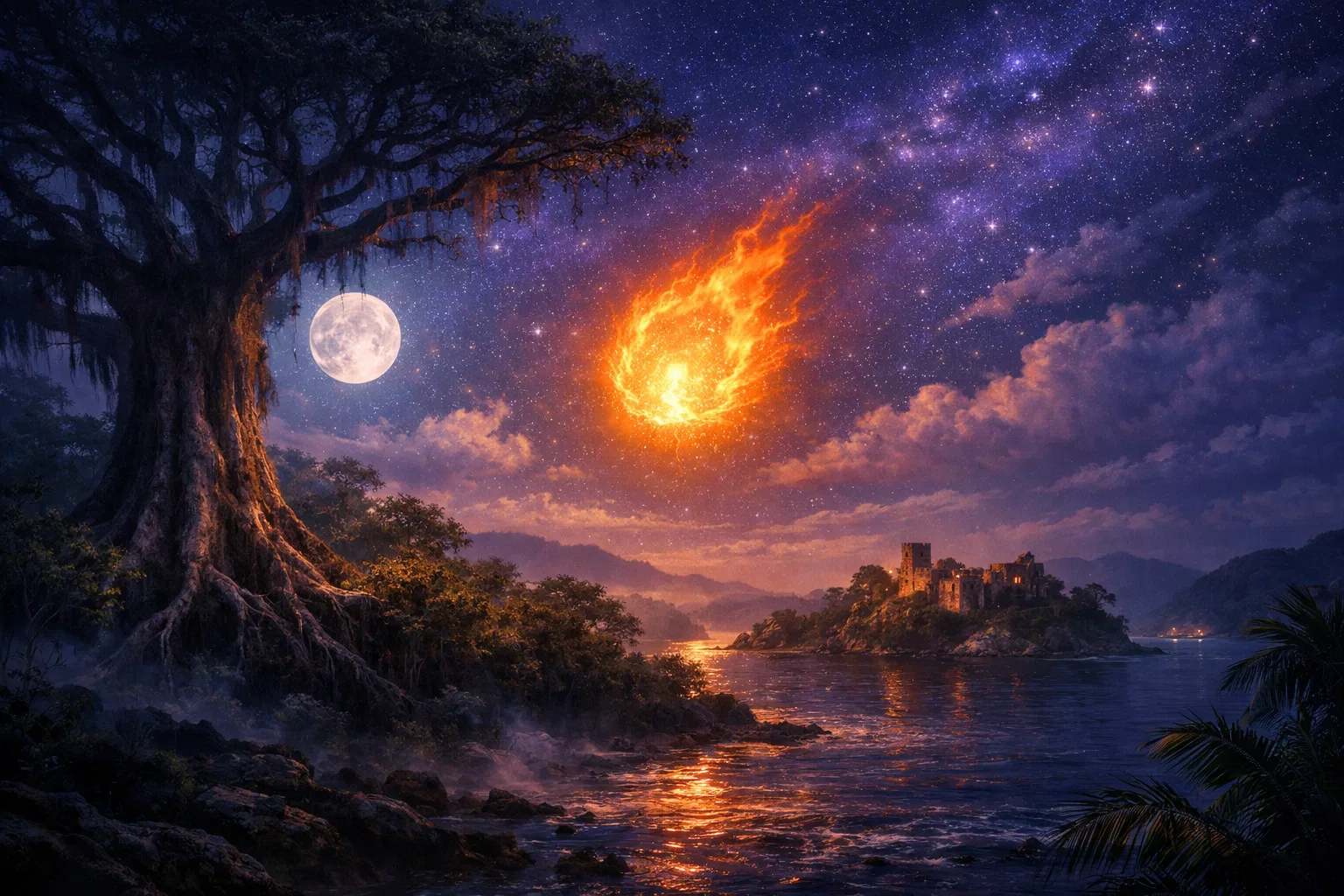
The soucouyant is one of Trinidad and Tobago’s most durable strange figures because it gives a memorable supernatural shape to something many people already fear: the unexplained light in the dark. In common Caribbean versions, the soucouyant appears by day as an apparently ordinary person, often an old woman, but by night sheds her skin and travels as a fireball, entering houses through tiny gaps to feed on blood. NALIS lists soucouyants among the folklore figures held in its heritage collections, alongside douens, lagahoo and other Caribbean characters.[Nalis]nalis.gov.ttOpen source on nalis.gov.tt.
The figure is Fortean in a particularly Caribbean way. A light in the sky may be a meteor, aircraft, drone, satellite, rocket exhaust, electrical effect or distant flame. But the soucouyant tradition supplies a local story-template: moving fire is not just moving fire; it may be a disguised neighbour, witchcraft, danger, envy or a secret life exposed. That interpretive reflex was visible in the 2026 Trinidad light episode, when one fisherman told the Trinidad Guardian he initially thought the bright object was a soucouyant before it was explained as a SpaceX launch-related sight.[Trinidad Guardian]guardian.co.ttOpen source on guardian.co.tt.
Sceptically, the soucouyant is a useful reminder that strange sightings do not arrive in culturally empty minds. People interpret odd lights through the stories available to them. Believers may treat the folklore as testimony to a hidden world; sceptics may see a long-running pattern of misidentification, sleep fears, social suspicion and storytelling. Either way, the soucouyant remains culturally powerful because it turns an aerial anomaly into a social drama: who is out at night, who is secretly dangerous, and what can pass through the smallest crack in a supposedly safe home?
Forest beings: when the bush watches back
Trinidad and Tobago’s forest folklore often works as a warning system. The bush is not just scenery; it is a place where children can be lost, hunters can overreach, watercourses can be polluted, and ordinary social rules may fail. Figures such as Papa Bois, Mama Dlo, douens and La Diablesse make that risk vivid.
NALIS describes Papa Bois as the protector of forest life, commonly imagined with a human upper body, deer-like cloven hooves, long hair, short horns and unusual speed. He is said to mislead hunters by setting false tracks, and the recommended response to meeting him is not violence but manners.[Nalis]nalis.gov.ttOpen source on nalis.gov.tt. As a piece of weird folklore, Papa Bois is less a “monster” than an ecological judge. The strangeness lies in the idea that the forest can answer back when humans take too much.
La Diablesse is more predatory. NALIS summarises her as a beautiful woman in a floor-length dress that hides one normal foot and one cloven hoof. She appears at night, lures men into lonely places or deep forest, and leaves them trapped or doomed; suggested folk remedies include reversing one’s clothes or lighting a flame.[Nalis]nalis.gov.ttOpen source on nalis.gov.tt. Read literally, she is a supernatural femme fatale. Read socially, she is a story about intoxication, desire, danger, and the perils of following appearances without noticing the hoof.
Mama Dlo, meanwhile, gives rivers and streams a guardian. In NALIS’s account, she is usually described as part woman and part snake, protecting rivers, lagoons and streams from pollution and punishing those who spoil watercourses or kill animals.[Nalis]nalis.gov.ttOpen source on nalis.gov.tt. This is where folklore and environmental common sense overlap. A river spirit need not be zoologically real to carry a practical message: water is alive in the moral imagination, and damaging it has consequences.
Douens, often described in Trinidadian folklore as lost or uncanny children with backwards feet and hidden faces, occupy another zone: the child-safety tale. Their backwards feet are narratively clever because they make tracking unreliable. A child who follows the wrong voice or wrong path may vanish into the bush. The weird detail is memorable; the lesson is brutally practical.
Tobago’s jumbies and the haunted social landscape
Tobago’s ghost lore shows how strange stories attach themselves to specific landscapes: silk cotton trees, cemeteries, roads, rum rituals, hunting grounds and old plantation sites. In a 2020 Newsday essay, historian Rita Pemberton argued that Tobago’s jumbie stories should not be dismissed as trivial superstition because they preserve clues about social psychology, ancestral relations and the issues that mattered to earlier communities.[Trinidad and Tobago Newsday]newsday.co.ttTrinidad and Tobago Newsday Ghost lore: The value of Tobago's jumbie storiesTrinidad and Tobago Newsday Ghost lore: The value of Tobago's jumbie stories
The details are wonderfully concrete. Pemberton notes beliefs around large trees, nocturnal work, cemeteries, dogs reacting to unseen presences, white apparitions rising from the ground, and hunters making appeals to ancestral spirits before or during a hunt. She also points to the silk cotton tree on the Northside Road as a major symbol of ancestral connection and enslaved resistance.[Trinidad and Tobago Newsday]newsday.co.ttTrinidad and Tobago Newsday Ghost lore: The value of Tobago's jumbie storiesTrinidad and Tobago Newsday Ghost lore: The value of Tobago's jumbie stories
For a Fortean reader, Tobago’s jumbie material is valuable because it does not depend on one spectacular case. Its force comes from repetition and social setting. The same kinds of places become charged again and again: old trees, graves, night roads, isolated gardens, plantation remnants. Sceptics may interpret these accounts through darkness, fear, animal sounds, alcohol, memory and expectation. Believers may see them as evidence that the dead remain active in the community. The culturally important point is that the stories keep moral and historical pressure on the landscape. A silk cotton tree is not just a tree; it may be a witness.
Haunted islands: Chacachacare and the quarantine imagination
Few places in Trinidad and Tobago invite ghost stories as naturally as Chacachacare. It has the right ingredients: isolation, abandoned buildings, illness, religious service, forced separation, military presence and difficult memory. The National Trust records that by 1926 all sufferers of leprosy had been transferred to Chacachacare, with Dominican Sisters following to care for them; the first transfer in 1921 was carried out secretly because of the controversy around the move.[National Trust of Trinidad and Tobago]nationaltrust.ttNational Trust of Trinidad and Tobago Islands of QuarantineNational Trust of Trinidad and Tobago Islands of Quarantine
That history matters more than any single ghost anecdote. Chacachacare’s haunted reputation is not simply a spooky tourism label; it grows from the emotional reality of quarantine. People were removed from ordinary life, separated from family and placed on an island associated with disease and stigma. Ruins then do what ruins always do: they invite the living to imagine voices in empty rooms.
The wider “quarantine islands” around Port of Spain also carry a mythic charge. The National Trust describes the Five Islands as having been “mythologically created” by a witch’s wand and an innumerate devil, while also recording their practical uses as military outposts, detention sites, elite retreats and disease-control facilities.[National Trust of Trinidad and Tobago]nationaltrust.ttNational Trust of Trinidad and Tobago Islands of QuarantineNational Trust of Trinidad and Tobago Islands of Quarantine That mixture is exactly the stuff of country-level Forteana: official history and folk imagination occupying the same small geography.
A cautious reading does not need to prove ghosts on Chacachacare. The stronger point is that the island’s documented past makes haunting feel plausible to visitors. The supernatural claim sits on top of verifiable isolation, medical fear and abandonment. That is why Chacachacare remains one of the country’s most resonant eerie places even when the evidence for apparitions is anecdotal.
La Brea Pitch Lake: real wonder, mythic punishment
La Brea Pitch Lake is the rare Fortean site where the physical phenomenon is already strange enough without embellishment. UNESCO’s World Heritage tentative-list entry describes the lake in south-west Trinidad as roughly 100 acres, about 250 feet deep at the centre, and holding around ten million tons of pitch. It also notes that the asphalt still moves with a slow natural stirring action, with prehistoric trees and other objects reported to have appeared, disappeared and reappeared in the material.[UNESCO World Heritage Centre]whc.unesco.orgWorld Heritage Centre La Brea Pitch LakeWorld Heritage Centre La Brea Pitch Lake
That is not paranormal, but it is deeply uncanny. A “lake” that can be walked on, mined, stirred by gas and bitumen, and capable of swallowing and returning objects has obvious myth-making power. UNESCO records an Indigenous legend in which a victorious tribe celebrated by eating sacred hummingbirds believed to hold ancestral spirits; in punishment, a winged god opened the earth and created a pitch lake that swallowed the village.[UNESCO World Heritage Centre]whc.unesco.orgWorld Heritage Centre La Brea Pitch LakeWorld Heritage Centre La Brea Pitch Lake
The scientific account is no less dramatic, just differently framed. UNESCO explains the lake through oil, gas, bitumen, mineral matter, faulting, folding and asphaltic material rising through geological structures over deep time.[UNESCO World Heritage Centre]whc.unesco.orgWorld Heritage Centre La Brea Pitch LakeWorld Heritage Centre La Brea Pitch Lake Research on the lake has also found active microbial life in the asphalt, with scientists treating it as an analogue for extreme hydrocarbon environments, including those imagined on Saturn’s moon Titan.[arXiv]arxiv.orgarXiv Microbial Life in a Liquid Asphalt DesertarXiv Microbial Life in a Liquid Asphalt Desert
Pitch Lake therefore sits at the centre of Trinidad and Tobago’s weird-history record for two reasons. It is a genuine natural anomaly with scientific importance, and it has a punishment myth that translates geological danger into moral narrative. The believer does not need to reject geology; the sceptic does not need to sneer at myth. Both are responses to a landscape that behaves in ways ordinary ground does not.
Modern sky scares and the old language of marvels
The May 2026 “mystery light” over Trinidad is a useful modern case because it shows how quickly contemporary technology can reactivate older folklore. According to the Trinidad Guardian, the bright light was widely filmed and discussed online before being identified as linked to SpaceX’s Starship V3 test flight; the article explicitly framed the public reaction against soucouyant and UFO interpretations.[Trinidad Guardian]guardian.co.ttOpen source on guardian.co.tt.
This is not unique to Trinidad and Tobago. Around the world, rocket launches, satellite trains, meteors and re-entering debris often produce brief waves of UFO speculation. But the local vocabulary matters. In Trinidad, a glowing object moving strangely across the evening sky can be joked about or feared as a soucouyant, not merely filed under “unidentified aerial phenomenon”. That gives the event a local flavour even when the explanation is global aerospace activity.
The episode also suggests a healthy model for handling future reports. First, preserve the witness experience: people really did see something unusual. Second, check timing, direction, video, launch schedules, aircraft, satellites and weather. Third, notice the cultural frame without mocking it. The soucouyant comparison was not just ignorance; it was a living folklore category doing what folklore does, making the unknown narratable.
Mystery animals, spirit birds and the edge of natural history
Trinidad and Tobago’s animal lore often sits close to real biodiversity. The country has genuinely striking wildlife, including dangerous snakes on Trinidad, nocturnal birds, forest mammals and creatures rarely seen by casual observers. That makes it easy for natural history and supernatural reading to blur.
The mapepire zanana, or bushmaster, is a good example of a real animal with near-mythic force. Trinidad is home to the bushmaster, a large venomous viper, while Tobago has no dangerous venomous snakes; local snake lists identify Lachesis muta muta as the mapepire zanana and Bothrops atrox as the mapepire balsain.[Wikipedia]WikipediaList of snakes of Trinidad and TobagoList of snakes of Trinidad and Tobago A rare, large, venomous rainforest snake does not need to be a cryptid to generate exaggerated stories. Its real danger and elusive habits are enough.
Bird folklore works differently. The “jumbie bird” is commonly associated with ominous night sounds and death warnings, and the phrase has become important enough in Trinidadian cultural memory to appear in literature, including Ismith Khan’s novel The Jumbie Bird. Accounts of the term link it to the ferruginous pygmy owl, a small bird more often heard than seen, which helps explain how a natural call can become a supernatural signal.[Wikipedia]WikipediaThe Jumbie BirdThe Jumbie Bird
These cases show why mystery-animal traditions should not be flattened into either “true creature” or “nonsense”. Often the creature is real, but the meaning attached to it is uncanny. A snake becomes a forest terror. An owl becomes a death omen. A dog barking at nothing becomes evidence of a jumbie. Natural history supplies the stimulus; culture supplies the charge.
What the evidence can and cannot support
The strongest evidence for Trinidad and Tobago’s Forteana is cultural, historical and environmental rather than paranormal. Folklore figures are well documented as traditions. Haunted sites often have verifiable histories of illness, slavery, quarantine, isolation or death. Pitch Lake is a documented geological wonder with an associated Indigenous legend. Modern sky scares can sometimes be checked against aerospace events, as in the 2026 SpaceX explanation.[nalis.gov.tt]nalis.gov.ttOpen source on nalis.gov.tt.
What the evidence does not support is treating these stories as proven supernatural fact. The soucouyant is not established as a biological or paranormal entity. Jumbie sightings are not controlled observations. Chacachacare’s ghost stories rest mostly on atmosphere, testimony and repetition rather than hard evidence. La Diablesse and douens are better understood as powerful folklore than as documented beings.
That does not make the material weak. It simply means the value lies elsewhere. Trinidad and Tobago’s strange traditions reveal how people interpret risk, landscape, desire, illness, ancestry, childhood danger, environmental damage and unexplained lights. They also show how a small country can hold multiple registers of mystery at once: Indigenous myth, African-derived spirit belief, Indian and Middle Eastern supernatural motifs, Catholic and colonial histories, modern media, scientific geology and space-age misidentification.

Why these stories still matter
Trinidad and Tobago’s weird-history record endures because it is unusually good at giving memorable shapes to uncertainty. The soucouyant gives a face to the light in the sky. Papa Bois gives authority to the forest. Mama Dlo gives water a guardian. Jumbies keep ancestors in the present tense. Chacachacare turns quarantine history into haunting. Pitch Lake makes the ground itself seem alive.
For readers of strange-but-grounded material, the country’s Forteana is therefore not a hunt for one decisive monster, ghost or UFO. It is a map of how mystery is made. Some mysteries shrink under investigation, as the 2026 sky light did. Some become richer when science explains them, as with Pitch Lake. Some remain important because they preserve emotional truths rather than physical ones. In Trinidad and Tobago, the uncanny is not separate from ordinary life; it is one of the languages ordinary life uses when the road is dark, the forest is loud, the old tree is watching, and the sky suddenly catches fire.
Amazon book picks
Further Reading
Books and field guides related to Where Folklore Meets Strange History. Use these as the next step if you want deeper reading beyond the article.

A Brief History of the Caribbean
Provides historical context behind regional folklore.

The Penguin Book of Ghost Stories
Appeals to readers interested in folklore and supernatural traditions.

eBay marketplace picks
Marketplace Samples
Live-tested eBay searches with available results related to this page.


Endnotes
1.
Source: whc.unesco.org
Title: World Heritage Centre La Brea Pitch Lake
Link:https://whc.unesco.org/en/tentativelists/5645/
2.
Source: arxiv.org
Title: arXiv Microbial Life in a Liquid Asphalt Desert
Link:https://arxiv.org/abs/1004.2047
3.
Source: Wikipedia
Title: List of snakes of Trinidad and Tobago
Link:https://en.wikipedia.org/wiki/List_of_snakes_of_Trinidad_and_Tobago
4.
Source: Wikipedia
Title: The Jumbie Bird
Link:https://en.wikipedia.org/wiki/The_Jumbie_Bird
5.
Source: Wikipedia
Link:https://en.wikipedia.org/wiki/Soucouyant
6.
Source: Wikipedia
Title: Trinidad and Tobago
Link:https://en.wikipedia.org/wiki/Trinidad_and_Tobago
7.
Source: Wikipedia
Link:https://en.wikipedia.org/wiki/Lagahoo
8.
Source: Wikipedia
Title: Rain of animals
Link:https://en.wikipedia.org/wiki/Rain_of_animals
9.
Source: Wikipedia
Title: Lluvia de peces
Link:https://en.wikipedia.org/wiki/Lluvia_de_peces
10.
Source: Wikipedia
Title: Pitch Lake
Link:https://en.wikipedia.org/wiki/Pitch_Lake
11.
Source: Wikipedia
Title: La Diablesse
Link:https://en.wikipedia.org/wiki/La_Diablesse
12.
Source: Wikipedia
Link:https://en.wikipedia.org/wiki/Chacachacare
13.
Source: Wikipedia
Title: Lachesis muta
Link:https://en.wikipedia.org/wiki/Lachesis_muta
14.
Source: guardian.co.tt
Link:https://www.guardian.co.tt/article/spacecraft-not-soucouyant-mystery-light-stirs-curiosity-across-trinidad-6.2.2591471.5d16fdcb1b
15.
Source: nalis.gov.tt
Link:https://www.nalis.gov.tt/blog/caribbean-folklore-part-1/
16.
Source: nalis.gov.tt
Link:https://www.nalis.gov.tt/blog/caribbean-folklore-part-2/
17.
Source: nalis.gov.tt
Link:https://www.nalis.gov.tt/blog/caribbean-folklore-part-3/
18.
Source: newsday.co.tt
Title: Trinidad and Tobago Newsday Ghost lore: The value of Tobago’s jumbie stories
Link:https://newsday.co.tt/2020/11/12/ghost-lore-the-value-of-tobagos-jumbie-stories/
19.
Source: nationaltrust.tt
Title: National Trust of Trinidad and Tobago Islands of Quarantine
Link:https://nationaltrust.tt/home/quarantine-islands-1/
20.
Source: nationaltrust.tt
Title: National Trust of Trinidad and Tobago Islands of Quarantine
Link:https://nationaltrust.tt/home/quarantine-islands-3/
21.
Source: facebook.com
Link:https://www.facebook.com/ExpressNewspapers/photos/what-many-in-trinidad-and-tobago-believed-was-a-soucouyant-a-fireball-like-figur/1411948787629988/
22.
Source: facebook.com
Link:https://www.facebook.com/ttnationaltrust/photos/%EF%B8%8F-explore-the-abandoned-beauty-of-chacachacare-on-our-adventure-tour-%EF%B8%8Fdiscover-t/1030700322434996/
23.
Source: guardian.co.tt
Link:https://www.guardian.co.tt/article-6.2.409936.cd15700cfb
24.
Source: wendyshearer.co.uk
Title: la diablesse
Link:https://wendyshearer.co.uk/2020/04/la-diablesse/
25.
Source: nalis.gov.tt
Link:https://www.nalis.gov.tt/blog/winer-postcard-collection-the-la-brea-pitch-lake/
26.
Source: newsday.co.tt
Title: lessons from mystical beings of the mas
Link:https://newsday.co.tt/2021/02/06/lessons-from-mystical-beings-of-the-mas/
27.
Source: newsday.co.tt
Title: trinidad and tobagos natural wonder the pitch lake
Link:https://newsday.co.tt/2023/11/16/trinidad-and-tobagos-natural-wonder-the-pitch-lake/
28.
Source: newsday.co.tt
Title: quarantine measures not new to tt
Link:https://newsday.co.tt/2020/04/25/quarantine-measures-not-new-to-tt/
29.
Source: chloemaraj68104874.wordpress.com
Link:https://chloemaraj68104874.wordpress.com/home-3/page-1/men-in-folklore/lagahoo/
30.
Source: chloemaraj68104874.wordpress.com
Title: la diablesse
Link:https://chloemaraj68104874.wordpress.com/home-3/page-1/women-in-folklore/la-diablesse/
31.
Source: caribbeanreads.com
Link:https://www.caribbeanreads.com/soucouyant/
Additional References
32.
Source: youtube.com
Title: The Tale of the Hunter and Papa Bois
Link:https://www.youtube.com/watch?v=yWL4p7lMaLs
Source snippet
Moko Jumbie | Documentary | Full Movie | Caribbean Heritage...
33.
Source: instagram.com
Link:https://www.instagram.com/reel/B-NtBo6HDU4/
34.
Source: reddit.com
Link:https://www.reddit.com/r/AbandonedPorn/comments/mmitgg/abandoned_nuns_quarters_at_the_abandoned_leper/
35.
Source: instagram.com
Link:https://www.instagram.com/reel/DYkHsb2KoyI/?hl=en
36.
Source: caribbeanentertainmenthub.com
Link:https://caribbeanentertainmenthub.com/caribbean-folklore-with-illustration
37.
Source: facebook.com
Link:https://www.facebook.com/groups/191766699268/posts/10161664275609269/
38.
Source: facebook.com
Link:https://www.facebook.com/groups/caribbeanphotographers/posts/31002427112689041/
39.
Source: trinidadlakeasphalt.com
Link:https://trinidadlakeasphalt.com/history/discovery-of-the-pitch-lake-and-its-use/
40.
Source: facebook.com
Link:https://www.facebook.com/NALISTT/videos/the-la-diabless-re-told-by-kester-peters/717698352521074/
41.
Source: instagram.com
Link:https://www.instagram.com/reel/DQfj_H5icgS/?hl=en
Topic Tree
Follow this branch
Related pages 192
- Afghan Forteana
- Antigua Uncanny
- Bosnian Mysteries
- Botswana Weird
- Brazil Strange
- +187 more in sidebar