Within Montenegro Forteana
Who Fought Montenegro's Storms in Their Sleep?
Montenegro's hail-defender folklore turned dangerous weather into a hidden battle fought by sleeping spirit-warriors.
On this page
- How hail defenders were recognised
- Storm battles, sleeping bodies and wandering souls
- Why weather folklore mattered to farming communities
Page outline Jump by section
Introduction
In the mountain communities of Montenegro, violent weather was not simply an inconvenience. A single hailstorm could destroy a family’s crops, threaten winter food supplies and wipe out a year’s work in minutes. Within that setting grew one of the country’s most distinctive supernatural traditions: the belief that certain people could leave their sleeping bodies, wage invisible battles against storm-bringing forces, and return exhausted after saving their neighbours’ fields. Rather than ghosts or witches, these figures were imagined as protectors whose gift was both feared and respected. Although modern scholarship treats the stories as folklore rather than evidence of paranormal events, they remain among the most remarkable examples of how Montenegrins explained the unpredictable power of nature.[Wikipedia]WikipediaOpen source on wikipedia.org.
How were Montenegro’s hail-defenders recognised?
Across Montenegro, eastern Herzegovina and neighbouring parts of the western Balkans, these weather champions were commonly known by regional names related to zduhać or stuha. Ethnographers describe them not as professional magicians but as ordinary members of the community believed to possess an inborn ability to defend their village from destructive weather. Their role was practical rather than mystical in the everyday sense: they protected harvests, orchards and livestock from hail, torrential rain and violent winds.[Wikipedia]WikipediaOpen source on wikipedia.org.
Unlike someone who learned magic, a weather-defender was generally believed to be born with the gift. Folk traditions often claimed that signs appeared at birth, particularly if a child was born enclosed in part of the birth membrane, known as the caul. Preserving the caul was sometimes thought to preserve the child’s future powers. Similar beliefs could also be attached to certain animals, especially working livestock whose wellbeing was closely tied to farming success.[Wikipedia]WikipediaOpen source on wikipedia.org.
Descriptions of these people are strikingly ordinary. They were not expected to look supernatural. Some traditions merely noted that they slept deeply, appeared thoughtful or serious, or were unusually difficult to wake. Their extraordinary qualities only emerged when dangerous weather approached.[Wikipedia]WikipediaOpen source on wikipedia.org.
Storm battles, sleeping bodies and wandering souls
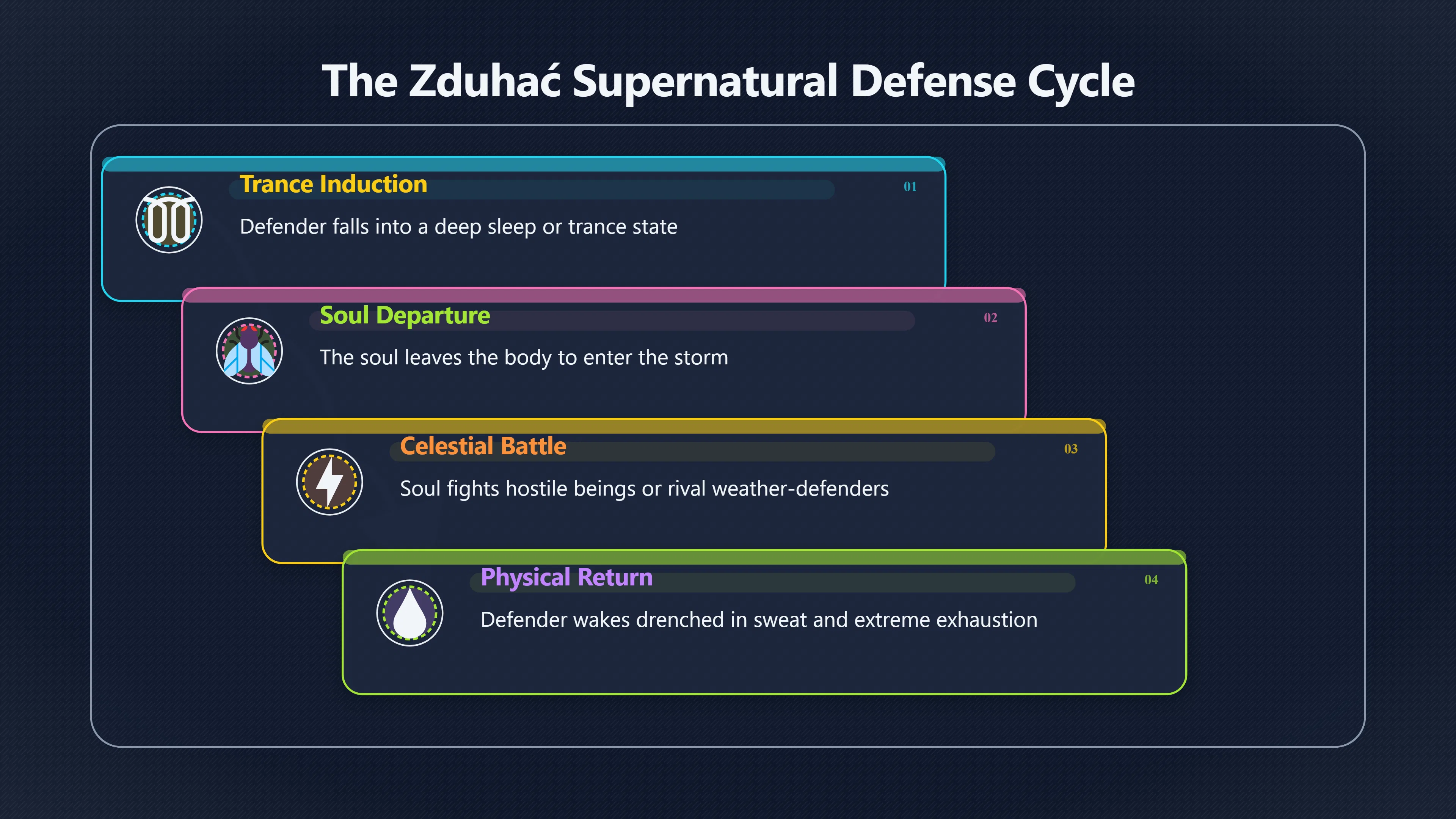
The most unusual feature of the tradition is its explanation of how weather-defenders fought storms. According to Montenegrin belief, the defender did not physically climb mountains or confront clouds. Instead, as threatening weather gathered, he would suddenly fall asleep or withdraw into a trance-like state. His soul was believed to leave his body and enter the storm itself.[Wikipedia]WikipediaOpen source on wikipedia.org.
Some accounts imagined the departing soul taking the form of a tiny insect such as a fly. Others simply described it as travelling “into the winds”. Once outside the body, the soul confronted hostile beings responsible for destructive weather or rival weather-defenders attempting to divert storms towards another district. These were not symbolic contests but literal battles in the folk imagination, fought high above the landscape while ordinary people watched thunderheads gathering below.[Wikipedia]WikipediaOpen source on wikipedia.org.
The sleeping body meanwhile required careful protection. Family members were warned not to move it or even change the body’s orientation. If the soul returned to find its body displaced, it might fail to re-enter it, resulting in death. This detail gave the tradition a vivid physical dimension: the invisible battle in the clouds had immediate consequences for the motionless figure lying indoors.[Wikipedia]WikipediaOpen source on wikipedia.org.
Stories commonly describe the defender waking drenched in sweat, exhausted and sometimes physically ill after the struggle. If he had been wounded during the supernatural battle, the injuries might supposedly appear as real sickness afterwards. These reports blurred the boundary between dreams, illness and spiritual warfare in ways that made perfect sense within the traditional worldview.[Wikipedia]WikipediaOpen source on wikipedia.org.
Who were they fighting?
The enemy varied between regions, showing that this was a flexible body of folklore rather than a fixed mythology.
In Montenegrin and neighbouring traditions, weather-defenders might battle:
- rival defenders from another valley or region trying to push storms onto their neighbours;
- supernatural beings believed to drive hail clouds;
- wandering souls associated with violent deaths;
- demonic or monstrous weather spirits that carried destructive storms.
Some traditions even imagined organised companies of weather-defenders fighting one another. A victorious group did more than repel bad weather: they were believed to carry away the future fertility of the defeated region, explaining why one district enjoyed an abundant harvest while another suffered crop failure. This gave poor harvests a moral and social explanation rather than leaving them to chance alone.[Wikipedia]WikipediaOpen source on wikipedia.org.
One especially colourful strand of folklore claimed that weather-warriors from Montenegro, Herzegovina and northern Albania fought opponents arriving from across the Adriatic in southern Italy. Such stories transformed ordinary storms crossing the sea into imagined military campaigns between supernatural defenders of distant farming communities.[Wikipedia]WikipediaOpen source on wikipedia.org.

Why this belief mattered to farming communities
Modern readers can easily overlook the practical importance of the tradition. Before weather forecasting, crop insurance or mechanised agriculture, hail represented an existential threat. A vineyard, orchard or field of grain could be devastated within minutes.
The weather-defender offered a reassuring explanation for uncertainty:
- someone in the community was actively protecting the harvest;
- unusual sleep, illness or exhaustion could have a meaningful cause;
- unequal harvests between neighbouring valleys reflected invisible struggles rather than random luck;
- communal prosperity depended partly upon the hidden courage of recognised protectors.
Rather than encouraging passivity, these beliefs reinforced community identity. A village that believed it possessed a powerful weather-defender felt symbolically defended against forces beyond human control.[Wikipedia]WikipediaOpen source on wikipedia.org.
Between folklore, psychology and history
Ethnographers generally interpret these stories as examples of traditional weather folklore rather than records of supernatural events. The recurring themes—dreaming, sleep paralysis, vivid visions, unexplained illness after storms and symbolic interpretations of natural disasters—fit patterns found across many farming societies.[Wikipedia]WikipediaOpen source on wikipedia.org.
What makes the Montenegrin tradition distinctive is the detailed mechanism. Many cultures tell stories about weather magic, but relatively few imagine respected members of the community leaving their bodies during sleep to conduct organised battles in the clouds while relatives carefully guard their apparently lifeless bodies.
Researchers also note that the tradition sits comfortably beside Montenegro’s long history of heroic storytelling. Invisible battles in the sky echoed the values of courage, sacrifice and communal defence celebrated in the country’s historical epics. The weather-defender was not merely a magician but another kind of guardian, fighting an enemy that threatened survival just as surely as any invading army.[Wikipedia]WikipediaOpen source on wikipedia.org.
Why the weather souls still fascinate
Today, nobody regards weather-defenders as part of meteorology, yet the stories remain among Montenegro’s richest pieces of strange folklore because they connect natural danger with an elaborate supernatural mechanism. The tradition explains not simply that storms were frightening, but exactly how ordinary people imagined those storms being resisted: by unseen spirit-warriors whose sleeping bodies lay quietly in village houses while their souls fought above the mountains.
That combination of everyday farming life, dramatic weather and invisible nocturnal combat gives Montenegro one of the most distinctive weather legends in European folklore. It survives not because it explains storms scientifically, but because it reveals how communities transformed the uncertainty of mountain agriculture into a compelling narrative of hidden guardians and unseen battles.[Wikipedia]WikipediaOpen source on wikipedia.org.
Amazon book picks
Further Reading
Books and field guides related to Who Fought Montenegro's Storms in Their Sleep?. Use these as the next step if you want deeper reading beyond the article.



Myths and symbols in pagan Europe
Covers pre-Christian beliefs that illuminate weather folklore.
Endnotes
1.
Source: Wikipedia
Link:https://en.wikipedia.org/wiki/Zduha%C4%87
Additional References
2.
Source: instagram.com
Link:https://www.instagram.com/p/DWvupazjWCK/
Source snippet
uctive weather, particularly hailstorms and violent storms. (This...
3.
Source: scribd.com
Title: In this way they provided rich
Link:https://www.scribd.com/document/294916319/Where-has-Zduhac-gone
Source snippet
The Role of Zduhać in Serbian Folklore | PDF | Shamanism“Their main function was to protect rural households, sometimes even wider...
4.
Source: youtube.com
Title: Płanetnik: Spirit of the Clouds and Weather
Link:https://www.youtube.com/watch?v=BMEE9anEkHI
Source snippet
Ala: The Storm Demon of Slavic Mythology...
5.
Source: youtube.com
Title: Zduhaci: The Forgotten Celestial Heroes From Western Serbian Villages
Link:https://www.youtube.com/watch?v=-X090EUXBRQ
Source snippet
Serbian Slavic Mythology - Zduhač...
6.
Source: youtube.com
Title: Serbian Slavic Mythology
Link:https://www.youtube.com/watch?v=9KM6oXT87zM
Source snippet
Płanetnik: Spirit of the Clouds and Weather...
7.
Source: youtube.com
Title: Ala: The Storm Demon of Slavic Mythology
Link:https://www.youtube.com/watch?v=Uh-qV2s6mv0
Source snippet
Brendan Noble...
8.
Source: youtube.com
Title: Aždaja: The Dragon of Slavic Mythology
Link:https://www.youtube.com/watch?v=9A-m5TpUznM
Topic Tree