Within Poland Mysteries
When Poland's Skies Turned Into Mysteries
Meteorite showers and fireballs once seemed supernatural but reveal how science can transform strange sky events into natural phenomena.
On this page
- The Pułtusk meteorite fall
- Modern fireball tracking
- From strange sightings to science
Page outline Jump by section
Introduction
Poland’s strangest sky events often began as moments of confusion: a sudden blaze crossing the heavens, a thunder-like explosion, stones falling from a clear winter sky, or a glowing object that seemed impossible to explain. The most famous example is the Pułtusk meteorite fall of 1868, when thousands of fragments rained down near the town of Pułtusk after a brilliant fireball and a series of detonations. What once looked like a supernatural warning became one of the most important meteorite falls ever studied.[Wikipedia]WikipediaPultusk (meteoritePultusk (meteorite
Modern Poland still experiences dramatic “mystery lights”, but the difference is that cameras, astronomy networks and scientific analysis can now often reconstruct what happened. Bright fireballs that once inspired fear or speculation can be tracked through the atmosphere, their paths calculated, and possible meteorite fragments searched for on the ground. The story of Polish sky mysteries is therefore less about proving the extraordinary and more about watching human explanations evolve as better evidence appears.[ScienceDirect]sciencedirect.comScienceDirect Current status of Polish Fireball NetworkCurrent status of Polish Fireball Network - ScienceDirectSeptember 1, 2017…
The Pułtusk meteorite fall: a sky mystery solved by science
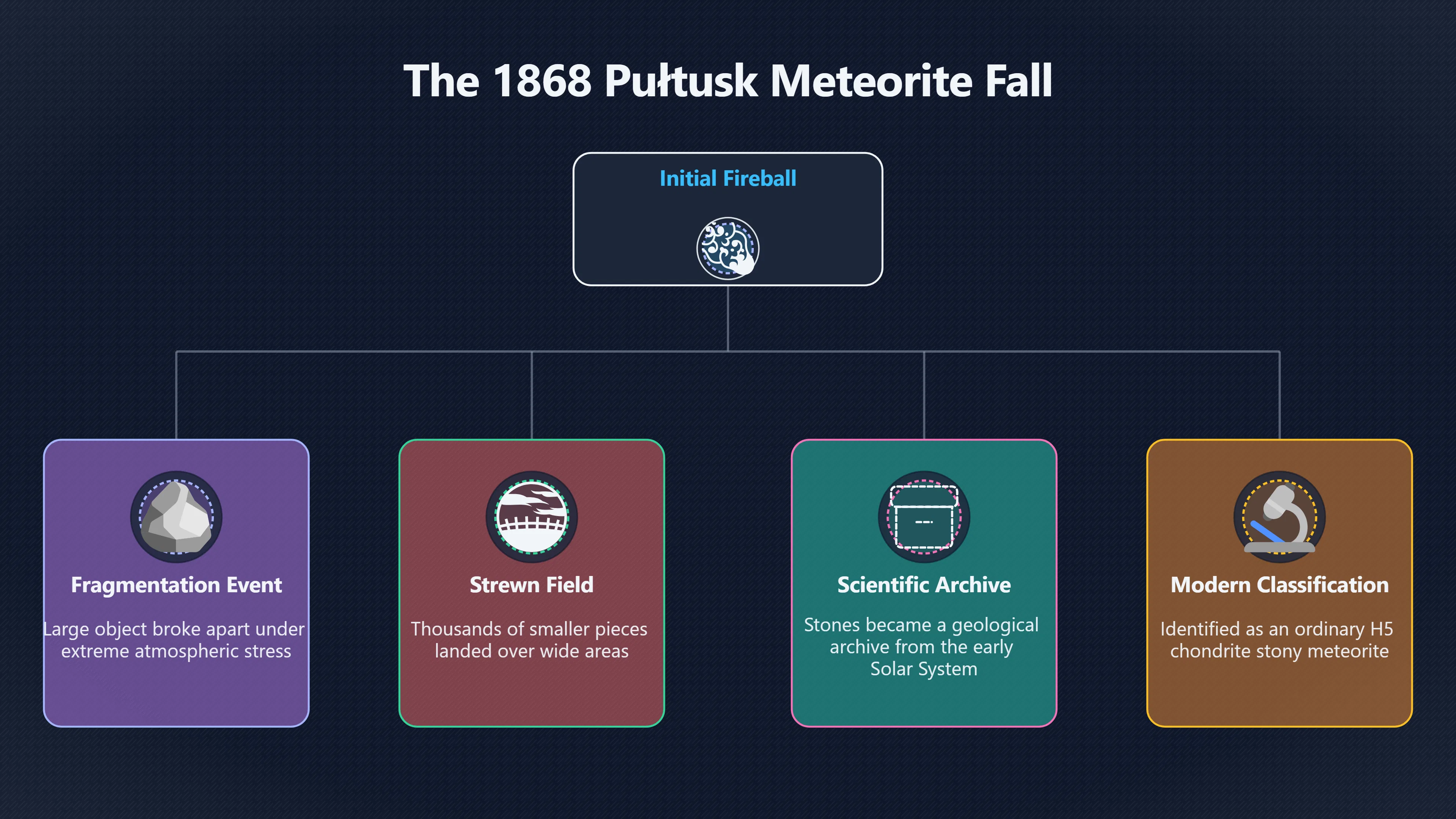
On 30 January 1868, residents near Pułtusk witnessed one of the most spectacular meteorite events of the nineteenth century. A brilliant fireball crossed the sky, followed by loud explosions. Stones then fell over a wide area, landing on fields, ice, buildings and other surfaces. The event was so unusual that it was recorded by many witnesses and quickly became a major scientific curiosity.[Wikipedia]WikipediaPultusk (meteoritePultusk (meteorite
The fall was not a single large rock striking the ground but a fragmentation event. A larger object entered Earth’s atmosphere and broke apart under enormous stress and heating. The result was a “strewn field” — an area where thousands of smaller pieces landed. Estimates of the recovered material are around 8,800 kilograms, with tens of thousands of individual fragments reported, although historical counts vary.[Wikipedia]WikipediaPultusk (meteoritePultusk (meteorite
The fragments became known as the Pułtusk meteorite, classified as an ordinary H5 chondrite — a type of stony meteorite containing material that formed in the early Solar System. The scientific importance of the fall came from the sheer number of fragments and the unusually well-documented observations. A frightening spectacle in the nineteenth-century sky became a geological archive from space.[Wikipedia]WikipediaPultusk (meteoritePultusk (meteorite
Why the fall seemed supernatural at the time
Before meteorites were widely accepted as objects from space, unusual stones falling from the sky were difficult to interpret. Across Europe, such events had often been linked with omens, divine messages or strange atmospheric events. The Pułtusk fall arrived during a period when scientific understanding of meteorites was still developing, making it a perfect example of a wider historical transition: a phenomenon that looked impossible gradually became evidence of another world beyond Earth.
The mystery was not that people had seen something imaginary. They had witnessed a genuinely rare event. The uncertainty came from the explanation. The same flashing object could be interpreted as a warning, a strange weather event, or — with later scientific methods — a fragment of an asteroid entering the atmosphere.
Modern fireballs: when strange lights become measurable events
Today, bright objects in the Polish sky are usually described as meteors, fireballs or bolides. A meteor is the visible streak of light produced when a small object from space burns through the atmosphere. A particularly bright meteor is called a fireball. If surviving material reaches the ground, it becomes a meteorite.
The transformation from mystery to measurement depends on observation. A single eyewitness may only report “a green light” or “a glowing ball falling from the sky”. Multiple cameras can reveal something far more precise: speed, direction, altitude, possible origin and whether fragments might have survived.
Poland has developed a specialist observation system through the Polish Fireball Network (PFN), coordinated by astronomers connected with the Copernicus Astronomical Centre of the Polish Academy of Sciences. The network uses automated cameras and analysis software to record bright meteors and calculate their trajectories. Research on the network reported hundreds of thousands of meteor detections and tens of thousands of calculated trajectories during its early operational years.[ScienceDirect]sciencedirect.comScienceDirect Current status of Polish Fireball NetworkCurrent status of Polish Fireball Network - ScienceDirectSeptember 1, 2017…
This approach changes the nature of a “mystery light”. Instead of asking only “what was that?”, researchers can ask:
- How fast was the object moving?
- Where did it enter the atmosphere?
- Did it break apart?
- Could anything have reached the ground?
- Was its orbit linked to an asteroid or comet?
The strange appearance remains, but the investigation becomes testable.
Recent Polish fireballs and the search for falling rocks
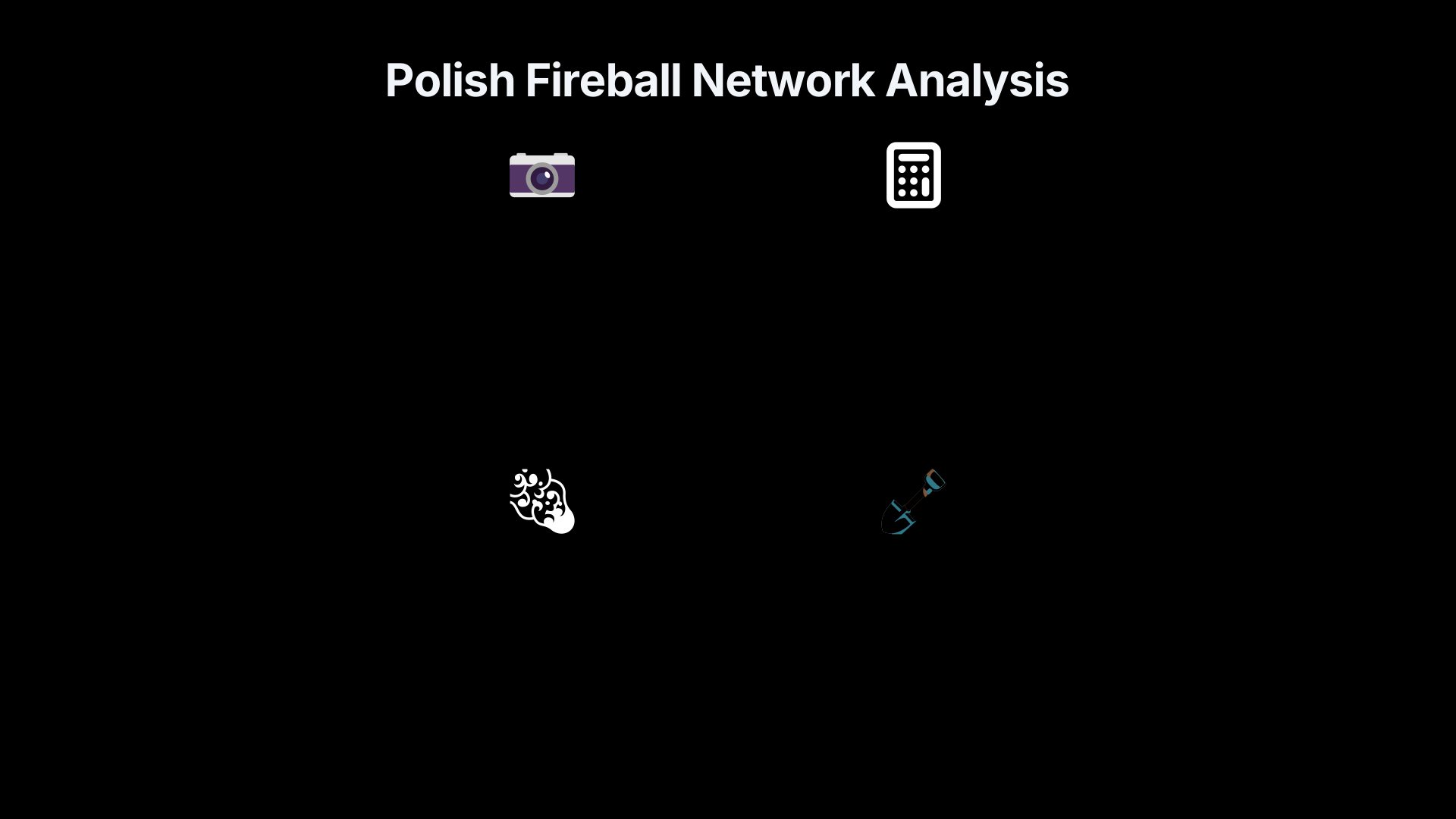
One example of modern investigation was the PF120916 Piecki fireball in 2016. The event was recorded by several PFN stations, allowing researchers to reconstruct its atmospheric path. The calculations suggested that fragments with a combined mass of roughly 10–15 kilograms might have survived the fall, leading to searches in the predicted impact area near Reszel in north-eastern Poland. The fragments were not successfully recovered, showing that even advanced prediction does not guarantee a discovery.[arXiv]arxiv.orgPF120916 Piecki fireball and Reszel meteorite fallJanuary 30, 2017…
Another example was the Ciechanów fireball of 2013. Multiple PFN observations allowed researchers to calculate its trajectory and estimate that a small meteorite fall might have occurred near Grabowo. The event demonstrated both the promise and difficulty of modern meteorite hunting: cameras can narrow the search area dramatically, but small dark stones can still disappear into fields, forests and farmland.[arXiv]arxiv.orgPF131010 Ciechanow fireball - the body possible related to Near Earth Asteroids 2010 TB54 and 2010 SX11July 30, 2015…
Large fireballs can also become public spectacles without producing meteorites. The 2015 fireball recorded over Poland was visible across a large region and was analysed using PFN observations. Its brightness, trajectory and orbital characteristics showed how a dramatic “sky mystery” could be connected to a small Solar System body rather than an unexplained object.[YouTube]youtube.comFireball 2015.01.13 16:50 UT (Polish Fireball Network) - YouTubeJanuary 13, 2015…
From strange sightings to science
Poland’s meteorite history shows a recurring pattern found throughout Fortean reports: the event itself may be real, while the explanation changes over time.
A glowing object crossing the night sky is not automatically evidence of something unknown. Fireballs can be caused by natural space debris entering the atmosphere, aircraft, satellites, atmospheric effects or other misidentified objects. The challenge is separating the initial impression from the physical evidence.
Meteorite science does not remove the wonder from these events. Instead, it adds another layer. The Pułtusk stones are fascinating precisely because they came from beyond Earth. Modern fireball networks reveal that a brief flash above a Polish village may represent a measurable visitor from the Solar System.
The same sky that once produced rumours of omens now produces data: camera frames, trajectory maps, chemical analyses and recovered fragments. Poland’s meteorite falls and mystery lights remain memorable not because they defy explanation, but because they show how unexplained events can become some of the clearest examples of science turning uncertainty into knowledge.
Morasko and the visible traces of space impacts
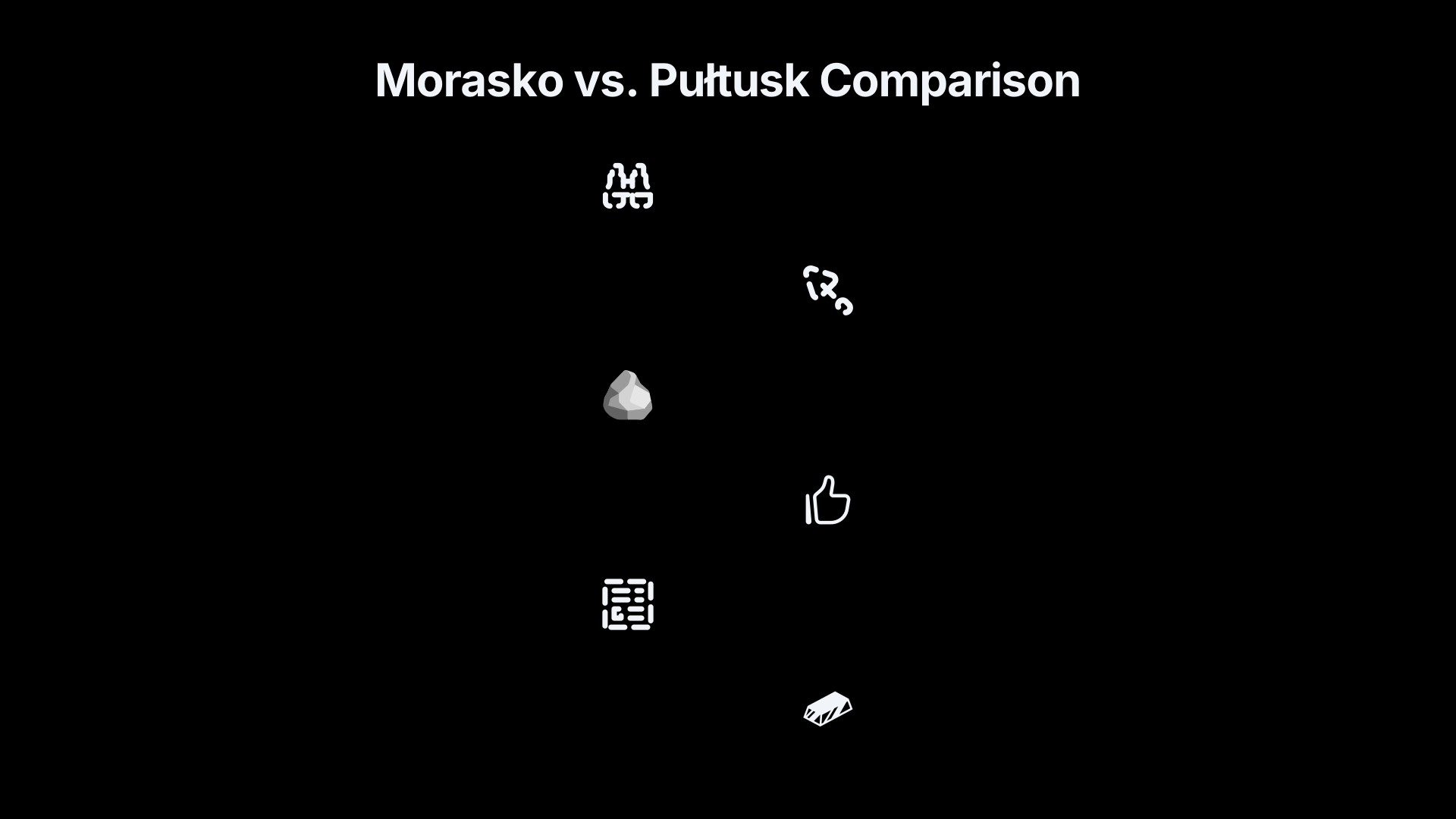
Not every Polish meteorite story is about a witnessed fall. Near Poznań, the Meteoryt Morasko Nature Reserve preserves evidence of an older impact event. Iron meteorites were discovered there from 1914 onwards, including a large specimen found during military trench digging. Geological studies identified crater-like depressions consistent with meteorite impacts, making Morasko one of Poland’s most important places where visitors can see the physical traces left by objects from space.[ScienceDirect]sciencedirect.comThe geology and morphology of the natural reserve “Meteoryt Morasko” - ScienceDirect…
Morasko is a useful contrast with Pułtusk. Pułtusk was a dramatic witnessed event: lights, explosions and falling stones. Morasko is a landscape mystery revealed through excavation and geology. Together they show two sides of the same story — sudden events observed in the sky, and quiet evidence waiting underground.
For centuries, unusual lights above Poland invited stories of signs, warnings and unknown forces. Today, they still inspire curiosity, but the strongest explanations usually begin with something much more concrete: a piece of rock, moving at enormous speed, briefly revealing its journey through the darkness of space.
Amazon book picks
Further Reading
Books and field guides related to When Poland's Skies Turned Into Mysteries. Use these as the next step if you want deeper reading beyond the article.
Meteorites: A Journey Through Space and Time
Directly covers meteorites, impacts, and scientific discovery.
The Demon-Haunted World: Science as a Candle in the Dark
Frames how unusual observations become understood.
The Atmosphere: An Introduction to Meteorology
Explains atmospheric events and fireballs.
Nightwatch : a practical guide to viewing the universe
Helps identify common sky phenomena.
Endnotes
1.
Source: Wikipedia
Title: Pultusk (meteorite)
Link:https://en.wikipedia.org/wiki/Pultusk_%28meteorite%29
2.
Source: sciencedirect.com
Title: ScienceDirect Current status of Polish Fireball Network
Link:https://www.sciencedirect.com/science/article/pii/S0032063316303440
Source snippet
Current status of Polish Fireball Network - ScienceDirectSeptember 1, 2017...
Published: September 1, 2017
3.
Source: nature.com
Title: Number of Fragments of the Puftusk Meteorite | Nature
Link:https://www.nature.com/articles/140113b0
Source snippet
July 17, 1937 — * Letter *...
Published: July 17, 1937
4.
Source: arxiv.org
Link:https://arxiv.org/abs/1701.08717
Source snippet
PF120916 Piecki fireball and Reszel meteorite fallJanuary 30, 2017...
Published: January 30, 2017
5.
Source: arxiv.org
Link:https://arxiv.org/abs/1507.08459
Source snippet
PF131010 Ciechanow fireball - the body possible related to Near Earth Asteroids 2010 TB54 and 2010 SX11July 30, 2015...
Published: July 30, 2015
6.
Source: youtube.com
Link:https://www.youtube.com/watch?v=Zvml9TqdVgQ
Source snippet
Fireball 2015.01.13 16:50 UT (Polish Fireball Network) - YouTubeJanuary 13, 2015...
Published: January 13, 2015
7.
Source: arxiv.org
Link:https://arxiv.org/abs/1605.06283
Source snippet
2015 Southern Taurid fireballs and asteroids 2005 UR and 2005 TF50...
8.
Source: sciencedirect.com
Link:https://www.sciencedirect.com/science/article/pii/S0032063301000113
Source snippet
The geology and morphology of the natural reserve “Meteoryt Morasko” - ScienceDirect...
9.
Source: sciencedirect.com
Link:https://www.sciencedirect.com/science/article/pii/S0169555X1730329X
Source snippet
alterations - ScienceDirectOctober 15, 2017 — GEOMORPHOLOGY Volume 295, 15 October 2017, Pages 586-597 MORPHOLOGY OF THE MORASKO CRATER F...
Published: October 15, 2017
10.
Source: sciencedirect.com
Title: Current status of Polish Fireball Network
Link:https://www.sciencedirect.com/science/article/abs/pii/S0032063316303440
Source snippet
September 1, 2017 — SECTION SNIPPETS STRUCTURE OF THE POLISH FIREBALL NETWORK The Polish Fireball Network (PFN) is a project...
Published: September 1, 2017
11.
Source: meteoryt.org
Title: historia stacji pfn
Link:https://www.meteoryt.org/historia-stacji-pfn/
Source snippet
⋆ Meteoryt.orgHISTORIA STACJI PFN * * * Image [20110212_192548] Pierwsza detekcja w Sieci PFN W Pracowni Komet i Meteorów i prowadzonego...
12.
Source: nature.com
Link:https://www.nature.com/articles/140504a0
Source snippet
Meteorites: the Number of Pultusk Stones, and the Spelling of “Widmanstätten Figures” | NatureSeptember 18, 1937 — *...
Published: September 18, 1937
13.
Source: youtube.com
Title: Meteorite Men: Pultusk
Link:https://www.youtube.com/watch?v=cm-phNly9Qg
Source snippet
Meteorite Men | S03 E01 | Morasko Craters Poland...
14.
Source: youtube.com
Title: Meteorite Men | S03 E01 | Morasko Craters Poland
Link:https://www.youtube.com/watch?v=-i10oYQIkeI
Source snippet
Meteorite PULTUSK from Poland...
15.
Source: youtube.com
Title: Meteorite PULTUSK from Poland
Link:https://www.youtube.com/watch?v=oCmilpor7Pw
Source snippet
Perseid Fireball. Very bright meteor exploded over Poland...
16.
Source: youtube.com
Title: Perseid Fireball. Very bright meteor exploded over Poland
Link:https://www.youtube.com/watch?v=HFMDAD_2rLY
Source snippet
4K Meteorite LOWICZ Mesosiderite fall from Poland 176g...
17.
Source: youtube.com
Title: 4K Meteorite LOWICZ Mesosiderite fall from Poland 176g
Link:https://www.youtube.com/watch?v=NxtOxGC-tl8
Source snippet
Pultusk meteorite fall Poland Meteorite Men: Pultusk StreamVault...
18.
Source: pfn.pkim.org
Title: niedługo po północy jedna ze stacji Pol
Link:https://pfn.pkim.org/
Source snippet
Fireball Network - Pracownia Komet i Meteorów | Małe ciała w Układzie SłonecznymMay 1, 2024 — POLISH FIREBALL NETWORK - PRACOWNIA KOMET I...
Published: May 1, 2024
19.
Source: pkim.org
Title: Polish Fireball Network
Link:https://www.pkim.org/?q=en
Source snippet
Pracownia Komet i Meteorów | Małe ciała w Układzie SłonecznymMay 1, 2024 — POLISH FIREBALL NETWORK - PRACOWNIA KOMET I METEORÓW Małe ciał...
Published: May 1, 2024
20.
Source: pkim.org
Title: Polish Fireball Network
Link:https://www.pkim.org/
Source snippet
Pracownia Komet i Meteorów | Małe ciała w Układzie SłonecznymMay 1, 2024 — NOWOŚCI NA STRONIE * Cyrqlarz nr 247 * W zakładce "Badania i W...
Published: May 1, 2024
21.
Source: pfn.pkim.org
Title: At this time we regularly perfor
Link:https://www.pfn.pkim.org/?q=en%2Fnode%2F1584
Source snippet
observations | Polish Fireball Network - Pracownia Komet i MeteorówAugust 11, 2011 — PHOTOGRAPHIC OBSERVATIONS * * * By Anonymous - Poste...
Published: August 11, 2011
22.
Source: pkim.org
Link:https://www.pkim.org/?q=en%2Ffrontpage
Source snippet
Polish Fireball Network - Pracownia Komet i Meteorów | Małe ciała w Układzie SłonecznymPolish Fireball Network - Pracownia Komet i Meteor...
23.
Source: pfn.pkim.org
Title: orgmeteor | Polish Fireball Network
Link:https://www.pfn.pkim.org/?q=pl%2Ftaxonomy%2Fterm%2F216
Source snippet
Polish Fireball Network - Pracownia Komet i MeteorówPolish Fireball Network - Pracownia Komet i Meteorów Małe ciała w Układzie Słoneczn...
24.
Source: science.gov
Link:https://www.science.gov/topicpages/f/fireballs
Source snippet
Topics by Science.gov2016-07-01 Fireball (Faint Intergalactic Redshifted Emission Balloon) is a NASA/CNES balloon-borne experiment to stu...
Additional References
25.
Source: researchgate.net
Link:https://www.researchgate.net/publication/326844745_Results_of_mineralogical_and_petrological_research_of_new_samples_on_the_Pultusk_meteorite_at_the_150th_anniversary_of_the_fall
Source snippet
June 1, 2018 — RESULTS OF MINERALOGICAL AND PETROLOGICAL RESEARCH OF NEW SAMPLES ON THE PUŁTUSK METEORITE AT THE 150TH ANNIVERSARY OF THE...
Published: June 1, 2018
26.
Source: astro.amu.edu.pl
Link:https://www.astro.amu.edu.pl/en/outreach/mor-cra/
Source snippet
trail in the “Morasko Meteorite” nature reserve – IAO AMUEDUCATIONAL TRAIL IN THE “MORASKO METEORITE” NATURE RESERVE EDUCATIONAL TRAIL IN...
27.
Source: geojournals.pgi.gov.pl
Link:https://geojournals.pgi.gov.pl/pg/article/view/29763
Source snippet
pgi.gov.plMeteoryty, kratery uderzeniowe i inne ślady kosmicznej katastrofy w rejonie Moraska pod Poznaniem | Przegląd GeologicznyMETEORY...
28.
Source: muzeum.pultusk.pl
Link:https://muzeum.pultusk.pl/meteoryt-pultusk/
Source snippet
Pułtusk – Muzeum Regionalne w PułtuskuMETEORYT PUŁTUSK NAJWIĘKSZY DESZCZ METEORYTÓW KAMIENNYCH W HISTORII Image „Dnia onegdajszego, 30 st...
29.
Source: explore-meteorite.com
Link:https://explore-meteorite.com/morasko-craters/
30.
Source: onlinelibrary.wiley.com
Link:https://onlinelibrary.wiley.com/doi/full/10.1111/maps.13929
Source snippet
of the daylight fireball of July 15, 2021, leading to a meteorite fall and find near Antonin, Poland, and a description of the recovered...
Published: July 15, 2021
31.
Source: jedynka.polskieradio.pl
Link:https://jedynka.polskieradio.pl/artykul/2009884%2C150-lat-temu-pod-Pu%C5%82tuskiem-spad%C5%82-najwi%C4%99kszy-deszcz-meteoryt%C3%B3w-w-dziejach-%C5%9Bwiata
Source snippet
polskieradio.pl150 lat temu pod Pułtuskiem spadł największy deszcz meteorytów w dziejach świata - Jedynka - polskieradio.plJanuary 30, 20...
32.
Source: camk.edu.pl
Title: Bright Taurid fireballs,Nicolaus Copernicus Astronomical Center, Warsaw
Link:https://camk.edu.pl/en/archiwum/2017/01/23/bright-taurid-fireballs/
Source snippet
January 23, 2017 — ENTRY CONTENT Creation date: 23.01.2017, Archive date: 23.01.2017 BRIGHT TAURID FIREBALLS Image The Polish Fireball Ne...
Published: January 23, 2017
33.
Source: researchgate.net
Title: (PDF) Recent fireballs registered by the Polish Fireball Network
Link:https://www.researchgate.net/publication/307546002_Recent_fireballs_registered_by_the_Polish_Fireball_Network
Source snippet
August 1, 2015 — Conference Paper PDF Available RECENT FIREBALLS REGISTERED BY THE POLISH FIREBALL NETWORK * August 2015 * Conference: In...
Published: August 1, 2015
34.
Source: researchgate.net
Link:https://www.researchgate.net/publication/313096351_PF120916_Piecki_fireball_and_Reszel_meteorite_fall
Source snippet
(PDF) PF120916 Piecki fireball and Reszel meteorite fallJanuary 1, 2017 — Article PDF Available PF120916 PIECKI FIREBALL AND RESZEL METEO...
Published: January 1, 2017
Topic Tree