Within El Salvador Weird
Why El Salvador's Roads Grow Teeth at Night
La Siguanaba, El Cipitio and the Cadejo turn lonely roads, rivers and bad choices into some of El Salvador's most durable legends.
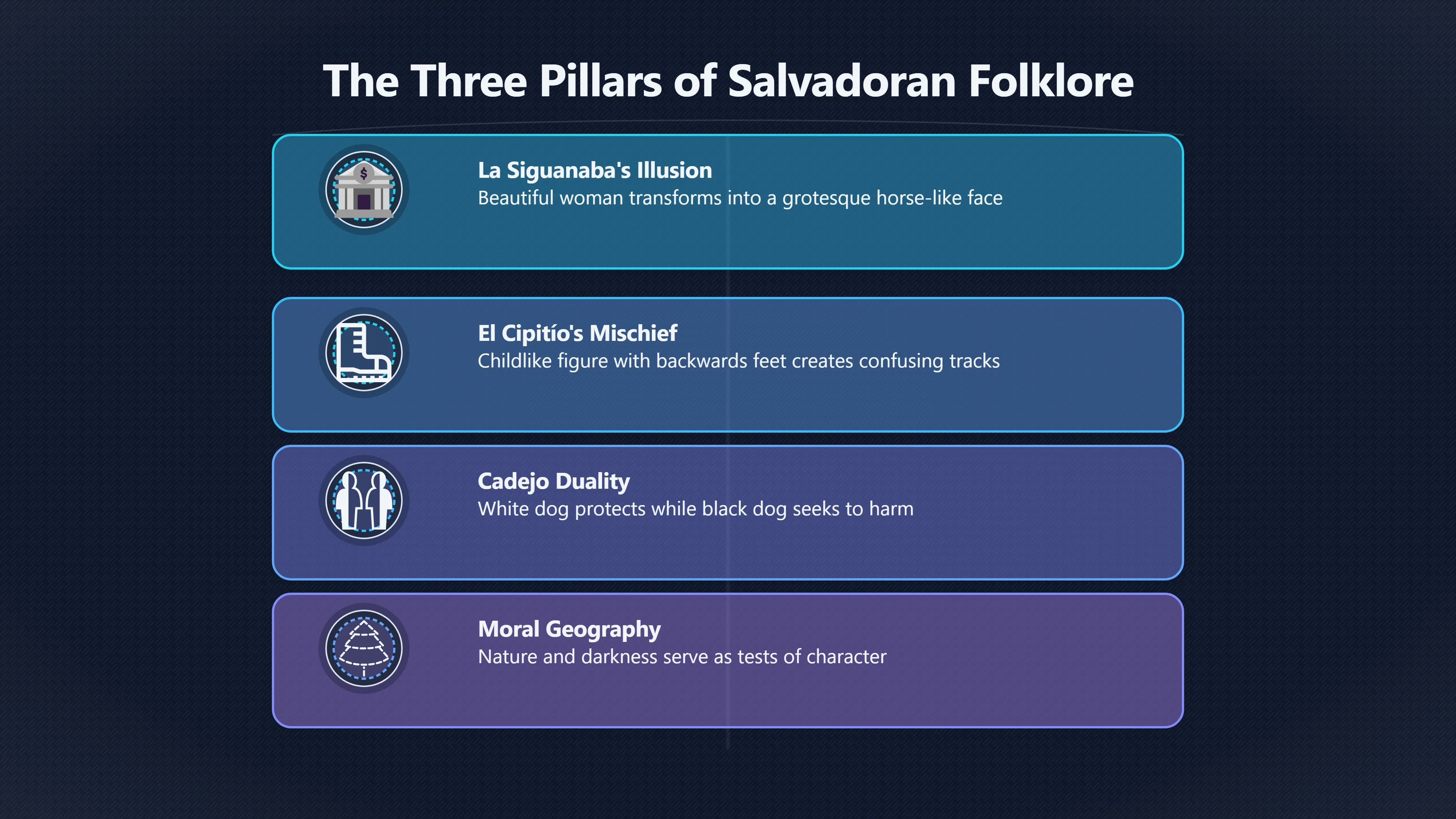
On this page
- La Siguanaba as punishment, warning and apparition
- El Cipitio and the trickster side of Salvadoran folklore
- The Cadejo and the moral geography of night travel
Page outline Jump by section
Introduction
Few Salvadoran legends have proved as enduring as the stories of La Siguanaba, El Cipitío and the Cadejo. Rather than functioning as isolated ghost tales, they create a shared moral landscape in which rivers, lonely roads and darkness become places where character is tested. The stories explain why it is dangerous to wander after midnight, drink to excess, pursue forbidden relationships or ignore the limits imposed by nature and society. At the same time, they preserve older Indigenous beliefs that later merged with Catholic ideas about sin, punishment and redemption. Far from disappearing, these legends remain woven into literature, festivals, school culture and tourism, making them one of the strongest examples of how Salvadoran folklore continues to shape the country’s strange-history tradition.[Visit El Salvador]visitelsalvador.aiVisit El SalvadorLa Siguanaba, El Cipitío and the Cadejo | Visit El Salvador5 Jan 2026 — The Cadejo (white or black) has a sound peculiar…

Why El Salvador’s Roads Grow Teeth at Night
Unlike many European ghost stories that centre on haunted houses, Salvadoran supernatural traditions often unfold outdoors. Rivers, streams, forest tracks and isolated roads are recurring settings because they were historically places of genuine danger. Travelling after dark meant poor visibility, wild terrain, robbery, accidents and isolation. Folklore transformed those practical risks into memorable supernatural encounters.
The result is a distinctive “moral geography”. Darkness is not portrayed as evil in itself, but as a place where poor judgement invites consequences. Someone walking home sober and responsibly is less likely to encounter trouble than the boastful drinker, the serial womaniser or the reckless traveller. Whether or not listeners believed the apparitions were literally real mattered less than the behavioural lesson embedded in the stories.[Wikipedia]WikipediaSalvadoran folkloreSalvadoran folklore
La Siguanaba as Punishment, Warning and Apparition
La Siguanaba is the best-known figure in this landscape. Although details vary between communities and across Central America, the Salvadoran tradition follows a remarkably consistent pattern.
She first appears as an exceptionally beautiful woman, often beside a river or washing clothes under moonlight. Men who approach her expecting romance discover that her beauty is an illusion. When she turns around, her face becomes grotesque—commonly described as horse-like or skeletal—and the encounter ends in terror rather than seduction. Some versions say the victim loses consciousness, becomes mentally disturbed or wanders aimlessly until daylight. Others simply emphasise overwhelming fear.[astadventures.com]astadventures.commyths legends of el salvadorAST AdventuresMyths & Legends of El Salvador14 Sept 2015 — La Siguanaba, Sihuanaba, Cigua, or Cegua, refers to a 'horrible woman,' previo…
What makes the legend distinctive is not merely the transformation but the choice of victims. La Siguanaba rarely attacks at random. Oral tradition consistently presents her as targeting:
- drunk men returning home late;
- adulterers and habitual seducers;
- boastful young men seeking sexual conquest;
- travellers who ignore warnings about dangerous places.
Because the punishment reflects the victim’s own behaviour, folklorists generally interpret the legend as a moral caution rather than a simple ghost story. It warns against infidelity, vanity, drunkenness and unnecessary night wandering while also giving communities a memorable explanation for frightening experiences in isolated places.[astadventures.com]astadventures.commyths legends of el salvadorAST AdventuresMyths & Legends of El Salvador14 Sept 2015 — La Siguanaba, Sihuanaba, Cigua, or Cegua, refers to a 'horrible woman,' previo…
Why the Story Endures
La Siguanaba survives because she operates on several symbolic levels simultaneously.
For children, she discourages wandering near rivers after dark. For adults, she represents the dangers of temptation and misplaced confidence. For writers and artists, she embodies deception itself: beauty masking danger.
Modern cultural institutions in El Salvador continue to present her as part of the country’s official folklore rather than as evidence for paranormal activity. Literary retellings by major Salvadoran authors have also helped move her beyond oral storytelling into national cultural identity, ensuring that each generation encounters the legend in new forms.[Visit El Salvador]visitelsalvador.aiVisit El SalvadorLa Siguanaba, El Cipitío and the Cadejo | Visit El Salvador5 Jan 2026 — The Cadejo (white or black) has a sound peculiar…
El Cipitío and the Trickster Side of Salvadoran Folklore
If La Siguanaba represents fear, El Cipitío supplies mischief.
Usually described as her eternally childlike son, El Cipitío is recognised by his oversized hat, rounded belly and backwards feet, which prevent anyone from successfully following his tracks. Rather than terrifying travellers, he delights in confusing them, playing harmless tricks and teasing young women from hiding places near fields and streams.[Wikipedia]WikipediaOpen source on wikipedia.org.
His backwards footprints are especially revealing as a folklore mechanism. Instead of attacking directly, he creates uncertainty. A person following his tracks ends up walking the wrong way, an elegant symbolic reminder that appearances can deceive just as thoroughly as La Siguanaba’s beauty.
Unlike his mother, El Cipitío rarely functions as a punisher. He occupies the liminal space between fairy, goblin and eternal child. His stories preserve humour within the same supernatural landscape, showing that Salvadoran folklore is not entirely built around fear. Mischief, curiosity and playful confusion also have a place in explaining the unpredictability of rural life.[Wikipedia]WikipediaOpen source on wikipedia.org.

The Cadejo and the Moral Geography of Night Travel
The Cadejo shifts attention from temptation to companionship on dangerous roads.
In Salvadoran tradition, the Cadejo appears as a mysterious dog encountered during solitary night journeys. Most versions distinguish between two forms:
- The white Cadejo, which protects travellers or escorts vulnerable people safely through dangerous places.
- The black Cadejo, which seeks to terrify, mislead or harm those it encounters.
This duality makes the Cadejo unusual among supernatural animals. Rather than representing evil alone, it embodies the competing possibilities present on every lonely road. One traveller may find unexpected protection; another may meet disaster.[Wikipedia]WikipediaOpen source on wikipedia.org.
Descriptions also contain memorable sensory details. Some traditions say its footsteps resemble goat hooves rather than canine paws, while others insist that if the sounds seem nearby the creature is actually distant, and if they seem distant it is already close. Such inversions reinforce the broader lesson shared with La Siguanaba: at night, ordinary senses cannot always be trusted.[Visit El Salvador]visitelsalvador.aiVisit El SalvadorLa Siguanaba, El Cipitío and the Cadejo | Visit El Salvador5 Jan 2026 — The Cadejo (white or black) has a sound peculiar…
The Cadejo also broadens the moral message. Although black-and-white symbolism often suggests absolute good versus evil, Salvadoran versions frequently portray the white Cadejo as protecting even intoxicated travellers from robbers or worse dangers. The lesson is therefore less about rewarding virtue than acknowledging that dangerous journeys may still attract unexpected guardians.[Wikipedia]WikipediaOpen source on wikipedia.org.
Why These Legends Form a Single Folklore System
Although often discussed separately, La Siguanaba, El Cipitío and the Cadejo function as interconnected figures.
La Siguanaba tests desire through illusion.
El Cipitío confuses direction through playful deception.
The Cadejo determines whether the road itself becomes protective or threatening.
Together they transform ordinary geography into moral geography. Rivers become places where temptation appears. Forest paths become spaces where directions fail. Roads become locations where unseen companions—good or bad—may accompany the traveller.
This interconnected structure explains why Salvadorans frequently mention the three legends together in festivals, educational material and cultural presentations. Rather than isolated monsters, they are recurring characters occupying the same imaginative landscape.[Visit El Salvador]visitelsalvador.aiVisit El SalvadorLa Siguanaba, El Cipitío and the Cadejo | Visit El Salvador5 Jan 2026 — The Cadejo (white or black) has a sound peculiar…
Folklore, Psychology and the Night
Modern sceptical interpretations do not require supernatural encounters to explain the stories’ persistence.
Night travel naturally alters perception. Moonlight obscures facial features, shadows distort familiar landmarks and fatigue makes people more prone to misinterpret sounds and movement. Fear itself narrows attention and encourages the mind to complete incomplete visual information. A lonely traveller already worried about robbers or wild animals is therefore primed to interpret ambiguous experiences dramatically.
Yet reducing the legends entirely to mistaken perception misses their cultural purpose. These stories survived because they encoded practical advice: avoid isolated rivers after dark, be cautious when drinking, respect social obligations and recognise that overconfidence creates vulnerability. Their endurance reflects successful storytelling rather than evidence that the apparitions themselves exist.
A Living Part of Salvadoran Identity
The remarkable feature of these legends is not that people continue to report supernatural encounters, but that the characters remain instantly recognisable across generations.
They appear in children’s educational programmes, literature, tourism campaigns, seasonal celebrations and public folklore events. Festivals featuring costumed versions of La Siguanaba, El Cipitío and the Cadejo demonstrate that these figures have become shared cultural symbols as much as ghost stories. Their role today is less about proving the paranormal than about preserving a distinctly Salvadoran way of imagining danger, responsibility and the mysterious possibilities that begin where the last streetlight ends.[wikipedia.org]WikipediaTimeless Stories of El SalvadorTimeless Stories of El Salvador
Amazon book picks
Further Reading
Books and field guides related to Why El Salvador's Roads Grow Teeth at Night. Use these as the next step if you want deeper reading beyond the article.

The Element Encyclopedia of Magical Creatures
Places supernatural beings into a wider context.
Myths and Legends of Latin America
Excellent background for Cadejo and related traditions.
eBay marketplace picks
Marketplace Samples
Live-tested eBay searches with available results related to this page.

Endnotes
1.
Source: Wikipedia
Title: Salvadoran folklore
Link:https://en.wikipedia.org/wiki/Salvadoran_folklore
2.
Source: Wikipedia
Link:https://en.wikipedia.org/wiki/Cipit%C3%ADo
3.
Source: Wikipedia
Link:https://en.wikipedia.org/wiki/Cadejo
4.
Source: Wikipedia
Title: Timeless Stories of El Salvador
Link:https://en.wikipedia.org/wiki/Timeless_Stories_of_El_Salvador
5.
Source: visitelsalvador.ai
Link:https://www.visitelsalvador.ai/blog/legendes-mythes-el-salvador
Source snippet
Visit El SalvadorLa Siguanaba, El Cipitío and the Cadejo | Visit El Salvador5 Jan 2026 — The Cadejo (white or black) has a sound peculiar...
6.
Source: astadventures.com
Title: myths legends of el salvador
Link:https://www.astadventures.com/blogs/blog-ast/myths-legends-of-el-salvador
Source snippet
AST AdventuresMyths & Legends of El Salvador14 Sept 2015 — La Siguanaba, Sihuanaba, Cigua, or Cegua, refers to a 'horrible woman,' previo...
7.
Source: espookytales.com
Title: the legend of la Siguanaba
Link:https://www.espookytales.com/blog/the-legend-of-la-Siguanaba/
Source snippet
2 Dec 2020 — In El Salvador, according to legend, she was originally called Sihuehuet, which means beautiful woman in Nahuatl.Read more...
8.
Source: espookytales.com
Title: The Legend of El Cipitio
Link:https://www.espookytales.com/blog/The-Legend-of-El-Cipitio/
Source snippet
Dec 5, 2020 — El Cipitio is the son of La Siguanaba. When his mother was cursed for eternity, he too was cursed. He was to remain a child...
9.
Source: visitelsalvador.ai
Link:https://www.visitelsalvador.ai/blog/legendes-mythes-el-salvador?lang=es
Source snippet
La Siguanaba, El Cipitío y el Cadejo | Visit El Salvador5 Jan 2026 — La Siguanaba es sin duda la leyenda más conocida de El Salvador...
10.
Source: mythfolks.com
Title: salvadoran folklore
Link:https://www.mythfolks.com/salvadoran-folklore
Source snippet
7 El Salvador Folklore Tales You've Never Heard16 Oct 2024 — El Cadejo is a classic Latin American folklore story of good vs. evil - with...
Additional References
11.
Source: facebook.com
Link:https://www.facebook.com/groups/281886105961506/posts/989228528560590/
Source snippet
Siguanaba and Cipitio in Latin American folkloreSiguanaba (also known as La Siguanaba) is a well-known figure from both Salvadoran and Gu...
12.
Source: superstitionsmap.com
Link:https://superstitionsmap.com/salvadoran-superstitions/
Source snippet
Salvadoran Superstitions (World #90, ≈190 total)For many people, El Cipitío keeps Salvadoran folklore playful, local, and deeply familiar...
13.
Source: cadancabrera.net
Title: salvadoran mythology la siguanaba
Link:https://cadancabrera.net/2020/10/18/salvadoran-mythology-la-siguanaba/
Source snippet
Salvadoran Mythology: La Siguanaba18 Oct 2020 — La Siguanaba stalks the countryside of El Salvador, appearing at night to travelers (usua...
14.
Source: youtube.com
Link:https://www.youtube.com/watch?v=VzvOd-uYzBM
Source snippet
ts and magic shaped fate. This ancient legend tells the story...
15.
Source: dl.iir.edu.ua
Link:https://dl.iir.edu.ua/iir-news/unveiling-guatemalan-lore-the-cadejo-and-la-siguanaba-1764813000
Source snippet
Guatemalan Lore: The Cadejo & La Siguanaba3 Dec 2025 — The Cadejo and La Siguanaba are powerful symbols that represent fundamental aspect...
16.
Source: babeltowerfr.wordpress.com
Link:https://babeltowerfr.wordpress.com/2018/04/21/el-salvador-into-a-world-of-myths-and-legends/
Source snippet
Salvador: Into a World of Myths and Legends - Babel Tower21 Apr 2018 — According to Salvadoran legend, La Siguanaba used to be known as S...
17.
Source: folklore.usc.edu
Title: el cipitio 5
Link:https://folklore.usc.edu/el-cipitio-5/
Source snippet
Cipitio12 May 2019 — Main Piece: “El Cipitio is the son of La Siguanaba, he was cursed to stay little forever. He likes to stalk young gi...
Published: May 2019
18.
Source: youtube.com
Link:https://www.youtube.com/watch?v=LdO6ZnBuM34
Source snippet
dor, awaiting the unsuspecting...
19.
Source: youtube.com
Link:https://www.youtube.com/watch?v=9WveIihjPIM
20.
Source: youtube.com
Link:https://www.youtube.com/watch?v=BRy_VSou39U
Topic Tree