Within Strange India
How Did Delhi Fear the Monkey Man?
Delhi's Monkey Man scare shows how rumours, fear and media can turn confused reports into a citywide monster story.
On this page
- The 2001 reports and changing descriptions
- Police, media and mass panic
- What the scare reveals about modern folklore
Page outline Jump by section
Introduction
In the spring of 2001, Delhi became gripped by fear of a mysterious creature that newspapers dubbed the “Monkey Man”. Residents reported night-time attacks by a bizarre figure that was said to leap across rooftops, scratch sleeping people and vanish before police arrived. Descriptions changed wildly from witness to witness, yet the rumours spread so rapidly that hundreds of sightings were reported, dozens of people were injured in panic, and several deaths were linked to attempts to flee an attacker that was never conclusively identified. Today, the Monkey Man scare is remembered less as a monster mystery than as one of India’s clearest examples of modern urban folklore taking shape in real time. It demonstrates how fear, rumour, media coverage and genuine uncertainty can combine to create a powerful collective story without firm evidence of the creature itself.[Wikipedia]WikipediaMonkey-man of DelhiMonkey-man of Delhi

The 2001 reports and changing descriptions
The panic emerged in Delhi during May 2001, although isolated rumours had circulated earlier in April. Many residents, particularly in densely populated eastern districts, slept on rooftops because of the intense summer heat and frequent power cuts. This unusual living pattern placed large numbers of people outdoors at night, where unfamiliar noises, shadows and sudden alarms could easily spread through neighbourhoods.[ResearchGate]researchgate.netResearchGate(PDF) A study on mass hysteria (monkey men?) victims in…The Monkey Man (2001, Delhi): Reports of a 4-foot hairy creature w…
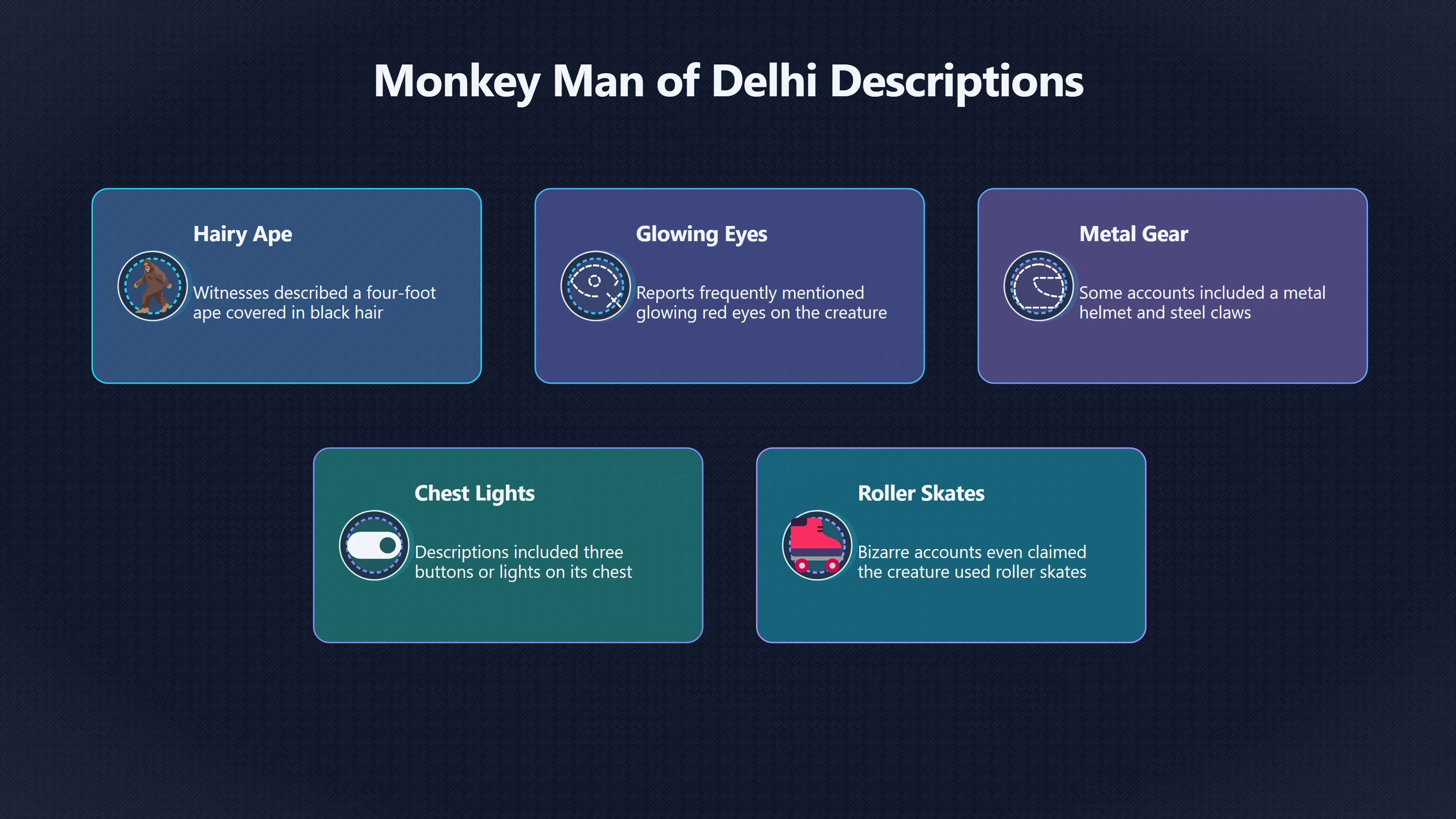
What witnesses claimed to have seen was remarkably inconsistent. Reports variously described:
- a four-foot ape covered in black hair;
- a much taller muscular creature;
- glowing red eyes;
- a metal helmet;
- steel claws;
- three buttons or lights on its chest;
- an ability to leap effortlessly between buildings;
- in some accounts, even roller skates.
Rather than converging on a single description, the alleged Monkey Man accumulated new features as the story spread. This shifting appearance is one reason researchers regard the reports as folklore in formation rather than testimony about a single identifiable animal or person.[Wikipedia]WikipediaMonkey-man of DelhiMonkey-man of Delhi
Police received hundreds of reports in only a few weeks. Sketch artists attempted to produce composite images, but the resulting drawings reflected the same contradictions found in eyewitness accounts. No verified physical evidence—such as photographs, footprints or captured suspects—ever established that a single attacker existed.[Wikipedia]WikipediaMonkey-man of DelhiMonkey-man of Delhi
Why the panic became so widespread
The Monkey Man scare illustrates how modern folklore can spread through ordinary communication rather than ancient tradition alone.
Several conditions helped the rumours grow:
- Constant media attention. Newspapers published fresh sightings almost daily, often alongside dramatic illustrations that reinforced public expectations.
- Anxiety and exhaustion. Hot weather, interrupted sleep and crowded living conditions heightened stress and made sudden alarms more believable.
- Neighbourhood communication. Before social media dominated public life, rumours travelled rapidly through local communities, mobile phones and television news.
- Expectation shaping perception. Once people expected to encounter a strange attacker, ambiguous sights or ordinary encounters could be interpreted through that framework.[indiatimes.com]timesofindia.indiatimes.comThe Times of IndiaIndians attacked by 'monkey man'1 Apr 2001 — MASS hysteria is sweeping across India's capital after reports of a superp…
Researchers studying the incident noted that many reported injuries appeared consistent with falls, panic or accidental self-injury rather than attacks by an unknown creature. The psychological effect of expecting danger often became more significant than any alleged physical assailant.[ResearchGate]researchgate.netResearchGate(PDF) A study on mass hysteria (monkey men?) victims in…The Monkey Man (2001, Delhi): Reports of a 4-foot hairy creature w…

Police, media and the consequences of fear
Delhi Police mounted a substantial response. Officers increased patrols, investigated reports and released artist’s impressions based on witness statements. Despite these efforts, no convincing suspect was ever found, and investigators repeatedly struggled with contradictory evidence.[Wikipedia]WikipediaMonkey-man of DelhiMonkey-man of Delhi
The panic nevertheless had very real consequences.
Several people suffered injuries while fleeing imagined attacks or jumping from rooftops and staircases after hearing cries that the Monkey Man had arrived. Contemporary reporting also linked two or three deaths to these panic-driven escapes rather than to confirmed assaults by any creature.[Wikipedia]WikipediaMonkey-man of DelhiMonkey-man of Delhi
Fear also encouraged mistaken identity. Innocent people were occasionally suspected or attacked after being confused with the supposed monster, showing how quickly rumour can turn into vigilantism when communities believe an invisible threat is nearby.[globalfactchecking.com]globalfactchecking.comcase study the monkey man of delhiHowever, the hysteria itself provoked very real instances of vigilante justice…Read more…
The episode became so famous that pranksters later attempted to imitate the Monkey Man, confirming that the legend had entered popular culture even after the original panic faded.[Wikipedia]WikipediaMonkey-man of DelhiMonkey-man of Delhi
Was there ever a real Monkey Man?
No explanation has gained universal acceptance because there is no evidence that a single phenomenon lay behind every report.
Among the suggestions proposed at the time were:
- isolated assaults by unidentified individuals;
- pranksters exploiting public fear;
- misidentified monkeys or langurs already familiar in Delhi;
- misperception in darkness;
- rumours amplified through repeated retelling;
- collective fear producing a wave of mistaken reports.
The explanation favoured by most psychologists, sociologists and sceptical investigators combines several of these factors rather than relying on one cause alone. They argue that the Monkey Man scare represents a classic example of a “phantom attacker” panic: reports of a threatening figure become socially contagious, encouraging sincere but unreliable eyewitness testimony without requiring an actual monster behind every account.[researchgate.net]researchgate.netResearchGate(PDF) A study on mass hysteria (monkey men?) victims in…The Monkey Man (2001, Delhi): Reports of a 4-foot hairy creature w…
This does not mean every witness deliberately fabricated a story. Many people almost certainly believed they had experienced something unusual. The key distinction is between the sincerity of witnesses and the objective accuracy of what they perceived under stressful conditions.

What the scare reveals about modern folklore
Unlike ancient legends handed down across generations, the Monkey Man demonstrates that folklore can emerge within weeks through newspapers, television and conversation.
The story borrowed familiar ingredients from older monster traditions—a nocturnal attacker, impossible agility and mysterious disappearances—but combined them with modern urban life. Details such as metallic claws, helmets and mechanical features gave the creature an oddly technological appearance that reflected a contemporary city rather than a traditional forest spirit.[Wikipedia]WikipediaMonkey-man of DelhiMonkey-man of Delhi
The Monkey Man has often been compared with other “phantom attacker” scares around the world, in which reports of mysterious assailants multiply despite little or no physical evidence. Such episodes are valuable to folklorists because they reveal how communities construct shared narratives from fragments of testimony, media reports and existing cultural expectations.[Springer]link.springer.comSocial Panics & Phantom Attackersmonkey men?) Victims in East Delhi. Indian Journal of Medical. Sciences, 57(8), 355–360; Bartholomew, R.E. (2001).Read more…
Within India’s wider record of strange stories, the Monkey Man occupies a distinctive place. Unlike mysteries rooted in ancient mythology or remote landscapes, it unfolded in one of the world’s largest cities under the gaze of modern journalism and police investigation. Its lasting fascination comes not from evidence that an unknown creature existed, but from the remarkable speed with which an uncertain rumour became one of India’s best-known pieces of contemporary folklore.
Amazon book picks
Further Reading
Books and field guides related to How Did Delhi Fear the Monkey Man?. Use these as the next step if you want deeper reading beyond the article.
Extraordinary Popular Delusions and the Madness of Crowds
Rating: 4.0/5 from 5 Google Books ratings
Excellent fit for understanding mass panic and rumor.



The truth never stands in the way of a good story
Closely matches the Monkey Man phenomenon.
eBay marketplace picks
Marketplace Samples
Live-tested eBay searches with available results related to this page.




Endnotes
1.
Source: Wikipedia
Title: Monkey-man of Delhi
Link:https://en.wikipedia.org/wiki/Monkey-man_of_Delhi
2.
Source: researchgate.net
Link:https://www.researchgate.net/publication/10591905_A_study_on_mass_hysteria_monkey_men_victims_in_East_Delhi
Source snippet
ResearchGate(PDF) A study on mass hysteria (monkey men?) victims in...The Monkey Man (2001, Delhi): Reports of a 4-foot hairy creature w...
3.
Source: link.springer.com
Title: Social Panics & Phantom Attackers
Link:https://link.springer.com/content/pdf/10.1007/978-981-97-4272-1.pdf
Source snippet
(monkey men?) Victims in East Delhi. Indian Journal of Medical. Sciences, 57(8), 355–360; Bartholomew, R.E. (2001).Read more...
4.
Source: globalfactchecking.com
Title: case study the monkey man of delhi
Link:https://globalfactchecking.com/case-study-the-monkey-man-of-delhi/
Source snippet
However, the hysteria itself provoked very real instances of vigilante justice...Read more...
5.
Source: Wikipedia
Title: List of mass panic cases
Link:https://en.wikipedia.org/wiki/List_of_mass_panic_cases
6.
Source: Wikipedia
Title: Unusual articles
Link:https://en.wikipedia.org/wiki/Wikipedia%3AUnusual_articles
Source snippet
Unusual articles... Monkey-man of Delhi, Reports in 2001 of a strange monkey-like creature appearing in New Delhi at night a...
7.
Source: Wikipedia
Link:https://en.wikipedia.org/wiki/Delhi
Source snippet
DelhiDelhi, officially the National Capital Territory (NCT) of Delhi, is a megacity and a union territory of India containing New Delh...
8.
Source: Wikipedia
Title: New Delhi
Link:https://en.wikipedia.org/wiki/New_Delhi
Source snippet
New DelhiNew Delhi is the seat of all three branches of the Government of India, hosting the Rashtrapati Bhavan (Presidential Palace)...
9.
Source: timesofindia.indiatimes.com
Link:https://timesofindia.indiatimes.com/indians-attacked-by-monkey-man/articleshow/334569671.cms
Source snippet
The Times of IndiaIndians attacked by 'monkey man'1 Apr 2001 — MASS hysteria is sweeping across India's capital after reports of a superp...
10.
Source: timesofindia.indiatimes.com
Link:https://timesofindia.indiatimes.com/city/delhi/600-employees-may-lose-jobs-anxiety-grips-delhi-gymkhana-club-staff-after-centre-orders-eviction-by-june-5/articleshow/131291194.cms
Source snippet
indiatimes.com‘600 employees may lose jobs’: Anxiety grips Delhi Gymkhana Club staff after Centre orders eviction by Ju...
Additional References
11.
Source: abcnews.com
Link:https://abcnews.com/International/story?id=81077&page=1
12.
Source: facebook.com
Link:https://www.facebook.com/DhruvRatheePage/posts/if-youre-a-90s-kid-you-must-be-remembering-the-horror-of-monkey-man-in-delhi-in-/620272486130781/
Source snippet
Dhruv RatheeIn May 2001, New Delhi residents experienced a period of panic and fear due to reports of a "monkey-man" or "Kala Bandar" att...
Published: May 2001
13.
Source: delhi.gov.in
Link:https://delhi.gov.in/
14.
Source: reddit.com
Title: anyone else remembers about monkey man in delhi
Link:https://www.reddit.com/r/india/comments/aa9rvw/anyone_else_remembers_about_monkey_man_in_delhi/
Source snippet
?In May 2001, New Delhi residents were convinced of a "monkey-man monster" causing terror in the city, and 397 ensuing police reports wer...
Published: May 2001
15.
Source: facebook.com
Link:https://www.facebook.com/TheInfographicsShow/posts/the-incident-to-this-day-an-unknown-anomaly-has-been-described-as-a-likely-examp/610570553964646/
Source snippet
hysteria. #monkeyman #india #newdelhi #hysteria #masshysteria...
16.
Source: steno.fm
Link:https://www.steno.fm/show/b7bb2612-5f63-516a-9808-d59ece65ed61
Source snippet
ess" accurate or helpful? When explaining how...Read more...
17.
Source: skepticalinquirer.org
Title: the monkey man panic 20 years later
Link:https://skepticalinquirer.org/exclusive/the-monkey-man-panic-20-years-later/
Source snippet
The Monkey Man Panic: 20 Years Later21 May 2021 — Some mysterious monkey-like creature attacked many residents in New Delhi, leaving fear...
Published: May 2021
18.
Source: youtube.com
Link:https://www.youtube.com/watch?v=oCTVIfPOTPQ
Source snippet
The Truth Behind Karachi's Chadda Group & Delhi's Monkey Man | Nukta True Crime...
19.
Source: cpcglobal.org
Title: Psychopathology Madjirova
Link:https://cpcglobal.org/publications/Psychopathology-Madjirova.pdf
Source snippet
monkey, masks with and without hair, cotton, wool, newspapers. During the experi- ment Little Albert showed no fear towards these things...
20.
Source: delhitourism.gov.in
Link:https://delhitourism.gov.in/
Source snippet
Welcome to Delhi Tourism: Official Tourism Website for...Delhi Tourism, a government undertaking facilitating tourism since 1975 will ta...
Topic Tree