Where Benin's Spirits Enter Public Life
Benin’s strange-history record is not built around one famous lake monster or a neat catalogue of flying saucers. Its strongest Fortean material sits in the borderland between living religion, sacred ecology, royal legend, spirit masquerade, tourist spectacle and misunderstood outsider reporting.
Page outline Jump by section
Why Benin’s weird record starts with Vodun
For a mainstream reader, the first trap is the Hollywood word “voodoo”. In Benin, Vodun is not simply a horror-film shorthand for dolls, curses and zombies. It is a broad West African religious world of deities, ancestors, ritual specialists, sacred places and relationships with natural forces. The US State Department’s 2023 religious freedom report, using Benin’s most recent census data from 2013, lists 11.6% of the population as practising Vodun, alongside large Christian and Muslim communities; that statistic almost certainly understates Vodun’s cultural reach, because many Beninese people move across religious identities in everyday practice.[State Department]state.gov547499 BENIN 2023 INTERNATIONAL RELIGIOUS FREEDOM REPORT547499 BENIN 2023 INTERNATIONAL RELIGIOUS FREEDOM REPORT
This matters for Forteana because many of Benin’s “strange” stories are not failed science reports. They are claims made inside a religious grammar: a forest has a spirit, a python is not merely a snake, lightning is not just weather, and a masked night guardian is not simply a man in raffia. Outsiders often turn those claims into spooky entertainment. Beninese practitioners and recent festival organisers have instead stressed that Vodun is a religion of spirits, nature, healing, memory and social order rather than a system of cartoon evil. Reuters reported in 2025 that Benin’s Vodun Days festival in Ouidah was explicitly trying to dispel stereotypes, with practitioners objecting to the idea that Vodun is about harmful witchcraft or dolls.[Reuters]reuters.comOpen source on reuters.com.
The modern public status of Vodun also gives Benin’s uncanny material an unusual political edge. Associated Press reported in June 2026 that Vodun was suppressed under Mathieu Kérékou’s Marxist-Leninist regime, then rehabilitated after the democratic transition of 1991 and treated as part of national heritage. That does not make every spirit claim historically verifiable. It does mean that stories of ritual power, sacred authority and spiritual fear are part of Benin’s modern public history, not just private superstition whispered at the edge of society.[AP News]apnews.comVodún, deeply rooted in Beninese society, emphasizes a spiritual connection to nature and plays a central role in communal identity. Desp…
Ouidah: the public stage where spirits became heritage
Ouidah is the obvious starting point for any reader looking for Benin’s strange-but-grounded material. It is promoted internationally as a centre of Vodun practice, associated with the annual January celebrations that draw worshippers, tourists and journalists. AP described the town’s festival as a gathering of thousands around ceremonies, dances and rituals intended to present Vodun as Beninese heritage and as a “return to the source” for African and Afro-descended visitors.[AP News]apnews.comOpen source on apnews.com.
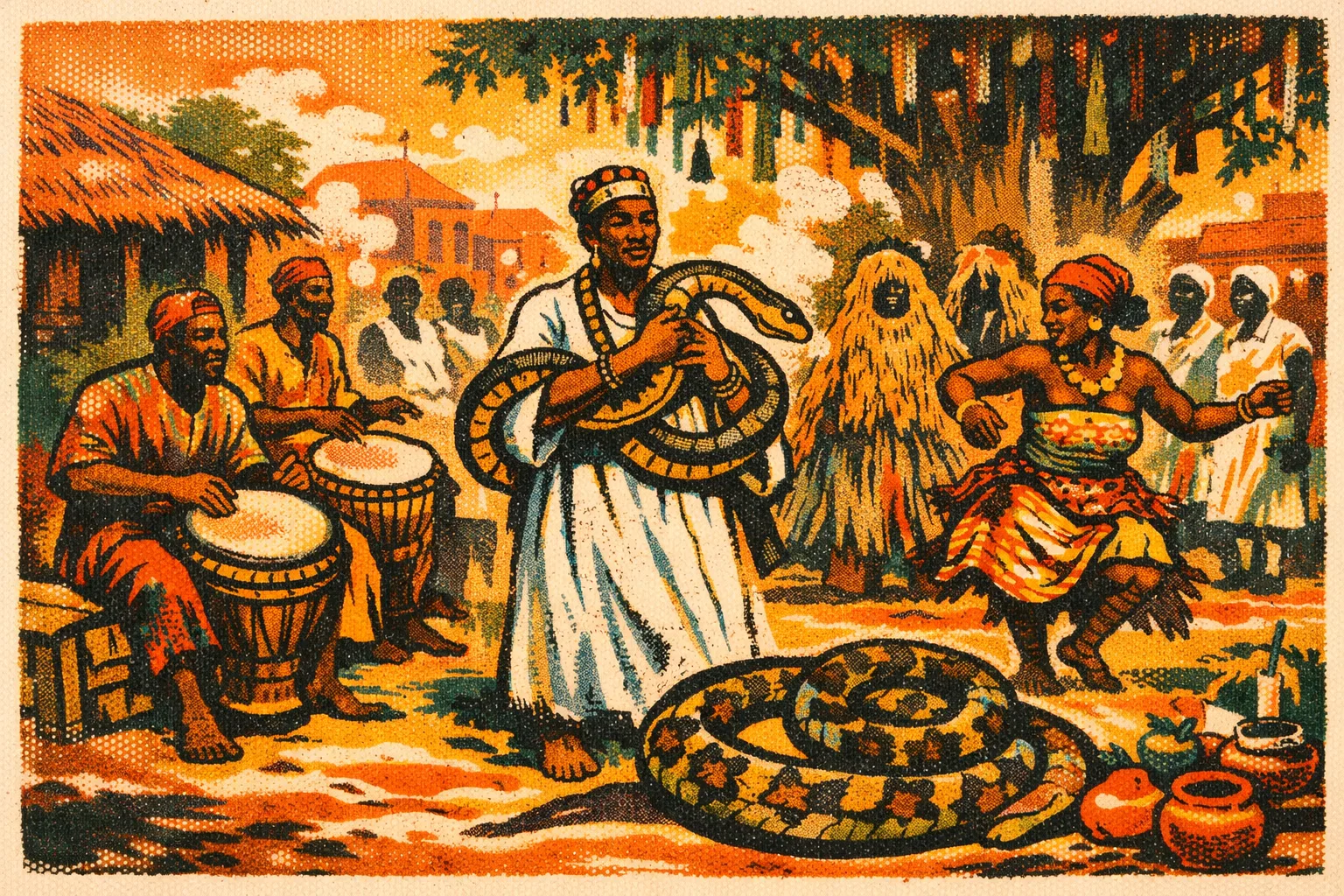
The city’s most photographed uncanny site is the Temple of Pythons. Pythons there are not treated as random reptiles put on display for tourists; they are embedded in a Vodun tradition in which serpents can stand for protection, fertility, continuity and divine presence. Reuters’ reporting on Vodun Days placed the Python Temple within a wider effort to explain Vodun on its own terms rather than through foreign stereotypes. That distinction is important: the Fortean interest lies in the way an animal becomes a religious actor, a public symbol and a tourist encounter all at once, not in pretending that a snake has been scientifically proven to possess supernatural powers.[Reuters]reuters.comOpen source on reuters.com.
Ouidah’s sacred forests deepen the same pattern. These are not just pretty groves with legends attached. AP reported in 2023 that Vodun practitioners regard Benin’s sacred forests as homes of spirits and places where priests seek guidance; the same report noted fears that shrinking forests threaten both religious life and social order. In one memorable local claim, residents around a former sacred forest said a petrol station built there had failed to prosper, with employees saying fuel turned to water — a classic Fortean-flavoured story because it sits precisely between local spiritual warning, economic anecdote and unverifiable marvel.[AP News]apnews.comOpen source on apnews.com.
A sceptical reading does not have to mock the claim. It can simply separate layers: the existence of sacred forests is well documented; deforestation and urban pressure are real; local interpretations of misfortune as spirit displeasure are part of Vodun belief; the petrol-to-water story remains testimony rather than tested evidence. That layered reading is often the fairest way to handle Benin’s uncanny record.

Zangbeto: night guardians, living law and the “empty costume” problem
The Zangbeto are among Benin’s most visually Fortean traditions: towering raffia forms that whirl, patrol and perform as “guardians of the night”. They are widely described in Ogu and related Vodun contexts as traditional protectors of the community, connected with night watch, social discipline and the detection of wrongdoing. Reuters highlighted the “guardians of the night” as one of the striking features of Vodun Days, while other accounts place Zangbeto within a wider West African tradition of masquerade, secrecy and local authority.[Reuters]reuters.comOpen source on reuters.com.
What makes Zangbeto fascinating as Forteana is the gap between performance and ontology: what is it, exactly, that the audience is seeing? A rational outsider sees a masked performer in a raffia structure. Traditional accounts may speak of a spirit, a force, a society, or a presence that should not be reduced to “a man inside”. The point is not to force a single answer. Masquerade traditions often work because they hold the social and the supernatural together. The public can know, at one level, that human organisation is involved, while still treating the appearing form as something more than ordinary theatre.
This is where Benin’s material differs from a simple ghost story. Zangbeto performances are not merely claims about a spooky thing seen once in the dark. They are repeatable, social, rule-governed events with a place in community order and festival display. The uncanny quality comes from the deliberate refusal to collapse the figure into either “just a costume” or “literal monster”. That makes Zangbeto one of Benin’s strongest country-level examples of living public weirdness: not unexplained in the laboratory sense, but persistently liminal.
Sacred forests and spirit ecology: when folklore changes the landscape
Benin’s sacred forests are especially important because they show how spirit belief can have measurable effects without requiring outsiders to accept every spiritual claim literally. AP’s 2023 report described thousands of sacred forests in Benin, many under pressure from farming, urbanisation and earlier anti-Vodun campaigns. Practitioners described these forests as homes of spirits, and religious leaders warned that their destruction damages not only biodiversity but also the social and spiritual fabric of the country.[AP News]apnews.comOpen source on apnews.com.
There is also a more technical evidence base. A research paper on African traditional religions and forest cover used Benin as a central case because adherence to traditional religion is reported in national data. The authors found evidence consistent with a positive relationship between African traditional religion and forest-cover change, and they also examined historical links with the old Kingdom of Dahomey, described as the birthplace of Vodun. That is not proof that spirits protect trees. It is evidence that beliefs about sacred land can influence human behaviour in ways visible from environmental data.[arXiv]arxiv.orgarXiv Sacred Ecology: The Environmental Impact of African Traditional ReligionsarXiv Sacred Ecology: The Environmental Impact of African Traditional Religions
For Fortean readers, this is a useful corrective. The strange claim — “the forest is inhabited by spirits” — may not be testable on its own. But the consequences of the claim can be very real: restricted access, taboos, preservation practices, fear of misfortune, ritual authority and conflicts over development. Benin’s sacred forests therefore belong in weird-history coverage not as haunted backdrops, but as places where invisible beings are said to organise visible human choices.
Thunder, stones and divine punishment
Another classic Fortean motif in Benin is the sky as a moral agent. In Fon and Dahomean religious traditions, the thunder deity often rendered as Hevioso, Xevioso or similar spellings is associated with thunder, lightning, rain and justice. Accounts of West African Vodun describe thunderstones connected with lightning strikes and shrines, while related traditions interpret lightning deaths, storms and unusual stones through the agency of a thunder divinity rather than through meteorology alone.[Wikipedia]WikipediaWest African VodúnWest African Vodún
The sceptical explanation for many “thunderstone” traditions is usually straightforward: unusual stones, prehistoric stone axes, meteorites, fulgurites or other objects become sacred because people connect them with a dramatic event in the sky. That pattern appears in many cultures. What makes Benin relevant is the way such objects sit inside a living ritual system rather than in a distant antiquarian cabinet. A stone or axe is not only an odd object; it can be evidence, warning, shrine component and story trigger.
This is one of the places where Fortean language must be careful. It would be lazy to say “Beninese people believed meteorites were magic” unless a specific meteorite case has been documented. It is more accurate to say that thunder, lightning and stones are part of Vodun’s symbolic and ritual field, and that stories of sky-sent punishment turn ordinary weather into moral drama. That is enough to make the material strange without pretending it is scientifically unresolved.
Ganvié: a lake village with a rescue legend
Ganvié, the stilt village on Lake Nokoué, is usually presented as heritage and travel history rather than Forteana. Yet its origin story has exactly the texture of a national weird-history tale: flight from slave raiders, refuge on water, sacred barriers and, in some tellings, animal helpers or divine protection. The French development agency AFD describes Ganvié as a lakeside settlement on UNESCO’s tentative list, about 30 kilometres from Cotonou, and notes that its name is commonly glossed as “we survived”.[afd.fr]afd.frreinventing venice africareinventing venice africa
The historical core is sobering rather than spooky. The Tofinu people are widely said to have settled on Lake Nokoué to escape slave raiding, using the water as a defensive refuge. Travel and heritage accounts often add that the raiders’ religious restrictions or fear of the lake helped protect the community. Other retellings add a Vodun priest, a hawk, a crocodile, or other marvellous assistance in the founding of the refuge. Those embellishments should not be treated as archival fact, but they reveal how trauma, geography and spiritual imagination fuse into a memorable origin legend.[The Ganvié Project]theganvieproject.comThe Ganvié ProjectofferingsThe Ganvié Projectofferings
As Forteana, Ganvié matters because it shows how the miraculous can attach itself to survival. The lake is not a monster’s lair; it is a sanctuary. The uncanny element is not an unexplained creature but the belief that water, taboo, animal power and divine guidance helped a vulnerable community live beyond the reach of violence.

Abomey: royal power, sacred objects and animal symbols
Benin’s royal history also carries a strong mythic charge, especially around the Kingdom of Dahomey and the palaces of Abomey. UNESCO describes the Royal Palaces of Abomey as major material testimony to a powerful kingdom that developed from the mid-17th century and was ruled by a succession of kings until 1900. The palaces, their bas-reliefs and royal objects are not “paranormal evidence”, but they are a key archive of symbolic power: animal emblems, royal myths, ritual objects and political memory worked together to make kingship feel more than merely administrative.[UNESCO World Heritage Centre]whc.unesco.orgOpen source on unesco.org.
Recent debates over the restitution of objects taken during colonial conquest have revived the spiritual and political significance of these materials. The Financial Times reported on France’s 2021 return of 26 royal objects to Benin and described sacred royal items from Abomey, including imagery around King Béhanzin. The strange-history angle here is not that the objects perform miracles on command. It is that sacred things taken as trophies can remain socially alive, carrying claims about ancestry, legitimacy, injury and repair across more than a century.[Financial Times]ft.comFinancial Times Restitution, wrangling and renewal in BeninFinancial Times Restitution, wrangling and renewal in Benin
This is a useful contrast with sensational paranormal collecting. A haunted-object story usually asks whether an artefact is cursed. Benin’s royal objects raise a stronger question: how does a community treat objects that were never merely “art” in the first place? In that sense, Abomey belongs beside sacred forests and Vodun shrines as part of a larger Beninese pattern: material things may be understood as vessels of force, memory and obligation.
What is missing: UFO flaps, monster files and classic Fortean paperwork
A surprising finding is that Benin does not have a strong, well-sourced public record of classic mid-20th-century UFO flaps, famous cryptids or repeated anomalous falls comparable to better-known Fortean cases elsewhere. Searches for Benin-specific UFO sightings, flying-saucer episodes and anomalous rains mostly lead to thin social-media material, unrelated uses of the word “Benin”, or general articles about animal rains rather than documented Beninese incidents. In responsible country-level Forteana, absence matters: it is better to say that the public evidence is thin than to pad the page with weak claims.
That does not mean Benin lacks sky or weather weirdness. It means the most culturally important sky material is religious and interpretive — thunder deities, lightning punishment, sacred stones — rather than a modern case file of unexplained aircraft. General Fortean literature on “rains” of frogs, fish and odd objects shows how such reports can be collected and debated, with sceptical explanations usually involving storms, waterspouts, misperception, exaggeration or incomplete reporting. But without a solid Benin-specific case, those examples should remain comparison points rather than imported evidence.[Smithsonian Magazine]smithsonianmag.comOpen source on smithsonianmag.com.
This restraint actually makes the Benin page stronger. The country’s distinctive strange-history record is not a borrowed UFO template. It is a living landscape of serpent shrines, night guardians, sacred forests, thunder justice, royal spirit-objects and survival legends.
How to read Benin’s strange material fairly
The fair approach is neither credulous nor dismissive. Benin’s Fortean material should be read through four overlapping lenses.
First, there is claim: practitioners, guides, priests, residents or storytellers may say that a spirit inhabits a forest, a python embodies sacred power, or lightning expresses divine justice. Those claims deserve accurate reporting, but not automatic conversion into fact.
Second, there is performance: Zangbeto masquerades, Vodun Days ceremonies and ritual dances are public, embodied events. Their strangeness is partly theatrical, partly religious and partly social. Treating them as either “fake magic” or “literal proof of spirits” misses how masquerade works.
Third, there is material evidence: temples, forests, palaces, bas-reliefs, returned royal objects and lake settlements exist. They anchor stories in place. A sacred forest can be mapped even if its spirits cannot; a python temple can be visited even if the serpent’s divinity is a matter of belief.
Fourth, there is cultural consequence: beliefs affect behaviour. Sacred groves may preserve biodiversity; fear of spiritual sanction may shape development disputes; festivals can recast a once-stigmatised religion as national heritage; legends of Ganvié can turn historical refuge into mythic survival.[apnews.com]apnews.comOpen source on apnews.com.
That is why Benin is such a useful country for grounded Forteana. Its strongest mysteries are not puzzles waiting for one clean debunking. They are living negotiations between belief, history, ecology, tourism, politics and memory.
The lasting pull of Benin’s uncanny landscape
Benin’s weird-history record endures because it is not confined to the margins. The uncanny is visible in major heritage sites, national festivals, sacred animals, royal memory and public debates over land. Ouidah’s Vodun celebrations attract international attention; sacred forests are reported as both ecological spaces and spirit homes; Ganvié turns survival into legend; Abomey’s royal objects make political history feel charged with ritual force.[apnews.com]apnews.comOpen source on apnews.com.
The result is a country whose Forteana is less about “what monster was seen?” and more about “what kind of world is being described?” In that world, snakes can be sacred neighbours, forests can be courts of unseen authority, thunder can judge, masks can patrol the night, and objects taken in war can return with more than museum value. A sceptic need not accept the supernatural claims to recognise the power of the stories. A believer need not reduce them to tourist spectacle. Benin’s strangeness lives in the charged space between those readings, which is exactly where the best country-level Forteana often belongs.
Amazon book picks
Further Reading
Books and field guides related to Where Benin's Spirits Enter Public Life. Use these as the next step if you want deeper reading beyond the article.
African religions & philosophy
Places Benin's beliefs within wider African religious traditions.

The Serpent and the Rainbow
Explores Haitian Vodou and the Western fascination with 'voodoo' narratives.

Vodun: Secrecy and the Search for Divine Power
Explains Vodun as practiced in Benin beyond popular stereotypes.
Vodun
First published 2018. Subjects: Secrecy (psychology), Tourism, Ethnology, nigeria, Benin, Vodou.
eBay marketplace picks
Marketplace Samples
Live-tested eBay searches with available results related to this page.
Endnotes
1.
Source: state.gov
Title: 547499 BENIN 2023 INTERNATIONAL RELIGIOUS FREEDOM REPORT
Link:https://www.state.gov/wp-content/uploads/2024/04/547499-BENIN-2023-INTERNATIONAL-RELIGIOUS-FREEDOM-REPORT.pdf
2.
Source: reuters.com
Link:https://www.reuters.com/world/africa/benin-festival-seeks-dispel-voodoo-stereotypes-2025-01-14/
3.
Source: reuters.com
Title: voodoo dances rituals wow tourists benin festival 2023 01 11
Link:https://www.reuters.com/world/africa/voodoo-dances-rituals-wow-tourists-benin-festival-2023-01-11/
4.
Source: Wikipedia
Link:https://en.wikipedia.org/wiki/Zangbeto
5.
Source: arxiv.org
Title: arXiv Sacred Ecology: The Environmental Impact of African Traditional Religions
Link:https://arxiv.org/abs/2401.13673
6.
Source: Wikipedia
Title: West African Vodún
Link:https://en.wikipedia.org/wiki/West_African_Vod%C3%BAn
7.
Source: Wikipedia
Link:https://en.wikipedia.org/wiki/X%C9%9Bvioso
8.
Source: afd.fr
Title: reinventing venice africa
Link:https://www.afd.fr/en/actualites/reinventing-venice-africa
9.
Source: whc.unesco.org
Link:https://whc.unesco.org/en/list/323/
10.
Source: 2021-2025.state.gov
Link:https://2021-2025.state.gov/reports/2022-report-on-international-religious-freedom/benin/
11.
Source: Wikipedia
Title: Fête du Vodoun
Link:https://en.wikipedia.org/wiki/F%C3%AAte_du_Vodoun
12.
Source: Wikipedia
Title: Religion in Benin
Link:https://en.wikipedia.org/wiki/Religion_in_Benin
13.
Source: Wikipedia
Link:https://en.wikipedia.org/wiki/Ganvie
14.
Source: Wikipedia
Title: Royal Palaces of Abomey
Link:https://en.wikipedia.org/wiki/Royal_Palaces_of_Abomey
15.
Source: Wikipedia
Title: Witchcraft accusations against children in Africa
Link:https://en.wikipedia.org/wiki/Witchcraft_accusations_against_children_in_Africa
16.
Source: Wikipedia
Title: UFO sightings in Africa
Link:https://en.wikipedia.org/wiki/UFO_sightings_in_Africa
17.
Source: Wikipedia
Title: Flying saucer
Link:https://en.wikipedia.org/wiki/Flying_saucer
18.
Source: reuters.com
Link:https://www.reuters.com/video/watch/idRW173013112025RP1/
19.
Source: reuters.com
Title: on benins voodoo holiday followers pray and sacrifice for peace id USKCN0UP0HB
Link:https://www.reuters.com/article/world/on-benins-voodoo-holiday-followers-pray-and-sacrifice-for-peace-idUSKCN0UP0HB/
20.
Source: reuters.com
Title: more than 100 graves robbed in benin for voodoo rituals id USBRE8AT0K7
Link:https://www.reuters.com/article/lifestyle/more-than-100-graves-robbed-in-benin-for-voodoo-rituals-idUSBRE8AT0K7/
21.
Source: unesdoc.unesco.org
Link:https://unesdoc.unesco.org/ark%3A/48223/pf0000112880
22.
Source: unesdoc.unesco.org
Link:https://unesdoc.unesco.org/ark%3A/48223/pf0000378275
23.
Source: whc.unesco.org
Link:https://whc.unesco.org/archive/2014/whc14-38com-8a-en.pdf
24.
Source: whc.unesco.org
Link:https://whc.unesco.org/en/activities/565/
25.
Source: unesdoc.unesco.org
Link:https://unesdoc.unesco.org/ark%3A/48223/pf0000117494
26.
Source: unesdoc.unesco.org
Link:https://unesdoc.unesco.org/ark%3A/48223/pf0000078424
27.
Source: justice.gov
Link:https://www.justice.gov/eoir/media/281356/dl?inline=
28.
Source: apnews.com
Link:https://apnews.com/article/df831990ce900c99b927c75e7179e461
Source snippet
Vodún, deeply rooted in Beninese society, emphasizes a spiritual connection to nature and plays a central role in communal identity. Desp...
29.
Source: apnews.com
Link:https://apnews.com/article/465e798bd2271ca5c4213416986d701a
30.
Source: apnews.com
Link:https://apnews.com/article/9c8737ad86d15e1503f3fc908c6c2518
31.
Source: theganvieproject.com
Title: The Ganvié Projectofferings
Link:https://theganvieproject.com/offerings
32.
Source: ft.com
Title: Financial Times Restitution, wrangling and renewal in Benin
Link:https://www.ft.com/content/af133939-e6da-411b-9404-217d2a6ae6a2
33.
Source: smithsonianmag.com
Link:https://www.smithsonianmag.com/science-nature/strange-rain-why-fish-frogs-and-golf-balls-fall-skies-180956527/
34.
Source: openfactbook.org
Link:https://openfactbook.org/countries/benin/
35.
Source: re-entanglements.net
Title: stone axes
Link:https://re-entanglements.net/stone-axes/
36.
Source: ebsco.com
Link:https://www.ebsco.com/research-starters/religion-and-philosophy/west-african-vodun
37.
Source: brickthology.com
Link:https://brickthology.com/category/thunderstone/
38.
Source: x.com
Link:https://x.com/ReutersAfrica/status/1879068451597086843
39.
Source: archive.govglance.org
Link:https://archive.govglance.org/factbook/benin
40.
Source: christoph.today
Link:https://christoph.today/benin/
Additional References
41.
Source: youtube.com
Link:https://www.youtube.com/watch?v=G87p-TwqIoU
Source snippet
See the Python Temple, Ouidah: Where Pythons are worshiped...
42.
Source: youtube.com
Title: See the Python Temple, Ouidah: Where Pythons are worshiped
Link:https://www.youtube.com/watch?v=tUnhPpM9lFo
Source snippet
The Secret Of Zangbeto Voodoo Dance - Benin's Spiritual Guardianship In Meko Village, Ouidah...
43.
Source: youtube.com
Title: Africa’s Most FEARED Religion: Voodoo
Link:https://www.youtube.com/watch?v=T1fkT65ftnU
Source snippet
Inside the Secret Voodoo Rituals of Benin's Samba Tribe | Atlantic | YouCurious?...
44.
Source: naturepl.com
Link:https://www.naturepl.com/stock-photo–zangbeto-traditional-voodoo-guardians-of-the-night-in-the-yoruba-image01448351.html?srsltid=AfmBOoqPtAwrnfiTcyX7SmWCDDD0xTzqDn0C8W_VFTCrunB9WuAvnHxt
45.
Source: academia.edu
Link:https://www.academia.edu/26054848/Contemporary_Vodun_Arts_of_Ouidah_B%C3%A9nin
46.
Source: instagram.com
Link:https://www.instagram.com/p/DVbmJk4gpnE/
47.
Source: researchgate.net
Link:https://www.researchgate.net/publication/310602020_Zangbeto_The_Traditional_Way_of_Policing_and_Securing_the_Community_among_the_Ogu_Egun_People_in_Badagry_Nigeria
48.
Source: facebook.com
Link:https://www.facebook.com/groups/275114380263865/posts/1230556291386331/
49.
Source: facebook.com
Link:https://www.facebook.com/groups/275114380263865/posts/1595384564903500/
50.
Source: facebook.com
Link:https://www.facebook.com/GHANAFUNTUBE/posts/add-ganvie-benin-to-your-bucket-list-/1435624388591450/
Topic Tree
Follow this branch
Related pages 192
- Afghan Forteana
- Antigua Uncanny
- Bosnian Mysteries
- Botswana Weird
- Brazil Strange
- +187 more in sidebar