Within Bahamas Strange
Is The Lusca Monster Really In The Blue Holes?
The Lusca turns the real hazards of Andros blue holes into a many-armed monster story with strong folklore and weak zoology.
On this page
- What the Lusca is said to be
- Why blue holes make believable monster country
- Scientific explanations for slime, tides and danger
Page outline Jump by section
Introduction
The Lusca is one of the Bahamas’ most famous monster legends, said to lurk in the blue holes of Andros Island. Depending on the storyteller, it is a giant octopus, a colossal cuttlefish, or an impossible hybrid with the head of a shark and the tentacles of an octopus. The legend is dramatic, but its lasting appeal comes from something very real: the blue holes themselves. These flooded limestone caves are deep, complex and genuinely hazardous, with powerful tidal flows, poor visibility and underwater passages that have claimed lives. The result is a classic piece of Bahamian Forteana in which folklore grows directly from an unusual landscape. There is no credible zoological evidence for a giant unknown predator in the blue holes, yet the legend continues because it captures the unsettling experience of places where the sea seems to breathe, disappear into darkness and occasionally behave in ways that appear almost alive.[GMU College of Science]science.gmu.eduwhat really lives king kong cavernGMU College of ScienceWhat really lives in King Kong Cavern?2 Sept 2021 — It seems unlikely that either mermaids or the Lusca lives in KK…
What the Lusca is said to be
Descriptions of the Lusca vary, but several themes recur across Bahamian folklore.
The creature is usually portrayed as:
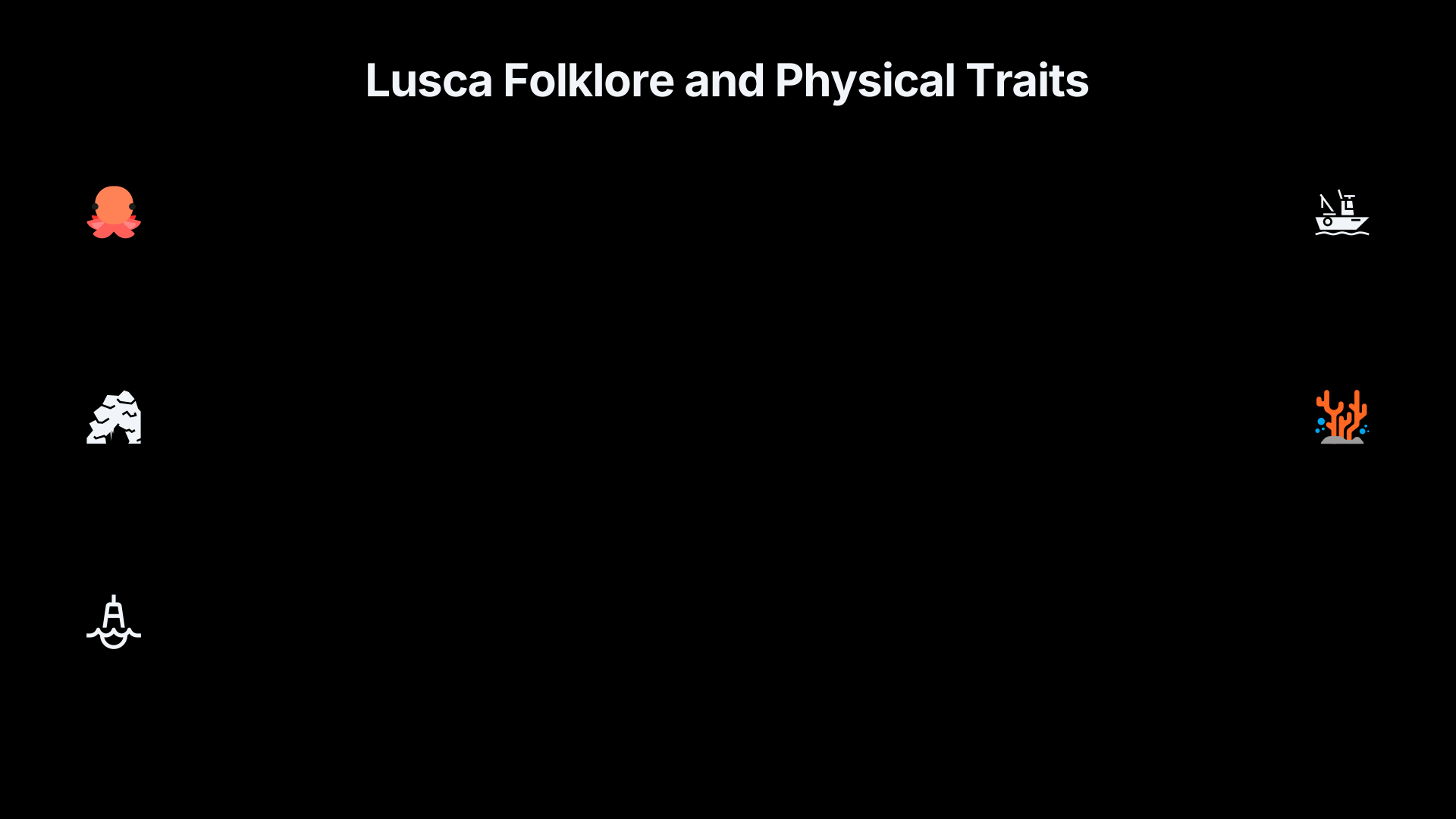
- A gigantic octopus or squid with immense strength.
- A shark-octopus hybrid capable of dragging boats or swimmers underwater.
- A predator living in submerged caves and blue holes, especially around Andros.
- A creature that attacks only when people venture too close to its underwater lair.
The hybrid appearance is particularly striking because it combines two genuine marine fears. Sharks represent speed and biting power, while octopuses symbolise grasping tentacles and hidden intelligence. Although no known cephalopod reaches the extraordinary sizes claimed for the Lusca, giant octopuses, large reef sharks and the darkness of underwater caves provide enough real-world inspiration for the legend to feel plausible at first glance.[Wikipedia]WikipediaLuscaThe Lusca is a name given to a mythological sea monster said to exist in the region of the blue holes nearby Andros, an island in th…
Unlike many sea-monster stories, the Lusca is closely tied to a specific environment rather than the open ocean. Its home is almost always described as the blue holes—vertical shafts leading into flooded cave systems where visibility quickly disappears and unexplored passages extend far beyond what casual visitors can see.
Why blue holes make believable monster country
The setting is essential to understanding why the Lusca became such a persistent legend.
Blue holes are flooded limestone sinkholes connected to extensive cave networks. Around Andros they occur both inland and offshore, with many linked to complex underwater passages carved when sea levels were much lower during the last Ice Age. Some descend hundreds of metres into darkness, while tidal forces can move water through hidden tunnels with surprising speed.[Explorersweb]explorersweb.comA Guide to the Blue Holes of the Bahamas' Andros IslandA Guide to the Blue Holes of the Bahamas' Andros Island
To anyone unfamiliar with their geology, these places possess several unsettling qualities:
- Their dark blue appearance makes them seem bottomless.
- Water can suddenly begin flowing in unexpected directions.
- Cold water may surge upward from unseen passages.
- Echoes and currents seem to emerge from nowhere.
- Divers disappear from view within seconds.
These are exactly the kinds of environmental cues that encourage supernatural interpretation. A powerful current pulling unexpectedly at a swimmer or fishing line becomes easier to imagine as an unseen creature than as water moving through kilometres of submerged limestone tunnels.
Many traditional accounts even describe the tidal movement itself as the Lusca breathing. When water rushes into a cave, the monster is inhaling; when cool water wells back up, it is exhaling. This interpretation gives a memorable personality to an otherwise invisible geological process.[Bahamas For Kids]bahamas4kids.comHalf-shark, half-octopus, Lusca lurks around in the underwater caves, tunnels and blue holes found all over…Read more…
The real dangers behind the legend
The blue holes do not need monsters to be dangerous.
Experienced cave divers regard submerged cave systems as among the most technically demanding underwater environments. Risks include becoming lost in branching tunnels, silting that destroys visibility, equipment failures, disorientation and strong tidal currents. Unlike open-water diving, there may be no direct route to the surface.
Offshore blue holes add further complications because they connect with the sea through hidden cave passages. Water movement changes with the tides, sometimes producing powerful inflows and outflows that can surprise divers.
For fishermen and swimmers, the danger is different but equally real. Deep vertical shafts may contain sudden depth changes, reduced visibility and strong local currents capable of making rescue difficult. Stories of boats being tugged unexpectedly or fishing gear disappearing into deep water become much less mysterious once the hydrology of these cave systems is understood, although they remain dramatic experiences.
The legend therefore functions as an effective cultural warning. “Stay away from the blue holes” becomes easier to remember when the warning takes the form of a monster waiting below.

Scientific explanations for slime, tides and danger
Some of the strangest features associated with the Lusca have straightforward scientific explanations, even if they remain visually spectacular.
The mysterious “slime”
One recurring claim involves strange white or grey mucus-like material appearing near underwater cave entrances, interpreted by some as evidence that a giant creature is living below.
Research at King Kong Cavern on the Andros barrier reef found a very different explanation. Scientists sampled the filamentous material and analysed its DNA, discovering that it was dominated by bacteria, particularly species of Arcobacter. The filaments appear to originate within the cave system and are carried out during strong tidal flows.[GMU College of Science]science.gmu.eduwhat really lives king kong cavernGMU College of ScienceWhat really lives in King Kong Cavern?2 Sept 2021 — It seems unlikely that either mermaids or the Lusca lives in KK…
Rather than monster secretions, the material represents an unusual microbial ecosystem adapted to oxygen-poor conditions.
Why the water sometimes “breathes”
Many blue holes experience noticeable water movement as tides force seawater through underground cave networks.
To an observer standing nearby, this can resemble a giant unseen organism inhaling and exhaling. Water may suddenly surge outward carrying colder, darker or chemically different water from deep within the cave system. The effect is dramatic enough that it naturally encouraged generations of supernatural explanations before the cave systems were scientifically explored.[GMU College of Science]science.gmu.eduwhat really lives king kong cavernGMU College of ScienceWhat really lives in King Kong Cavern?2 Sept 2021 — It seems unlikely that either mermaids or the Lusca lives in KK…
Hidden chemistry below the surface
Research on Andros blue holes has shown that many contain sharply layered water. Oxygen-rich freshwater near the surface gives way below the halocline to deeper saline water that may contain little or no oxygen together with hydrogen sulphide—the gas responsible for the smell of rotten eggs. These chemically distinct layers support specialised microbial communities but would not provide suitable habitat for an enormous air-breathing or actively hunting monster.[GMU College of Science]science.gmu.eduwhat really lives king kong cavernGMU College of ScienceWhat really lives in King Kong Cavern?2 Sept 2021 — It seems unlikely that either mermaids or the Lusca lives in KK…
Is there any evidence for a real Lusca?
Despite the legend’s popularity, there is no verified physical evidence that an unknown giant cephalopod or shark-octopus hybrid inhabits Bahamian blue holes.
There are no authenticated specimens, photographs, sonar records or biological samples supporting the existence of such an animal. Nor do the oxygen-poor conditions found in many deeper cave sections appear compatible with sustaining a huge active predator.[GMU College of Science]science.gmu.eduwhat really lives king kong cavernGMU College of ScienceWhat really lives in King Kong Cavern?2 Sept 2021 — It seems unlikely that either mermaids or the Lusca lives in KK…
Some investigators have suggested that occasional sightings may have involved unusually large octopuses viewed under poor conditions. Octopuses can dramatically alter their shape and colour, and an animal moving quickly through dark water might easily appear unfamiliar or exaggerated in memory. Television investigations and cryptozoological discussions have generally concluded that misidentification of known marine animals is a far more plausible explanation than an undiscovered giant species.[Wikipedia]WikipediaLuscaThe Lusca is a name given to a mythological sea monster said to exist in the region of the blue holes nearby Andros, an island in th…
That does not mean every story was invented. People genuinely experience frightening currents, strange sounds, disappearing visibility and unexplained sensations in blue holes. The disagreement lies not in whether these experiences occur, but in how they should be interpreted.

Why the Lusca still matters
The Lusca survives because it performs several roles at once.
As folklore, it transforms an unusual geological landscape into a memorable story. As a cautionary tale, it warns children, swimmers and fishermen not to underestimate dangerous water. As modern Forteana, it demonstrates how genuine environmental mysteries can evolve into monster traditions without requiring fraud or deliberate invention.
Scientific exploration has made Andros’ blue holes more fascinating rather than less. Researchers continue to discover unusual cave chemistry, specialised bacteria and remarkably complex underwater systems that remain difficult to explore. Those discoveries replace the monster with something arguably just as remarkable: an alien-looking natural environment hidden beneath familiar tropical seas.
The Lusca therefore occupies an unusual place in Bahamian folklore. It is almost certainly not a real animal, but it remains an effective symbol of the very real dangers and mysteries concealed beneath the calm surface of the islands’ famous blue holes.


eBay marketplace picks
Marketplace Samples
Live-tested eBay searches with available results related to this page.



Endnotes
1.
Source: science.gmu.edu
Title: what really lives king kong cavern
Link:https://science.gmu.edu/news/what-really-lives-king-kong-cavern
Source snippet
GMU College of ScienceWhat really lives in King Kong Cavern?2 Sept 2021 — It seems unlikely that either mermaids or the Lusca lives in KK...
2.
Source: Wikipedia
Link:https://en.wikipedia.org/wiki/Lusca
Source snippet
LuscaThe Lusca is a name given to a mythological sea monster said to exist in the region of the blue holes nearby Andros, an island in th...
3.
Source: explorersweb.com
Title: A Guide to the Blue Holes of the Bahamas’ Andros Island
Link:https://explorersweb.com/a-guide-to-the-blue-holes-of-the-bahamas-andros-island/
4.
Source: youtube.com
Title: The Lusca | The Caribbean’s Giant Sea Monsters
Link:https://www.youtube.com/watch?v=MzB36TuRnxU
Source snippet
Jeremy May Have Found The Lusca Monster Of The Blue Holes | River Monsters...
5.
Source: bahamas4kids.com
Link:https://www.bahamas4kids.com/stories/stories-myths.html
Source snippet
Half-shark, half-octopus, Lusca lurks around in the underwater caves, tunnels and blue holes found all over...Read more...
6.
Source: caribbeanfolkloremonth.wordpress.com
Link:https://caribbeanfolkloremonth.wordpress.com/2025/09/15/lusca/
Source snippet
Caribbean Folklore Month15 Sept 2025 — It is a truly terrifying sea monster. Said to live within the giant underwater blue holes around t...
Additional References
7.
Source: reddit.com
Link:https://www.reddit.com/r/Cryptozoology/comments/13jsjxu/have_you_heard_of_lusca/
8.
Source: folktalesamerica.com
Title: the lusca of the blue holes bahamian folktale
Link:https://folktalesamerica.com/the-lusca-of-the-blue-holes-bahamian-folktale/
Source snippet
The Lusca of the Blue Holes: Bahamian Folktale24 Dec 2025 — A Bahamian folktale and sea legend about the Lusca, a fearsome blue hole mons...
9.
Source: youtube.com
Link:https://www.youtube.com/watch?v=l6aB2sEHL9Q
Source snippet
Kraken Aquatics Podcast #020 - The Mystery of the Blue Hole: The World's Most Treacherous Dive Sites...
10.
Source: ihearthula.wordpress.com
Title: folktale friday lusca and the blue holes
Link:https://ihearthula.wordpress.com/2021/03/26/folktale-friday-lusca-and-the-blue-holes/
Source snippet
Friday: Lusca and the Blue Holes26 Mar 2021 — Endemic to the Caribbean, the Lusca was most likely used to dissuade people from venturing...
11.
Source: youtube.com
Title: Jeremy May Have Found The Lusca Monster Of The Blue Holes | River Monsters
Link:https://www.youtube.com/watch?v=bnWg7hM07Qg
Source snippet
Beast From The Deep Water Lair | River Monsters S8E2...
12.
Source: youtube.com
Title: Beast From The Deep Water Lair | River Monsters S8E2
Link:https://www.youtube.com/watch?v=f02C9k4TmR8
Source snippet
Have Experts Found Evidence Of The Lusca Sea Monster? | Curse Of The Bermuda Triangle...
13.
Source: youtube.com
Title: Kraken Aquatics Podcast #020
Link:https://www.youtube.com/watch?v=txtWLXb3IM8
Topic Tree