Within Afghan Forteana
Did Bamiyan's Dragon Become a Valley?
A split ridge near Bamiyan turns geology into a dragon-slaying legend tied to Hazrat Ali, springs and sacred landscape memory.
On this page
- The dragon shaped ridge west of Bamiyan
- Hazrat Ali, sacred water and local memory
- Geology, pilgrimage and the legend's afterlife
Page outline Jump by section
Introduction
Bamiyan’s Dragon Valley is one of Afghanistan’s most striking examples of a landscape becoming a legend. A few kilometres west of Bamiyan lies a long, split ridge of rock known locally as Dara-e Ajdahar, or the Valley of the Dragon. According to local tradition, the ridge is the petrified body of a monstrous dragon slain by Hazrat Ali, whose sword split the creature from head to tail. Springs emerging from the rock are said to be the dragon’s tears and blood. The physical landscape is entirely real; the dragon is not. What makes the site remarkable is the way geology, religious memory and local identity have become inseparable over centuries. Rather than being a simple fairy tale, the story has transformed an unusual geological formation into one of Afghanistan’s most enduring sacred landscapes.[afghanistan-analysts.org]afghanistan-analysts.orgBut had it not been for HazratAfghanistan Analysts Network - EnglishOur summer travel tips for Bamyan ProvinceTir 13, 1392 AP — A short ride west of Bamyan bazar, it o…

The dragon-shaped ridge west of Bamiyan
The Dragon Valley lies around five to seven kilometres west of Bamiyan, within the wider cultural landscape famous for its Buddhist caves and the niches of the destroyed giant Buddhas. Visitors encounter a long, narrow ridge rising from the valley floor, deeply cleft along its length. Even without knowing the legend, the formation has an unmistakably serpentine appearance, encouraging comparisons with the back of a giant reptile.[Afghanistan Analysts Network - English]afghanistan-analysts.orgBut had it not been for HazratAfghanistan Analysts Network - EnglishOur summer travel tips for Bamyan ProvinceTir 13, 1392 AP — A short ride west of Bamyan bazar, it o…
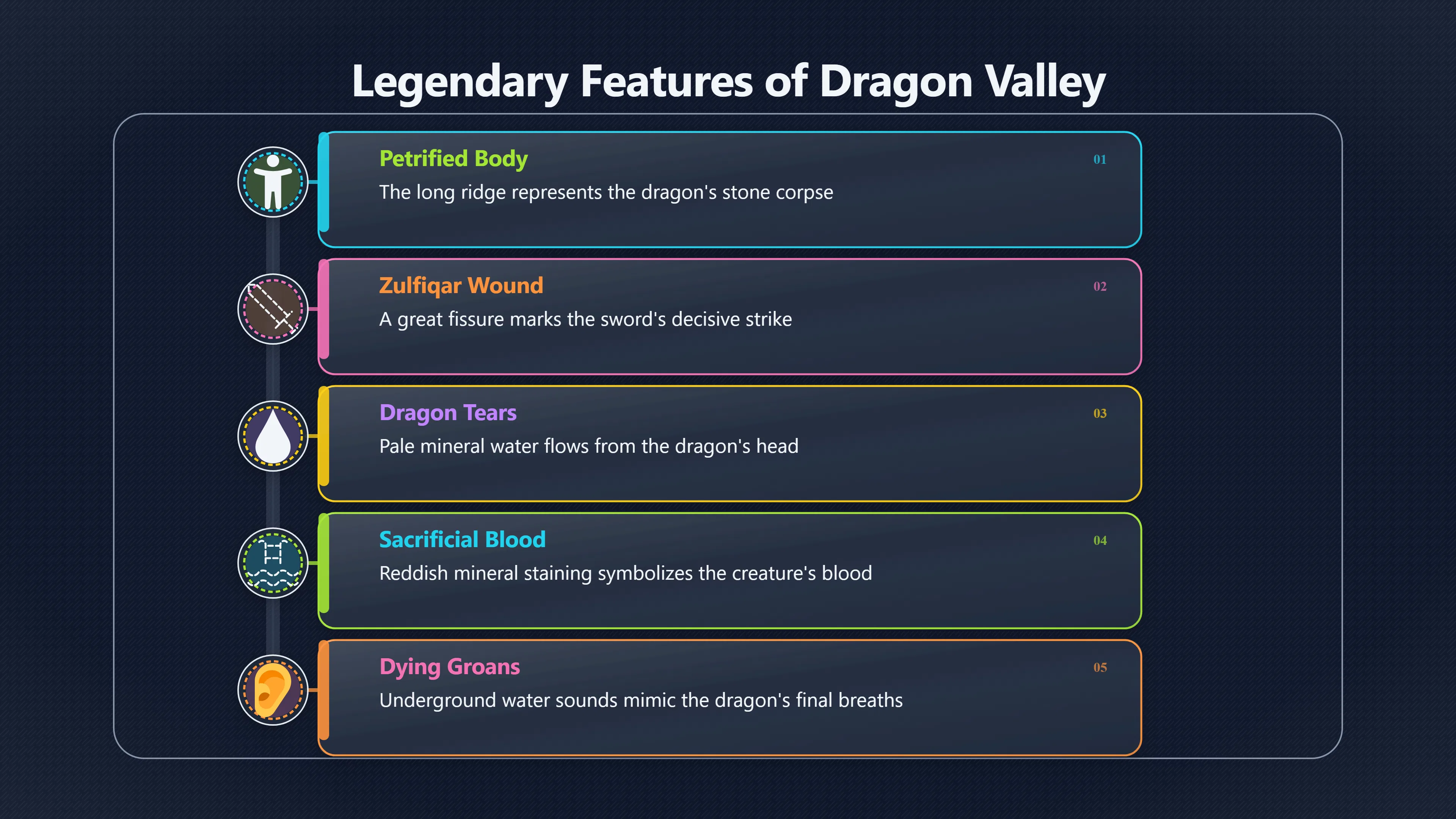
Local tradition explains every visible feature of the landscape:
- the ridge is the dragon’s petrified body;
- the great fissure is the wound made by Hazrat Ali’s sword, Zulfiqar;
- pale mineral-rich water flowing from the “head” represents the dragon’s tears;
- in some versions, reddish water or mineral staining symbolises its blood;
- faint sounds of underground water have been interpreted as the dragon’s dying groans.[Visit Bamyan]visit-bamyan.comVisit Bamyan Dragon ValleyVisit BamyanDragon Valley - Visit BamyanKhordad 15, 1399 AP — Legend has it that this spine of rock split in two is that of a dragon who…
The legend survives partly because the geology lends itself so readily to storytelling. The ridge is unusually elongated, dramatically fractured and accompanied by springs, making it an ideal example of what folklorists sometimes call a “legend-ready” landscape—a place whose appearance almost demands explanation.
Hazrat Ali, sacred water and local memory
The central figure in the legend is Hazrat Ali, the cousin and son-in-law of the Prophet Muhammad. Although there is no historical evidence that Ali ever travelled to Bamiyan, stories linking him to miraculous feats are widespread across Central and South Asia. Such traditions often attach his name to springs, mountains and dramatic geological formations, transforming ordinary terrain into sacred history.[Afghanistan Analysts Network - English]afghanistan-analysts.orgBut had it not been for HazratAfghanistan Analysts Network - EnglishOur summer travel tips for Bamyan ProvinceTir 13, 1392 AP — A short ride west of Bamyan bazar, it o…
In Bamiyan’s version, the dragon had terrorised the valley, demanding regular sacrifices from the local population. Ali confronted the beast, survived its fiery breath and killed it with a single stroke of Zulfiqar. The defeated creature became stone, permanently fixing the victory into the landscape itself.[Visit Bamyan]visit-bamyan.comVisit Bamyan Dragon ValleyVisit BamyanDragon Valley - Visit BamyanKhordad 15, 1399 AP — Legend has it that this spine of rock split in two is that of a dragon who…
The springs flowing from the ridge are as important as the dragon itself. Water emerging from rock has long attracted religious significance across many cultures, and in Bamiyan the mineral-rich springs reinforce the impression that the ridge is a living relic rather than an ordinary outcrop. The continuing flow of water gives physical permanence to an otherwise mythical event.
Unlike many dragon stories, this legend is not primarily about discovering a monster. Instead, it explains why a distinctive place looks the way it does while expressing a moral narrative in which divine authority overcomes chaos.

How geology created the legend
Geologists see no mystery in the ridge’s physical origin. It is a natural geological formation shaped by the region’s complex tectonic history, faulting and erosion. The long central crack resembles the sort of fracture produced by natural earth movements rather than a deliberate cut. Groundwater moving through fractured rock also explains the emergence of mineral-rich springs.[ResearchGate]researchgate.netBand-e-Amir Lakes and Dragon Valley (Bamiyan)Numerous legends, the earliest likely dating to the establishment of the Zoroast…
Research on the wider Bamiyan region highlights how seismic activity has repeatedly shaped its landscape. Nearby Band-e Amir’s travertine dams, springs and changing water systems all owe their existence to geological processes acting over thousands of years. The Dragon Valley belongs to this same dynamic environment, where faults, carbonate deposits and groundwater combine to produce unusual landforms that readily inspire folklore.[ResearchGate]researchgate.netBand-e-Amir Lakes and Dragon Valley (Bamiyan)Numerous legends, the earliest likely dating to the establishment of the Zoroast…
Rather than replacing the legend, geological explanations help explain why such a legend emerged here instead of elsewhere. The landscape already looked extraordinary before anyone told stories about it.
Why the valley became sacred
Dragon Valley illustrates a recurring pattern found across many cultures: remarkable natural features become sacred because people attach memorable stories to them.
In Bamiyan, several historical layers overlap:
- the valley was an important Buddhist religious centre for centuries;
- after the spread of Islam, new sacred narratives became attached to the same landscape;
- local communities preserved these traditions through oral storytelling rather than written chronicles;
- pilgrimage and local visits reinforced the site’s reputation across generations.[Afghanistan Analysts Network - English]afghanistan-analysts.orgBut had it not been for HazratAfghanistan Analysts Network - EnglishOur summer travel tips for Bamyan ProvinceTir 13, 1392 AP — A short ride west of Bamyan bazar, it o…
The legend therefore reflects cultural continuity more than religious replacement. Instead of erasing the landscape’s older importance, Islamic tradition reinterpreted it through a new heroic figure. The result is a sacred geography in which mountains, springs and valleys all acquire historical and spiritual meaning.
This layering is one reason Bamiyan fascinates historians. Within a relatively small area, Buddhist archaeology, Islamic folklore and striking geology coexist without being reducible to a single explanation.
Geology, pilgrimage and the legend’s afterlife
Today the Dragon Valley is visited for several overlapping reasons. Some visitors come out of religious respect for the association with Hazrat Ali. Others are attracted by the spectacular scenery or by curiosity about one of Afghanistan’s best-known legends. Travel writers frequently note that the valley feels like a place where myth and landscape naturally reinforce one another rather than compete.[Visit Bamyan]visit-bamyan.comVisit Bamyan Dragon ValleyVisit BamyanDragon Valley - Visit BamyanKhordad 15, 1399 AP — Legend has it that this spine of rock split in two is that of a dragon who…
The story has also become part of Bamiyan’s cultural identity. Alongside the Buddhas, Band-e Amir and the surrounding mountains, the Dragon Valley contributes to an image of Bamiyan as a landscape where history and legend remain visible in the terrain itself. Modern tourism often presents the site as both a geological attraction and a living piece of folklore rather than attempting to separate the two.
For students of Fortean traditions, the valley offers an instructive example of sacred geology. No credible evidence suggests that a literal dragon ever existed, and the ridge is well explained by natural processes. Yet dismissing the story as merely false misses its cultural importance. The legend explains an unusual landscape, links it to a revered religious figure, preserves local memory and gives generations of visitors a vivid way to understand the valley. In that sense, the “dragon” continues to shape Bamiyan—not as a prehistoric creature, but as one of Afghanistan’s most enduring examples of a landscape transformed into living myth.
Amazon book picks
Further Reading
Books and field guides related to Did Bamiyan's Dragon Become a Valley?. Use these as the next step if you want deeper reading beyond the article.

The Penguin Book of Dragons
Explores dragon traditions that illuminate the Bamiyan legend.

Afghanistan A Cultural And Political History
Explains the historical setting behind Bamiyan traditions.

The places in between
Strong landscape focus complements Bamiyan's legendary geography.
eBay marketplace picks
Marketplace Samples
Live-tested eBay searches with available results related to this page.




Endnotes
1.
Source: afghanistan-analysts.org
Title: But had it not been for Hazrat
Link:https://www.afghanistan-analysts.org/en/reports/context-culture/traveling-bamyan/
Source snippet
Afghanistan Analysts Network - EnglishOur summer travel tips for Bamyan ProvinceTir 13, 1392 AP — A short ride west of Bamyan bazar, it o...
2.
Source: visit-bamyan.com
Title: Visit Bamyan Dragon Valley
Link:https://visit-bamyan.com/dragon-valley/
Source snippet
Visit BamyanDragon Valley - Visit BamyanKhordad 15, 1399 AP — Legend has it that this spine of rock split in two is that of a dragon who...
3.
Source: researchgate.net
Link:https://www.researchgate.net/publication/249551884_Band-e-Amir_Lakes_and_Dragon_Valley_Bamiyan_myths_and_seismicity_in_Afghanistan
Source snippet
Band-e-Amir Lakes and Dragon Valley (Bamiyan)Numerous legends, the earliest likely dating to the establishment of the Zoroast...
Additional References
4.
Source: daryaexpeditions.com
Link:https://www.daryaexpeditions.com/valley-of-the-dragon-dara-e-ajdaha-bamiyan-afghanistan/
5.
Source: youtube.com
Link:https://www.youtube.com/watch?v=PLksCD1CrRM
Source snippet
Afghanistan's Mysterious Dragon Valley in BamyanJoin me as I explore the breathtaking Dragon Valley in Bamyan, Afghanistan — a place wher...
6.
Source: evendo.com
Title: Mineral-rich springs, one clear and one red,
Link:https://evendo.com/locations/afghanistan/drangiana/landmark/dragon-valley
Source snippet
Dragon Valley: Where Legend Carves the LandscapeAccording to legend, Hazrat Ali cleaved a monstrous dragon in two here, its body forming...
7.
Source: induscaravan.com
Title: re discovering afghanistan:bamiyan valley
Link:https://www.induscaravan.com/blog/re-discovering-afghanistan%EF%BC%9Abamiyan-valley/
Source snippet
Re-discovering Afghanistan:Bamiyan ValleyTir 9, 1403 AP — According to legend, when a village girl was about to be sacrificed to a dragon...
8.
Source: medium.com
Link:https://medium.com/%40soniahshah/from-dragons-to-the-red-city-adventures-across-bamiyans-hidden-gems-d73a2089e23d
Source snippet
zrat Ali, the Prophet Mohammed's son-in-law and...
9.
Source: adventuresoflilnicki.com
Title: dragon valley afghanistan
Link:https://adventuresoflilnicki.com/dragon-valley-afghanistan/
Source snippet
Dara e Ajdahar: Dragon Valley, AfghanistanFarvardin 22, 1405 AP — 7 km west of Bamyan lies a spine of volcanic rock, rising from the vall...
10.
Source: youtube.com
Title: یک روز خوش در اژدها بامیان visiting the famous DRAGON VALLEY of Afghanistan
Link:https://www.youtube.com/watch?v=PhBHIoKhKOQ
Source snippet
Preserving the archaeological remains of the Bamiyan Valley...
11.
Source: youtube.com
Title: Historical footage of Bamiyan statues
Link:https://www.youtube.com/watch?v=RDbrZaoXh4I
Source snippet
Dara e Ajdahar: The Dragon Valley, Bamyan Afghanistan[https://www.youtube.com/watch?v=6-nPM_ykHco](https://www.youtube.com/watch?v=6-nPM_ykHco) Evendo...
12.
Source: unesco.org
Title: document 5380
Link:https://www.unesco.org/archives/multimedia/document-5380
Source snippet
Bamiyan Land of Light | World HeritageMordad 18, 1400 AP — Bamiyan was once a place of Buddhist pilgrimage, now it is more closely associ...
13.
Source: youtube.com
Title: Preserving the archaeological remains of the Bamiyan Valley
Link:https://www.youtube.com/watch?v=-Aie4HtNtwQ
Source snippet
Historical footage of Bamiyan statues...
Topic Tree