Where Lithuania's Weird Stories Take Root
Lithuania’s strange-history record is not dominated by one famous monster or one cleanly “unsolved” case.
Page outline Jump by section
Introduction
The country’s oddest stories matter because they are rarely just curiosities. The Hill of Crosses became a devotional site and a symbol of resistance. The Devil Museum in Kaunas turned a trickster figure into a national collection. Soviet-era UFO reports show how “unknown objects” can be shaped by censorship, military secrecy and poor evidence. Modern balloon incursions, meanwhile, are a reminder that some “mystery lights” turn out to be politics, smuggling and air-traffic risk rather than visitors from elsewhere.
Why Lithuania’s weird record starts with places
Lithuanian Forteana is unusually landscape-centred. In older Baltic tradition, strangeness often attaches to a grove, hill, spring, lake or field, rather than to a single named monster. Folklorist Vykintas Vaitkevičius notes that sacred groves of the Balts are known through linguistic evidence, historical documents from the 12th to 18th centuries, folklore motifs and surviving religious practices around trees and natural holy places. He also stresses the difficulty of studying a culture grounded in oral tradition, where evidence is scattered and often fragmentary.[folklore.ee]folklore.eevrvflore42.PM Dvrvflore42.PM D
That gives Lithuania’s weird history a distinctive flavour. The most durable “cases” are not always sightings but sites: places where a tree, hill or patch of land has carried meaning for centuries. Vaitkevičius records many place-name traces connected with sacredness, including hills, fields, lakes, rivers and wetlands, and argues that Baltic sacred space was often a wider landscape rather than a single fenced-off shrine.[folklore.ee]folklore.eevrvflore42.PM Dvrvflore42.PM D
This matters for modern readers because it changes what counts as evidence. A Lithuanian sacred grove story is not like a laboratory claim. It is a layered record: a name on a map, a medieval or early modern note, a tale told by villagers, a ritual act beneath a tree, and sometimes a modern reinterpretation. The mystery is not “did a spirit live there?” so much as “how did this place keep its power after the old religion changed, the forest vanished, and the story became folklore?”
The Hill of Crosses: miracle, memory and defiance
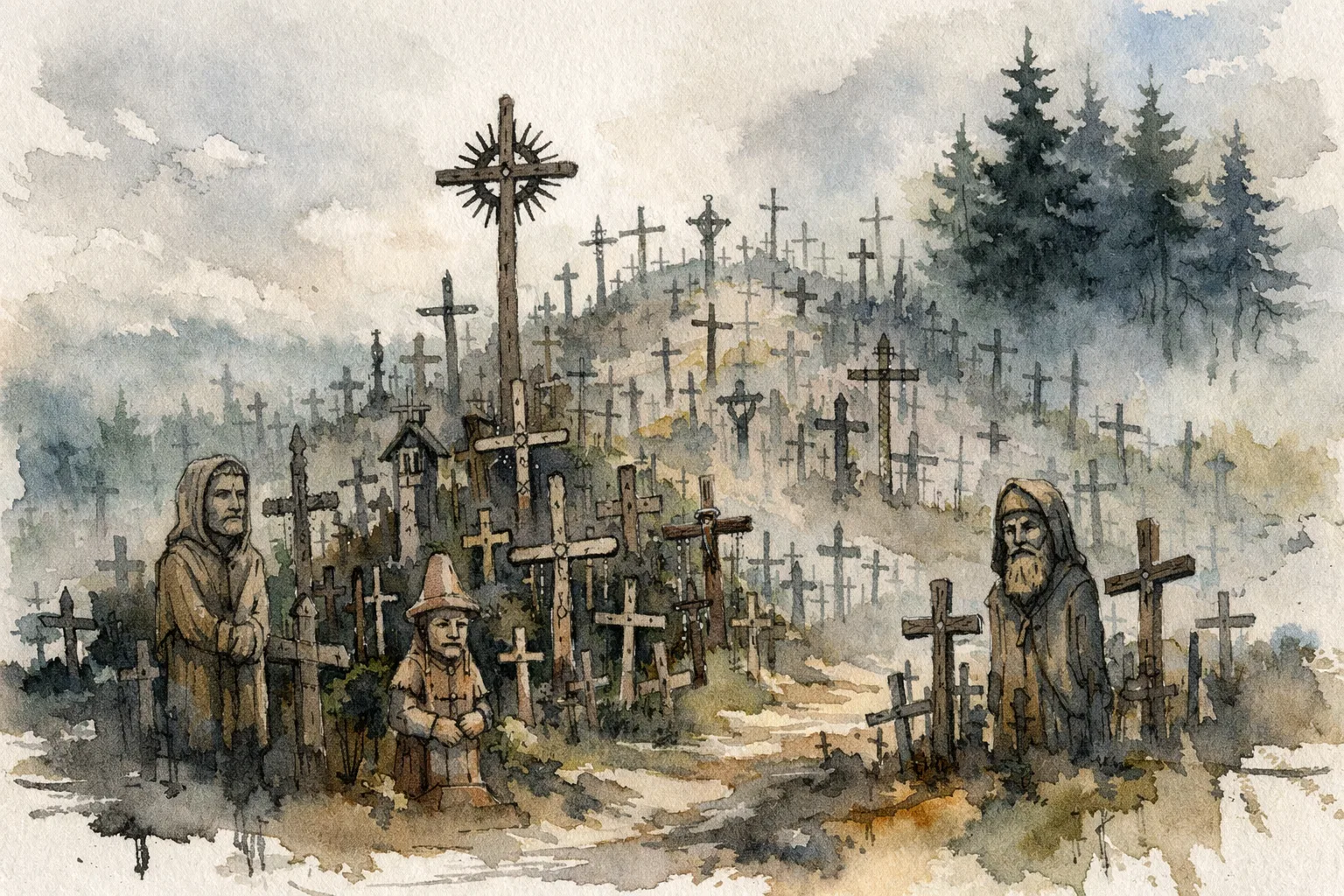
The Hill of Crosses near Šiauliai is one of Lithuania’s most famous uncanny landscapes, though its strangeness is devotional and political rather than ghostly. The site’s official history says crosses there were first mentioned in written chronicles in 1850, while tradition links the first crosses to families mourning victims of the 1831 rebellion, when the tsarist authorities did not allow proper commemoration. The same account says the hill became especially important during Soviet rule, when the authorities treated it as a hostile religious and national symbol.[Kryžių Kalnas]kryziukalnas.ltOpen source on kryziukalnas.lt.
The Fortean pull of the hill lies in repetition. Crosses were removed, burnt, buried, broken up, or bulldozed, yet they kept returning. The site’s own history records that more than 5,000 crosses were demolished in 1961, another 1,200 by 1975, and that during 1973–75 hundreds were removed each year. Roads were blocked, the area was guarded by the Soviet army and KGB, and there were even attempts to flood the territory; still, crosses reappeared after nightfall.[Kryžių Kalnas]kryziukalnas.ltOpen source on kryziukalnas.lt.
A sceptical reading does not need to invoke miracles to find the story powerful. The “uncanny” element is social: a landscape behaving like a rumour that cannot be suppressed. UNESCO’s listing of Lithuanian cross-crafting and its symbolism notes that the symbolic role of crosses was reinforced under Soviet rule despite official bans. The result is a site where folk art, mourning, pilgrimage and national endurance overlap so tightly that the place feels legendary even when every part of the story is historically human.[UNESCO ICH]ich.unesco.orgOpen source on unesco.org.
Devils, helpers and the practical supernatural
Lithuanian folklore is full of beings that are not easily sorted into “good” and “evil”. This is especially true of the devil figure, which is one reason Kaunas has such an apt museum for the country’s weird side. The Devils Museum grew from the private collection of artist Antanas Žmuidzinavičius, who began collecting devil figures in 1906 after receiving a wooden devil sculpture; according to the museum, a priest later gave him an 18th-century sculpture of Saint Michael trampling the devil, but cut off the saint and brought only the devil because the full object was too large.[ciurlionis.lt]ciurlionis.ltDevil CollectionDevil Collection
That detail is comic, grotesque and very Lithuanian in tone. The devil is not merely a horned villain borrowed from church art. In folk narratives he can be foolish, crafty, dangerous, ridiculous, rural and surprisingly close to ordinary life. The museum’s existence turns a feared figure into something collectable, theatrical and culturally self-aware.
Another revealing figure is Aitvaras, a fortune-bringing but morally ambiguous household spirit. The Money Museum of the Bank of Lithuania describes Aitvaras as appearing in forms such as a fiery flying snake, black rooster, black crow, dragon or whirlwind. It may bring fortune to good or mistreated people, but it can also punish, cause fires or destroy crops by becoming a whirlwind.[pinigumuziejus.lt]pinigumuziejus.ltAncient Baltic deities that brought fortune to people | Money MuseumAncient Baltic deities that brought fortune to people | Money Museum
That ambiguity is classic Fortean material. A strange light, a sudden wind, unexplained wealth or a fire in the yard can be pulled into the same explanatory field. Believers may see agency. Sceptics may see weather, gossip, theft, class resentment or cautionary storytelling. Either way, the tale is doing real social work: it explains luck, warns against greed and turns invisible household anxiety into a being with habits.
Children, fear and the creatures at the edge of home
Some Lithuanian supernatural traditions were not about distant ruins or wild forests, but about child safety. Vita Džekčioriūtė-Medeišienė’s study of child-threatening mythical creatures in traditional Lithuanian culture uses archival material from the late 19th century and first half of the 20th century. It distinguishes between threats adults appear to have taken seriously and “constructed” threats used to frighten children into safer behaviour.[Academy's Library Repository]real.mtak.huAcademy's Library Repository
One example is Laumė, described in that study as a feminine mythical creature associated with water and somewhat similar to fairies. In some traditions, Laumė, devils or witches might harm newborns or even replace a baby with one of their own, which explains why infants were not supposed to be left alone.[Academy's Library Repository]real.mtak.huAcademy's Library Repository
Modern readers may recognise the pattern even without sharing the belief. Folklore turns real hazards into memorable figures. Water, night, illness, childbirth, isolation and neglect become stories about beings that lurk, steal or punish. The result is not “evidence” for a creature, but evidence for a culture’s risk map: what adults feared, what children were warned against, and how the home itself could become uncanny after dark.
Witches’ hills and folklore you can walk through
Lithuania’s witch traditions are especially tied to hills. A recent study of Lithuanian folk legends of the witches’ sabbath identifies Šatrija Hill as the traditional site associated with such gatherings in both folk legends and witchcraft-trial documents. The study analyses 99 legends from the Lithuanian Folklore Archives and argues that the distinctive Lithuanian feature is not just the European witch motif of flight, devil worship or secret assembly, but the strength of the link between these stories and specific landscapes.[publicera.kb.se]publicera.kb.seOpen source on kb.se.
This is a useful corrective to tourist simplifications. A “witch hill” is not merely a spooky attraction. It is a way of pinning invisible disorder to a visible place. If cows stop giving milk, someone falls ill, a person behaves strangely, or a farmhand claims to have seen a nocturnal gathering, the hill becomes a narrative magnet.
The modern Hill of Witches in Juodkrantė shows how such material can be turned into public art. It is an open-air sculpture trail on the Curonian Spit, with wooden figures of witches, devils and other folklore characters. The Neringa Museums description calls it a unique museum of wooden sculptures where devils, witches and folklore figures “reign supreme”, while other accounts place it within a living tradition of Lithuanian woodcarving and midsummer legend.[neringosmuziejai.lt]neringosmuziejai.ltOpen source on neringosmuziejai.lt.
That transformation is important. Lithuania’s supernatural archive is not locked in books. It is walked, carved, photographed and repackaged. Some of the fear has become play; some of the old belief has become heritage. Yet the imagery still works because the figures remain recognisable: the witch on the hill, the devil in the woods, the night path where ordinary rules loosen.
Soviet sky lights and the Palanga connection
Lithuania’s best-known connection to a wider UFO case is the Petrozavodsk phenomenon of 20 September 1977, a large Soviet and northern European wave of strange-light reports. Accounts describe sightings across a huge area, and one report places a sighting over Palanga in Lithuania during the same sequence. The case became significant partly because it fed into Soviet official interest in “anomalous atmospheric phenomena”.[Wikipedia]WikipediaPetrozavodsk phenomenonPetrozavodsk phenomenon
The explanations remain disputed in popular retellings, but the serious lesson is clear: Soviet UFO history sits in a fog of military secrecy, space launches, atmospheric phenomena, censorship and genuine witness confusion. The Committee for Skeptical Inquiry’s account of Soviet state UFO research notes that Soviet investigators recognised three broad categories for such reports: human activity, natural processes in the atmosphere or near space, and extraterrestrial activity. That range is more sober than most later UFO folklore.[Skeptical Inquirer]skepticalinquirer.orgOpen source on skepticalinquirer.org.
For Lithuania, the Palanga report is less a stand-alone alien encounter than a reminder that the country sat inside a larger Soviet information system. A light in the sky could be an astronomical event, a rocket-related effect, a military matter, an atmospheric oddity, or an honest witness report filtered through bureaucracy and rumour.
The 1996 Vilnius police UFO report
Lithuania’s more concrete modern UFO file is the 1996 report of a strange object near Vilnius. A declassified FBIS translation of an ITAR-TASS item says two duty motor police patrol officers saw a spherical, pulsing object on 25 June near the Vilnius–Medininkai road, close to Nemėžis, about 10 km from the capital. The report says the object hovered 20–30 metres above the ground, made an electric or electronic crackling sound, moved away as the officers approached, rose and departed towards Vilnius.[documents2.theblackvault.com]documents2.theblackvault.comOpen source on theblackvault.com.
The same document reports that rapid-reaction forces, sniffer dogs and police reinforcements arrived; officials measured background radiation, recorded the continuing sound, found no suspicious object, and noted flattened grass in a radius of about 10 metres. It also says Lithuanian scientists had not yet expressed an opinion, while a police commissioner stated that the two officers were psychologically healthy and not known as cranks.[documents2.theblackvault.com]documents2.theblackvault.comOpen source on theblackvault.com.
This is exactly the kind of case that attracts believers and frustrates sceptics. It has named witnesses, official response, a location, physical traces of a sort, and no tidy published resolution in the document. But it is still a translated press report, not a full scientific investigation. The possible explanations range from misidentified equipment or balloons to a hoax, an atmospheric electrical event, military activity, or an unknown but ordinary object. Its value is not that it proves a UFO was extraordinary. Its value is that it shows how quickly a local anomaly can become an official incident when police, borders and public order are involved.
When “mystery objects” are balloons, smuggling and politics
Lithuania’s recent balloon incidents show why Fortean sky reports need caution. In 2025, Reuters reported that smuggling balloons from Belarus repeatedly disrupted Lithuanian airspace and forced closures at Vilnius airport. Lithuanian authorities said the balloons were being used to carry cheap Belarusian cigarettes into Lithuania and described the pattern as a “hybrid attack”; Belarus denied responsibility and accused Lithuania of exaggeration.[Reuters]reuters.comLithuania declares state of emergency over balloons from Belarus | ReutersLithuania declares state of emergency over balloons from Belarus | Reuters
Reuters’ explainer says these high-altitude helium or hydrogen balloons can pass over the border at about 3–4 kilometres, with smugglers tracking and directing them to land. A typical balloon may carry 500 to 1,500 packs of cigarettes, while their flight height can overlap with aircraft approach paths, creating a civil-aviation hazard. Since October 2025, Reuters reported, Vilnius airport had been closed for more than 60 hours because of the threat, affecting more than 350 flights and about 51,000 passengers.[Reuters]reuters.comOpen source on reuters.com.
This is not paranormal, but it belongs in a Lithuania Forteana page because it demonstrates a recurring rule: the sky is socially interpreted. A light or object is never just visual data. It arrives inside a political moment, a border problem, a media cycle and a set of fears. Today’s “unidentified object” may be tomorrow’s contraband balloon.
Real falls from the sky
Lithuania does have verified falls from the sky, but they are meteorites rather than frogs, fish or miracle objects. The Meteoritical Bulletin lists Padvarninkai as an official meteorite name, an observed fall in Lithuania in 1929, with a mass of 3.86 kg and classification as a eucrite-mmict, a type of stony meteorite.[LPI]lpi.usra.eduLPIMeteoritical Bulletin: Entry for PadvarninkaiLPIMeteoritical Bulletin: Entry for Padvarninkai
The Nature Research Centre in Lithuania says its meteorite collection includes 26 unique specimens, with the best-known Lithuanian examples being the Andrioniškis meteorite that fell in Anykščiai District in 1929 and fragments of the Žemaitkiemis meteorite found in Ukmergė District in 1933.[Gamtos tyrimų centras]gamtostyrimai.ltGamtos tyrimų centras Collection of MeteoritesGamtos tyrimų centras Collection of Meteorites
For Fortean readers, this is a useful distinction. “Falls from the sky” are a classic strange-report category, but not every fall is anomalous. Meteorites are rare, dramatic and scientifically real. They can generate rumours because witnesses hear explosions, see fireballs or find odd stones, but they also leave physical evidence that can be catalogued, classified and compared. Lithuania’s meteorites are therefore a grounded counterpart to its more elusive sky stories.
What is missing is almost as revealing
Compared with some countries, Lithuania does not have a globally dominant lake monster, a single famous phantom animal or a heavily documented “rain of animals” case in the strongest accessible sources. That absence should not be padded into false drama. Lithuania’s weird-history record is strongest where folklore, sacred geography and political history overlap.
The country’s strange material is less about isolated monsters and more about thresholds: the forest edge, the hilltop, the nursery, the cross-covered mound, the border road at night, the airport approach path. Those are places where ordinary life meets uncertainty. In older stories, the uncertainty becomes a devil, witch, household spirit or dangerous fairy-like being. In modern records, it becomes an official UFO report, a misidentified aerial object, a security alert or a news story about balloons.
Why Lithuania’s Forteana still has cultural pull
Lithuanian Forteana endures because it does not sit neatly on one shelf. It is part folklore, part religious practice, part national memory, part Soviet archive and part modern airspace problem. The same country can give us sacred groves, a museum full of devils, witch hills, an official-looking UFO file, and meteorites with catalogue entries.
The most honest reading is neither credulous nor dismissive. Many Lithuanian strange reports are best understood as legends, testimony, ritual memory, misidentification, politics or unresolved local episodes. But that does not make them worthless. They show how people make sense of fear, luck, loss, oppression and the sky. In Lithuania, the weird is often less a break from history than a way history keeps speaking after dark.
Endnotes
1.
Source: folklore.ee
Title: vrvflore42.PM D
Link:https://www.folklore.ee/folklore/vol42/vaitkevicius.pdf
2.
Source: ich.unesco.org
Link:https://ich.unesco.org/en/RL/cross-crafting-and-its-symbolism-00013
3.
Source: ciurlionis.lt
Title: Devil Collection
Link:https://ciurlionis.lt/activity/permanent-exhibitions/velniu-kolekcija-en/
4.
Source: pinigumuziejus.lt
Title: Ancient Baltic deities that brought fortune to people | Money Museum
Link:https://www.pinigumuziejus.lt/en/news/ancient-baltic-deities-that-brought-fortune-to-people
5.
Source: real.mtak.hu
Title: Academy’s Library Repository
Link:https://real.mtak.hu/128222/1/article-p425.pdf
6.
Source: publicera.kb.se
Link:https://publicera.kb.se/arv/article/view/48457
7.
Source: neringosmuziejai.lt
Link:https://www.neringosmuziejai.lt/en/hill-of-witches/
8.
Source: Wikipedia
Title: Petrozavodsk phenomenon
Link:https://en.wikipedia.org/wiki/Petrozavodsk_phenomenon
9.
Source: documents2.theblackvault.com
Link:https://documents2.theblackvault.com/documents/cia/ufos/C05516234.pdf
10.
Source: reuters.com
Title: Lithuania declares state of emergency over balloons from Belarus | Reuters
Link:https://www.reuters.com/world/lithuania-declares-state-emergency-over-smuggler-balloons-belarus-2025-12-09/
11.
Source: reuters.com
Link:https://www.reuters.com/world/why-are-smuggling-balloons-closing-down-lithuanias-main-airport-2025-10-29/
12.
Source: lpi.usra.edu
Title: LPIMeteoritical Bulletin: Entry for Padvarninkai
Link:https://www.lpi.usra.edu/meteor/metbull.php?code=18069
13.
Source: Wikipedia
Title: List of reported UFO sightings
Link:https://en.wikipedia.org/wiki/List_of_reported_UFO_sightings
14.
Source: Wikipedia
Title: Lithuanian mythology
Link:https://en.wikipedia.org/wiki/Lithuanian_mythology
15.
Source: Wikipedia
Title: Lake monster
Link:https://en.wikipedia.org/wiki/Lake_monster
16.
Source: Wikipedia
Title: List of Lithuanian gods and mythological figures
Link:https://en.wikipedia.org/wiki/List_of_Lithuanian_gods_and_mythological_figures
17.
Source: Wikipedia
Link:https://en.wikipedia.org/wiki/%C5%BDmuidzinavi%C4%8Dius_Museum
18.
Source: Wikipedia
Title: Hill of Crosses
Link:https://en.wikipedia.org/wiki/Hill_of_Crosses
19.
Source: Wikipedia
Title: Rain of animals
Link:https://en.wikipedia.org/wiki/Rain_of_animals
20.
Source: Wikipedia
Title: Category:Meteorites found in Lithuania
Link:https://en.wikipedia.org/wiki/Category%3AMeteorites_found_in_Lithuania
21.
Source: Wikipedia
Title: Padvarninkai meteorite
Link:https://en.wikipedia.org/wiki/Padvarninkai_meteorite
22.
Source: Wikipedia
Link:https://en.wikipedia.org/wiki/Werewolf
23.
Source: Wikipedia
Title: Hill of Witches
Link:https://en.wikipedia.org/wiki/Hill_of_Witches
24.
Source: publicera.kb.se
Link:https://publicera.kb.se/arv/article/download/48457/50728/160828
25.
Source: publicera.kb.se
Link:https://publicera.kb.se/arv/article/view/48457/50728
26.
Source: publicera.kb.se
Link:https://publicera.kb.se/arv/issue/current
27.
Source: reuters.com
Title: lithuania again shuts vilnius airport due balloons airspace 2025 10 25
Link:https://www.reuters.com/world/europe/lithuania-again-shuts-vilnius-airport-due-balloons-airspace-2025-10-25/
28.
Source: reuters.com
Title: lithuanias vilnius airport closes again due balloons 2025 11 23
Link:https://www.reuters.com/world/europe/lithuanias-vilnius-airport-closes-again-due-balloons-2025-11-23/
29.
Source: reuters.com
Title: lithuania will reopen belarus border after balloon incidents 2025 11 19
Link:https://www.reuters.com/world/lithuania-will-reopen-belarus-border-after-balloon-incidents-2025-11-19/
30.
Source: reuters.com
Link:https://www.reuters.com/world/lithuanias-vilnius-airport-closes-again-due-balloons-local-authorities-say-2025-11-20/
31.
Source: meteoritical.org
Link:https://meteoritical.org/publications/meteoritical-bulletin
32.
Source: meteoritical.org
Link:https://meteoritical.org/meteorites
33.
Source: unknown.lt
Link:https://www.unknown.lt/en/location/hill-of-witches
34.
Source: ia600809.us.archive.org
Link:https://ia600809.us.archive.org/21/items/algirdas-j.-greimas-of-gods-and-men-studies-in-lithuanian-mythology-midland-book/Algirdas%20J.%20Greimas%20-%20Of%20Gods%20and%20Men_%20Studies%20in%20Lithuanian%20Mythology%20%28Midland%20Book%29-Indiana%20University%20Press%20%281992%29.pdf
35.
Source: meteorites.ru
Link:https://www.meteorites.ru/menu/collection-e/collect-e_p.html
36.
Source: kryziukalnas.lt
Link:https://kryziukalnas.lt/?id=44
37.
Source: skepticalinquirer.org
Link:https://skepticalinquirer.org/newsletter/history-of-state-ufo-research-in-the-ussr/
38.
Source: gamtostyrimai.lt
Title: Gamtos tyrimų centras Collection of Meteorites
Link:https://gamtostyrimai.lt/en/mineral-museum/collection-of-meteorites/
39.
Source: cia.gov
Link:https://www.cia.gov/readingroom/docs/DOC_0000098713.pdf
40.
Source: cia.gov
Title: FOIA CASE LOG CALENDER YE[16111550]
Link:https://www.cia.gov/readingroom/docs/FOIA%20CASE%20LOG%20CALENDER%20YE%5B16111550%5D.pdf
41.
Source: cia.gov
Link:https://www.cia.gov/readingroom/document/06935701
42.
Source: cia.gov
Title: DOC 0005517761
Link:https://www.cia.gov/readingroom/docs/DOC_0005517761.pdf
43.
Source: insu.hal.science
Link:https://insu.hal.science/insu-04241898/document
44.
Source: publicwitness.wordandway.org
Title: hill of crosses
Link:https://publicwitness.wordandway.org/p/hill-of-crosses
45.
Source: distancefromnormal.com
Title: the devils museum
Link:https://distancefromnormal.com/2020/01/30/the-devils-museum/
46.
Source: icq.eps.harvard.edu
Link:https://www.icq.eps.harvard.edu/meteorites.html
47.
Source: russiasperiphery.pages.wm.edu
Title: the hill of crosses
Link:https://russiasperiphery.pages.wm.edu/baltic-states/lithuania/general/the-hill-of-crosses/
48.
Source: wiki.meteoritica.pl
Link:https://wiki.meteoritica.pl/index.php5/Padvarninkai
49.
Source: galactic-stone.com
Link:https://galactic-stone.com/pages/falls
50.
Source: marcogehlhar.it
Title: The Hill of Crosses
Link:https://marcogehlhar.it/the-hill-of-crosses
Additional References
51.
Source: youtube.com
Title: The Most Cursed Sculpture Garden in Europe | Hill of Witches
Link:http://www.youtube.com/watch?v=CjtB4rxZ7AM
Source snippet
Lithuania folklore legends hill of crosses devil museum Tour of the Hill of crosses (Kryžių kalnas) Lithuania, UNESCO Escapethecouch...
52.
Source: youtube.com
Title: Neringa Spit & Witches Hill: Lithuania’s Legendary Forest of Devils & Witches
Link:http://www.youtube.com/watch?v=W8WEsZbhy1E
Source snippet
The Most Cursed Sculpture Garden in Europe | Hill of Witches...
53.
Source: youtube.com
Title: Tour of the Hill of crosses (Kryžių kalnas) Lithuania, UNESCO
Link:http://www.youtube.com/watch?v=CLdxICn2bP0
Source snippet
Neringa Spit & Witches Hill: Lithuania’s Legendary Forest of Devils & Witches...
54.
Source: loc.gov
Link:https://www.loc.gov/everyday-mysteries/browse-all-questions/item/can-it-rain-frogs-fish-and-other-objects/
55.
Source: youtube.com
Title: The Slow Death of European Paganism | Converting Lithuania
Link:http://www.youtube.com/watch?v=M1xUW3qOcSc
Source snippet
Tour of the Hill of crosses (Kryžių kalnas) Lithuania, UNESCO...
56.
Source: facebook.com
Link:https://www.facebook.com/TimesofIndia/posts/lithuania-has-declared-a-state-of-emergency-following-repeated-air-traffic-disru/1275257517981766/
57.
Source: instagram.com
Link:https://www.instagram.com/reel/DR1YYPdDET5/?hl=en
58.
Source: academia.edu
Link:https://www.academia.edu/30015577/Sacred_Sites
59.
Source: researchgate.net
Link:https://www.researchgate.net/publication/269607076_Ancient_Sacred_Places_in_Lithuania_Crossroads_of_Geography_Archaeology_and_Folklore
60.
Source: researchgate.net
Link:https://www.researchgate.net/publication/339503878_Witchcraft_Court_Cases_in_the_Grand_Duchy_of_Lithuania_in_the_Sixteenth_to_Eighteenth_Centuries

Topic Tree
Follow this branch
Related pages 192
- Afghan Forteana
- Antigua Uncanny
- Bosnian Mysteries
- Botswana Weird
- Brazil Strange
- +187 more in sidebar