Within Dominica Weird
Why Do Dominica's Old Stories Warn Against Night?
Dominica's spirit traditions connect forests, crossroads and night travel with older Kalinago, African and Creole ways of reading danger.
On this page
- Kalinago storytelling and living landscape
- Jumbies, Diab, soucouyant and La Diablesse
- Folklore as caution rather than simple superstition
Page outline Jump by section
Introduction
Dominica’s stories about the night are less concerned with proving that ghosts exist than with teaching people how to move through a demanding landscape. In Kalinago tradition and the island’s wider Creole folklore, darkness changes the meaning of forests, rivers, crossroads and lonely roads. A traveller who ignores old warnings may become lost, frightened or vulnerable, whether because of spirits, wild terrain or poor judgement. That blend of practical caution and supernatural storytelling is what gives Dominica’s night lore its lasting power. Rather than existing as a separate world of fantasy, these tales sit alongside everyday life, preserving memories of the island’s Indigenous heritage, African traditions, French Creole influences and Christian beliefs.[dominicahighcommission.co.uk]dominicahighcommission.co.ukthe kalinago peopleDominica High CommissionThe Kalinago PeopleThe hunter-gatherer Ortoiroid people settled Dominica from about 3000bc to 400bc, to the moder…

Kalinago storytelling and the living landscape
For the Kalinago people, the landscape has long been understood as more than scenery. Mountains, rivers, caves and forests are places where ancestral memory, respect for nature and spiritual awareness meet. Stories passed between generations often encourage listeners to treat the natural world with humility rather than conquest, especially after sunset when familiar landmarks become harder to read and danger increases.[Dominica High Commission]dominicahighcommission.co.ukthe kalinago peopleDominica High CommissionThe Kalinago PeopleThe hunter-gatherer Ortoiroid people settled Dominica from about 3000bc to 400bc, to the moder…
Modern efforts to preserve Kalinago heritage continue to present these traditions as living culture rather than relics of the past. Educational projects developed with Kalinago elders include stories in which spirits, sacred places and symbolic animals guide young people through moral tests. The supernatural elements are not presented simply as horror stories but as lessons about courage, environmental responsibility, respect for elders and proper conduct.[Unsouth South]unsouthsouth.orgUnsouth SouthJEWEL KALINAGO OF THE THEThe Jewel of the Kalinago is a comic book for young children and students. The story is anchored on…
Night occupies a special place within this storytelling. Dense rainforest can quickly become disorientating after dark, while rivers, ravines and steep slopes pose genuine hazards. Folklore therefore reinforces sensible behaviour: avoid wandering alone, respect places associated with ancestors and think carefully before entering unfamiliar forest at night. In that sense, the stories preserve practical knowledge as much as spiritual belief.[Dominica High Commission]dominicahighcommission.co.ukthe kalinago peopleDominica High CommissionThe Kalinago PeopleThe hunter-gatherer Ortoiroid people settled Dominica from about 3000bc to 400bc, to the moder…
Jumbies, Diab, soucouyant and La Diablesse
As African, Indigenous, French and later Christian traditions blended, Dominica developed a Creole spirit world shared in broad outline with neighbouring Caribbean islands but shaped by local places and storytelling.
Among the best-known figures are:
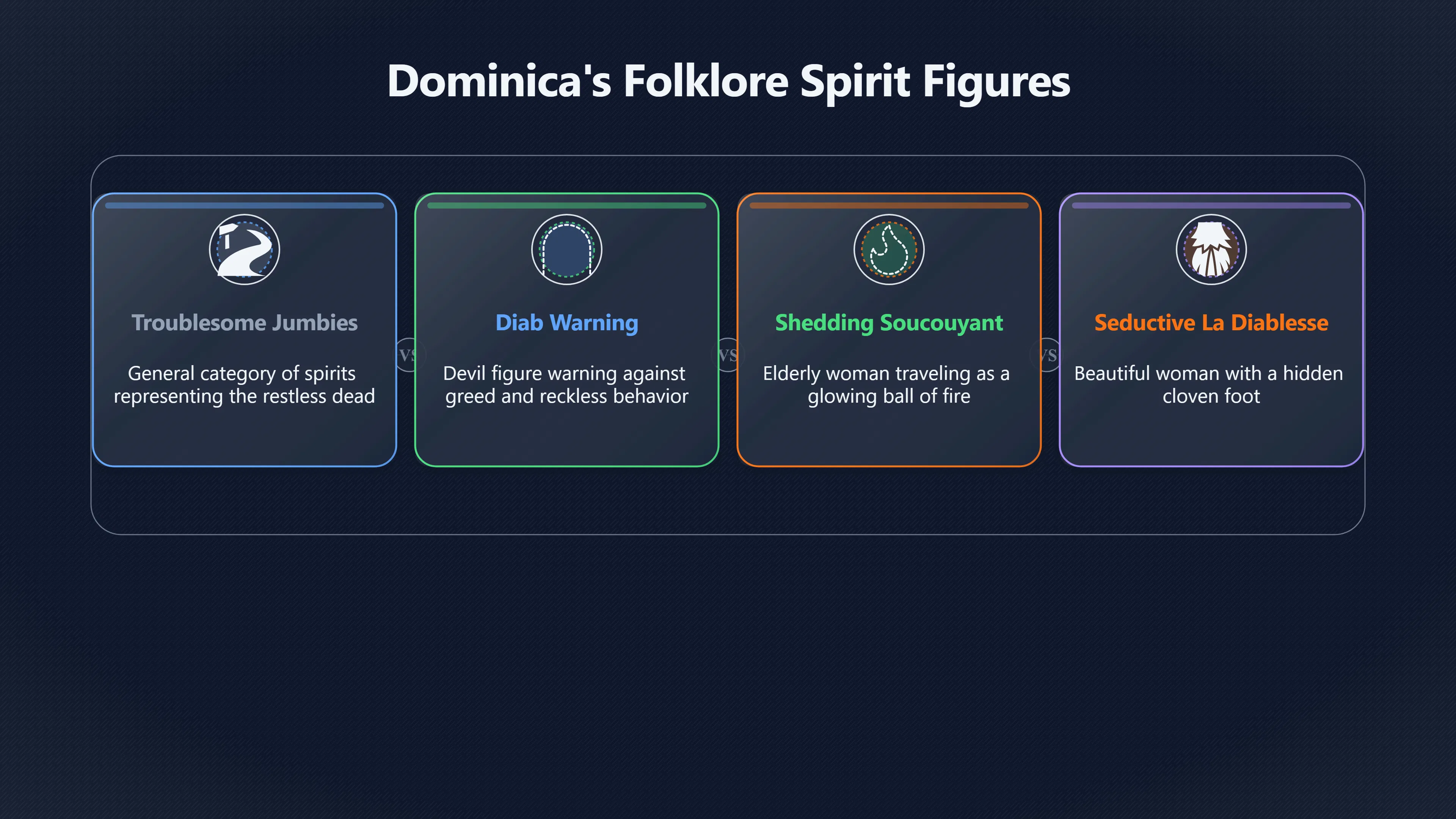
- Jumbies are the most general category of troublesome spirits. A jumbie may represent the restless dead, an unseen presence on lonely roads or simply an unexplained encounter. The word covers many different supernatural beings rather than a single creature, and stories often describe travellers feeling watched or being led astray after dark.[Wikipedia]WikipediaOpen source on wikipedia.org.
- The Diab, or Devil, appears in numerous Dominican tales as a warning against temptation, greed or reckless behaviour. Rather than elaborate theological figures, these stories usually place evil close to everyday life, especially on isolated roads or at lonely crossroads after sunset.[DOM767]dom767.comCultural ExperiencesTales of mythical creatures like the Soucouyant and La Diablesse blend African and European mythologies, reflec…
- The soucouyant is one of the Caribbean’s most famous supernatural figures. Usually described as an elderly woman who sheds her skin at night and travels as a glowing ball of fire before feeding on sleeping victims, the soucouyant appears across several islands, including Dominica. Modern researchers generally treat the figure as a fusion of West African beliefs with French Caribbean folklore rather than evidence of a uniquely Dominican creature.[Wikipedia]WikipediaOpen source on wikipedia.org.
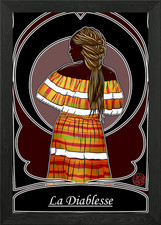
- La Diablesse is portrayed as a beautiful woman who conceals a cloven foot beneath elegant clothing. She charms unwary men before leading them away from the safety of the road into forests, ravines or other dangerous places. Variations occur throughout the French-speaking Caribbean, but Dominican retellings naturally relocate her into the island’s mountainous terrain.[Wikipedia]WikipediaLa DiablesseLa Diablesse
These figures are not isolated inventions. They belong to a wider Caribbean tradition in which stories travelled between islands with enslaved Africans, Indigenous communities, colonial settlers and later Creole society. Dominica’s versions remain distinctive because they are consistently tied to its steep forests, narrow roads and volcanic landscape rather than anonymous haunted locations.[Caribbean Authors]caribbeanauthors.wordpress.coma little about caribbean folkloreFor example, Anansi, the spider, the weaver of webs and stories is West African in origin.Read more…

Why are crossroads and forests so often feared?
Many Dominican stories begin with an ordinary journey that becomes strange after sunset. A familiar path suddenly seems unfamiliar. A traveller hears footsteps with no visible companion. Someone becomes convinced they have walked in circles despite knowing the route well.
Believers may interpret such experiences as encounters with spirits or places where supernatural forces are especially active. Sceptics point instead to well-understood psychological effects: darkness reduces visual information, unfamiliar sounds become easier to misinterpret, fatigue impairs judgement and dense rainforest can create powerful feelings of isolation. In mountainous country, losing a path after sunset can become genuinely dangerous without requiring any paranormal explanation.
The folklore works precisely because these natural experiences are common enough to feel believable. Instead of competing with reality, the stories attach moral and spiritual meaning to experiences that many travellers recognise.[Caribbean Authors]caribbeanauthors.wordpress.coma little about caribbean folkloreFor example, Anansi, the spider, the weaver of webs and stories is West African in origin.Read more…
Folklore as caution rather than simple superstition
One common misunderstanding is that Caribbean spirit stories were intended only to frighten children. In reality, they often performed several social functions at once.
They could:
- discourage unnecessary travel after dark;
- warn young people about strangers or risky behaviour;
- encourage respect for elders’ advice;
- reinforce care for forests, rivers and sacred places;
- preserve older Indigenous and African ideas beneath later Christian language.
Seen this way, a story about La Diablesse luring travellers into the forest also discourages reckless night journeys. Tales about jumbies haunting isolated roads encourage people to travel together. Accounts of mysterious lights or unseen presences remind listeners that nature deserves caution even when no spirit appears.[unsouthsouth.org]unsouthsouth.orgUnsouth SouthJEWEL KALINAGO OF THE THEThe Jewel of the Kalinago is a comic book for young children and students. The story is anchored on…
Why the stories still matter
Modern Dominica is a country of mobile phones, paved roads and expanding tourism, yet traditional night lore has not disappeared. Storytelling festivals, cultural organisations and Kalinago heritage projects continue to present these traditions as part of the island’s identity rather than embarrassing relics of the past. Visitors may hear references to jumbies or La Diablesse alongside practical advice about travelling safely through remote valleys after dark.[dominicahighcommission.co.uk]dominicahighcommission.co.ukthe kalinago peopleDominica High CommissionThe Kalinago PeopleThe hunter-gatherer Ortoiroid people settled Dominica from about 3000bc to 400bc, to the moder…
For students of Fortean history, this makes Dominica especially interesting. The island offers relatively few famous ghost cases investigated by paranormal researchers, but it preserves something arguably more valuable: a living body of oral tradition in which Indigenous memory, Creole culture and the realities of a rugged landscape continue to shape how people think about the night. The enduring mystery lies not in proving whether spirits exist, but in understanding why these stories remain meaningful long after the conditions that first inspired them have changed.
Amazon book picks
Further Reading
Books and field guides related to Why Do Dominica's Old Stories Warn Against Night?. Use these as the next step if you want deeper reading beyond the article.
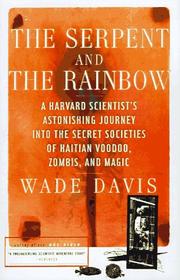
The Serpent and the Rainbow
Directly complements Caribbean beliefs about spirits and the unseen.

The hero with a thousand faces
Useful for readers interested in symbolic folklore themes.

The Rough Guide to The Caribbean
Adds cultural context for Dominica and neighboring islands.

eBay marketplace picks
Marketplace Samples
Live-tested eBay searches with available results related to this page.
Endnotes
1.
Source: dom767.com
Link:https://www.dom767.com/dompedia/dominica-cultural-experiences/
Source snippet
Cultural ExperiencesTales of mythical creatures like the Soucouyant and La Diablesse blend African and European mythologies, reflec...
2.
Source: Wikipedia
Link:https://en.wikipedia.org/wiki/Jumbee
3.
Source: Wikipedia
Link:https://en.wikipedia.org/wiki/Soucouyant
4.
Source: Wikipedia
Title: La Diablesse
Link:https://en.wikipedia.org/wiki/La_Diablesse
5.
Source: dominicahighcommission.co.uk
Title: the kalinago people
Link:https://www.dominicahighcommission.co.uk/the-kalinago-people.html
Source snippet
Dominica High CommissionThe Kalinago PeopleThe hunter-gatherer Ortoiroid people settled Dominica from about 3000bc to 400bc, to the moder...
6.
Source: caribbeanauthors.wordpress.com
Title: a little about caribbean folklore
Link:https://caribbeanauthors.wordpress.com/2021/10/01/a-little-about-caribbean-folklore/
Source snippet
For example, Anansi, the spider, the weaver of webs and stories is West African in origin.Read more...
7.
Source: unsouthsouth.org
Link:https://unsouthsouth.org/wp-content/uploads/2023/02/Dominica-Comic-Book_FINAL-1.pdf
Source snippet
Unsouth SouthJEWEL KALINAGO OF THE THEThe Jewel of the Kalinago is a comic book for young children and students. The story is anchored on...
Additional References
8.
Source: youtube.com
Link:https://www.youtube.com/watch?v=zvXKJfCwwmM
Source snippet
Caribbean Stories|Fact or Folklore | S1: E1| La DiablesseLa Diablesse - (Lajables), the Devil Woman Many tall tales, stories and true tru...
9.
Source: uwispace.sta.uwi.edu
Link:https://uwispace.sta.uwi.edu/bitstreams/b55d4d5b-baa7-4d42-84ef-bdf2dcac92fe/download
Source snippet
Studies Project HUMN 3099 - UWISpaceIn his very short story “Jumbie Chase Me”, Keens-Douglas references the Jumbie and La...
10.
Source: facebook.com
Link:https://www.facebook.com/groups/269202760462518/posts/1551627458886702/
Source snippet
he temptress and seductress whose wiles would entrap any...Read more...
11.
Source: facebook.com
Link:https://www.facebook.com/NALISDebeTT/posts/trinidad-and-tobago-possesses-its-unique-and-intriguing-mix-of-folklore-and-lege/189370572690348/
Source snippet
So in 2019 on my trip to Martinique my friend...Read more...
12.
Source: explorersweb.com
Title: guide caribbean folklore
Link:https://explorersweb.com/guide-caribbean-folklore/
Source snippet
A Guide to Caribbean Folklore14 Feb 2023 — La Diablesse is a seductive beauty, looking to cause trouble and often death to any naive man...
13.
Source: youtube.com
Title: Unveiling the Kalinago: The Untold Pre-Columbian Legacy of Dominica
Link:https://www.youtube.com/watch?v=kvMDypkJvoI
Source snippet
How the Caribbean Indigenous Survived Colonization: The Kalinago, Garifuna and Taino...
14.
Source: youtube.com
Link:https://www.youtube.com/watch?v=qaEE8l_MSVA
Source snippet
The Kalinagos of Dominica...
15.
Source: youtube.com
Title: The Kalinagos of Dominica
Link:https://www.youtube.com/watch?v=3sDXrwdt-cQ
Source snippet
Beautiful Dominica: Creole Culture | LargeUp TV...
16.
Source: youtube.com
Title: Beautiful Dominica: Creole Culture | Large Up TV
Link:https://www.youtube.com/watch?v=rG9yNbTdJw0
Source snippet
Celebrating the First People...
17.
Source: youtube.com
Title: Celebrating the First People!
Link:https://www.youtube.com/watch?v=y6BAre-U3sM
Topic Tree