Within New Zealand Weird
Could New Zealand Hide Mystery Animals?
The waitoreke and Fiordland moose show how animal reports can hover between folklore, misidentification and genuine field curiosity.
On this page
- The waitoreke and the almost mammal less islands
- Fiordland moose and survival rumours
- Misidentification, tracks and why the stories persist
Page outline Jump by section
Introduction
New Zealand has remarkably few native land mammals, making every report of an unexpected four-legged creature seem more significant than it might elsewhere. That unusual ecology has helped create two of the country’s most enduring mystery-animal stories: the waitoreke, an elusive otter-like creature said to haunt South Island waterways, and the supposed survival of North American moose in the vast wilderness of Fiordland. Neither case has produced evidence accepted by mainstream zoology, yet neither has entirely disappeared from public discussion. Together they illustrate how folklore, genuine natural-history puzzles, difficult terrain and occasional tantalising clues can blur the boundary between legend and scientific curiosity.

Unlike many cryptid traditions, these stories are rooted in real ecological questions. Could a small native mammal have escaped scientific notice? Could a tiny introduced population survive undetected in one of the world’s least accessible temperate forests? The available evidence suggests caution rather than certainty, but the questions remain culturally fascinating precisely because they are not entirely absurd.
The waitoreke and the almost mammal-less islands
The waitoreke, sometimes called the New Zealand otter or South Island otter, occupies an unusual place in New Zealand folklore. Descriptions generally agree on a small, brown, short-legged animal living around rivers and lakes, with habits resembling an otter more than a seal. Reports were concentrated in parts of the South Island, particularly remote wetlands and forested waterways. Early Māori traditions included references to such an animal, although modern scholars disagree over whether these accounts describe a distinct creature, an unfamiliar seal encountered inland, or stories that changed over time.[New Zealand Ecological Society]newzealandecology.orgNew Zealand Ecological Society- A REASSESSMENTAugust 24, 2004 — The waitoreke, or supposed South Island otter, has remained a mystery for…
European explorers added further intrigue. Members of Captain James Cook’s expedition reported glimpsing an unidentified four-footed animal in Dusky Sound during the eighteenth century, although the expedition’s naturalist, Georg Forster, argued that poor light or mistaken identification was a far more likely explanation. Later nineteenth-century naturalists, including Julius von Haast, believed they had seen tracks or heard convincing testimony from Māori informants, but none succeeded in collecting an animal.[Wikipedia]WikipediaOpen source on wikipedia.org.
The puzzle became especially tempting because New Zealand’s native fauna appears so incomplete by comparison with other large islands. Apart from bats, the country evolved without native terrestrial mammals. To nineteenth-century zoologists, discovering an unknown mammal would have transformed understanding of New Zealand’s natural history.
Yet the physical evidence has always remained frustratingly weak. A skin once attributed to the waitoreke did not clearly match an unknown species and has since been considered more consistent with another animal, possibly an imported specimen or a misidentified marsupial skin. Modern reassessments conclude that although many witness reports were sincere, none provides enough verifiable evidence to establish the existence of a surviving native otter-like mammal.[New Zealand Ecological Society]newzealandecology.orgNew Zealand Ecological Society- A REASSESSMENTAugust 24, 2004 — The waitoreke, or supposed South Island otter, has remained a mystery for…
Fiordland moose and survival rumours
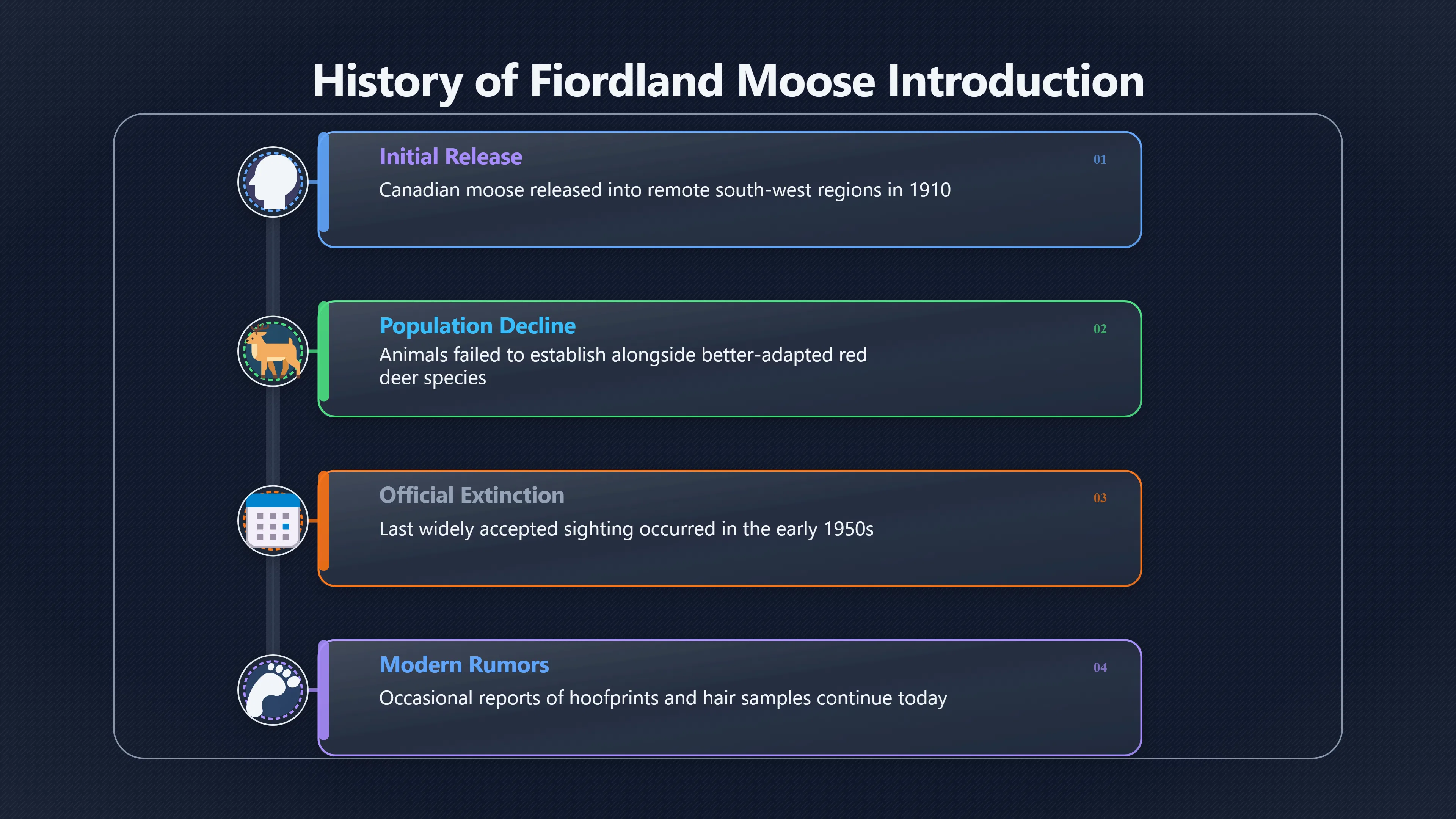
The Fiordland moose story begins with history rather than folklore. In 1910, a small number of Canadian moose were released into the remote south-west of the South Island in an attempt to establish a hunting population. Unlike mythical creatures, these animals unquestionably existed.
Officially, however, they disappeared decades ago. The last widely accepted sighting occurred in the early 1950s, and the population was generally regarded as extinct after failing to establish itself alongside better-adapted red deer.[The Guardian]theguardian.comAlthough the last confirmed sighting occurred in 1951 and they were declared extinct, rumors and anecdotal evidence—including footprints…
What keeps the story alive is the nature of Fiordland itself. The region consists of immense forests, deep valleys, heavy rainfall and limited human access. Even today, large areas receive very little foot traffic. Because the habitat is so difficult to survey, occasional reports continue to emerge of oversized hoofprints, distinctive browsing damage, antlers, hair samples and fleeting sightings by hunters or trampers.[The Guardian]theguardian.comAlthough the last confirmed sighting occurred in 1951 and they were declared extinct, rumors and anecdotal evidence—including footprints…
Some pieces of evidence have attracted genuine scientific attention. Hair collected in Fiordland during the early 2000s was analysed and reported as matching moose DNA, while long-term searchers have argued that tracks, feeding signs and remote-camera images are consistent with a tiny surviving population. Researchers such as biologist Ken Tustin have spent decades documenting these clues, regarding the question as a legitimate field investigation rather than simply a cryptid hunt.[nzgeo.com]nzgeo.comNew Zealand GeographicShadow TheatreBut a request from New Zealand to determine if hair samples collected in Fiordland were from moose ra…
Mainstream wildlife authorities remain unconvinced. A few hairs or ambiguous photographs do not demonstrate the existence of a breeding population, particularly when modern trail cameras have become increasingly widespread. Without repeated photographs, fresh carcasses, living animals or other independently verifiable evidence, the scientific consensus continues to regard New Zealand’s moose as functionally extinct.[The Guardian]theguardian.comAlthough the last confirmed sighting occurred in 1951 and they were declared extinct, rumors and anecdotal evidence—including footprints…
Misidentification, tracks and why the stories persist
The two cases survive for different reasons but share common mechanisms.
The waitoreke is sustained largely by historical testimony. Because no confirmed specimen exists, every report must compete with more ordinary explanations such as:
- seals travelling unusually far inland;
- swimming dogs;
- introduced mammals seen briefly in poor conditions;
- memory shaped by earlier stories;
- genuine but mistaken observations in difficult terrain.
The Fiordland moose story rests on a different foundation. Since moose certainly lived there in the past, modern reports do not require an unknown species—only the survival of an extremely small remnant population. That makes the hypothesis more plausible in principle, but still very difficult to prove.
Tracks provide another example of the problem. Large hoofprints, broken branches and browsing marks can sometimes distinguish one species from another, but weather rapidly alters footprints and several deer species produce overlapping signs. In dense rainforest, isolated clues rarely tell a complete story.[ResearchGate]researchgate.netResearchGate(PDF) Current status of moose in Fiordland, New Zealand22 July 2015 — The sightings, field evidence, video and DNA evidence c…
Remote landscapes also influence human perception. Fiordland’s forests restrict visibility to only a few metres in places, while rivers, mist and heavy rain make brief encounters particularly difficult to interpret. The combination encourages honest uncertainty rather than deliberate fabrication.
Why these stories matter in New Zealand’s strange history
Neither the waitoreke nor the Fiordland moose occupies the same place as famous monsters such as the Loch Ness Monster. Their appeal lies in how close they remain to ordinary zoology.
The waitoreke reflects an older period when New Zealand’s wildlife was still being discovered and mapped. Before species such as the takahē were rediscovered, the possibility that another elusive native animal might survive seemed less far-fetched than it does today. Even now, the legend illustrates how oral tradition, colonial exploration and scientific curiosity interacted during the nineteenth century.[New Zealand Ecological Society]newzealandecology.orgNew Zealand Ecological Society- A REASSESSMENTAugust 24, 2004 — The waitoreke, or supposed South Island otter, has remained a mystery for…
The Fiordland moose story, meanwhile, demonstrates how history can evolve into modern folklore. A documented animal introduction gradually became a mystery after confirmed sightings ceased. Every new footprint or distant glimpse revives the question, while every failed expedition strengthens the sceptical case without entirely extinguishing hope. Recent media attention following new reported sightings shows that public fascination remains remarkably resilient despite the absence of definitive proof.[The Guardian]theguardian.comAlthough the last confirmed sighting occurred in 1951 and they were declared extinct, rumors and anecdotal evidence—including footprints…
Together these cases occupy an unusual middle ground between folklore and field biology. They remind us that remote landscapes can preserve uncertainty for surprisingly long periods, while also showing why extraordinary claims ultimately depend on ordinary evidence. Until that evidence appears, the waitoreke remains a legend shaped by natural history, and the Fiordland moose remains one of New Zealand’s most intriguing unresolved wildlife stories.
Amazon book picks
Further Reading
Books and field guides related to Could New Zealand Hide Mystery Animals?. Use these as the next step if you want deeper reading beyond the article.
The Sixth Extinction
Provides ecological background relevant to species survival debates.
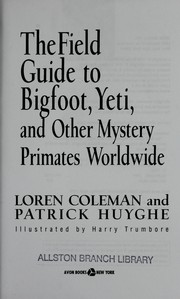
The field guide to Bigfoot, Yeti, and other mystery primates...
Introduces methods for assessing cryptid claims.

Still in Search of Prehistoric Survivors
Explores reports of surviving unusual animals.
eBay marketplace picks
Marketplace Samples
Live-tested eBay searches with available results related to this page.
Endnotes
1.
Source: Wikipedia
Link:https://en.wikipedia.org/wiki/Waitoreke
2.
Source: researchgate.net
Link:https://www.researchgate.net/publication/280239591_Current_status_of_moose_in_Fiordland_New_Zealand
Source snippet
ResearchGate(PDF) Current status of moose in Fiordland, New Zealand22 July 2015 — The sightings, field evidence, video and DNA evidence c...
Published: July 2015
3.
Source: Wikipedia
Link:https://en.wikipedia.org/wiki/Fiordland
Source snippet
Fiordlanda non-administrative geographical region of New Zealand in the south-western corner of the South Island, comprising the weste...
4.
Source: newzealandecology.org
Link:https://newzealandecology.org/nzje/2629/pdf
Source snippet
New Zealand Ecological Society- A REASSESSMENTAugust 24, 2004 — The waitoreke, or supposed South Island otter, has remained a mystery for...
Published: August 24, 2004
5.
Source: theguardian.com
Link:https://www.theguardian.com/world/2025/may/23/new-zealand-moose-mystery-fiordland-national-park
Source snippet
Although the last confirmed sighting occurred in 1951 and they were declared extinct, rumors and anecdotal evidence—including footprints...
6.
Source: nzgeo.com
Link:https://www.nzgeo.com/stories/shadow-theatre/
Source snippet
New Zealand GeographicShadow TheatreBut a request from New Zealand to determine if hair samples collected in Fiordland were from moose ra...
7.
Source: newzealand.com
Link:https://www.newzealand.com/nz/fiordland/
Source snippet
Things to see and do - South Island - New ZealandFiordland is a walking and hiking paradise, and home to three of New Zealand's Great Wal...
8.
Source: nzdacanterbury.org
Title: Fiordland Moose
Link:https://nzdacanterbury.org/fiordland-moose/
Source snippet
New Zealand Deerstalkers' AssociationThe difficulties of tracking and sighting a small population of moose were made even worse by ever p...
9.
Source: cdm20022.contentdm.oclc.org
Link:https://cdm20022.contentdm.oclc.org/digital/collection/p20022coll6/id/103/
Source snippet
in Fiordland - FRI Protection Forestry ReportsEvidence from past records suggests that the moose population has declined and the current...
Additional References
10.
Source: facebook.com
Link:https://www.facebook.com/TheFolklorePodcast/posts/from-the-folklore-of-new-zealand-the-waitoreke-is-a-small-otter-like-creature-wi/1454274073380175/
Source snippet
The Folklore PodcastFrom the folklore of New Zealand, the Waitoreke is a small otter-like creature with brown fur and short legs. It is m...
11.
Source: fiordland.org.nz
Link:https://www.fiordland.org.nz/
Source snippet
Visit Fiordland: Beyond BeliefDiscover incredible Fiordland, gateway to Milford Sound, Doubtful Sound & three NZ Great Walks. Find inspir...
12.
Source: fiordland.org.nz
Link:https://www.fiordland.org.nz/visit/fiordland-national-park/
13.
Source: cruisemilfordnz.com
Link:https://www.cruisemilfordnz.com/milford-sound-history/fiordlands-waitoreke/
14.
Source: youtube.com
Link:https://www.youtube.com/watch?v=o9skE-QNDOo
Source snippet
Moose in New Zealand? | The Story of the Fiordland MooseAt one point moose could be found in New Zealand with some even saying that moose...
15.
Source: queenstownnz.co.nz
Link:https://www.queenstownnz.co.nz/plan/surrounding-region/fiordland/
Source snippet
Fiordland, New ZealandExplore Fiordland, in the South Island of New Zealand. Home to Mitre Peak, Milford and Doubtful Sound, Te Anau, and...
16.
Source: biggame.org
Link:https://www.biggame.org/search-continues-for-new-zealand-moose/
Source snippet
Search Continues for New Zealand MooseAlthough there have been no confirmed sightings in over 60 years, hairs, footprints, and moose-spec...
17.
Source: reddit.com
Title: the elusive moose in new zealand did they die off
Link:https://www.reddit.com/r/UnresolvedMysteries/comments/otu8yw/the_elusive_moose_in_new_zealand_did_they_die_off/
Source snippet
The Elusive Moose in New Zealand: Did they die off...Apparently, the last recorded sighting of a moose in New Zealand is 1952 in Fiordla...
18.
Source: reddit.com
Link:https://www.reddit.com/r/Cryptozoology/comments/1jvxp3e/ive_been_obsessed_with_the_new_zealand_moose_but/
Source snippet
as antlers being found, but I'm not quite sure of the primary...Read more...
19.
Source: wcl.govt.nz
Title: lockdown cryptid spotting a librarians guide
Link:https://www.wcl.govt.nz/news/lockdown-cryptid-spotting-a-librarians-guide/
Source snippet
Lockdown Cryptid-Spotting: A Librarian's Guide2 Sept 2021 — Waitoreke. Also known as the New Zealand otter or kaurehe, the waitoreke is a...
Topic Tree