Within Tanzania Strange
What Was Zanzibar's Popobawa Panic Really About?
Zanzibar's Popobawa reports mix monster folklore, taboo talk, sleep-paralysis explanations and real social harm.
On this page
- Reports from Pemba and Zanzibar Town
- Belief, sleep paralysis and taboo talk
- Mob violence and the afterlife of the story
Page outline Jump by section
Introduction
The Popobawa is Tanzania’s most famous modern monster, but it is better understood as a recurring cycle of fear than as a single unexplained creature. Reports from Zanzibar, especially the islands of Pemba and Unguja, describe a shape-shifting night attacker said to enter homes, paralyse sleepers and sometimes sexually assault its victims. The best-known outbreak erupted in 1995, when rumours spread rapidly between communities, leading many people to sleep outdoors around fires for safety. The panic became so widespread that it attracted international attention, while later outbreaks were reported in 2000, 2001 and 2007.[ResearchGate]researchgate.netchanging explanations of a collective panic in Zanzibar14 Feb 2015 — However, reports of popobawa in Zanzibar deviated from s…

What makes the Popobawa remarkable is not evidence for a supernatural being but the way folklore, personal experience, politics, sleep disorders, religious belief and social anxiety combined into a powerful public phenomenon. It remains one of the clearest examples of how a modern legend can produce genuine fear, real injuries and lasting cultural significance.
Reports from Pemba and Zanzibar Town
Although stories about mysterious spirits have long existed in Zanzibar, the Popobawa appears to be a comparatively recent addition to local folklore. Most researchers trace the earliest reports to Pemba during the 1960s, after which sightings reappeared in waves over subsequent decades. The 1995 panic became the defining episode because reports spread rapidly across Pemba, then to Unguja, including Zanzibar Town, before reaching parts of mainland Tanzania.[Wikipedia]WikipediaOpen source on wikipedia.org.
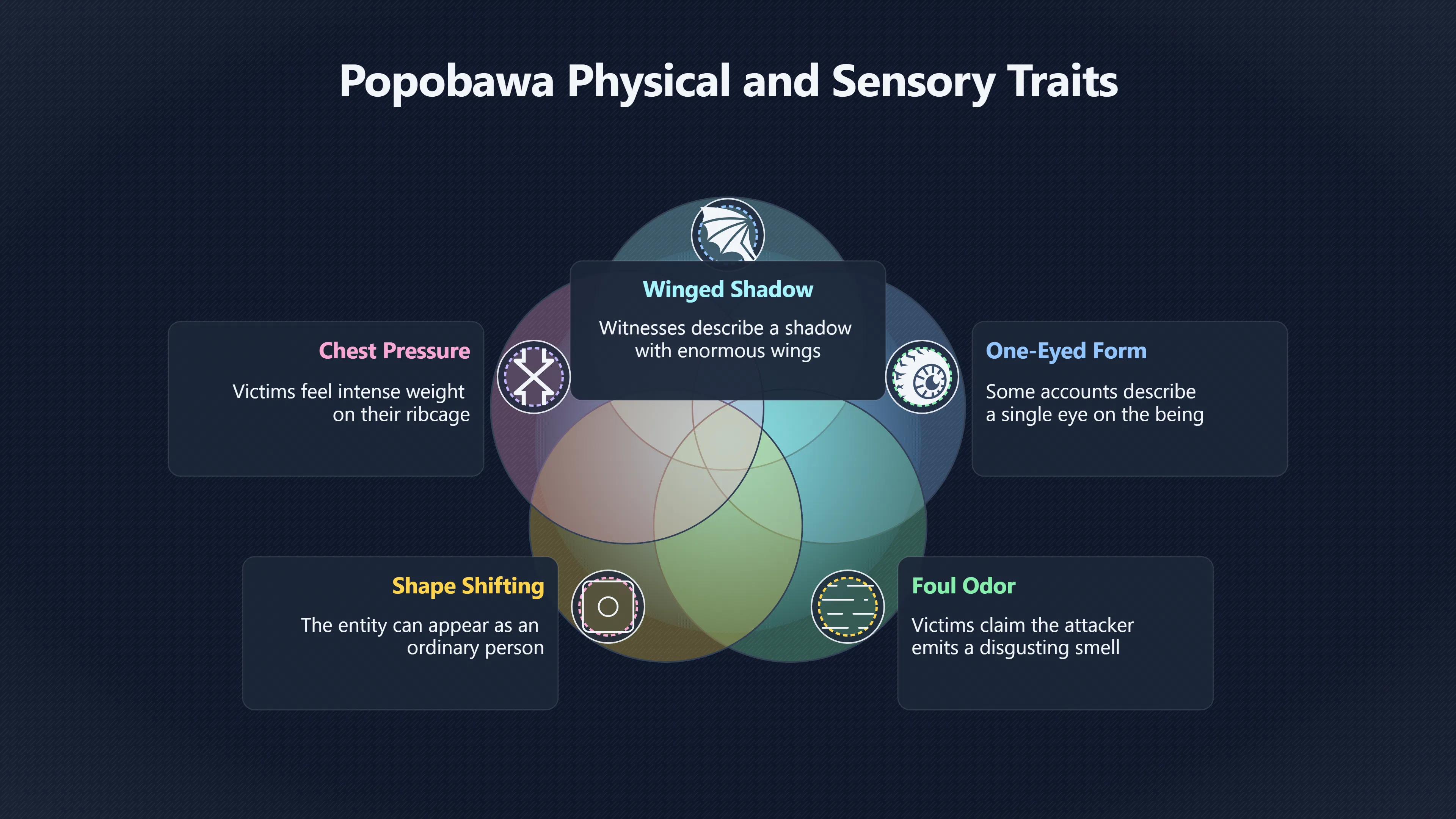
Witnesses did not all describe the same creature. Some spoke of a shadow with enormous wings, others of a one-eyed being, while many insisted it could change shape and even appear as an ordinary person. The name itself literally means “bat wing”, referring more to its shadow than to a fixed physical appearance.[Wikipedia]WikipediaOpen source on wikipedia.org.
Accounts nevertheless shared several recurring features:
- attacks occurred almost exclusively at night;
- victims described waking suddenly but being unable to move or shout;
- many reported intense pressure on the chest or body;
- some claimed the attacker emitted a foul smell before appearing;
- sexual assault, particularly anal rape, became one of the most feared elements of the tradition;
- victims often believed they had to tell others about the attack or risk another visit.
These similarities helped rumours spread because each new report reinforced familiar expectations. Rather than producing hundreds of unrelated monster stories, the panic generated a recognisable script that many people already understood.[researchgate.net]researchgate.netchanging explanations of a collective panic in Zanzibar14 Feb 2015 — However, reports of popobawa in Zanzibar deviated from s…
Martin Walsh’s research into the 1995 outbreak suggests that the earliest reports appeared around Mkoani on Pemba during Ramadan before expanding across the islands. As the panic grew, explanations also changed. Some people blamed spirits, others suspected sorcery, while political rumours increasingly attached themselves to the phenomenon as the outbreak developed.[ResearchGate]researchgate.netchanging explanations of a collective panic in Zanzibar14 Feb 2015 — However, reports of popobawa in Zanzibar deviated from s…
Why did people experience the Popobawa?
One reason the Popobawa continues to fascinate researchers is that many reported experiences resemble well-documented episodes of sleep paralysis. During sleep paralysis, a person briefly wakes while the body remains temporarily unable to move. The experience is frequently accompanied by vivid hallucinations, a frightening sense of another presence in the room and pressure on the chest.
These symptoms overlap strikingly with many Popobawa testimonies. Sceptical investigators such as Joe Nickell argued that the folklore provided a cultural explanation for a universal neurological experience. Rather than seeing an anonymous shadow, sufferers interpreted the frightening event through a locally familiar figure.[Wikipedia]WikipediaOpen source on wikipedia.org.
However, reducing every report to sleep paralysis oversimplifies the phenomenon. Researchers working in Zanzibar have pointed out that many accounts included features extending beyond classic sleep-paralysis episodes, particularly detailed narratives of sexual assault, shared expectations within communities and public discussions that shaped later experiences. Walsh argues that collective panic, social tension and local belief all contributed alongside individual night-time experiences.[ResearchGate]researchgate.netchanging explanations of a collective panic in Zanzibar14 Feb 2015 — However, reports of popobawa in Zanzibar deviated from s…
The timing of some outbreaks has also attracted attention. The major 1995 panic occurred during Ramadan, when altered sleeping patterns, fasting and increased night-time religious activity may have made frightening sleep experiences more likely for some people while simultaneously increasing discussion within communities. This does not prove a medical explanation, but it illustrates how physiological and cultural factors can reinforce one another.[americanghostwalks.com]americanghostwalks.comPopobawa, DrMartin Walsh, and Zanzibar's Idea Virus Story1 Mar 2017 — Discover how a shapeshifting demon sparked fear, sleep paralysis, and mob viole…
Belief, taboo and difficult conversations
The Popobawa cannot be understood simply as a monster story because it became a socially acceptable way to discuss subjects that were otherwise extremely difficult to raise publicly.
Linguist Katrina Daly Thompson argues that conversations about Popobawa often allowed people to speak indirectly about sexual violence, fear, masculinity, vulnerability and power. Since the attacks were attributed to a supernatural being rather than another person, victims could sometimes discuss experiences that might otherwise have been surrounded by shame or silence. She also argues that foreign reporting often misunderstood these conversations by treating them as straightforward evidence that people literally believed in a flying monster, overlooking their social and linguistic complexity.[Wikipedia]WikipediaOpen source on wikipedia.org.
This helps explain why the folklore persisted even after individual panics subsided. The Popobawa functioned not only as a frightening creature but also as a cultural language for discussing anxieties that extended far beyond the supernatural.
Why politics became part of the story
One unusual feature of the Popobawa is its repeated association with periods of political uncertainty.
Observers noticed that major outbreaks often coincided with times of heightened political tension in Zanzibar. Rumours spread that opponents had unleashed supernatural forces against one another or that unseen powers were punishing communities. Walsh argues that political interpretation became increasingly important during the 1995 panic, although it was not necessarily the original explanation when reports first emerged. Instead, political meanings accumulated as rumours travelled between communities.[ResearchGate]researchgate.netchanging explanations of a collective panic in Zanzibar14 Feb 2015 — However, reports of popobawa in Zanzibar deviated from s…
This does not mean that elections somehow created the experiences. Rather, the same atmosphere of uncertainty that encourages political rumours may also encourage supernatural rumours, allowing each to reinforce the other.
When folklore became dangerous
The Popobawa panic was not merely an entertaining ghost story. It had genuine social consequences.
Many families abandoned sleeping indoors, gathering outside around communal fires in the belief that groups would be safer from attack. Others sought protection through prayers, charms or traditional healers. Entire neighbourhoods reorganised their nightly routines because of the fear generated by the rumours.[Wikipedia]WikipediaOpen source on wikipedia.org.
The darkest consequence was violence against suspected manifestations of the Popobawa. Because the spirit was believed capable of changing shape, individuals behaving unusually or regarded as suspicious could become targets. Walsh documents cases in which innocent people were assaulted, including the killing of a mainland visitor during the 1995 panic after he was identified with the feared being.[Academia]academia.eduKilling Popobawa collective panic and violence in ZanzibarKilling Popobawa: collective panic and violence in Zanzibar14 Apr 2026 — The 1995 Popobawa panic in Zanzibar caused widespread fe…
This is an important reminder that folklore can produce real-world harm even when its supernatural claims remain unverified.
Why the Popobawa still matters
The Popobawa survives because it sits at the intersection of several different kinds of mystery.
For believers, it remains a dangerous supernatural presence capable of attacking households without warning. For psychologists, it illustrates how sleep paralysis, expectation and fear can combine into convincing experiences. For anthropologists, it demonstrates how communities negotiate politics, religion, sexuality and social stress through shared stories. For historians of Forteana, it is one of the clearest examples of a modern legend evolving in real time rather than surviving only from distant folklore.[researchgate.net]researchgate.netchanging explanations of a collective panic in Zanzibar14 Feb 2015 — However, reports of popobawa in Zanzibar deviated from s…
Unlike many famous monsters, the Popobawa is significant not because anyone has produced convincing physical evidence that it exists, but because the belief itself has repeatedly reshaped behaviour. People altered where they slept, how they interpreted frightening night-time experiences, whom they trusted and, in tragic cases, whom they feared enough to attack.
That combination of folklore, testimony, psychology and social consequence explains why the Popobawa remains Tanzania’s defining modern monster story and one of the most studied examples of night-terror folklore anywhere in the world.
Amazon book picks
Further Reading
Books and field guides related to What Was Zanzibar's Popobawa Panic Really About?. Use these as the next step if you want deeper reading beyond the article.
Extraordinary Popular Delusions and the Madness of Crowds
Rating: 4.0/5 from 5 Google Books ratings
Explores mass belief and social panics.

eBay marketplace picks
Marketplace Samples
Live-tested eBay searches with available results related to this page.


Endnotes
1.
Source: researchgate.net
Link:https://www.researchgate.net/publication/272202097_The_politicisation_of_Popobawa_changing_explanations_of_a_collective_panic_in_Zanzibar
Source snippet
changing explanations of a collective panic in Zanzibar14 Feb 2015 — However, reports of popobawa in Zanzibar deviated from s...
2.
Source: Wikipedia
Link:https://en.wikipedia.org/wiki/Popobawa
3.
Source: library.panos.co.uk
Link:https://library.panos.co.uk/features/stories/popobawa.html
4.
Source: academia.edu
Link:https://www.academia.edu/694054/The_politicisation_of_Popobawa_changing_explanations_of_a_collective_panic_in_Zanzibar
Source snippet
The politicisation of Popobawa: changing explanations of a...14 Apr 2026 — This paper examines the development of the 1995 panic, and sh...
5.
Source: americanghostwalks.com
Title: Popobawa, Dr
Link:https://www.americanghostwalks.com/blog/2017/02/28/133-popobawa-dr-martin-walsh-idea-virus
Source snippet
Martin Walsh, and Zanzibar's Idea Virus Story1 Mar 2017 — Discover how a shapeshifting demon sparked fear, sleep paralysis, and mob viole...
6.
Source: academia.edu
Title: Killing Popobawa collective panic and violence in Zanzibar
Link:https://www.academia.edu/9430494/Killing_Popobawa_collective_panic_and_violence_in_Zanzibar
Source snippet
Killing Popobawa: collective panic and violence in Zanzibar14 Apr 2026 — The 1995 Popobawa panic in Zanzibar caused widespread fe...
7.
Source: youtube.com
Link:https://www.youtube.com/watch?v=7Eerrmdhx40
Source snippet
Explored...
8.
Source: youtube.com
Title: Popobawa: Zanzibar’s Terrifying Night Demon
Link:https://www.youtube.com/watch?v=Hgs0qemgGgw
Source snippet
SLEEP PARALYSIS - with Medical Anthropology Researcher Samantha Treasure #TheExplorersCLUB...
9.
Source: youtube.com
Title: SLEEP PARALYSIS
Link:https://www.youtube.com/watch?v=yEHApzrmIBk
Source snippet
Jinn of an island - Story of Popobawa Monster...
Additional References
10.
Source: iris.unito.it
Link:https://iris.unito.it/retrieve/e27ce42c-9ccd-2581-e053-d805fe0acbaa/Popobawa.pdf
11.
Source: scribd.com
Link:https://www.scribd.com/document/13997211/Diabolical-Delusions-and-Hysterical-Narratives-in-a-Postmodern-State
Source snippet
of brutality and terror experienced during and after the slave trade...Read more...
12.
Source: archive.org
Title: Sleep Paralysis djvu.txt
Link:https://archive.org/stream/SleepParalysis_201801/Sleep%20Paralysis_djvu.txt
Source snippet
Internet ArchiveFull text of "Sleep Paralysis"Walsh, Michael. 2009. The politicisation of Popobawa: Changing explanations of a collec¬ ti...
13.
Source: journals.sagepub.com
Link:https://journals.sagepub.com/doi/10.1177/0963662515600391
Source snippet
case of genital shrinking in 11 countries7 Sept 2015 — Walsh M (2009) The politicisation of Popobawa: Changing explanations of a collecti...
14.
Source: arxiv.org
Title: arXiv Sleep Paralysis: phenomenology, neurophysiology and treatment
Link:https://arxiv.org/abs/1704.02342
15.
Source: youtube.com
Title: Jinn of an island
Link:https://www.youtube.com/watch?v=4jtbb2m_j0w
16.
Source: youtube.com
Title: Popobawa Explored
Link:https://www.youtube.com/watch?v=FEI4AzsIxws
Source snippet
Popobawa: Zanzibar's Terrifying Night Demon...
Topic Tree