Within Lithuania Weird
Did the Hill of Crosses Become Lithuania's Unkillable Legend?
The Hill of Crosses feels uncanny because demolished crosses kept returning as devotion, mourning and defiance.
On this page
- Origins in mourning and rebellion
- Soviet destruction and night time rebuilding
- Miracle claims, memory and sceptical readings
Page outline Jump by section
Introduction
The Hill of Crosses, just outside Šiauliai in northern Lithuania, is one of Europe’s most unusual religious landscapes. At first glance it looks almost supernatural: a low hill buried beneath tens of thousands of crosses, rosaries and devotional objects that seem to multiply endlessly. Its enduring mystery, however, is less about unexplained forces than about an extraordinary historical pattern. Again and again, authorities destroyed the crosses. Again and again, ordinary people quietly replaced them, often under cover of darkness. That cycle transformed the site from a local place of mourning into one of Lithuania’s most powerful symbols of faith, memory and peaceful resistance. In the country’s strange-history tradition, the Hill of Crosses occupies a unique place because its “miracle” is not a ghost story or apparition but the seemingly unstoppable return of a landscape that refused to stay erased.[Wikipedia]WikipediaHill of CrossesHill of Crosses

Origins in mourning and rebellion
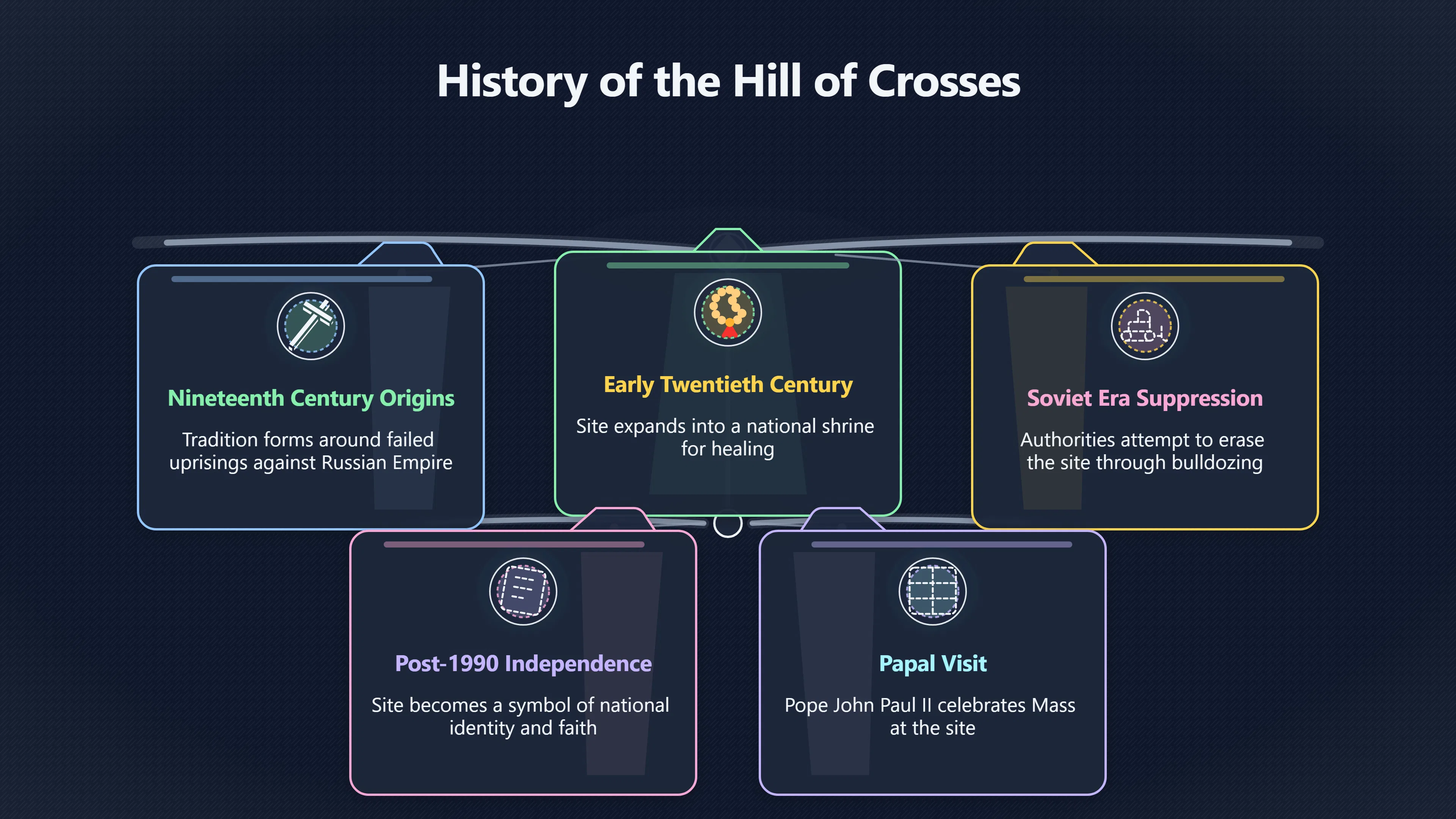
The precise beginning of the Hill of Crosses remains uncertain, adding to its aura. Historians broadly agree that the tradition took shape during the nineteenth century, but exactly when and why the first crosses appeared cannot be proved beyond doubt.
The strongest historical tradition links the site to the failed uprisings against the Russian Empire in 1831 and later in 1863. Many participants disappeared or were denied proper burial, leaving grieving families without graves to visit. According to this account, relatives placed symbolic crosses on the former hillfort in remembrance of the missing dead. The hill therefore became both a memorial and a quiet act of political defiance against imperial rule.[Wikipedia]WikipediaHill of CrossesHill of Crosses
Alternative stories also circulate. Some local legends claim that miraculous healings encouraged people to leave crosses in thanks for answered prayers. Others describe the hill as a place where parents prayed for sick children or where visions inspired acts of devotion. These traditions are difficult to verify historically, but they illustrate how the site acquired a reputation as somewhere where prayer and suffering were thought to meet in unusual ways. Rather than contradicting the historical explanation, they show how popular memory layered miracle traditions onto an already significant landscape.
By the beginning of the twentieth century the hill already contained hundreds of crosses. Pilgrims were no longer commemorating only rebellion victims. They came to pray for relatives, for healing, for peace and for Lithuania itself, gradually turning a local memorial into a national shrine.[Wikipedia]WikipediaHill of CrossesHill of Crosses
Why the hill felt almost impossible to destroy
The feature that gives the Hill of Crosses its Fortean flavour is repetition. Unlike a conventional monument built once and preserved, this landscape repeatedly disappeared and reappeared.
During Soviet rule the authorities viewed the hill as doubly dangerous. It represented Catholic belief, which official ideology opposed, while simultaneously expressing Lithuanian national identity. Officials therefore attempted to eliminate it not simply by removing crosses but by erasing the entire tradition.
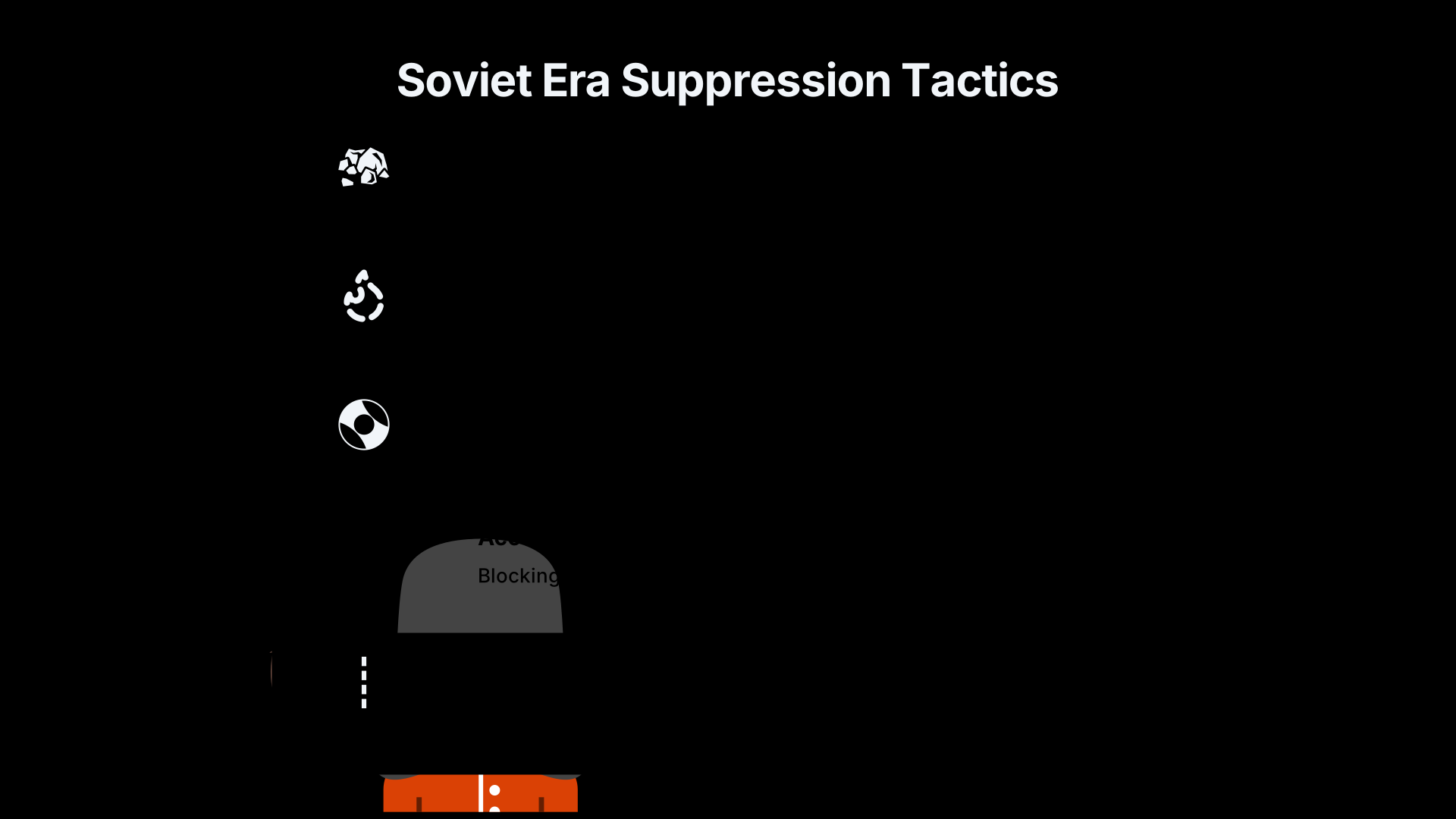
Known campaigns included:
- Large-scale bulldozing operations, particularly in 1961.
- Burning wooden crosses and crushing concrete memorials.
- Removing metal crosses for scrap.
- Blocking roads leading to the site.
- Stationing guards and security personnel nearby.
- Threatening or arresting people caught carrying crosses.
- Considering engineering schemes, including flooding the area, to prevent rebuilding.[wikipedia.org]WikipediaHill of CrossesHill of Crosses
None of these measures worked for long.
Almost immediately after each clearance, local people returned, often during the night, carrying new crosses by hand. Individuals acted independently rather than under central organisation. Families remembered relatives. Believers fulfilled vows. Others simply wished to show that Soviet power could not dictate memory.
This repeated rebuilding created the impression of a place that regenerated itself. Visitors arriving after successive demolitions found fresh crosses already standing. To supporters, that persistence resembled a living miracle. To historians, it demonstrates the remarkable resilience of decentralised civil resistance: a tradition impossible to suppress because thousands of individuals quietly chose to recreate it.[Wikipedia]WikipediaHill of CrossesHill of Crosses
Was there really a miracle?
Whether the Hill of Crosses should be considered miraculous depends largely on what one means by the word.
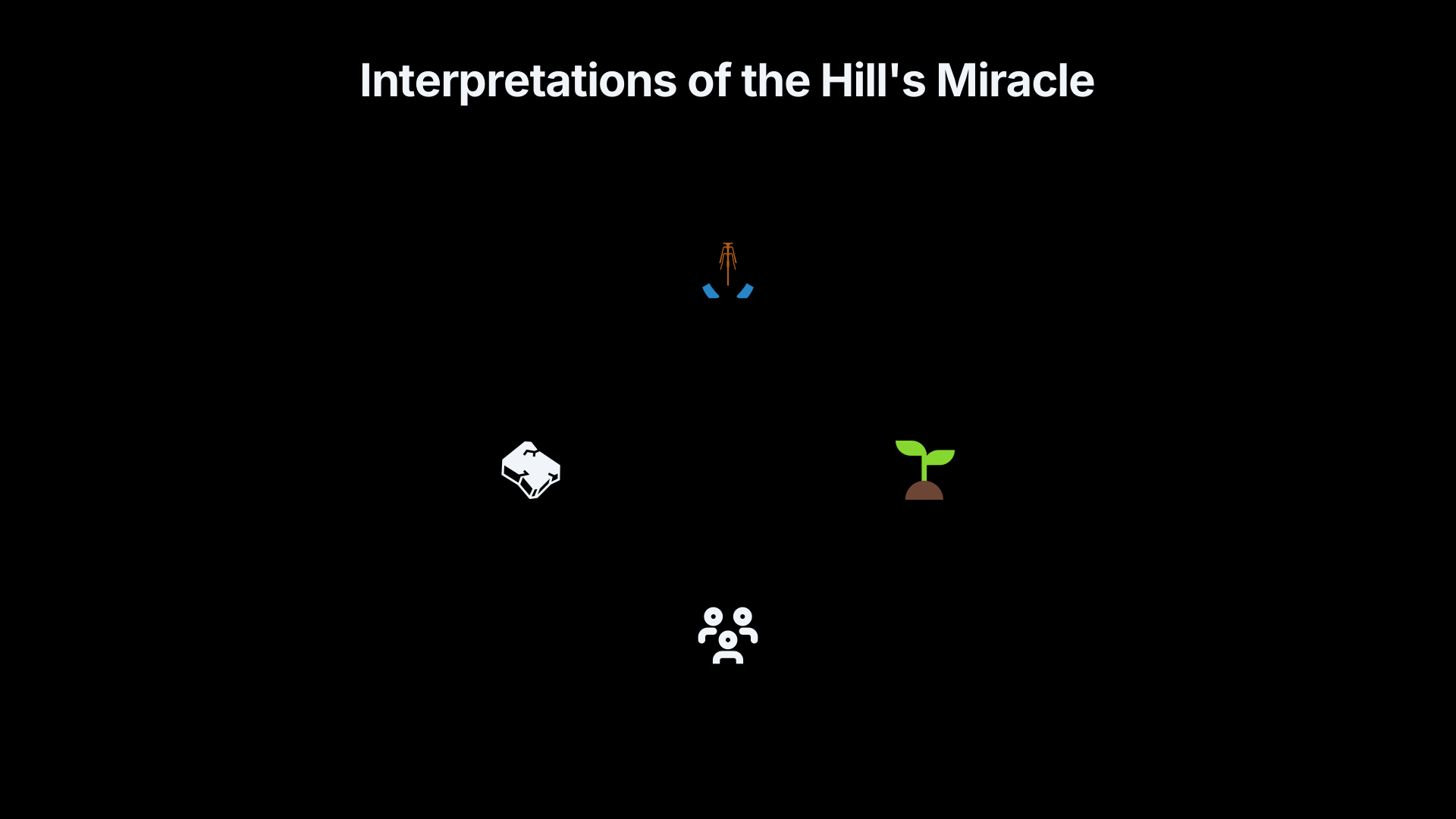
For many Catholic pilgrims, the miracle is spiritual rather than physical. The hill is associated with answered prayers, healing, consolation after bereavement and the visible survival of faith despite decades of persecution. Pilgrims continue to leave crosses in gratitude for recoveries, family milestones or hopes for the future. The atmosphere itself is often described as profoundly moving rather than frightening.[Lithuania Travel]lithuania.travelThe Hill of Crosses | Lithuania TravelExplore the Hill of Crosses in Žemaitija, a spiritual site adorned with thousands of crosses, repre…
Others point to the repeated survival of the site as miraculous in a broader sense. A place that authorities destroyed several times nevertheless grew larger after every attack. In that interpretation, the miracle lies not in suspending the laws of nature but in the unexpected endurance of human conviction.
Sceptical historians offer a different reading. They note that there is no evidence of supernatural rebuilding. Every new cross was carried there by ordinary people who accepted genuine personal risk. The hill expanded because thousands of individual acts accumulated over decades. Its apparent indestructibility emerged from collective determination rather than unexplained forces.[Wikipedia]WikipediaHill of CrossesHill of Crosses
These interpretations need not exclude one another. Believers may see divine inspiration working through human courage, while secular observers view the same events as an extraordinary example of peaceful resistance.
The uncanny power of endless accumulation
Unlike many religious monuments, the Hill of Crosses has no finished form. It constantly changes.
Large carved memorials stand beside tiny handmade wooden crosses. Metal crucifixes hang from older structures. Rosaries drape across branches and railings. Memorial plaques commemorate families, political prisoners, children and pilgrims from around the world.
Because anyone may contribute, the site grows organically rather than according to a master plan. Estimates of the number of crosses have varied dramatically over time, rising from only a few hundred before the Second World War to tens of thousands by the late Soviet period and well over 100,000—possibly approaching 200,000 today depending on how individual objects are counted. Precise totals are impossible because new offerings continually appear.[Wikipedia]WikipediaHill of CrossesHill of Crosses
This uncontrolled accumulation contributes to the hill’s uncanny reputation. Visitors often describe the sound of thousands of rosaries and metal crosses clicking together in the wind. Photographs can make the site appear eerie or even haunted, particularly at dawn, dusk or in winter. Yet the emotional effect comes less from fear than from confronting an immense physical record of countless private hopes and losses.
From forbidden shrine to national symbol
Lithuania regained independence in 1990, removing the political conditions that had made the hill an act of resistance. Instead of fading, its significance broadened.
A pivotal moment came in 1993 when Pope John Paul II celebrated Mass at the site and described it as a place of hope, peace, love and sacrifice. His visit brought international attention and confirmed the hill’s importance within modern Catholic pilgrimage. A Franciscan monastery was later established nearby to serve visitors.[Wikipedia]WikipediaHill of CrossesHill of Crosses
At the same time, international recognition of Lithuanian cross-crafting strengthened appreciation of the tradition that had produced the hill. UNESCO inscribed Lithuanian cross-crafting and its symbolism on the Representative List of the Intangible Cultural Heritage of Humanity, recognising the practice as a distinctive expression of cultural and religious identity that survived periods of political repression.[Wikipedia]WikipediaHill of CrossesHill of Crosses
Today the Hill of Crosses functions simultaneously as:(#endnote-1 “Endnote 1”)[Wikipedia]WikipediaHill of CrossesHill of Crosses
- A Catholic pilgrimage destination.[russiasperiphery.pages.wm.edu]russiasperiphery.pages.wm.eduthe hill of crossesHill of CrossesThe Hill of Crosses is a Catholic pilgrimage site in northern Lithuania. A large mound covered with “a tangled forest of c…
- A memorial to historical suffering.
- A monument to non-violent resistance.
- A powerful symbol of Lithuanian identity.
- One of Europe’s most distinctive cultural landscapes.[Lithuania Travel]lithuania.travelThe Hill of Crosses | Lithuania TravelExplore the Hill of Crosses in Žemaitija, a spiritual site adorned with thousands of crosses, repre…
Why it remains part of Lithuania’s strange-history tradition
The Hill of Crosses belongs in Lithuania’s Fortean landscape not because it offers convincing evidence of paranormal events, but because it occupies the unusual boundary between miracle, folklore, history and lived experience.
Stories of miraculous healing, mysterious origins and answered prayers continue to circulate among pilgrims. Historians instead emphasise political repression, collective memory and civil resistance. Both perspectives recognise the same remarkable fact: a modest hill became one of the country’s defining symbols through repeated acts that appeared, to contemporaries, almost impossible to stop.
Its enduring fascination lies in that ambiguity. Whether interpreted as divine intervention, national determination or the cumulative force of countless anonymous people refusing to forget, the Hill of Crosses presents a rare example of an “unkillable” legend—one whose greatest mystery is not how the crosses appeared, but why every attempt to erase them only seemed to make them return in greater numbers.[wikipedia.org]WikipediaHill of CrossesHill of Crosses
Amazon book picks
Further Reading
Books and field guides related to Did the Hill of Crosses Become Lithuania's Unkillable Legend?. Use these as the next step if you want deeper reading beyond the article.

The Balts
First published 1963. Subjects: Antiquities, Baltic region, Balts (Indo-European people).

The spirit of the liturgy
First published 2000. Subjects: Catholic Church, Doctrines, Liturgy, Catholic church, liturgy, Roman catholicism.

Baltic Mythology
Helps explain the religious landscape surrounding the Hill of Crosses.
eBay marketplace picks
Marketplace Samples
Live-tested eBay searches with available results related to this page.

Endnotes
1.
Source: Wikipedia
Title: Hill of Crosses
Link:https://en.wikipedia.org/wiki/Hill_of_Crosses
2.
Source: lithuania.travel
Link:https://lithuania.travel/en/where-to-visit/regions/zemaitija-en/the-hill-of-crosses
Source snippet
The Hill of Crosses | Lithuania TravelExplore the Hill of Crosses in Žemaitija, a spiritual site adorned with thousands of crosses, repre...
3.
Source: lithuania.travel
Link:https://lithuania.travel/en/where-to-visit/top-sites-in-lithuania/hill-of-crosses
Source snippet
Hill of Crosses | Lithuania TravelThe site of a wooden castle in the Middle Ages, the hillfort today known as the Hill of Crosses became...
4.
Source: Wikipedia
Link:https://en.wikipedia.org/wiki/Hill
Source snippet
HillA hill is a landform that extends above the surrounding terrain. It often has a distinct summit, and is usually applied to peaks w...
5.
Source: youtube.com
Title: Hill of Crosses
Link:https://www.youtube.com/watch?v=P0nX9PGRW64
Source snippet
Lithuania | The Most Powerful Place You've Never Seen...
6.
Source: nationalgeographic.com
Title: things to do hill of crosses religious tourism
Link:https://www.nationalgeographic.com/travel/article/things-to-do-hill-of-crosses-religious-tourism
Source snippet
National GeographicVisit the Hill of Crosses in LithuaniaFeb 26, 2018 — During the Soviet era, religion remained banned and the Hill of C...
7.
Source: facebook.com
Title: The Hill
Link:https://www.facebook.com/TheHill/
Source snippet
1856220 likes · 1716020 talking about this. The Hill is the premier source for policy and political coverage...
8.
Source: play.google.com
Link:https://play.google.com/store/apps/details?hl=en_US&id=com.thehill.thehill
Source snippet
Hill - Apps on Google PlayCovering congress & politics with a focus on business and lobbying, political campaigns, and goings on on Capit...
9.
Source: publicwitness.wordandway.org
Title: hill of crosses
Link:https://publicwitness.wordandway.org/p/hill-of-crosses
Source snippet
of Crosses - by Brian Kaylor - A Public Witness - Word&WayApr 6, 2566 BE — So the Soviets destroyed many more crosses on multiple occasio...
10.
Source: russiasperiphery.pages.wm.edu
Title: the hill of crosses
Link:https://russiasperiphery.pages.wm.edu/baltic-states/lithuania/general/the-hill-of-crosses/
Source snippet
Hill of CrossesThe Hill of Crosses is a Catholic pilgrimage site in northern Lithuania. A large mound covered with “a tangled forest of c...
Additional References
11.
Source: merriam-webster.com
Link:https://www.merriam-webster.com/dictionary/hill
Source snippet
HILL Definition & Meaning1. a usually rounded natural elevation of land lower than a mountain 2. an artificial heap or mound (as of earth...
12.
Source: eioco.nl
Link:https://eioco.nl/en/hill-of-crosses-in-lithuania-a-pilgrimage-destination-and-a-site-of-peaceful-resistance/
Source snippet
Hill of Crosses in Lithuania a pilgrimage destination and...15 Sept 2022 — During Soviet totalitarian oppression the Hill of Crosses was...
13.
Source: economy-finance.ec.europa.eu
Title: Economy and Finance Kryžių Kalnas (the Hill of Crosses)
Link:https://economy-finance.ec.europa.eu/euro/euro-coins-and-notes/euro-coins/commemorative-coins/unesco-cultural-heritage-kryziu-kalnas-hill-crosses_en
Source snippet
Economy and FinanceKryžių Kalnas (the Hill of Crosses) - Economy and FinanceThe design depicts the Hill of Crosses: fragments of wooden a...
14.
Source: deepbaltic.com
Title: The Hill of Crosses: A Monument to the Defiant Spirit
Link:https://deepbaltic.com/2016/05/21/the-hill-of-crosses-a-monument-to-the-defiant-spirit-of-lithuania/
Source snippet
May 21, 2016 — The famous Hill of Crosses is the very masterstroke of that movement: a memorial not just to resistance, but moreover to c...
Published: May 21, 2016
15.
Source: x.com
Link:https://x.com/thehill?lang=en
Source snippet
hington, breaking news and retweets of our reporters.Read more...
16.
Source: religionunplugged.com
Title: The fact the Lithuanian Catholics kept
Link:https://religionunplugged.com/news/2019/1/7/pilgrimage-a-journey-to-lithuanias-enigmatic-hill-of-crosses
Source snippet
Religion UnpluggedPilgrimage: A journey to Lithuania's enigmatic Hill of CrossesFeb 11, 2019 — National Geographic cited cross-making as...
17.
Source: tourtheholylands.com
Title: lithuania the hill of crosses
Link:https://www.tourtheholylands.com/holy-land-tour-locations/holy-land-tours/lithuania-the-hill-of-crosses
Source snippet
Lithuania: The Hill of Crosses — Holy Land ToursMar 9, 2021 — During the years of communist rule in Lithuania, the Hill of Crosses was ra...
18.
Source: odysseytraveller.com
Title: hill of crosses lithuania
Link:https://www.odysseytraveller.com/articles/hill-of-crosses-lithuania/
Source snippet
The Definitive Guide22 Jan 2020 — Known as the Hill of Crosses (Kryziu Kalnas), it is both a pilgrimage site and a testament to Lithuania...
19.
Source: matadornetwork.com
Title: lithuania hill of crosses
Link:https://matadornetwork.com/read/lithuania-hill-of-crosses/
Source snippet
Lithuania's Hill of Crosses Is Delightfully CreepyOct 2, 2018 — The Hill of Crosses in Lithuania, with its one hundred thousand crosses...
20.
Source: youtube.com
Title: Hill of Crosses Lithuania | The Most Powerful Place You’ve Never Seen
Link:https://www.youtube.com/watch?v=9YacjpZ5TXs
Source snippet
120,000 crosses in one place! The mysterious Hill of Crosses - LITHUANIA...
Topic Tree