Within Angola Forteana
What Is Angola's Two Faced Kishi?
The kishi turns Angola's folktale monsters into a sharper question about charm, danger and evidence in oral tradition.
On this page
- The Chatelain source trail
- Monster, spirit or warning tale
- Why the kishi travels so well
Page outline Jump by section
Introduction
The kishi is often introduced as Angola’s terrifying “two-faced monster”: handsome from the front, ravenous from behind. That image is memorable, but it is only part of the story. The strongest evidence for the kishi comes not from eyewitness reports or cryptozoological investigations, but from nineteenth-century records of Kimbundu oral tradition. These tales reveal a more complex figure that sits somewhere between monster, spirit, cautionary symbol and narrative device. Rather than asking whether a two-faced predator literally roamed Angola, the more useful question is why generations of storytellers preserved such a creature and what role it played within Kimbundu society.

For anyone exploring Angola’s Fortean traditions, the kishi matters because it occupies the meeting point of folklore, historical documentation and modern reinvention. It is one of the country’s best-attested strange beings in written sources, yet almost everything popularly repeated today has passed through layers of translation, adaptation and popular culture. Understanding that journey makes the legend more interesting, not less.
The Chatelain source trail
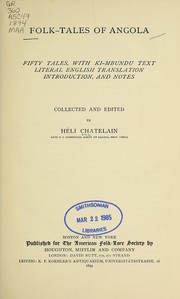
The foundation for almost every modern discussion of the kishi is Héli Chatelain’s 1894 Folk-tales of Angola. A Swiss linguist and missionary who worked extensively with Kimbundu speakers, Chatelain collected fifty tales in the original language alongside English translations and explanatory notes. His volume remains one of the earliest substantial records of Angolan oral literature available to English readers.[Internet Archive]archive.orgInternet ArchiveFolk-tales of Angola… 1894. Page 6. Page 7. FOLK-TALES OF ANGOLA. FIFTY TALES. WITH KI-MBUNDU TEXT… HELI CHATELAIN…
Unlike many later retellings, Chatelain did not present the ma-kishi as a neatly defined species with a standard appearance or behaviour. Instead, they appear within several stories as dangerous supernatural beings or monstrous enemies. The table of contents alone shows their recurring importance, with tales including Ngana Samba and the Ma-kishi and references within the heroic cycle of Sudika-Mbambi.[Internet Archive]archive.orgInternet Archive Folk-tales of AngolaFifty tales, with Ki-mbundu text, literal…HELI CHATELAIN. New York… III. Na Nzua dia Kimanueze. 65. IV. The Woman who Longed for Fi…
This distinction matters because modern internet summaries often compress multiple traditions into a single dramatic description. Chatelain’s material instead reflects the flexibility of oral storytelling. Different tales emphasise different dangers, just as European fairy tales portray witches, giants or wolves in varying ways depending on the lesson being told.
His work also preserves the Kimbundu text alongside translation, allowing later scholars to compare language rather than relying entirely on Victorian interpretation. Although Chatelain inevitably viewed the material through the assumptions of his era, his collection remains the closest surviving written witness to many nineteenth-century Kimbundu narratives.[Internet Archive]archive.orgInternet ArchiveFolk-tales of Angola… 1894. Page 6. Page 7. FOLK-TALES OF ANGOLA. FIFTY TALES. WITH KI-MBUNDU TEXT… HELI CHATELAIN…
Monster, spirit or warning tale?
One reason the kishi can seem difficult to classify is that different traditions emphasise different aspects of the being.
Some modern descriptions portray the creature as:
- an attractive man who seduces women;
- a hidden hyena-faced predator with enormous jaws;
- a flesh-eating monster;
- a spirit capable of deception rather than simply a physical animal.
These are not necessarily contradictory. Folklore rarely works through rigid biological categories. Instead, the same figure can serve different narrative purposes depending on the storyteller and audience.
The famous “two faces” illustrate this perfectly. The human face represents familiarity, charm and trust. The hidden animal face represents concealed appetite and violence. Whether listeners imagined an actual supernatural creature or understood the story as symbolic, the warning remains the same: outward appearances can conceal mortal danger.
That moral function becomes even clearer when compared with other traditional warning figures around the world. Like Europe’s wolves in grandmother’s clothing or shape-shifting tricksters found elsewhere in Africa, the kishi dramatises the risks of misplaced trust. Its horror comes not from enormous size or magical powers but from doubleness—the unsettling idea that one identity hides another.
Why evidence points to folklore rather than zoology
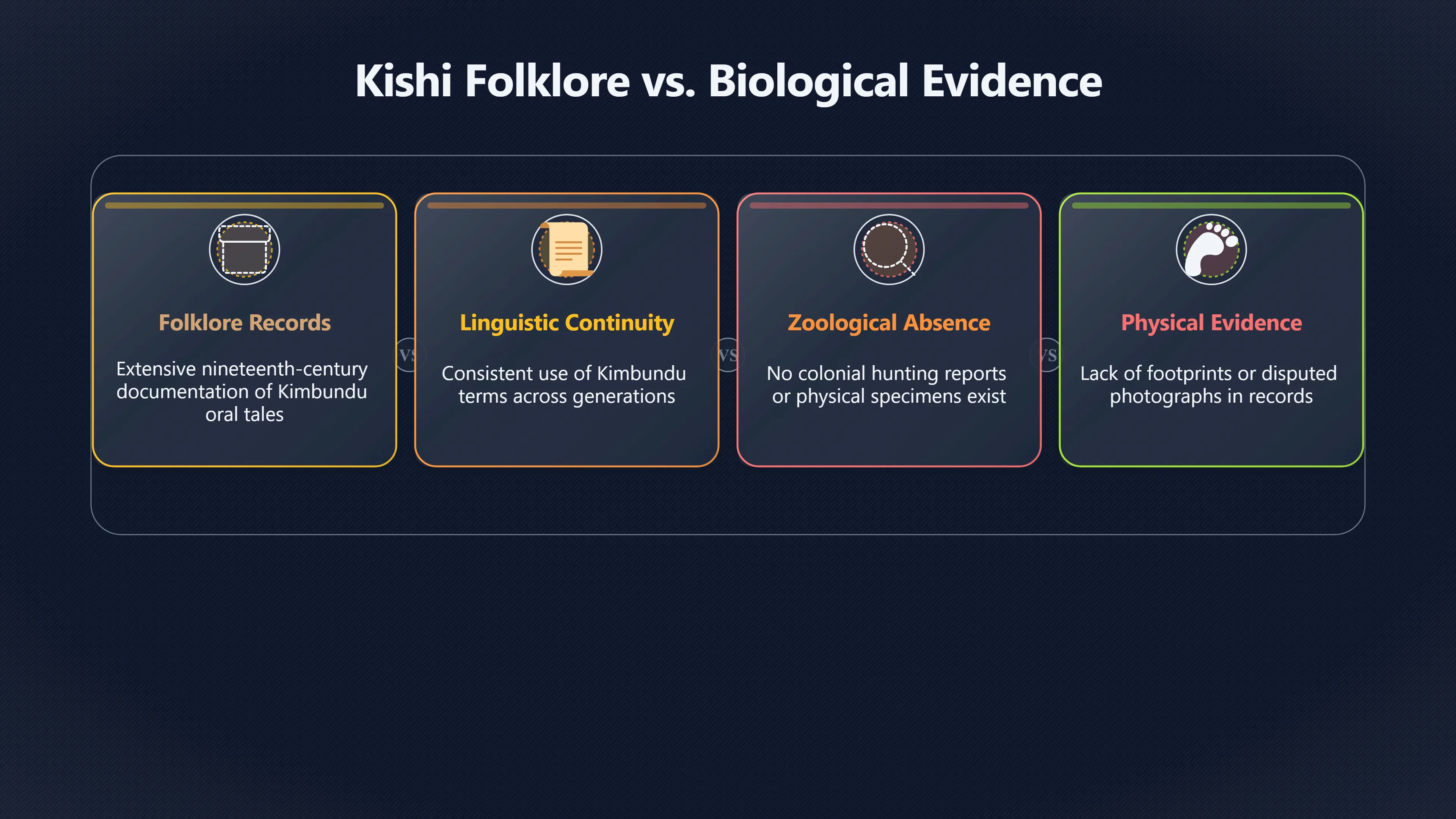
Unlike mystery animals that leave claimed footprints, carcasses or disputed photographs, the kishi has almost no evidential tradition outside folklore.
There are no well-documented colonial hunting reports describing two-faced beasts, no preserved specimens and no modern field investigations producing physical evidence. Instead, nearly every detailed account ultimately traces back to literary or oral sources rooted in Kimbundu storytelling.[Internet Archive]archive.orgInternet ArchiveFolk-tales of Angola… 1894. Page 6. Page 7. FOLK-TALES OF ANGOLA. FIFTY TALES. WITH KI-MBUNDU TEXT… HELI CHATELAIN…
That does not diminish its importance within Angola’s strange-history record. Instead, it changes the kind of evidence readers should expect.
The evidence consists of:
- repeated appearance across preserved oral narratives;
- linguistic continuity in Kimbundu traditions;
- nineteenth-century documentation by collectors;
- continued survival in modern retellings.
For Fortean readers, this places the kishi closer to Britain’s Black Shuck or Japan’s yōkai than to a cryptid pursued through biological fieldwork. The historical question is not “Was the monster photographed?” but “How consistently has this supernatural figure been remembered, and what does that continuity tell us?”
The importance of language
Modern English descriptions often blur several related words that occur across Bantu-speaking regions.
Terms such as kishi, nkishi and mukisi have broader associations with spirits or spiritual beings in several Bantu languages extending beyond Angola. This linguistic background helps explain why later writers sometimes describe the kishi as a demon, elsewhere as a monster, and elsewhere as a spirit. Those labels reflect translation choices rather than necessarily describing entirely different beings.[Wikipedia]WikipediaKishi (folkloreKishi (folklore
This is one reason caution is needed when comparing modern summaries. A website may confidently describe a single creature with fixed characteristics, while the older sources preserve a richer and less standardised tradition.
Why the kishi travels so well
The kishi has become one of Angola’s most internationally recognised legendary beings because its central image is immediately memorable. A creature with two faces needs little explanation, and its symbolism translates easily across cultures.
Modern fantasy novels, online mythology collections, role-playing games and folklore websites frequently repeat the image of the handsome man concealing a predatory face. In many of these retellings the social and linguistic context has largely disappeared, leaving an easily exported monster concept.[Mythlok]mythlok.comKishi: The Dual Faced OneKishi: The Dual Faced OneSeptember 8, 2025 — In Angola, its story is still told as a warning against superficial judgment, remind…
That popularity has advantages and drawbacks.
On one hand, it introduces global audiences to Angolan folklore that might otherwise remain unfamiliar. On the other, repeated simplification can make readers assume there is one definitive version of the legend when the historical evidence instead points to a family of related stories preserved through oral tradition.
For readers interested in Angola’s Fortean heritage, the older Kimbundu narratives remain more rewarding than the simplified monster profile. They reveal not merely an exotic beast but a sophisticated warning tale about deception, social trust and hidden danger—one whose power has allowed it to survive long after the original storytellers first passed it from one generation to the next.



eBay marketplace picks
Marketplace Samples
Live-tested eBay searches with available results related to this page.




Endnotes
1.
Source: archive.org
Link:https://archive.org/download/folktalesofangol00chat/folktalesofangol00chat.pdf
Source snippet
Internet ArchiveFolk-tales of Angola... 1894. Page 6. Page 7. FOLK-TALES OF ANGOLA. FIFTY TALES\. WITH KI-MBUNDU TEXT... HELI CHATELAIN...
2.
Source: archive.org
Title: Internet Archive Folk-tales of Angola
Link:https://archive.org/download/ajs8768.0001.001.umich.edu/ajs8768.0001.001.umich.edu.pdf
Source snippet
Fifty tales, with Ki-mbundu text, literal...HELI CHATELAIN. New York... III. Na Nzua dia Kimanueze. 65. IV. The Woman who Longed for Fi...
3.
Source: archive.org
Link:https://archive.org/details/folktalesofangol00chat
Source snippet
Internet ArchiveFolk-tales of Angola; fifty tales with Kimbundu text, liberal...17 Aug 2015 — Folk-tales of Angola; fifty tales with Kim...
4.
Source: Wikipedia
Title: Héli Chatelain
Link:https://en.wikipedia.org/wiki/H%C3%A9li_Chatelain
5.
Source: Wikipedia
Title: Kishi (folklore)
Link:https://en.wikipedia.org/wiki/Kishi_%28folklore%29
6.
Source: mythlok.com
Title: Kishi: The Dual Faced One
Link:https://mythlok.com/kishi/
Source snippet
Kishi: The Dual Faced OneSeptember 8, 2025 — In Angola, its story is still told as a warning against superficial judgment, remind...
Published: September 8, 2025
7.
Source: archive.org
Link:https://archive.org/download/folktalesofango00chat/folktalesofango00chat.pdf
Source snippet
Folk-tales of Angola. Fifty tales, with Ki-mbundu text, literal...Copyright, 1894. By the AMERICAN FOLK-LORE SOCIETY. All rights reserv...
8.
Source: archive.org
Link:https://archive.org/details/folktalesangola00chatgoog
Source snippet
Folk-tales of Angola: Fifty Tales, with Ki-mbundu Text...5 Apr 2008 — Folk-tales of Angola: Fifty Tales, with Ki-mbundu Text, Literal En...
9.
Source: archive.org
Title: Folk-tales of Angola
Link:https://archive.org/details/folktalesofango00chat
Source snippet
Fifty tales, with Ki-mbundu text, literal...1 May 2017 — Folk-tales of Angola. Fifty tales, with Ki-mbundu text, literal English transla...
Published: May 2017
10.
Source: archive.org
Link:https://archive.org/details/folktalesangola01chatgoog
Source snippet
Folk-tales of Angola: Fifty Tales, with Ki-mbundu Text...23 Jul 2009 — Folk-tales of Angola: Fifty Tales, with Ki-mbundu Text, Literal E...
11.
Source: archive.org
Link:https://archive.org/stream/ajs8768.0001.001.umich.edu/ajs8768.0001.001.umich.edu_djvu.txt
Source snippet
frican languages as well as for students of comparative folk-lore...
12.
Source: archive.org
Link:https://archive.org/stream/folktalesangola00chatgoog/folktalesangola00chatgoog_djvu.txt
13.
Source: youtube.com
Link:https://www.youtube.com/watch?v=rnS9ldfV1cs
Source snippet
10 Mythical Creatures from Africa You Might Not Know (Ft. Antoine Bandele) [Part 2]...
Additional References
14.
Source: catalog.hathitrust.org
Link:https://catalog.hathitrust.org/Record/002032707
Source snippet
Record: Folk-tales of Angola: fifty tales, with...Folk-tales of Angola: fifty tales, with Ki-mbundu text, literal English translation...
15.
Source: scribd.com
Link:https://www.scribd.com/document/703421632/Mythical-Creatures-and-Magical-Beasts-An-Illustrated-Book-of-Monsters-from-Timeless-Folktales-Folklore-and-Mythology-Volumes-1-and-2-Legendary-Lores
Source snippet
are usually attributed to, man-eating monsters are a common theme, and the Kishi...
16.
Source: amazon.de
Link:https://www.amazon.de/Folk-Tales-Angola-Ki-Mbundu-Translation-Introduction/dp/1528174003?tag=searcht-20
Source snippet
glish Translation, Introduction, and Notes Early in 1885 I landed at Loanda...
17.
Source: amazon.com
Link:https://www.amazon.com/Folk-Tales-Angola-Ki-Mbundu-Translation-Introduction/dp/1528174003?tag=searcht-20
Source snippet
dition presents Ki-Mbundu text alongside literal English translation...
18.
Source: amazon.de
Link:https://www.amazon.de/Folk-tales-Kimbundu-Liberal-Translation-Introduction/dp/101532729X?tag=searcht-20
Source snippet
of the knowledge base of civilization as we know it...
19.
Source: library.si.edu
Link:https://library.si.edu/digital-library/book/folktalesofango00chat
Source snippet
si.eduFolk-tales of AngolaFolk-tales of Angola. Chatelain, Héli. Pub. for the American Folk-lore Society by Houghton Mifflin and company...
20.
Source: youtube.com
Link:https://www.youtube.com/watch?v=K_4nk7H-KSI
Source snippet
The Kishi: Angola's Two-Faced Demon...
21.
Source: books.google.com
Title: Folk tales of Angola
Link:https://books.google.com/books/about/Folk_tales_of_Angola.html?id=78TYAAAAMAAJ
Source snippet
google.comFolk-tales of Angola: Fifty Tales, with Ki-mbundu Text...Folk-tales of Angola: Fifty Tales, with Ki-mbundu Text, Literal Engl...
22.
Source: youtube.com
Title: Kishi: Angola’s Deadly Two-Faced Demon
Link:https://www.youtube.com/watch?v=cyTNiBUAzfw
Source snippet
Kishi: Angola's Two-Faced Demon Revealed...
23.
Source: onlinebooks.library.upenn.edu
Link:https://onlinebooks.library.upenn.edu/webbin/book/lookupid?key=olbp35431
Source snippet
upenn.eduFolk-Tales of Angola: Fifty Tales, With Ki-Mbundu Text...
Topic Tree