Within Kiribati
When the Pacific Looks Supernatural
Kiribati's strangest reports often begin with the sea, where rare animals, glowing water and mirages can feel uncanny.
On this page
- Glowing water and strange lights
- Large animals and deep water surprises
- Mirages, storms and distance at sea
Page outline Jump by section
Introduction
For a nation made up almost entirely of low coral atolls, the sea is the setting for many of Kiribati’s strangest experiences. Stories of glowing waves, enormous marine animals glimpsed far offshore, phantom islands and uncanny lights have all found a place in local memory. Yet unlike the classic sea-monster traditions of Europe or North America, Kiribati’s mysteries usually emerge from real encounters with an immense and often unpredictable ocean rather than from a long catalogue of sensational reports.
The most interesting question is therefore not whether the Pacific around Kiribati is supernatural, but why perfectly natural events can appear so extraordinary. In many cases, modern marine science provides convincing explanations without making the experiences themselves any less remarkable. The combination of exceptional visibility, powerful atmospheric effects, deep ocean trenches, unusual wildlife and vast distances creates conditions where even experienced sailors can witness phenomena that seem almost impossible.
Glowing water and strange lights
One of the most dramatic sights reported throughout the tropical Pacific is water that appears to glow with an eerie blue or green light after dark. Around Kiribati, where artificial lighting is minimal across many outer islands, such displays can seem especially vivid.
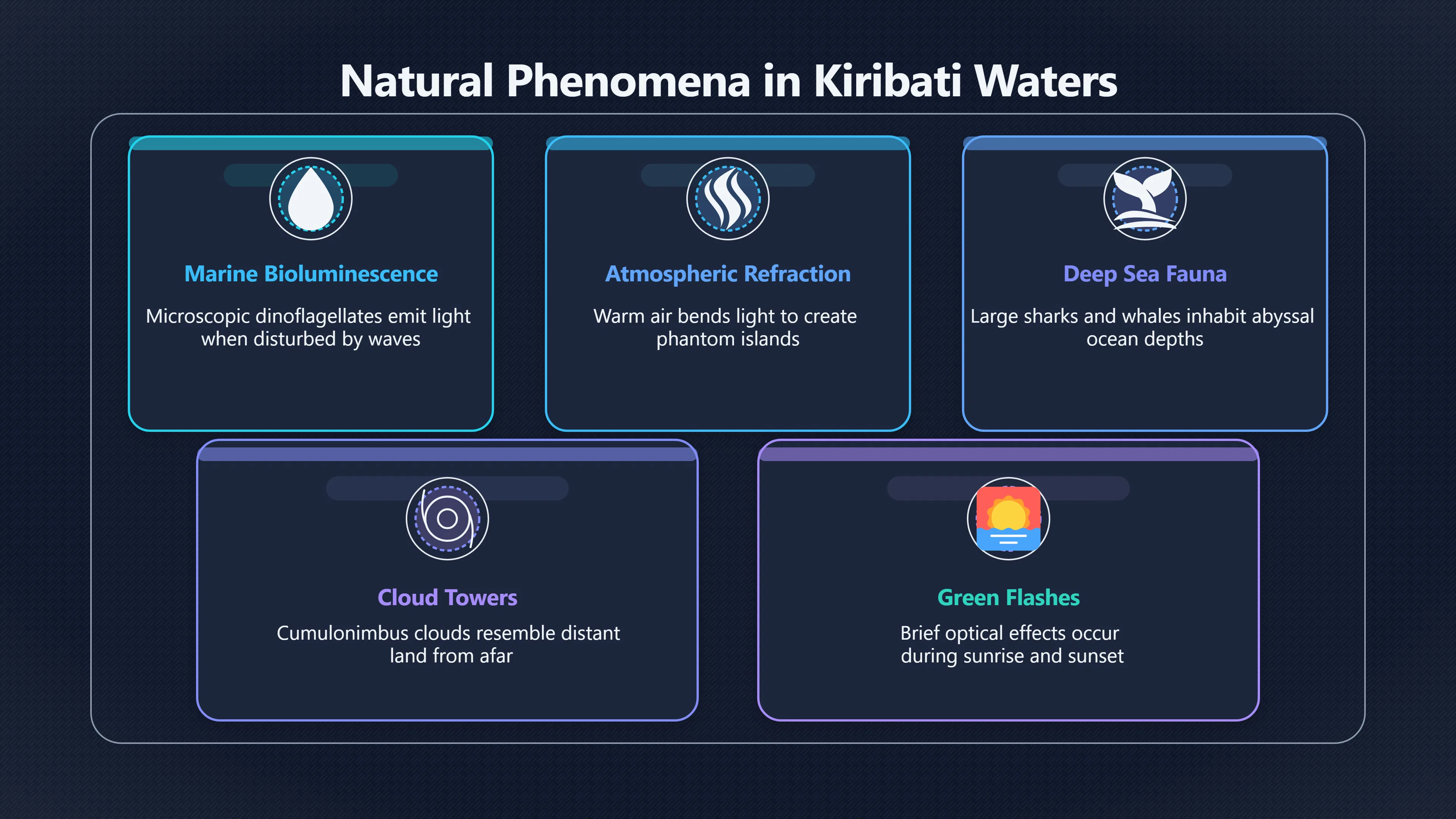
The most common explanation is marine bioluminescence. Countless microscopic organisms, particularly certain species of dinoflagellates, emit light when disturbed by waves, fish or boat wakes. The result can be glowing surf, sparkling footprints in shallow lagoons or luminous trails following moving vessels. Marine biologists regard this as one of the ocean’s most widespread natural light displays rather than an unusual rarity, although local conditions determine when it becomes spectacular.[ResearchGate]researchgate.netResearch Gate(PDF) Bioluminescence in the SeaResearchGate(PDF) Bioluminescence in the SeaJanuary 15, 2010 — This review explores recent advances, including the chemical and molecular…
Occasionally, observers also report isolated glowing patches or moving lights over the sea. These are more difficult to explain individually because historical descriptions are often brief. Possible natural causes include:
- concentrated blooms of bioluminescent plankton;
- schools of fish disturbing luminous organisms;
- moonlight reflecting from unusual wave patterns;
- distant fishing vessels seen through atmospheric distortion;
- electrical storms beyond the horizon illuminating clouds.
In isolated communities with little competing light, even familiar natural events can appear unusually dramatic. The same conditions that make Kiribati famous for exceptionally dark skies also make faint marine lights far easier to notice.
Unlike some regions of the world, there is little reliable evidence that Kiribati has a long tradition of mysterious “ghost lights” over the ocean comparable with well-known European or North American folklore. Most accounts fit comfortably within known marine and atmospheric phenomena.
Large animals and deep-water surprises
Kiribati sits amid enormous expanses of open Pacific Ocean where deep water lies relatively close to many coral atolls. This geography means encounters with impressive marine life are entirely plausible.
Large sharks, giant manta rays, whale sharks, ocean sunfish and visiting whales can all produce startling sightings, especially when only part of an animal breaks the surface. A long body seen briefly through waves may appear serpent-like, while several surfacing animals can easily be mistaken for a single enormous creature.
This helps explain why occasional reports of “sea monsters” from the wider Pacific have usually faded under closer examination. Without photographs, specimens or multiple detailed witness accounts, distinguishing an unknown animal from an unusual view of a known species becomes almost impossible.
Kiribati’s waters are also crossed by migratory whales whose appearances can seem sudden and mysterious to people who have not encountered them recently. A whale surfacing unexpectedly near a small boat may reveal only a curved back or tail before disappearing into water thousands of metres deep, naturally encouraging speculation about what was actually seen.
The deep Pacific contributes another psychological factor. Beyond the protective reefs surrounding many atolls, the ocean floor drops away dramatically into abyssal depths. Knowing that enormous animals genuinely inhabit these waters—including species rarely observed alive—encourages the feeling that almost anything might emerge.
At the same time, marine science continues to discover previously unknown deep-sea species every year. These discoveries remind us that while unidentified sightings are usually resolved as known animals, the deep Pacific remains one of Earth’s least explored environments.
Mirages, storms and distance at sea
Perhaps the most convincing “supernatural” experiences around Kiribati arise not from mysterious creatures but from the atmosphere itself.
Warm tropical air over relatively cooler water creates ideal conditions for refraction, bending light in ways that distort distant objects. Islands may appear higher than they really are, ships can seem to float above the horizon, and distant clouds may resemble mountains or land that vanishes as conditions change.
For navigators crossing hundreds of kilometres of open ocean, these effects can be profoundly deceptive. A low coral atoll only a few metres above sea level may become visible long before expected under favourable conditions, while atmospheric distortion can also make nonexistent land seem to appear temporarily.
Storms contribute further illusions. Towering cumulonimbus clouds can rise more than 15 kilometres into the atmosphere, becoming visible from enormous distances. Lit by sunrise, sunset or distant lightning, these cloud towers may resemble islands, volcanic peaks or glowing cities beyond the horizon.
Other natural effects that can seem uncanny include:
- Heat haze, which causes shimmering or distorted coastlines.
- Superior and inferior mirages, where light bends to shift apparent positions of distant objects.
- Long-range lightning, visible from storms far beyond the observer’s horizon.
- Green flashes, brief optical effects seen at sunrise or sunset under favourable atmospheric conditions.
These phenomena are well documented in atmospheric physics, yet they remain startling enough that even experienced mariners occasionally misinterpret what they are seeing.
Why the ocean feels mysterious in Kiribati
The cultural importance of these experiences goes beyond simple optical tricks.
Traditional navigation across the central Pacific relied on extraordinary observational skills. Expert navigators interpreted wave patterns, bird movements, cloud formations and subtle changes in sea colour to locate islands over immense distances. In such an environment, unusual sights demanded careful attention because they could signal genuine danger, approaching weather or nearby land.
Stories of strange marine encounters therefore often served practical as well as entertaining purposes. A tale about an enormous creature might encourage caution in dangerous waters. Reports of mysterious lights could preserve memories of unusual environmental conditions. Accounts of deceptive islands reinforced the need for skilled navigation rather than unquestioning trust in first impressions.
Rather than reflecting belief in constant supernatural intervention, many traditions express respect for an ocean capable of surprising even the most experienced traveller.
Why natural explanations do not diminish the wonder
From a Fortean perspective, Kiribati illustrates an important distinction. The country has relatively few well-documented claims that remain genuinely unexplained, yet it possesses countless opportunities for ordinary natural processes to produce extraordinary experiences.
Bioluminescence transforms dark seas into glowing landscapes. Atmospheric refraction creates phantom islands and floating horizons. Rare marine animals appear briefly before disappearing into immense depths. Distant storms paint impossible shapes across empty ocean.
Science explains the underlying mechanisms with increasing confidence, but explanation does not eliminate their emotional impact. Standing alone on a coral atoll at night while waves sparkle with living light, or watching what appears to be an island materialise on the horizon before fading into haze, it is easy to understand why the Pacific has inspired generations of stories in which the boundary between the natural and the uncanny feels remarkably thin.
Amazon book picks
Further Reading
Books and field guides related to When the Pacific Looks Supernatural. Use these as the next step if you want deeper reading beyond the article.

The Hidden Life of Trees
Broader natural-world curiosity audience overlaps with readers of unexplained phenomena.

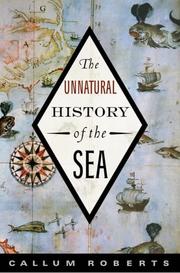
The Unnatural History of the Sea
Explores human encounters with the ocean and changing perceptions of marine mysteries.
eBay marketplace picks
Marketplace Samples
Live-tested eBay searches with available results related to this page.

Endnotes
1.
Source: researchgate.net
Title: Research Gate(PDF) Bioluminescence in the Sea
Link:https://www.researchgate.net/publication/49667852_Bioluminescence_in_the_Sea
Source snippet
ResearchGate(PDF) Bioluminescence in the SeaJanuary 15, 2010 — This review explores recent advances, including the chemical and molecular...
Published: January 15, 2010
Additional References
2.
Source: instagram.com
Link:https://www.instagram.com/reel/DZV1tbwRvlV/
Source snippet
us uses its intelligence and unique capabilities to aid in the creation of...
3.
Source: facebook.com
Link:https://www.facebook.com/Ranker/posts/sailors-and-ocean-enthusiasts-describe-the-creepiest-thing-theyve-seen-at-sea-/1360766626085352/
Source snippet
Sailors And Ocean Enthusiasts Describe The Creepiest...At sunrise, I discovered a large serpent, or sea monster, coming down the bay...
4.
Source: youtube.com
Title: DRAIN THE OCEANS: The Greatest Mysteries of the Pacific Ocean
Link:https://www.youtube.com/watch?v=gQmXq36Q_Ik
Source snippet
"MARINE BIOLOGY: What Causes Bioluminescence in the Ocean?[https://www.youtube.com/watch?v=gbu5R-jpHE4..."](https://www.youtube.com/watch?v=gbu5R-jpHE4...")...
5.
Source: youtube.com
Title: NATIONAL GEOGRAPHIC: Glowing Waves and Deep Sea Mysteries Explained
Link:https://www.youtube.com/watch?v=HNAHeRV2gWY
Source snippet
DRAIN THE OCEANS: The Greatest Mysteries of the Pacific Ocean...
6.
Source: youtube.com
Title: NATIONAL GEOGRAPHIC: Why the Pacific Ocean Is So Mysterious
Link:https://www.youtube.com/watch?v=NTxYag55q3Q
Source snippet
NATIONAL GEOGRAPHIC: Glowing Waves and Deep Sea Mysteries Explained...
7.
Source: youtube.com
Title: THE ROYAL INSTITUTION: The Science of Magical Glowing Seas
Link:https://www.youtube.com/watch?v=sE-589FPA5s
8.
Source: youtube.com
Link:https://www.youtube.com/watch?v=gbu5R-jpHE4
Source snippet
THE ROYAL INSTITUTION: The Science of Magical Glowing Seas...
Topic Tree