Within Libya Weird
Did Space Fire Make Libyan Desert Glass?
Libyan Desert Glass is a real yellow natural glass whose likely cosmic origin keeps science close to Fortean wonder.
On this page
- Where the yellow glass is found
- Tutankhamun, tools and ancient use
- Impact, airburst and missing crater debates
Page outline Jump by section
Introduction
Libyan Desert Glass is one of the few genuinely mysterious natural objects that comfortably sits between mainstream geology and Fortean fascination. Scattered across the Great Sand Sea on the Libya–Egypt border, the translucent yellow glass is entirely real, around 29 million years old, and so unusual that pieces were prized by prehistoric toolmakers and later found in the jewellery of the Egyptian pharaoh Tutankhamun. The mystery is not whether the glass exists but how it formed. Scientists agree that it records an extraordinarily energetic event involving material from space. What they still debate is whether that event was a direct meteorite impact, a gigantic atmospheric explosion, or an impact whose crater has since vanished beneath the Sahara. That unresolved question has made Libyan Desert Glass one of North Africa’s most enduring geological mysteries rather than a supernatural one.[Phys.org]phys.orgLibyan desert's yellow glass: How we discovered the origin…November 21, 2023 — 21 Nov 2023 — It was first described in a scientific pa…

Where the yellow glass is found
Libyan Desert Glass, also called Great Sand Sea Glass, occurs across a broad strewn field in the Great Sand Sea, extending across eastern Libya and western Egypt. The glass lies among gravel plains and between massive sand dunes rather than in a single concentrated deposit. Individual fragments range from tiny chips to lumps weighing several kilograms, with colours varying from pale straw yellow to greenish gold.[Wikipedia]WikipediaLibyan desert glassLibyan desert glass
Unlike volcanic obsidian, the glass is extraordinarily rich in silica, often approaching 98 percent. It also contains unusual inclusions, bubbles and streaks that preserve clues about the violent conditions under which it formed. The Sahara’s extremely dry climate has helped preserve these fragments for tens of millions of years with surprisingly little chemical alteration.[DIVA Portal]diva-portal.orgDIVA PortalLibyan Desert Glass: Specimen Collection at the Great…December 3, 2024 — by A Barghathi · 2024 — Libyan desert glass (LDG)…
For travellers and early explorers, the scattered yellow stones looked almost unnatural. Before their origin was investigated scientifically, suggestions ranged from volcanic activity to lightning strikes and even the remains of ancient furnaces. Modern geological analysis has eliminated those ideas, but the cosmic explanation has proved more complicated than expected.
Tutankhamun, tools and ancient use
Long before modern scientists became interested in Libyan Desert Glass, people recognised that it was unusual.
During the Late Stone Age, the glass was worked into blades, scrapers and other cutting tools. Because it fractures with razor-sharp edges, it could be knapped much like flint or obsidian. Archaeological discoveries show that prehistoric communities deliberately collected and transported it rather than simply using whatever stone happened to be nearby.[Wikipedia]WikipediaLibyan desert glassLibyan desert glass
Its most famous appearance came thousands of years later in ancient Egypt. A carved scarab beetle made from Libyan Desert Glass forms the centrepiece of one of the elaborate pectorals recovered from Tutankhamun’s tomb. Although the Egyptians almost certainly had no idea how the material had formed, they clearly regarded it as precious enough for royal jewellery.
This connection gives the glass an unusual place in cultural history. It is simultaneously:
- a geological curiosity nearly 29 million years old;
- an archaeological material used by prehistoric peoples;
- a luxury gemstone chosen for a pharaoh’s burial;
- and a continuing scientific puzzle.
The presence of the scarab has also helped keep the mystery alive in popular books, documentaries and museum displays, where the object often becomes a gateway into the larger question of the glass’s origin.[Phys.org]phys.orgLibyan desert's yellow glass: How we discovered the origin…November 21, 2023 — 21 Nov 2023 — It was first described in a scientific pa…
Why scientists know something extraordinary happened
Although the exact mechanism remains debated, there is little dispute that Libyan Desert Glass required temperatures far beyond ordinary desert conditions.
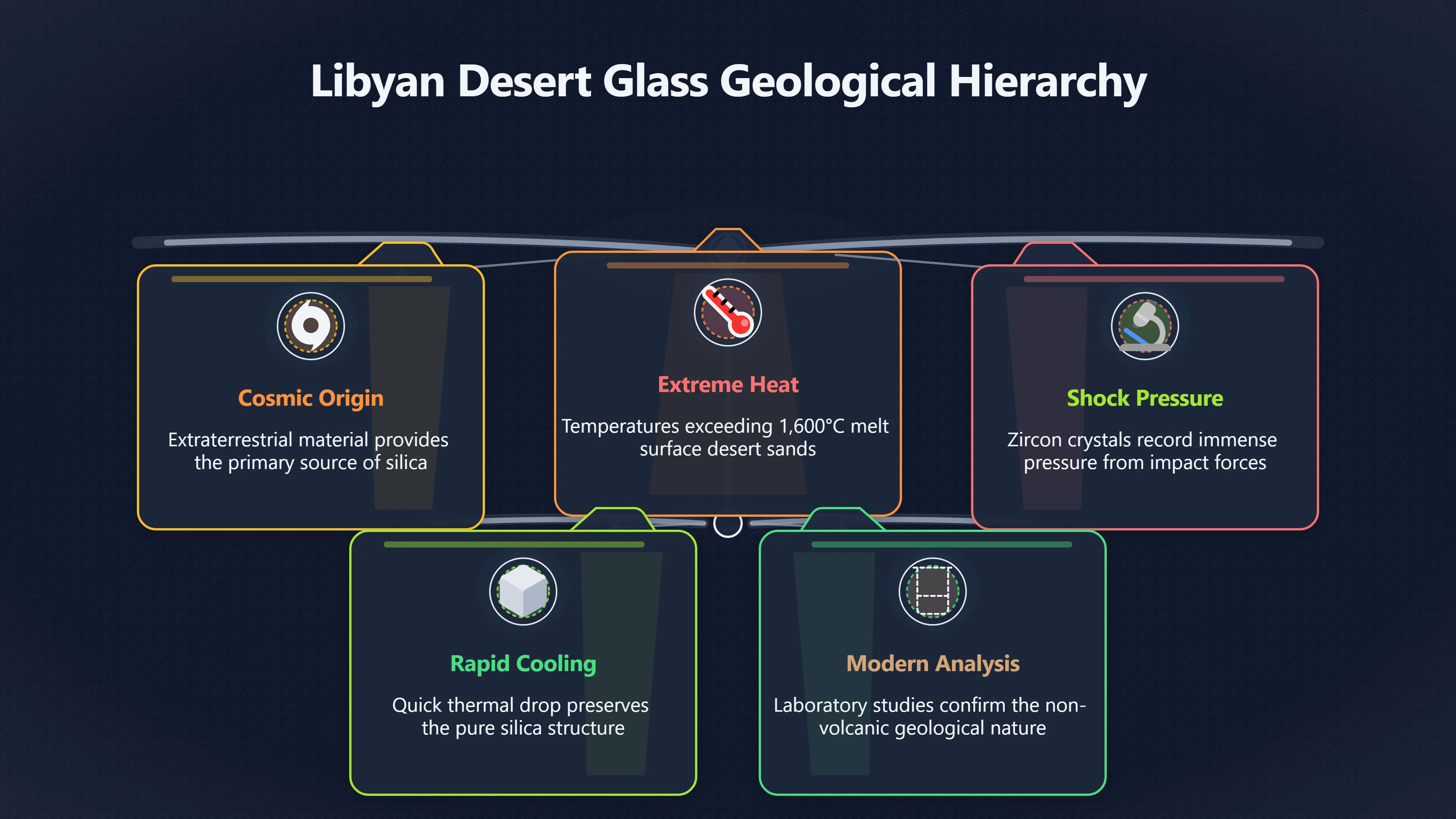
Producing such pure silica glass demands temperatures exceeding roughly 1,600°C, and probably considerably higher in places. Laboratory studies have identified microscopic minerals that record immense pressures and rapid cooling, pointing towards an event involving an extraterrestrial impact rather than conventional geological processes.[Wikipedia]WikipediaLibyan desert glassLibyan desert glass
One particularly important line of evidence comes from zircon crystals trapped inside the glass. Modern microscopic analysis has found crystal structures associated with extreme shock pressures. These minerals act almost like geological memory chips, preserving evidence of conditions that ordinary volcanic heat cannot reproduce. Studies published from 2019 onwards strengthened the case that a genuine impact event occurred somewhere in the region, even if the precise location remains uncertain.[Wikipedia]WikipediaLibyan desert glassLibyan desert glass
For geologists, this shifted the debate. The question became less “Did something from space cause this?” and more “Exactly what kind of cosmic event was it?”

Why is there no obvious crater?
This is the question that gives Libyan Desert Glass its Fortean appeal.[Wikipedia]WikipediaLibyan desert glassLibyan desert glass
Many famous impact events leave spectacular craters. Libyan Desert Glass does not appear to have one that can be confidently linked to its formation.
Several explanations have been proposed.
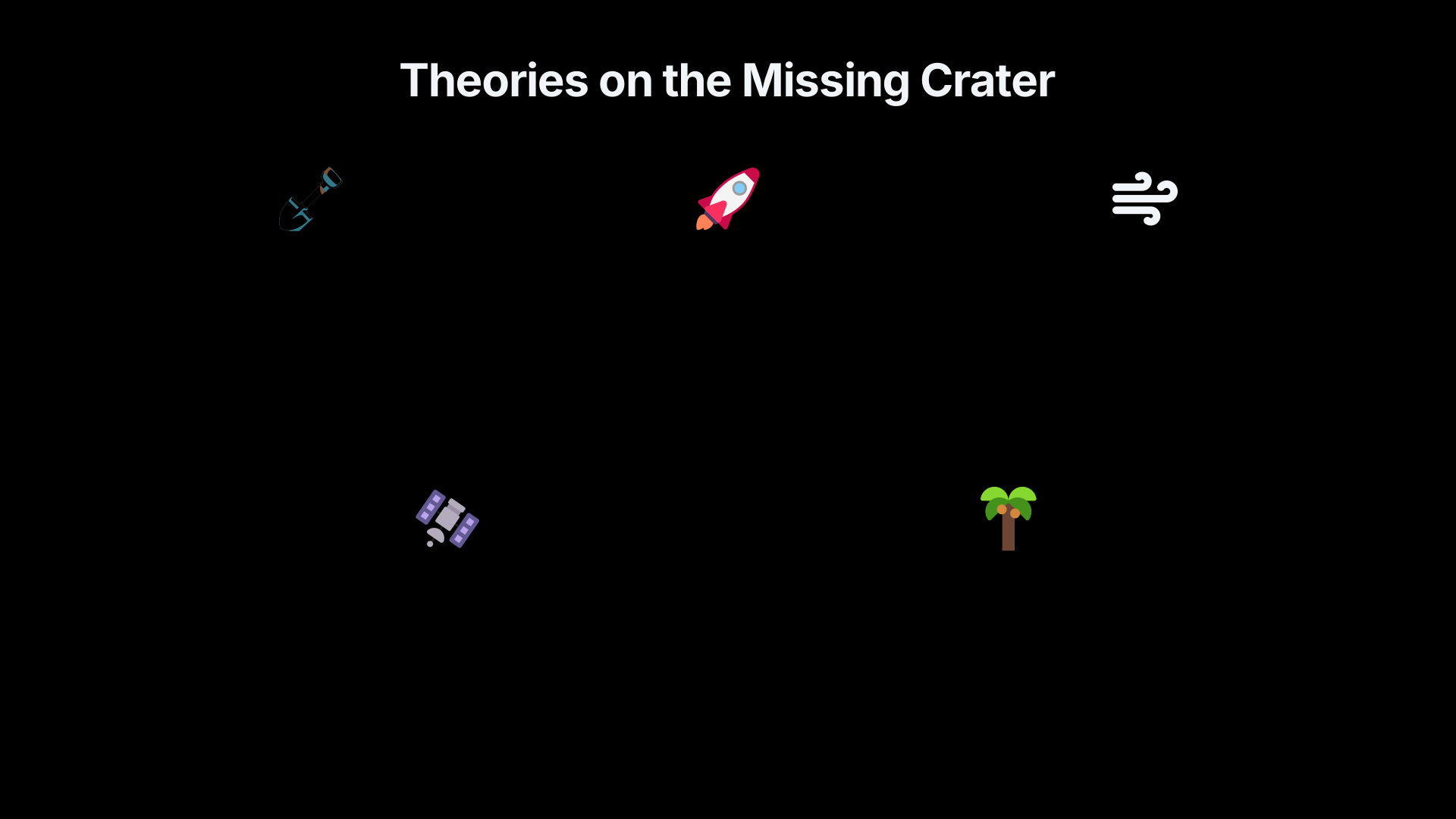
A buried crater. One possibility is that the responsible crater lies hidden beneath younger sediments or vast shifting dunes. Thirty million years of erosion, tectonic change and sand movement could easily disguise a relatively modest impact structure.
An airburst. Another influential idea suggested that a large asteroid or comet exploded in the atmosphere before striking the ground. The enormous flash of heat could have melted surface sands into glass without excavating a classic crater, drawing comparisons with the much smaller 1908 Tunguska explosion in Siberia. This explanation gained attention during the 2000s because it neatly accounted for the missing crater.[Mini Museum]shop.minimuseum.comMini Museum Libyan Desert Glass: The Rock of GodMini MuseumLibyan Desert Glass: The Rock of GodFebruary 2, 2024 — 2 Feb 2024 — Due to the lack of any visible impact crater, the most lik…
A conventional impact. More recent studies of shock minerals have challenged the pure airburst model. The extreme pressures recorded inside zircon crystals appear difficult to generate solely through an atmospheric explosion, suggesting that at least some direct impact was involved.[Wikipedia]WikipediaLibyan desert glassLibyan desert glass
Rather than settling the argument, these discoveries have narrowed it. Few researchers now doubt a cosmic origin, but they continue debating exactly how the event unfolded.
The search for the missing impact site
Several candidate structures have periodically been proposed as the source of the glass.
The vast feature known as Kebira, identified through satellite imagery near the Libya–Egypt border, attracted attention because of its enormous size and location. Some researchers suggested it might represent an ancient impact basin capable of producing the glass. Others argued that the evidence was insufficient and that the circular landforms could instead reflect ordinary geological erosion and drainage patterns. As a result, Kebira has never achieved acceptance as a confirmed impact crater.[Wikipedia]WikipediaKebira CraterKebira Crater
Other nearby structures, including the Oasis impact crater in Libya, have also entered discussions about regional impact history. However, none has been convincingly demonstrated to be the direct source of Libyan Desert Glass.
This uncertainty often surprises readers because the evidence for an impact event is stronger than the evidence for its precise location. In effect, scientists possess convincing clues about the violence of the event while still lacking the crime scene.
Why the mystery remains compelling
Libyan Desert Glass illustrates a recurring theme in Libya’s stranger history: genuine scientific uncertainty can feel more remarkable than paranormal speculation.
Unlike many Fortean stories, the central mystery has narrowed over time rather than expanding into increasingly extravagant claims. Improved laboratory techniques have strengthened the evidence for an exceptionally energetic cosmic event while eliminating several earlier explanations. Yet each scientific advance has highlighted another puzzle, particularly the absence of an undisputed crater.
That combination makes the glass unusually satisfying from a Fortean perspective. There is no need to invoke lost civilisations, alien technology or supernatural forces. The confirmed facts are already extraordinary: nearly thirty million years ago, somewhere above or within the Sahara, an event of immense energy transformed ordinary desert sand into one of Earth’s purest natural glasses. Fragments of that event later became prehistoric tools, royal jewellery and, today, one of Libya’s most intriguing intersections between archaeology, geology and enduring mystery.
Amazon book picks
Further Reading
Books and field guides related to Did Space Fire Make Libyan Desert Glass?. Use these as the next step if you want deeper reading beyond the article.
Rocks from Space
Explains impacts, meteorites and related geological phenomena behind desert glass.

Meteorites
Contains several previously unpublished accounts of meteorite recoveries in Australia and provides deatails on many Australian contributi...
eBay marketplace picks
Marketplace Samples
Live-tested eBay searches with available results related to this page.

Endnotes
1.
Source: phys.org
Link:https://phys.org/news/2023-11-libyan-yellow-glass-rare-mysterious.html
Source snippet
Libyan desert's yellow glass: How we discovered the origin...November 21, 2023 — 21 Nov 2023 — It was first described in a scientific pa...
Published: November 21, 2023
2.
Source: Wikipedia
Title: Libyan desert glass
Link:https://en.wikipedia.org/wiki/Libyan_desert_glass
3.
Source: diva-portal.org
Link:https://www.diva-portal.org/smash/get/diva2%3A1918097/FULLTEXT01.pdf
Source snippet
DIVA PortalLibyan Desert Glass: Specimen Collection at the Great...December 3, 2024 — by A Barghathi · 2024 — Libyan desert glass (LDG)...
Published: December 3, 2024
4.
Source: Wikipedia
Title: Kebira Crater
Link:https://en.wikipedia.org/wiki/Kebira_Crater
5.
Source: shop.minimuseum.com
Title: Mini Museum Libyan Desert Glass: The Rock of God
Link:https://shop.minimuseum.com/blogs/specimens/libyan-desert-glass-the-rock-of-god?srsltid=AfmBOop6wWHUG6L3JigKBjYRE_GQ0EnpBk6iKHhWjnwjJgOdKozYqkcW
Source snippet
Mini MuseumLibyan Desert Glass: The Rock of GodFebruary 2, 2024 — 2 Feb 2024 — Due to the lack of any visible impact crater, the most lik...
Published: February 2, 2024
6.
Source: egyptunitedtours.com
Title: great sand sea glass
Link:https://egyptunitedtours.com/great-sand-sea-glass/
Source snippet
This theory explains: The absence of a large impact crater. The widespread distribution of glass. The...Read more...
Additional References
7.
Source: geoscopy.com
Link:https://geoscopy.com/libyan-desert-glass-king-tuts-scarab-the-impact-debate/
Source snippet
Libyan Desert Glass: King Tut's Scarab & the Impact DebateDiscover how Libyan Desert Glass, a 29 million year old Sahara impact melt, was...
8.
Source: researchgate.net
Link:https://www.researchgate.net/publication/232415261_Libyan_Desert_Glass_has_the_enigma_of_its_origin_been_resolved
Source snippet
Libyan Desert Glass: has the enigma of its origin been...Libyan Desert Glass is a silica-rich natural glass, found strewn over an area o...
9.
Source: gemrockauctions.com
Title: Discover its origin, rarity, and value in this
Link:https://www.gemrockauctions.com/learn/a-z-of-gemstones/libyan-desert-glass?srsltid=AfmBOopv5WjC32430IQCX60IP-CB4whv3yuqervfcfWQBn4zDQt0eWag
Source snippet
Libyan Desert Glass: King Tut's Treasure, Ancient Origins...Libyan Desert Glass is a rare golden impact glass formed millions of years a...
10.
Source: youtube.com
Title: Mystery of Libyan Desert Glass • Extraterrestrial Origin? | Christian Köberl
Link:https://www.youtube.com/watch?v=ttzovNjdp_E
Source snippet
Impactites Explained ☄️What happens when a METEORITE hits Earth?! Asteroid Impact Tektite Moldavite...
11.
Source: youtube.com
Title: The Mystery of Libyan Desert Glass
Link:https://www.youtube.com/watch?v=WqiPjFTT4CM
Source snippet
Mystery of Libyan Desert Glass • Extraterrestrial Origin? | Christian Köberl...
12.
Source: facebook.com
Link:https://www.facebook.com/awesomevideoss/posts/a-stunning-new-discovery-is-deepening-the-mystery-surrounding-the-famous-yellow-/1282210754072807/
13.
Source: youtube.com
Link:https://www.youtube.com/watch?v=1rnX3ve9-qg
14.
Source: youtube.com
Title: What is Libyan Desert Glass
Link:https://www.youtube.com/watch?v=lUpwK-b0aBU
Source snippet
Libyan Desert Glass; A Mysterious Gift From Space...
15.
Source: youtube.com
Title: Libyan Desert Glass; A Mysterious Gift From Space
Link:https://www.youtube.com/watch?v=jGbqjozrL_I
Source snippet
The Mystery of Libyan Desert Glass...
Topic Tree