Where Equatorial Guinea Keeps Its Strange Stories
Equatorial Guinea’s strange-history record is less a catalogue of famous UFO flaps or newspaper monsters than a quieter, more revealing mix of sacred landscapes, spirit geography, oral epic, witchcraft fears, and the unnerving power of rainforest ecology.
Page outline Jump by section
Why Equatorial Guinea has few famous “classic” anomalies
Readers looking for a neatly documented Equatorial Guinean equivalent of Loch Ness, Roswell, or a spectacular “rain of frogs” case will quickly run into a problem: the public record is thin. That does not mean the country has no strange traditions. It means the material is carried more often through oral literature, local ritual knowledge, missionary and anthropological writing, and recent social rumour than through widely digitised newspapers or English-language paranormal catalogues.
This matters for credibility. A modern UFO database such as Enigma Labs states that it has not yet received UFO sighting reports from Equatorial Guinea, which is useful negative evidence: it does not prove that nobody has ever reported strange lights there, but it does show that the country is not, at present, represented by a robust public UFO-reporting trail in that database.[Enigma Labs | Report a UFO sighting]enigmalabs.ioOpen source on enigmalabs.io.
The same caution applies to anomalous “falls” of fish, frogs or other animals. Such events are a classic Fortean motif worldwide, but there is no strong, specific public case tied to Equatorial Guinea in the accessible sources checked here. The general explanation for many animal-rain reports is not supernatural: the Library of Congress notes that updrafts and waterspouts can plausibly carry lightweight animals or debris, while also warning that many historical accounts are second-hand or misread storm effects.[The Library of Congress]loc.govOpen source on loc.gov.
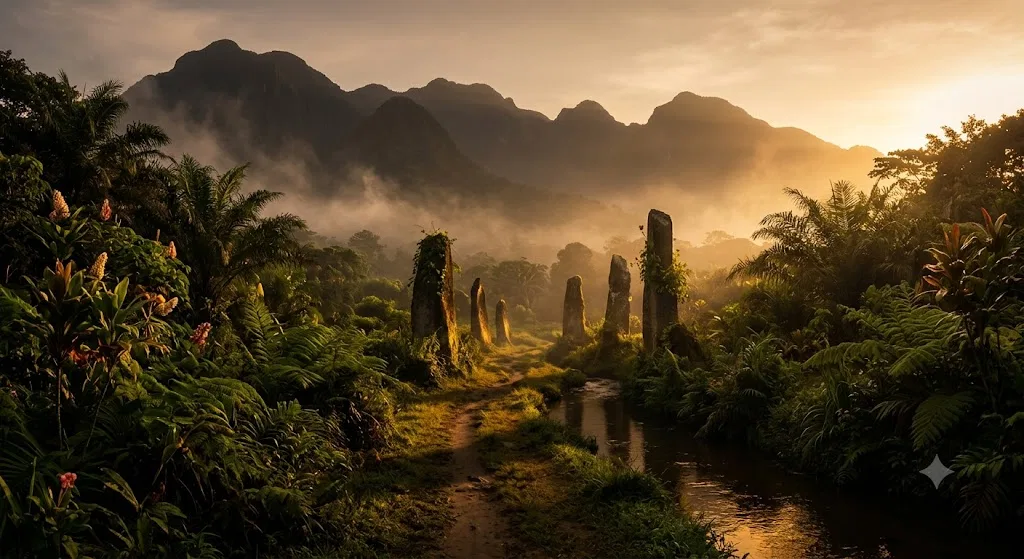
So the best approach is not to inflate weak material. Equatorial Guinea’s strongest weird-history evidence lies in the meeting point of folklore, sacred place, oral performance, witchcraft belief and a landscape that is genuinely dramatic: volcanic islands, high rainfall, dense forest, endangered primates, caves, crater regions and difficult-to-survey terrain. UNESCO’s profile of Bioko describes an island of lowland rainforest, high-altitude Afro-montane forest, sharp microclimates and exceptional rainfall in the south, with distinctive and threatened fauna including drills, black colobus monkeys, duikers and pangolins.[UNESCO]unesco.orgIsla de BiokoIsla de Bioko
Bioko’s sacred geography: stones, lakes and spirit places
The richest country-specific material comes from Bioko, the volcanic island long associated with the Bubi people. Archaeological work describes Bioko as unusual and under-researched: the island was populated by the Bubi at an early stage of the Bantu expansion, yet its archaeological sequence remains poorly understood, with many earlier records depending on colonial-period work and later academic reconstruction.[ResearchGate]researchgate.netOpen source on researchgate.net.
That patchy evidence makes the surviving ritual geography more important. Archaeological discussion of Bioko notes standing stones of different sizes associated with cults or spirits, including stones linked to child protection, fertility and continuing Bubi rites. These are not “mystery monuments” in the sensational sense; they are culturally meaningful ritual objects whose interpretation depends on Bubi tradition, colonial documentation and later scholarship.[ResearchGate]researchgate.netOpen source on researchgate.net.
Bubi belief is especially place-based. A SAGE reference entry on Equatorial Guinea’s music and culture describes the Bubi as the autochthonous people of Bioko, with a rich belief system involving Ruppé and Bisila as principles from which spirits of creation, heroes and humanly relevant powers emerge. It also notes numerous sacred places: menhirs, caves, rivers, mountains and waterfalls.[ResearchGate]researchgate.net397639846 ARANZADI 2019 Equatorial Guinea History Culture and Geography of Music397639846 ARANZADI 2019 Equatorial Guinea History Culture and Geography of Music
A translated overview of Father Antonio Aymemí’s work on the Bubi gives the most vivid sense of how this becomes Fortean material. It describes a world in which Bioko is shared by human communities and good or bad spirits, where misfortune, sickness and injury may be attributed to hostile spiritual forces. Village approaches could be marked by arches hung with amulets, bones, feathers, horns and shells, intended to block bad spirits and recall the ancestors.[The Bubis]thebubis.comOpen source on thebubis.com.
The same account links distinctive landmarks with named spiritual powers: Pico Basilé, Lake Claret, lagoons, caves, rivers and grottoes are presented not merely as scenery but as charged points in a spiritual map. For a Fortean reader, the key point is not that the spirits can be verified as external beings. It is that place, memory, fear, healing and social order are fused into a landscape where unusual stones, caves and waters are not inert curiosities but active signs.[The Bubis]thebubis.comOpen source on thebubis.com.

Fang epic and the ambiguous monster
On the mainland, the strongest weird-history thread runs through Fang oral tradition, especially the mvet: both a musical instrument and a performance tradition used for epic stories, genealogy, philosophy and myth. Isabela de Aranzadi’s SAGE entry describes the Fang as Equatorial Guinea’s largest ethnic group and notes that the mvet is sung by troubadours who perform epic topics, love songs and genealogies. The stories include the great deeds of the Ekang, described as immortals and mythical representations of Fang thought.[ResearchGate]researchgate.net397639846 ARANZADI 2019 Equatorial Guinea History Culture and Geography of Music397639846 ARANZADI 2019 Equatorial Guinea History Culture and Geography of Music
This is where “monster” material belongs in Equatorial Guinea: not as a zoological claim first, but as a narrative being inside performance. The creature most often surfaced in modern English-language Fortean searches is the Ebigane, described in a folklore bestiary as an ambiguous Fang monster known in Cameroon, Gabon and Equatorial Guinea, able to appear as animal, human or a mixture of both, and associated with mvet legends.[A Book of Creatures]abookofcreatures.comA Book of Creatures EbiganeA Book of Creatures Ebigane
That ambiguity is the point. The Ebigane is not useful because it gives cryptozoologists a checklist animal to hunt. It is useful because it shows how Fang narrative can blur categories that modern readers often try to keep separate: human and animal, ancestor and monster, history and myth, performance and warning. The strangeness sits in the story-world, not in a carcass, photograph or formal sighting report.
A sceptical reading would treat the Ebigane as folklore: a meaningful monster of oral epic rather than an undiscovered species. A believer, or at least a tradition-minded listener, might treat it as a sign that the visible forest is not the whole forest. The evidence supports the first reading more strongly, but the second explains why such beings remain memorable.
Ekong: the zombie of modern wealth
The most striking modern uncanny motif in Equatorial Guinea is ekong, a witchcraft idea documented by anthropologist Josep Martí Pérez. A CSIC record identifies Martí’s article as “Witchcraft between Tradition and Modernity: the Ekong Case in Equatorial Guinea”, with keywords including ekong, witchcraft and beliefs.[Digital CSIC]digital.csic.esOpen source on csic.es.
The belief is unsettling because it sounds almost like a Central African zombie economy. In the accessible summary of Martí’s Spanish-language work, ekong is described as a relatively modern form of witchcraft in which a specialist transforms victims into “living dead” or post-mortem workers forced to labour for another person’s benefit. The field data were gathered in Bata in 2006 and 2007, making this not merely a remote “ancient superstition” but a contemporary urban and social concern.[Scribd]es.scribd.comOpen source on scribd.com.
Other scholarship on Equatorial Guinea’s social imagination connects similar ekong or kong ideas with wealth, betrayal and political fear. A doctoral thesis discussing Malabo notes that ekong is among the newer and popular forms of witchcraft in Equatorial Guinea, in which a witch steals a victim’s body from the grave so the dead person works like a zombie to enrich the witch.[ERA]era.ed.ac.ukOpen source on ed.ac.uk.
This is classic modern Forteana because the “monster” is also a social theory. Ekong stories ask where sudden wealth comes from, who has been sacrificed for it, and whether prosperity is built on invisible exploitation. In that sense, the rumour is not random horror. It translates anxieties about inequality, kinship, labour and political power into a frighteningly concrete image: the dead working out of sight.
A grounded interpretation does not need to treat ekong as literal necromancy. It can be read as a form of moral accusation and social explanation, especially in a country where oil wealth, authoritarian rule and inequality have shaped modern life. Minority Rights Group describes severe repression of Bubi political activity under the Nguema regimes, while recent reporting continues to frame Equatorial Guinea as a country marked by concentrated power and rights concerns.[Minority Rights Group]minorityrights.orgMinority Rights Group Bubi in Equatorial GuineaMinority Rights Group Bubi in Equatorial Guinea
Spirits, healing and the sound of protection
Equatorial Guinea’s uncanny traditions are not all frightening. Many are protective, therapeutic or communal. In Bubi ritual culture, sound itself can have a cleansing or spirit-addressing role. Aranzadi notes that the Bubi traditionally did not use drums in the same way as neighbouring groups; instead, the elëbbó bell is described as an instrument used to cleanse evil, symbolise particular spirits, evoke them and assist in curing rituals.[ResearchGate]researchgate.net397639846 ARANZADI 2019 Equatorial Guinea History Culture and Geography of Music397639846 ARANZADI 2019 Equatorial Guinea History Culture and Geography of Music
The same source describes other Bubi instruments and sound-making practices used in ceremony, communication and spirit address, including sounding seeds, flute, bow, calabashes, stones, sticks and clapping. Some instruments could communicate news or send messages to spirits.[ResearchGate]researchgate.net397639846 ARANZADI 2019 Equatorial Guinea History Culture and Geography of Music397639846 ARANZADI 2019 Equatorial Guinea History Culture and Geography of Music
That detail changes how a reader should understand “haunting” in this context. The relevant question is not simply “Do people believe in ghosts?” but “How do communities manage a world where misfortune, illness and place may have spiritual dimensions?” The answer, in Bubi material, involves sound, sacred objects, place-specific powers, ancestors and ritual boundaries.
Encyclopedia.com’s general profile of Equatorial Guineans also notes that Christianity is widespread while traditional beliefs remain, including a supreme being and lower-level spirits that may assist people or bring misfortune. It describes elaborate Bubi funeral rites involving belief in an afterlife and reincarnation, with grave goods left for the dead and sacred planting at the grave.[Encyclopedia.com]encyclopedia.comEquatorial Guineans | Encyclopedia.comEquatorial Guineans | Encyclopedia.com
Rainforest animals and the making of “mystery beasts”
Equatorial Guinea is one of those countries where ordinary zoology is already strange enough to feed legends. Bioko’s forests contain endangered primates and other elusive mammals; the island’s terrain and rainfall make observation difficult; and hunting, habitat pressure and restricted research access complicate what outsiders can confidently say about wildlife. UNESCO’s Bioko profile highlights both the island’s ecological richness and conservation challenges, including threats from hunting to distinctive mammals.[UNESCO]unesco.orgIsla de BiokoIsla de Bioko
That matters because many “mystery animal” traditions worldwide begin in real encounters with rare, nocturnal, endangered or misidentified creatures. A drill glimpsed in dense forest, a pangolin seen briefly at night, a turaco heard but not seen, or a duiker moving through undergrowth can easily become bigger in retelling. This does not debunk local tradition; it explains why the border between animal knowledge and monster story is porous.
The country’s lack of a famous lake monster is therefore not a failure of weirdness. It may simply reflect the kind of environment Equatorial Guinea has. Its strange animal stories are more likely to emerge from rainforest margins, hunting paths, sacred groves, night sounds and oral epic than from a tourist-branded lake creature with a nickname and souvenir postcards.
The archive problem: why silence is not absence
Equatorial Guinea’s Fortean record is shaped by an archive problem. The country is small, multilingual, politically sensitive and historically under-researched in many fields. Gomashie’s study of language in Equatorial Guinea notes that indigenous languages are mostly oral in tradition and are used in family settings, folklore, music and religion, while some are threatened when they stop being transmitted to children.[Instituto Cervantes]cervantes.esOpen source on cervantes.es.
That matters for strange-history research because oral traditions are vulnerable. If a ghost story, monster warning or spirit-place narrative is not recorded in a searchable newspaper or digitised book, it can look invisible to outsiders even when it is locally meaningful. Conversely, when a fragment does appear online, it may be over-amplified by paranormal writers because there is so little else to compare it with.
Bioko’s archaeology shows a similar issue. Clist and de Maret describe the island as important but insufficiently studied, with research interrupted after independence and a long period of inactivity before later work resumed. They also note that many available sequences depend on limited excavations and older colonial-era documentation.[ResearchGate]researchgate.netOpen source on researchgate.net.
For the reader, the safest conclusion is this: Equatorial Guinea almost certainly has more local strange stories than the public English-language web reveals, but the strongest available evidence supports a careful page about sacred landscapes, oral monsters and witchcraft modernity rather than a dramatic list of “unexplained incidents”.
How sceptics and believers read the same material
The same Equatorial Guinean traditions can be read in several ways, and the fairest treatment keeps those readings separate.
As folklore: Bubi spirit places, Fang epic beings and ekong stories can be understood as symbolic systems that help communities discuss illness, fertility, danger, wealth, death and belonging. This is the strongest evidence-based reading because the sources document beliefs, rituals and narratives rather than physical proof of paranormal events.[researchgate.net]researchgate.net397639846 ARANZADI 2019 Equatorial Guinea History Culture and Geography of Music397639846 ARANZADI 2019 Equatorial Guinea History Culture and Geography of Music
As social diagnosis: Ekong, especially, makes sense as a story about modernity. It turns invisible labour, sudden enrichment and mistrust into an image of the dead being exploited for profit. That does not make the belief “false” in a simple way; it makes it socially revealing.[Scribd]es.scribd.comOpen source on scribd.com.
As sacred geography: For tradition bearers, mountains, lakes, caves and stones may not be metaphors. They may be places where spiritual relations are maintained. Outside readers should not flatten that into either credulity or dismissal. The stronger question is what those places do in community memory.[The Bubis]thebubis.comOpen source on thebubis.com.
As possible misidentification: Where strange animals, lights or falls are concerned, natural explanations should be considered first. Rainforest ecology, weather, animal behaviour, oral exaggeration and second-hand reporting can produce sincere but mistaken accounts. The Library of Congress makes the same point for animal-rain reports generally: some are plausible, many are misread storm effects, and historical testimony is often unreliable.[The Library of Congress]loc.govOpen source on loc.gov.
Why Equatorial Guinea belongs in a Fortean country guide
Equatorial Guinea’s weird-history profile is subtle but distinctive. It is not built around a single globally famous mystery. It is built around the fact that the country’s landscapes and social history make the uncanny feel embedded: Bioko’s sacred stones and spirit sites, Fang mythic performance, Bubi sound rituals, ekong witchcraft fears, threatened languages, thin archives and dense rainforest all point to a world where the strange is remembered through place, performance and rumour rather than through police reports or tabloid clippings.
The most responsible summary is therefore not “Equatorial Guinea is full of unexplained phenomena.” It is this: Equatorial Guinea preserves a rich but unevenly documented body of strange tradition, strongest where folklore, ritual, ecology and social anxiety overlap. Its Forteana is less about proving monsters and more about understanding how people map danger, power, ancestry and uncertainty onto the places they live.
Amazon book picks
Further Reading
Books and field guides related to Where Equatorial Guinea Keeps Its Strange Stories. Use these as the next step if you want deeper reading beyond the article.

Africa is not a country
Provides broader context for understanding African traditions.
The palm-wine drinkard and his dead palm-wine tapster in the...
First published 1952. Subjects: Fiction, Yoruba (African people), Folklore, Wine and wine making, Nigeria, fiction.
eBay marketplace picks
Marketplace Samples
Live-tested eBay searches with available results related to this page.
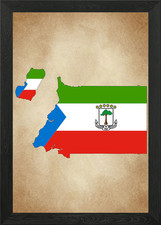
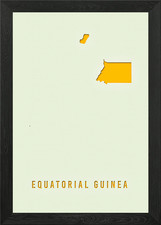
Endnotes
1.
Source: researchgate.net
Title: 397639846 ARANZADI 2019 Equatorial Guinea History Culture and Geography of Music
Link:https://www.researchgate.net/publication/397639846ARANZADI_2019_Equatorial-_Guinea_History_Culture_and_Geography_of_Music
2.
Source: researchgate.net
Link:https://www.researchgate.net/publication/348587961_The_Carboneras_Beach_archaeological_site_on_Bioko_Island_Equatorial_Guinea_old_data_and_new_stories_about_a_unique_culture
3.
Source: digital.csic.es
Link:https://digital.csic.es/handle/10261/81458?locale=en
4.
Source: enigmalabs.io
Link:https://enigmalabs.io/explore/gq
5.
Source: unesco.org
Title: Isla de Bioko
Link:https://www.unesco.org/en/mab/isla-de-bioko
6.
Source: es.scribd.com
Link:https://es.scribd.com/document/187263776/ekong
7.
Source: era.ed.ac.uk
Link:https://era.ed.ac.uk/bitstream/handle/1842/35440/Carter2014.pdf?isAllowed=y&sequence=2
8.
Source: encyclopedia.com
Title: Equatorial Guineans | Encyclopedia.com
Link:https://www.encyclopedia.com/international/encyclopedias-almanacs-transcripts-and-maps/equatorialguineans
9.
Source: cervantes.es
Link:https://www.cervantes.es/imagenes/file/biblioteca/situacion_espanol/guinea_ecuatorial_humanities.pdf
10.
Source: researchgate.net
Link:https://www.researchgate.net/publication/289900655_Contracts_with_spirits_and_crocodiles_magically_transformed_Witchcraft_in_Guinea-Bissau
11.
Source: researchgate.net
Title: 39402730 Algunas notas sobre el Ekong en Guinea Ecuatorial
Link:https://www.researchgate.net/publication/39402730_Algunas_notas_sobre_el_Ekong_en_Guinea_Ecuatorial
12.
Source: researchgate.net
Title: 231787865 Body power and sacrifice in Equatorial Africa
Link:https://www.researchgate.net/publication/231787865_Body_power_and_sacrifice_in_Equatorial_Africa
13.
Source: digital.csic.es
Title: Jornades12 MartiÌ
Link:https://digital.csic.es/bitstream/10261/8225/1/Jornades12_Marti%C3%8C%C2%81.pdf
14.
Source: digital.csic.es
Link:https://digital.csic.es/browse?etal=10&null=&offset=404049&order=ASC&rpp=20&sort_by=1&type=title
15.
Source: scribd.com
Link:https://www.scribd.com/document/964777271/Biological-Anomalies-Humans-I-William-R-Corliss
16.
Source: scribd.com
Link:https://www.scribd.com/document/706748547/AVM-PhD-THESIS
17.
Source: archive.org
Link:https://archive.org/stream/GeophysicalAnomalies/Geophysical%20Anomalies_djvu.txt
18.
Source: loc.gov
Link:https://www.loc.gov/everyday-mysteries/browse-all-questions/item/can-it-rain-frogs-fish-and-other-objects/
19.
Source: thebubis.com
Link:https://www.thebubis.com/Overview.html
20.
Source: abookofcreatures.com
Title: A Book of Creatures Ebigane
Link:https://abookofcreatures.com/2020/11/16/ebigane/
21.
Source: minorityrights.org
Title: Minority Rights Group Bubi in Equatorial Guinea
Link:https://minorityrights.org/communities/bubi/
22.
Source: Wikipedia
Title: Bubi people
Link:https://en.wikipedia.org/wiki/Bubi_people
23.
Source: Wikipedia
Title: Equatorial Guinea
Link:https://en.wikipedia.org/wiki/Equatorial_Guinea
24.
Source: minorityrights.org
Title: mrg brief put2021 asa4spreads
Link:https://minorityrights.org/app/uploads/2023/12/mrg-brief-put2021-asa4spreads.pdf
25.
Source: minorityrights.org
Title: download 649 full text
Link:https://minorityrights.org/app/uploads/2023/12/download-649-full-text.pdf
26.
Source: journals.openedition.org
Link:https://journals.openedition.org/etudesafricaines/pdf/18023
27.
Source: sk.sagepub.com
Title: equatorial guinea
Link:https://sk.sagepub.com/ency/edvol/globalreligion/chpt/equatorial-guinea
28.
Source: assets.publishing.service.gov.uk
Title: publishing.service.gov.uk Equatorial Guinea
Link:https://assets.publishing.service.gov.uk/media/695fb2f757e7407fe07765d8/Equatorial_Guinea_Toponymic_Factfile.pdf
29.
Source: abookofcreatures.com
Title: equatorial guinea
Link:https://abookofcreatures.com/category/equatorial-guinea/
Additional References
30.
Source: apnews.com
Link:https://apnews.com/article/d0e9fef2c7a7377da7b6f13acb097872
Source snippet
During his visit, the Pope denounced exploitation of African resources and inequality but stopped short of directly condemning the regime...
31.
Source: youtube.com
Title: The African Country No One Visits – The Truth About Equatorial Guinea
Link:https://www.youtube.com/watch?v=UrBA3o4zrhk
Source snippet
The most mysterious god of Equatorial Guinea - YouTube The most mysterious god of Equatorial Guinea - YouTube...
32.
Source: youtube.com
Title: The Bubi People: Guardians of Bioko’s Heritage
Link:https://www.youtube.com/watch?v=_7aUJrJaVl8
Source snippet
The African Country No One Visits – The Truth About Equatorial Guinea...
33.
Source: youtube.com
Title: The most mysterious god of Equatorial Guinea
Link:https://www.youtube.com/watch?v=PN_opIHyB2k
Source snippet
2 Hrs of Fang Mvet, Bantu Drums, Bubi Flute, and Bayele Forest Music...
34.
Source: academia.edu
Link:https://www.academia.edu/104742523/UFOs_Earthquakes_and_the_Straight_Line_Mystery_The_Answer_to_the_UFO_Enigma
35.
Source: instagram.com
Link:https://www.instagram.com/reel/CMKmMV9g3fW/
36.
Source: ethnologue.com
Link:https://www.ethnologue.com/language/bvb/
37.
Source: joshuaproject.net
Link:https://joshuaproject.net/people_groups/10977
38.
Source: ethnologue.com
Link:https://www.ethnologue.com/language/buw/
39.
Source: tribeguess.com
Link:https://www.tribeguess.com/learn/bubi
Topic Tree
Follow this branch
Related pages 192
- Afghan Forteana
- Antigua Uncanny
- Bosnian Mysteries
- Botswana Weird
- Brazil Strange
- +187 more in sidebar