Within Korea Strange
The Korean Monsters Behind Old Fears
Bulgasari and other Korean creatures show how monsters became symbols for power, greed and human fears rather than simple beasts.
On this page
- Bulgasari and the metal eating creature legend
- Other spirits and strange beings
- Monsters as cultural symbols
Page outline Jump by section
Introduction
Bulgasari is one of Korea’s strangest legendary creatures: a monster that cannot easily be killed, grows by eating metal, and turns human attempts to destroy it into fuel for its own power. Unlike many monster traditions where the creature represents an outside threat, Bulgasari is more complicated. In Korean folklore it can be both a disaster and a force of punishment, reflecting fears about oppression, uncontrolled desire and the consequences of creating something too powerful to control.[K-Occult]koccult.comK-Occult Bulgasari (The Iron-Eating Monster) — Korean Occult Archive – K-OccultK-Occult Bulgasari (The Iron-Eating Monster) — Korean Occult Archive – K-Occult
The legend belongs to a wider Korean tradition in which strange beings were not simply imaginary animals but symbols used to explore social tensions and moral questions. Monsters, spirits and hybrid creatures often represented dangers that were difficult to name directly: greed, injustice, illness, disorder or the fear that human actions could unleash forces beyond control. Bulgasari remains especially memorable because its unusual appetite — consuming iron instead of flesh — links a supernatural creature to everyday concerns about weapons, tools, labour and power.[K-Occult]koccult.comK-Occult Bulgasari (The Iron-Eating Monster) — Korean Occult Archive – K-OccultK-Occult Bulgasari (The Iron-Eating Monster) — Korean Occult Archive – K-Occult
Bulgasari and the metal-eating creature legend
A monster that grows from human anger
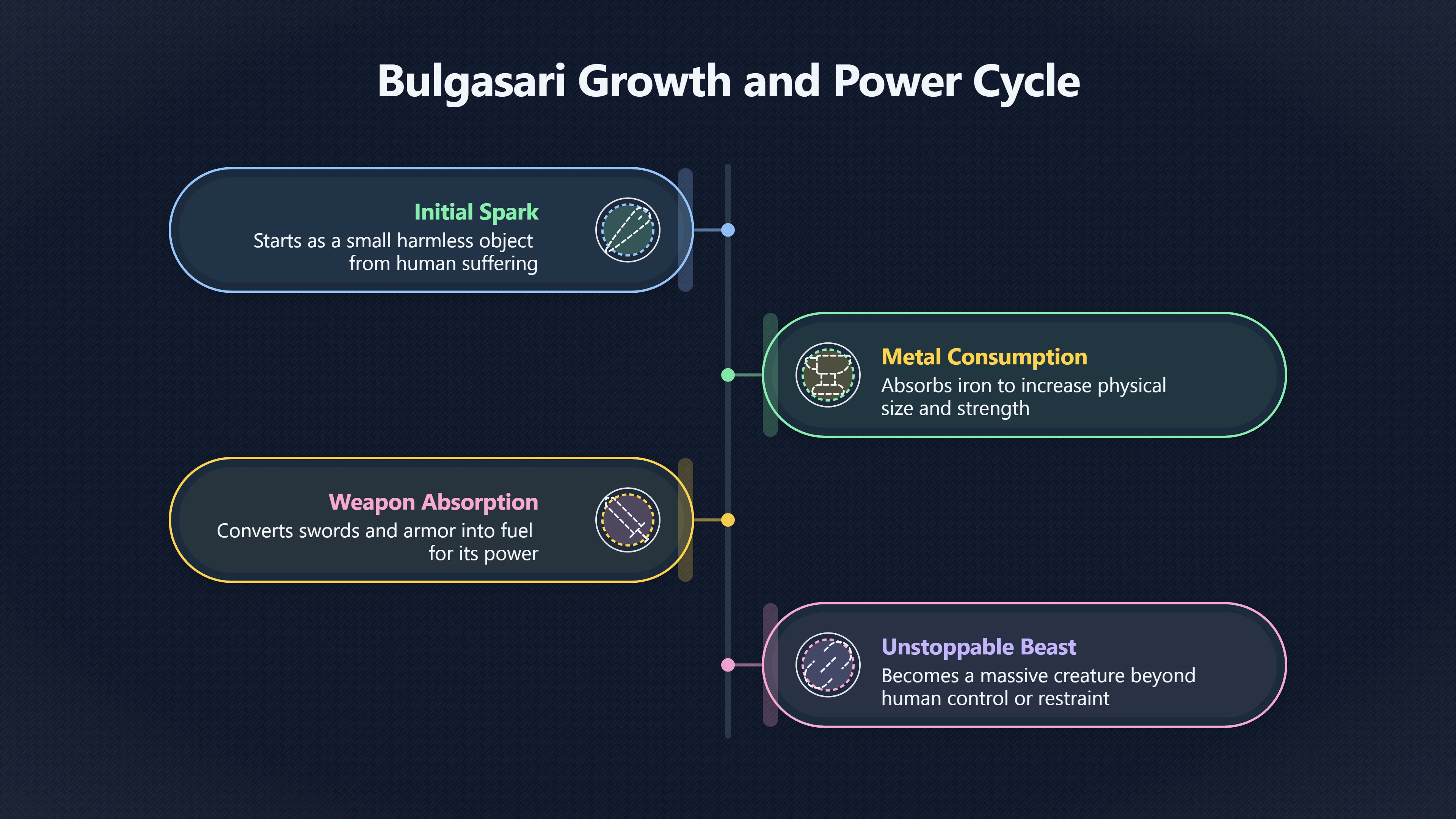
The best-known versions of the Bulgasari story describe a creature that begins as something small and harmless before becoming an unstoppable beast. In some tellings, it is created from rice grains or a small object made during a time of suffering and grows after being fed metal objects such as needles. As it consumes more iron, it becomes larger and stronger, eventually eating weapons sent against it.[K-Occult]koccult.comK-Occult Bulgasari (The Iron-Eating Monster) — Korean Occult Archive – K-OccultK-Occult Bulgasari (The Iron-Eating Monster) — Korean Occult Archive – K-Occult
This unusual ability gives the story its central tension. Soldiers normally defeat monsters through force, but Bulgasari turns the tools of force into nourishment. Swords, armour and weapons do not weaken it; they strengthen it. The image captures a fear found in many societies: that violence and repression can create the very problem they are meant to eliminate.
The creature’s name is also connected with the idea of being impossible to kill. Traditional explanations link Bulgasari with the notion of an “unkillable” being, although different spellings and interpretations of the name have produced additional meanings in later discussions.[Wikipedia]WikipediaBulgasari (creatureBulgasari (creature The important point in the folklore is not zoological accuracy but symbolic power: Bulgasari represents something that has escaped ordinary human control.
Protector or destroyer? The monster’s double meaning
Bulgasari is unusual because it does not fit neatly into the category of a purely evil monster. Some traditions present it as a creature that destroys corruption or punishes wrongdoing, while others emphasise the danger it becomes once its appetite grows beyond limits.[Wikipedia]WikipediaBulgasari (creatureBulgasari (creature
This ambiguity is one reason the creature has survived. A simple villain is often forgotten, but a monster that can be both useful and dangerous reflects a more complicated human experience. A force that removes one threat may create another. A power that begins as protection may become destructive when nobody can restrain it.
In this sense, Bulgasari resembles a warning about unintended consequences. The creature does not merely attack society from outside; it grows from society’s own conflicts and then becomes a new problem.

Other spirits and strange beings in Korean imagination
Korean folklore contains many supernatural beings that sit between animal, spirit and moral symbol. These creatures were not always designed as horror figures. Some protected households, warned against bad behaviour or represented hopes for good fortune. The National Folk Museum of Korea notes that animal imagery in Korean tradition carried meanings connected with protection, ideas about life and religious beliefs, appearing in art, rituals and everyday objects.[NFM]nfm.go.krNFMNational Folk Museum of Korea영어 > Collection > Folk story > The Story of the Twelve Animals of the Korean Zodiac > The Twelve Animals of the Korean Zodiac > Animal Fo…
The contrast between Bulgasari and more positive symbolic creatures shows how Korean monster traditions often worked through opposites. A dragon could represent authority, protection and harmony, while a monster such as Bulgasari could express the danger of unchecked appetite.[NFM]nfm.go.krNFMNational Folk Museum of Korea영어 > Collection > Folk story > The Story of the Twelve Animals of the Korean Zodiac > The Twelve Zodiac Animals > Dragon…
Other legendary beings, including spirits associated with places, mountains and human misfortune, served similar cultural roles. Their importance was not only whether people believed they physically existed, but what stories about them allowed communities to discuss. A frightening creature could become a way of talking about real fears: unfair rulers, social disorder, hunger, illness or the unknown.
Monsters as cultural symbols
Fear of greed and endless consumption
Bulgasari’s defining feature is its hunger. It does not simply eat once and disappear; it grows because it consumes more and more. This makes the creature a powerful symbol of greed. The more metal it receives, the stronger it becomes, creating a cycle where attempts to satisfy or defeat it only increase the problem.[K-Occult]koccult.comK-Occult Bulgasari (The Iron-Eating Monster) — Korean Occult Archive – K-OccultK-Occult Bulgasari (The Iron-Eating Monster) — Korean Occult Archive – K-Occult
The choice of metal is also meaningful. Iron was associated with practical survival: farming tools, household objects, armour and weapons. A creature that eats iron threatens both warfare and everyday life. It consumes the materials needed for defence, work and ordinary existence, turning a familiar resource into something vulnerable.
From folklore creature to modern cultural icon
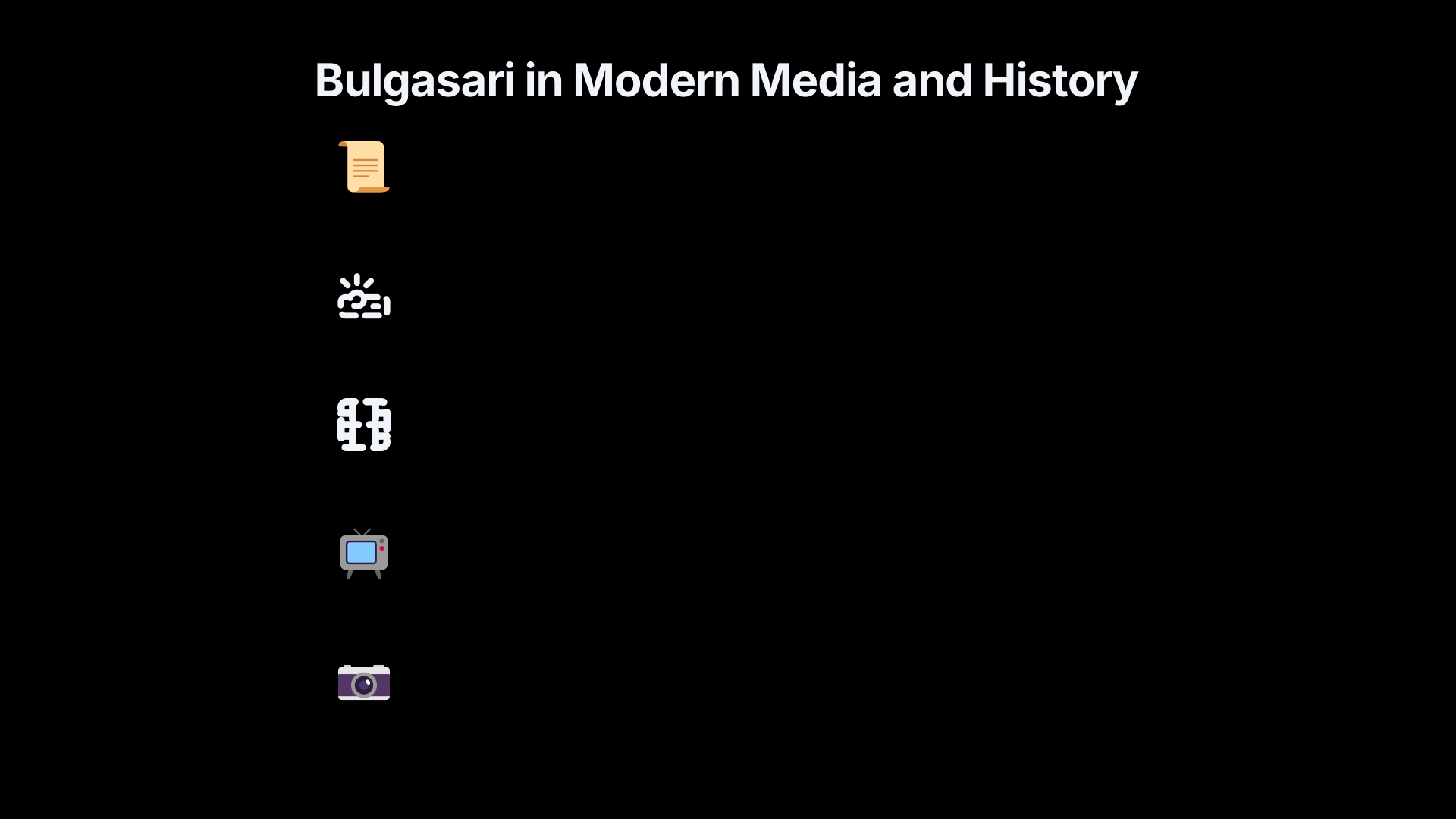
Bulgasari has continued to appear in modern Korean popular culture because its symbolism adapts easily. The creature became the subject of the South Korean monster film Bulgasari and later inspired the better-known North Korean film Pulgasari, where the monster was reimagined in a giant creature-film style influenced by international cinema.[Wikipedia]WikipediaOpen source on wikipedia.org.
These later versions changed aspects of the legend but kept the central idea: a powerful being created in response to human suffering can become difficult to control. The monster’s journey from folklore to cinema shows why old legends survive. They provide flexible symbols that can be reused to discuss different fears in different eras.
Bulgasari therefore belongs to the strange-history landscape of South Korea not because there is evidence for a literal metal-eating animal, but because the legend records something real about human imagination. It preserves anxieties about power, injustice and desire in the shape of an unforgettable creature: a monster that grows stronger from the very things people use to fight it.[K-Occult]koccult.comK-Occult Bulgasari (The Iron-Eating Monster) — Korean Occult Archive – K-OccultK-Occult Bulgasari (The Iron-Eating Monster) — Korean Occult Archive – K-Occult
Amazon book picks
Further Reading
Books and field guides related to The Korean Monsters Behind Old Fears. Use these as the next step if you want deeper reading beyond the article.

The Book of Mythical Beasts and Magical Creatures
Supports readers interested in monsters across world folklore.
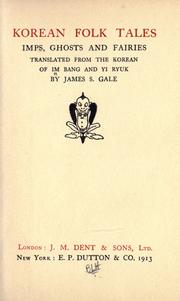
Korean folk tales: imps, ghosts and fairies
Directly supports Korean monsters, spirits, and traditional stories.
eBay marketplace picks
Marketplace Samples
Live-tested eBay searches with available results related to this page.
Endnotes
1.
Source: Wikipedia
Title: Bulgasari (creature)
Link:https://en.wikipedia.org/wiki/Bulgasari_%28creature%29
2.
Source: nfm.go.kr
Title: NFMNational Folk Museum of Korea
Link:https://www.nfm.go.kr/english/subIndex/1001.do
Source snippet
영어 > Collection > Folk story > The Story of the Twelve Animals of the Korean Zodiac > The Twelve Animals of the Korean Zodiac > Animal Fo...
3.
Source: nfm.go.kr
Title: NFMNational Folk Museum of Korea
Link:https://nfm.go.kr/english/subIndex/1016.do
Source snippet
영어 > Collection > Folk story > The Story of the Twelve Animals of the Korean Zodiac > The Twelve Zodiac Animals > Dragon...
4.
Source: Wikipedia
Link:https://en.wikipedia.org/wiki/Bulgasari
5.
Source: korea.net
Link:https://www.korea.net/NewsFocus/Culture/view?articleId=264328
Source snippet
January 3, 2025 — EXHIBITION OF ARTWORKS FEATURING SERPENTS MARKS YEAR OF SNAKE Jan 03, 2025 * * * * [Button: A+] * [Button: A] * [Button...
Published: January 3, 2025
6.
Source: koccult.com
Title: K-Occult Bulgasari (The Iron-Eating Monster) — Korean Occult Archive – K-Occult
Link:https://koccult.com/creatures/bulgasari-iron-eating-monster
7.
Source: koccult.com
Title: The 5 Most Terrifying Creatures from the Joseon
Link:https://koccult.com/originals/top-5-terrifying-joseon-creatures
Source snippet
K-OccultMarch 5, 2026 — 4. BULGASARI / BULGASAL (불가사리 / 불가살이): THE IRON-EATING CALAMITY Among Korean monsters, Bulgasari is one of the...
Published: March 5, 2026
8.
Source: nfm.go.kr
Title: National Folk Museum of Korea
Link:https://www.nfm.go.kr/user/bbs/english/17/469/bbsDataView/24291.do?page=1
Source snippet
Title | The Blue Dragon Period | Dec 20, 2023 - Mar 3, 2024 Venue | Special Exhibition Hall Ⅱ (NFMK Seoul) The Blue Dragon Ma...
9.
Source: nfm.go.kr
Title: National Folk Museum of Korea
Link:https://nfm.go.kr/english/subIndex/970.do
Source snippet
영어 > Collection > National designated cultural assetsCollection * National designated cultural assets * Search for a collection * Keyword...
10.
Source: mythus.fandom.com
Link:https://mythus.fandom.com/wiki/Bulgasari
Source snippet
Myth and Folklore Wiki | Fandomin: Korean mythology, Korean creatures BULGASARI Sign In to Save Save Edit * History * Purge * Talk (0)...
11.
Source: koccult.com
Link:https://koccult.com/creatures/bulgae
Source snippet
Bulgae (The Fire Dogs of Eclipse) — Korean Occult Archive – K-OccultBULGAE (THE FIRE DOGS OF ECLIPSE) 불개 Unverified The Bulgae are Korean...
Additional References
12.
Source: researchgate.net
Link:https://www.researchgate.net/publication/340381729_Born_of_Two_Koreas_of_Human_Blood_Monstrosity_and_the_Discourse_of_Humanity_and_Pacifism_in_the_Film_Bulgasari
Source snippet
(PDF) Born of Two Koreas, of Human Blood: Monstrosity and the Discourse of Humanity and Pacifism in the Film BulgasariArticle PDF Availab...
13.
Source: museum.go.kr
Link:https://www.museum.go.kr/site/eng/exhiSpecialTheme/view/current?exhiSpThemId=1750619&listType=gallery
Source snippet
NATIONAL MUSEUM OF KOREA>Exhibitions>Special Exhibitions>Current ExhibitionsCURRENT EXHIBITIONS Past Thematic Finding Dragons at the Muse...
14.
Source: english.visitkorea.or.kr
Link:https://english.visitkorea.or.kr/svc/contents/contentsView.do?vcontsId=110875
Source snippet
Folk Museum of Korea (국립민속박물관)- VISITKOREA* * * # National Folk Museum of Korea (국립민속박물관) * [Input] My Likes 0 [Input] My Bookmarks 10 *...
15.
Source: museum.go.kr
Title: NATIONA L MUSEUM OF KOREA>Exhibitions>Special Exhibitions>Current Exhibitions
Link:https://www.museum.go.kr/ENG/contents/E0202010000.do?exhiSpThemId=4179&listType=&menuId=current&schM=view
Source snippet
NATIONAL MUSEUM OF KOREA>Exhibitions>Special Exhibitions>Current ExhibitionsNovember 30, 2010 — CURRENT EXHIBITIONS Past Thematic Tomb Mu...
Published: November 30, 2010
16.
Source: english.visitkorea.or.kr
Title: visitkorea.or.kr National Folk Museum of Korea (국립민속박물관)- VISITKOREA1 / 8 *
Link:https://english.visitkorea.or.kr/svc/whereToGo/locIntrdn/rgnContentsView.do?menuSn=351&vcontsId=110875
Source snippet
Folk Museum of Korea (국립민속박물관)- VISITKOREA1 / 8 * Introduction * Basic info * Map * What's nearby Located inside Gyeongbokgung Palace, th...
17.
Source: kculture.chbae.com
Title: BULGASARI: THE IRON-EATING MONSTER The bulgasari (불가사리) is a str
Link:https://kculture.chbae.com/2025/02/korean-folklore-creatures-goblins-and.html
Source snippet
Folklore Creatures: Goblins and More - A Complete GuideFebruary 19, 2025 — This creature appears in various forms across East Asian mytho...
Published: February 19, 2025
18.
Source: kci.go.kr
Link:https://www.kci.go.kr/kciportal/ci/sereArticleSearch/ciSereArtiView.kci?sereArticleSearchBean.artiId=ART002871922
Source snippet
THE COMPETING ARCHETYPES OF BULGASARI AND GODZILLA 현대북한연구 이 학술지 인용지수 조회 이 학술지 논문 검색 2022, vol.25...
19.
Source: kci.go.kr
Title: 불가사리 문헌 및 스토리텔링의 다학제적 분석을 통한 상징적인 의미의 해석과 현대 미디어 적용에 관한 연구
Link:https://www.kci.go.kr/kciportal/ci/sereArticleSearch/ciSereArtiView.kci?sereArticleSearchBean.artiId=ART002758717
Source snippet
「숑도말년 불가살이젼」과 북한 영화 <불가사리>를 중심으로 -불가사리 문헌 및 스토리텔링의 다학제적 분석을 통한 상징적인 의미의 해석과 현대 미디어 적용에 관한 연구 - 「숑도말년 불가살이젼」과 북한 영화 <불가사리>를 중심으로 - A STUDY...
20.
Source: unearthedstorieshistory.blogspot.com
Title: Bulgasari: The Iron-Devouring Monster of Korean Legends
Link:https://unearthedstorieshistory.blogspot.com/2025/12/bulgasari-iron-devouring-monster-of.html
Source snippet
December 9, 2025 — BULGASARI: THE IRON-DEVOURING MONSTER OF KOREAN LEGENDS 🐲 Bulgasari: Korea’s Metal-Eating Mythical Monster If you love...
Published: December 9, 2025
21.
Source: koreanfilm.or.kr
Title: Ko-pick: The Evolution of Creatures in K-Content
Link:https://www.koreanfilm.or.kr/eng/news/ko_pick.jsp?blbdComCd=601029&mode=VIEW&pageRowSize=10&seq=41
Source snippet
April 12, 2024 — This week we examine how creatures have evolved in Korean content; from the first Korean monster film Bulgasari (1962) t...
Published: April 12, 2024
Topic Tree