Within Somalia Strange
When Spirits Become a Social Diagnosis
Somali spirit traditions sit on the uneasy border between religion, distress, trance, healing and community response.
On this page
- Jinn belief in Somali religious life
- Possession, illness and help seeking
- Music, trance and ritual negotiation
Page outline Jump by section
Introduction
Belief in jinn and other unseen spiritual forces is part of mainstream Islamic belief, and in Somalia it has long shaped how many people understand unexplained illness, sudden behavioural change and emotional distress. Alongside these religious ideas sits a broader set of healing traditions, including spirit-possession rituals sometimes grouped under the name Saar. For outsiders these practices can appear mysterious or overtly supernatural. For many Somalis, however, they have functioned as practical ways of explaining suffering, mobilising family support and seeking relief when conventional medicine was unavailable or considered ineffective.
From a Fortean perspective, these traditions occupy an intriguing borderland. They generate dramatic accounts of possession, altered states of consciousness and remarkable behaviour, yet they are also deeply embedded in religion, community life and local ideas about health. The central question is therefore not whether spirits objectively caused the reported experiences, but why spirit explanations became socially persuasive, how healing rituals developed around them, and how modern medicine now interprets the same experiences.
When spirits become a social diagnosis
In Somali society, unusual behaviour has often been interpreted through several overlapping explanations. Many people distinguish between recognised psychiatric illness, ordinary emotional hardship and conditions believed to involve spiritual forces. Jinn, the evil eye and witchcraft have all appeared in traditional explanations for distress, particularly when symptoms seem sudden, dramatic or resistant to ordinary treatment. Academic reviews of Somali mental health consistently note that these beliefs strongly influence how families seek help, with religious and traditional healers frequently consulted before psychiatric services.[DOI]doi.orgMental health crisis in Somalia: a review and a way forward | International Journal of Mental Health Systems | Springer Nature LinkFeb…
This does not mean every Somali attributes mental illness to spirits. Urbanisation, education and expanding mental-health services have broadened public discussion, especially among younger generations and the Somali diaspora. Nevertheless, researchers continue to find that spiritual explanations remain influential because they fit both religious teaching and longstanding cultural models of illness.[ScienceDirect]sciencedirect.comWhat can Somali community talk about mental health tell us about our own? Contextualizing the symptoms of mental health - Sc…
For readers interested in strange traditions, this distinction matters. Reports of possession should not automatically be treated as paranormal evidence. They are better understood as culturally meaningful interpretations of experiences that may also receive neurological, psychiatric or psychological explanations.
Jinn belief in Somali religious life
Islam teaches that jinn are created beings distinct from humans and angels. Because belief in jinn comes directly from the Qur’an, many Somali Muslims regard their existence as a matter of faith rather than folklore. The question is usually not whether jinn exist, but whether a particular illness or behaviour should be attributed to them.
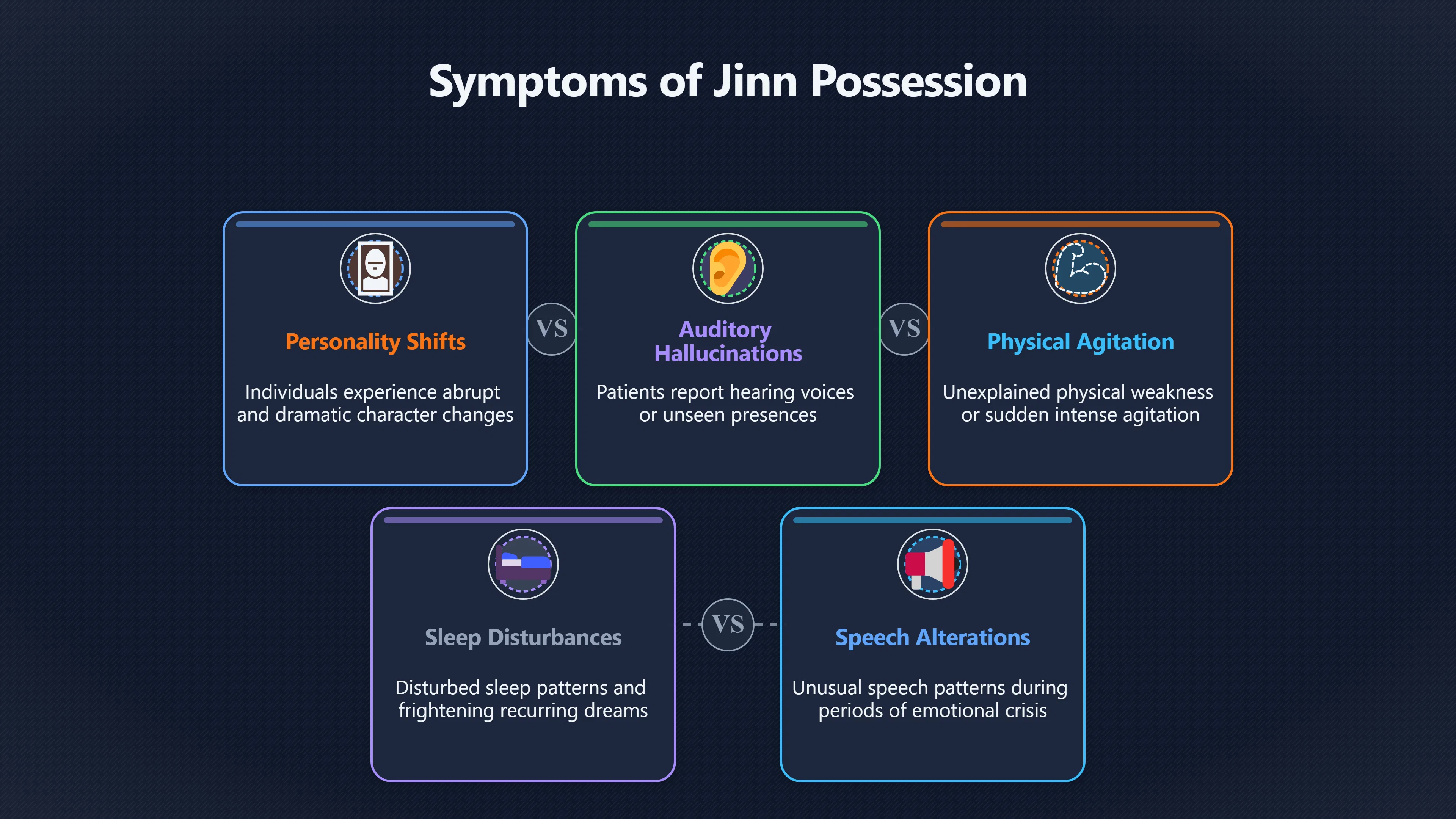
Claims of possession often involve experiences such as:
- abrupt personality changes;
- hearing voices or perceiving unseen presences;
- unexplained physical weakness or agitation;
- disturbed sleep or frightening dreams;
- unusual speech or behaviour during periods of emotional crisis.
From within the belief system, these experiences may indicate spiritual interference rather than disease. Consequently, families frequently seek ruqya—Qur’anic recitation intended to expel harmful spiritual influence—or consultation with respected religious leaders. Reviews of Somali healthcare repeatedly identify Qur’anic healing as one of the country’s most common first responses to suspected possession.[doi.org]doi.orgMental health crisis in Somalia: a review and a way forward | International Journal of Mental Health Systems | Springer Nature LinkFeb…
Modern psychiatry approaches these same experiences differently. Clinicians generally regard them as symptoms that require careful assessment for trauma, psychosis, mood disorders, neurological illness or other medical conditions. Contemporary psychiatric literature also emphasises that belief in jinn itself should not be confused with mental illness, since it forms part of ordinary religious belief for many Muslims.[Cambridge University Press & Assessment]cambridge.orgCambridge University Press & AssessmentJinn and mental health: looking at jinn possession in modern psychiatric practice | The Psychiatri…
Possession, illness and help-seeking
Somalia’s recent history has profoundly shaped this subject. Decades of civil conflict, displacement, poverty and limited access to healthcare have contributed to high levels of psychological trauma while leaving formal mental-health services severely under-resourced. Under these circumstances, religious and traditional healing often remain the most accessible sources of care.[Frontiers]frontiersin.orgFrontiersFrontiers | Prevalence of mental disorders and psychological trauma among conflict- affected population in Somalia: a cross-sect…
Researchers studying Somali communities describe a pattern in which distress is interpreted through culturally familiar categories. Instead of focusing primarily on Western psychiatric diagnoses, families may distinguish between ordinary hardship, severe “madness” and conditions understood as spirit possession. This affects not only diagnosis but also the order in which treatment is sought.[ScienceDirect]sciencedirect.comWhat can Somali community talk about mental health tell us about our own? Contextualizing the symptoms of mental health - Sc…
This creates a genuine tension rather than a simple clash between science and belief. Many Somali clinicians, researchers and religious leaders argue that spiritual care and medical treatment need not be mutually exclusive. Someone may receive Qur’anic healing while also benefiting from psychiatric assessment, medication or psychological therapy. Increasingly, public-health researchers argue that culturally sensitive mental-health services must understand local beliefs instead of dismissing them outright.[DOI]doi.orgMental health crisis in Somalia: a review and a way forward | International Journal of Mental Health Systems | Springer Nature LinkFeb…
Music, trance and ritual negotiation
Alongside orthodox Islamic healing exists a separate family of possession traditions commonly associated with Saar. These ceremonies are better documented in neighbouring Ethiopia, Sudan and the Red Sea coast, but related practices have also been recorded among Somali communities, particularly in coastal regions and areas with long histories of cultural exchange.
Rather than attempting to destroy the possessing spirit, Saar traditions have often sought to negotiate with it. Ceremonies may involve rhythmic drumming, repetitive music, dancing and trance, creating a controlled setting in which the afflicted person enters an altered state. Within the ritual, the spirit’s identity, wishes or grievances may be explored through symbolic dialogue.
Anthropologists have interpreted these ceremonies in several ways:
- as culturally recognised methods of expressing psychological distress;
- as communal healing rituals that strengthen social support;
- as negotiated relationships with spirits within local belief systems;
- as opportunities for people—especially women in some societies—to express otherwise restricted emotions or social tensions.
The point is not that every participant literally believed a spirit had been scientifically demonstrated. Instead, the ritual created a socially accepted framework in which suffering could be acknowledged and managed.
A World Health Organization situation analysis of Somali mental health identifies several traditional healing systems alongside Qur’anic treatment. Among them are possession-related traditions such as Mingis, described as resembling Ethiopian Saar practices, together with other regional healing rites that blend local customs with Islamic belief. This illustrates that Somali healing has never consisted of a single, uniform tradition but rather a spectrum of religious and cultural responses.[Iris]iris.who.intA SITUATIONOctober 4, 2025…
Why these stories feel genuinely uncanny
Spirit-possession narratives continue to fascinate because they often contain elements that appear difficult to explain: dramatic voice changes, unusual strength, apparent amnesia after trance episodes or behaviour that witnesses regard as entirely unlike the person’s normal character.
Believers interpret such features as evidence of spiritual agency. Anthropologists generally see them as culturally shaped expressions of trance or possession. Psychiatrists may instead investigate dissociative disorders, psychosis, severe trauma, epilepsy or other neurological conditions. None of these explanations necessarily accounts for every reported detail, which is one reason possession traditions remain compelling subjects of folklore and comparative religion.[Cambridge University Press & Assessment]cambridge.orgCambridge University Press & AssessmentJinn and mental health: looking at jinn possession in modern psychiatric practice | The Psychiatri…
Importantly, dramatic testimony alone cannot establish supernatural causation. Experiences of altered consciousness occur across many cultures, but the meaning attached to them varies according to local religious beliefs, social expectations and available forms of treatment.
Why Saar and jinn traditions remain part of Somalia’s strange history
Within Somalia’s wider catalogue of unusual traditions, spirit possession occupies a distinctive place because it sits at the intersection of religion, folklore, medicine and lived experience. Unlike stories about mysterious animals or unexplained objects, possession narratives continue to influence everyday decisions about illness and care.
Their enduring importance lies less in proving the existence of spirits than in showing how communities make sense of suffering. They reveal a society where invisible forces may be invoked to explain visible distress, where ritual can provide comfort even when its mechanisms remain debated, and where modern psychiatry increasingly recognises that effective treatment must take local beliefs seriously rather than simply dismissing them.
For students of Forteana, Somali jinn traditions therefore illustrate a recurring theme found around the world: the strangest stories often tell us as much about human culture, resilience and interpretation as they do about the mysterious experiences themselves.

Amazon book picks
Further Reading
Books and field guides related to When Spirits Become a Social Diagnosis. Use these as the next step if you want deeper reading beyond the article.

The Spirit Catches You and You Fall Down
Illustrates how spiritual and medical explanations of illness coexist.


The Golden Bough
First published 1890. Subjects: Mythology, Magic, Superstition, Religion, Primitive Religion.
Myths and symbols in pagan Europe
First published 1988. Subjects: Norse Mythology, Celtic Mythology, Religion, Celts, Mythology, Norse.
eBay marketplace picks
Marketplace Samples
Live-tested eBay searches with available results related to this page.


Endnotes
1.
Source: doi.org
Link:https://doi.org/10.1186%2Fs13033-022-00525-y
Source snippet
Mental health crisis in Somalia: a review and a way forward | International Journal of Mental Health Systems | Springer Nature LinkFeb...
2.
Source: sciencedirect.com
Link:https://www.sciencedirect.com/org/science/article/abs/pii/S1747989419000036
Source snippet
What can Somali community talk about mental health tell us about our own? Contextualizing the symptoms of mental health - Sc...
3.
Source: ethnomed.org
Title: Ethno Med Somali Mental Health
Link:https://ethnomed.org/resource/somali-mental-health/
Source snippet
In Somali culture, concepts of mental health only inc...
4.
Source: cambridge.org
Link:https://www.cambridge.org/core/journals/the-psychiatrist/article/jinn-and-mental-health-looking-at-jinn-possession-in-modern-psychiatric-practice/0012DFF288FA8958C7A52CAB2F29B679
Source snippet
Cambridge University Press & AssessmentJinn and mental health: looking at jinn possession in modern psychiatric practice | The Psychiatri...
5.
Source: doi.org
Link:https://doi.org/10.1108/IJMHSC
Source snippet
Contextualizing the symptoms of mental health | International Journal of Migration, Health and Social Care | Emerald PublishingApril 12...
6.
Source: ethnomed.org
Title: Somali Refugee Mental Health Cultural Profile
Link:https://ethnomed.org/resource/somali-refugee-mental-health-cultural-profile/
Source snippet
Picture of Hargeisa Mental Ward. As previously mentioned, mild forms of affective disorders ar...
7.
Source: frontiersin.org
Link:https://www.frontiersin.org/journals/public-health/articles/10.3389/fpubh.2023.1219992/full
Source snippet
FrontiersFrontiers | Prevalence of mental disorders and psychological trauma among conflict- affected population in Somalia: a cross-sect...
8.
Source: iris.who.int
Link:https://iris.who.int/bitstream/handle/10665/116674/EMROPUB_2010_EN_736.pdf?sequence=1
Source snippet
A SITUATIONOctober 4, 2025...
Published: October 4, 2025
Additional References
9.
Source: ecoi.net
Link:https://www.ecoi.net/en/document/2050497.html
Source snippet
ACCORD – Austrian Centre for Country of Origin and Asylum Research and Documentation (Author): “Anfragebeantwortung zu Somalia: Umgang mi...
10.
Source: repositorio.iscte-iul.pt
Link:https://repositorio.iscte-iul.pt/handle/10071/7534
Source snippet
iscte-iul.ptRepositório do Iscte – Instituto Universitário de Lisboa: Religion and healing among Somalis in Sweden when experiencing illn...
11.
Source: tandfonline.com
Link:https://www.tandfonline.com/doi/full/10.1080/07853890.2025.2546057
Source snippet
August 13, 2025 — RISKS, INTERACTIONS, AND QUALITY CONTROL OF HERBAL MEDICINES While traditional herbal remedies are generally perceived...
Published: August 13, 2025
12.
Source: emerald.com
Title: What can Somali community talk about mental health tell us about our own?
Link:https://www.emerald.com/insight/content/doi/10.1108/ijmhsc-03-2018-0020/full/html
Source snippet
Contextualizing the symptoms of mental health | International Journal of Migration, Health and Social Care | Emerald PublishingApril 12...
13.
Source: ecoi.net
Title: Der Begriff sar beschreibe sowohl den Zustand der besessenen Person
Link:https://www.ecoi.net/en/document/2029113.html
Source snippet
ACCORD – Austrian Centre for Country of Origin and Asylum Research and Documentation (Author): “Anfragebeantwortung zu Somalia: Lage von...
14.
Source: saxafimedia.com
Title: Sitaat As Part Of Somali Women’s Everyday Religion | Saxafi Media
Link:https://saxafimedia.com/sitaat-part-somali-womens-everyday-religion/
Source snippet
Spirit possession saar (zar) is a widely known phenomenon in the Horn of Africa as well as on the East African coast and its hinterland...
15.
Source: pure.psu.edu
Title: what can somali community talk about mental health tell us about
Link:https://pure.psu.edu/en/publications/what-can-somali-community-talk-about-mental-health-tell-us-about-/
Source snippet
Contextualizing the symptoms of mental health - Penn StateJuly 15, 2019 — WHAT CAN SOMALI COMMUNITY TALK ABOUT MENTAL HEALTH TELL US ABOU...
Published: July 15, 2019
16.
Source: islamawareness.net
Link:https://www.islamawareness.net/Africa/Somalia/som_article001.html
Source snippet
Its primary objective is to signal the times for migration, but it may...
17.
Source: pubmed.ncbi.nlm.nih.gov
Link:https://pubmed.ncbi.nlm.nih.gov/28506078/
Source snippet
2017 Oct;25(5):471-473. doi: 10.1177/1039856217707392. Epub 2017 May 15. 'MY HUSBAND IS POSSESSED BY A JINN': A CASE STUDY IN TRANSCULTUR...
18.
Source: pubmed.ncbi.nlm.nih.gov
Link:https://pubmed.ncbi.nlm.nih.gov/33251964/
Source snippet
2021 Feb;31(3):484-497. doi: 10.1177/1049732320970492. Epub 2020 Nov 30. TRADITIONAL MEDICINE AND HELP-SEEKING BEHAVIORS FOR HEALTH PROBL...
Topic Tree