Within Eswatini Strange
Why Lightning Became Eswatini's Strangest Force
Eswatini's lightning lore turns real thunderstorm danger into stories of kings, witches, deep pools, and supernatural birds.
On this page
- Royal thunder, witch sent lightning, and deep pool birds
- Highveld storms and the real hazard behind the lore
- How sceptics and believers read the same strike
Page outline Jump by section
Introduction
Lightning has long occupied a unique place in Eswatini’s folklore because it is both an unmistakable natural danger and a powerful cultural symbol. In a country where violent summer thunderstorms are common, stories developed that linked lightning to kings, witches, hidden water spirits and mysterious birds. These traditions did not arise from an imaginary threat. They grew around one of the region’s most dangerous weather hazards, giving dramatic and often frightening events a moral and spiritual explanation. Historical ethnographies, modern hazard research and oral traditions all show that lightning in Eswatini has been understood as more than weather, even while meteorology fully explains how thunderstorms form. The fascination lies not in proving supernatural claims, but in seeing how real danger became woven into one of southern Africa’s richest bodies of storm folklore.[AcleNet]aclenet.orgLightning fatalities in Swaziland: 2000–2007January 16, 2017 — Kuper (1947), observed that traditionally Swazis believe in two typ…

Royal thunder, witch-sent lightning, and the bird from deep pools
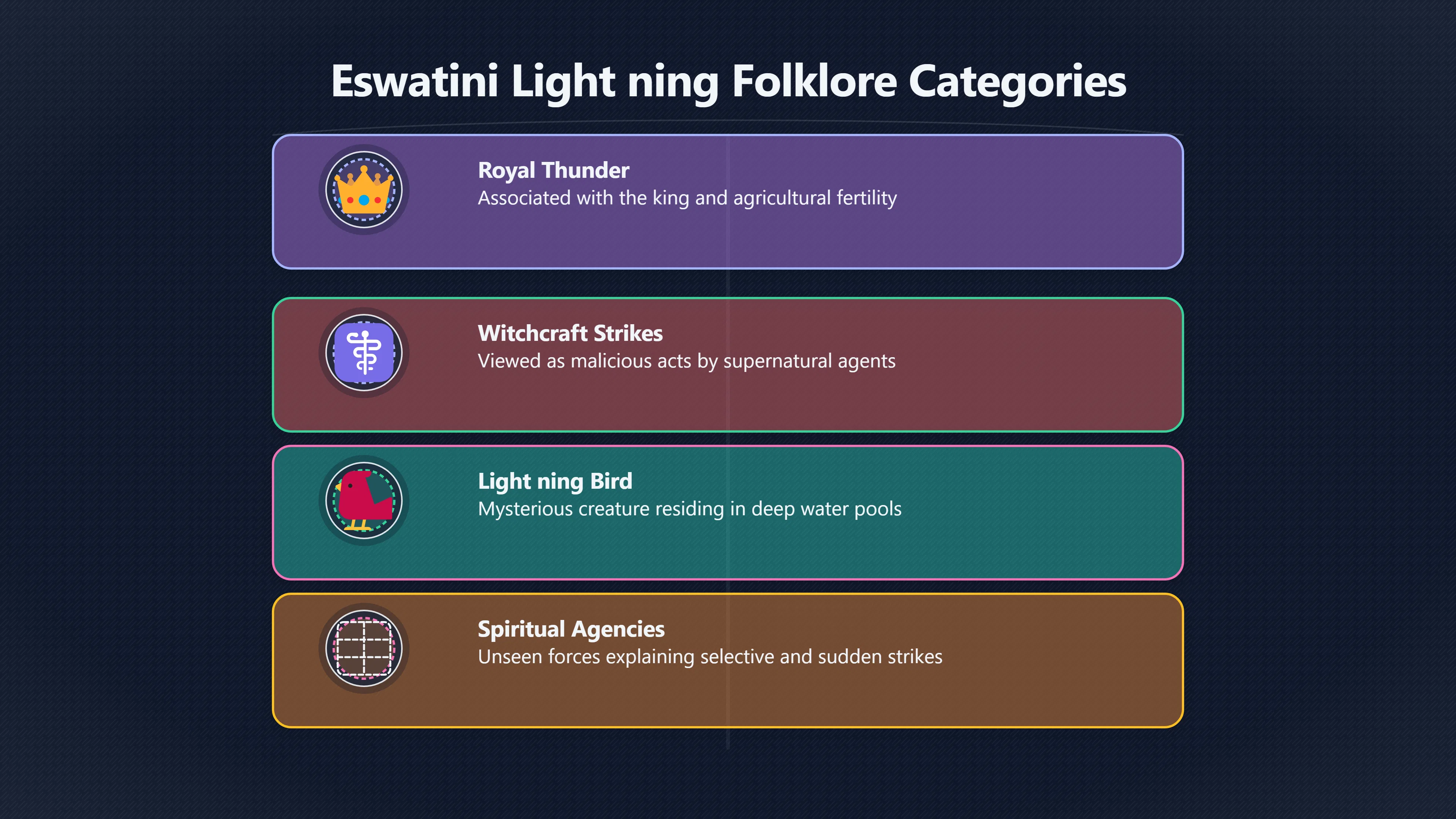
One of the most distinctive features of Swazi tradition is the belief that not all lightning was the same. Anthropologist Hilda Kuper, writing from fieldwork in the mid-twentieth century, recorded a traditional distinction between thunder associated with the king and thunder attributed to witches or wizards. Later research on lightning fatalities repeated this observation, noting that royal thunder was regarded as beneficial, bringing vitality to crops, while witch-sent lightning was feared as destructive and deliberately targeted.[AcleNet]aclenet.orgLightning fatalities in Swaziland: 2000–2007January 16, 2017 — Kuper (1947), observed that traditionally Swazis believe in two typ…
This belief reflects an important aspect of traditional political authority. The king was symbolically connected with fertility, rain and the wellbeing of the kingdom. Storms that nourished the land could therefore be interpreted as part of legitimate authority over nature, while unusually destructive strikes were more easily explained as malicious acts carried out through supernatural means.
Running alongside these ideas is another striking tradition: the belief that lightning originated from a mysterious bird living in deep pools. Kuper recorded this belief in the early 1950s, and later hazard researchers cited it as part of the cultural background surrounding lightning in Eswatini. The tradition does not describe an ordinary bird nesting beside rivers. Instead, it places the source of lightning within hidden places associated with water, danger and unseen power.[AcleNet]aclenet.orgLightning fatalities in Swaziland: 2000–2007January 16, 2017 — Kuper (1947), observed that traditionally Swazis believe in two typ…
Although Eswatini’s version is relatively concise in published sources, it fits into a broader family of southern African lightning bird traditions. Across neighbouring regions, especially among Zulu-speaking communities, the legendary lightning bird is often described as a supernatural creature connected with storms and sometimes with witchcraft. Details vary from one culture to another, and there is no evidence that every version was shared in Eswatini, but the recurring association between birds, thunderstorms and hidden spiritual power suggests a long-standing regional pattern rather than an isolated local legend.[Wikipedia]WikipediaLightning birdLightning bird
Highveld storms and the real hazard behind the lore
The persistence of lightning folklore becomes much easier to understand when viewed against Eswatini’s geography.
Western Eswatini, particularly the Highveld, experiences frequent convective thunderstorms during the summer rainy season. Moist air from the Indian Ocean rises over elevated terrain, producing powerful afternoon storms with intense lightning. Studies estimate very high lightning flash densities in parts of the country, and the Highveld has long been recognised as one of the nation’s most lightning-prone regions.[AcleNet]aclenet.orgLightning fatalities in Swaziland: 2000–2007January 16, 2017 — Kuper (1947), observed that traditionally Swazis believe in two typ…
Lightning is therefore not simply an occasional curiosity. It kills people and livestock, damages homes, disrupts electricity supplies and threatens anyone working outdoors. The first systematic review of lightning fatalities in Swaziland identified dozens of deaths between 2000 and 2007, while also noting that earlier national record-keeping had been incomplete. Victims were disproportionately young adults, particularly men engaged in outdoor work, and fatalities clustered during the afternoon, matching the peak period for thunderstorm development.[AcleNet]aclenet.orgLightning fatalities in Swaziland: 2000–2007January 16, 2017 — Kuper (1947), observed that traditionally Swazis believe in two typ…
These patterns help explain why lightning acquired such cultural significance:
- Strikes appear sudden and highly selective, often affecting one individual while leaving nearby people unharmed.
- Storms arrive rapidly during the hottest part of the day, creating an impression of overwhelming supernatural force.
- Livestock losses and crop damage could devastate rural households.
- The unpredictability of individual strikes encouraged explanations based on intention rather than probability.
In societies without modern weather forecasting, interpreting such apparently targeted events through stories of kings, witches or spiritual beings offered a framework for understanding experiences that otherwise seemed arbitrary.

Why one king’s death mattered
One historical episode reinforced lightning’s symbolic importance.
The early nineteenth-century Swazi king Ndvungunye is traditionally said to have been killed by lightning around 1805. The event appears in historical works cited by later researchers and became part of royal history rather than merely folklore.[AcleNet]aclenet.orgLightning fatalities in Swaziland: 2000–2007January 16, 2017 — Kuper (1947), observed that traditionally Swazis believe in two typ…
Whether viewed as a tragic accident or as an event carrying symbolic meaning, the story demonstrated that lightning spared no one—not even a king associated with royal authority over storms. For later generations, the account strengthened lightning’s reputation as an extraordinary force capable of crossing ordinary social boundaries.
How sceptics and believers read the same strike
The same lightning strike can produce very different interpretations.
A scientific explanation begins with atmospheric physics. Warm, moist air rises, electrical charge separates within thunderclouds, and lightning discharges when the electrical potential becomes great enough. Modern meteorology can explain why western Eswatini experiences particularly intense thunderstorms and why afternoon storms are especially common during the rainy season.[AcleNet]aclenet.orgLightning fatalities in Swaziland: 2000–2007January 16, 2017 — Kuper (1947), observed that traditionally Swazis believe in two typ…
Traditional interpretations address different questions. Rather than asking how lightning forms, they ask why a particular person, family or homestead was struck. Within that framework, ideas about witchcraft, royal authority or hidden spiritual agencies provide explanations for apparently selective misfortune.
Neither perspective necessarily answers the other’s central question. Meteorology explains the physical mechanism of every lightning strike. Folklore explains its social and moral meaning within a community.
Researchers studying lightning safety in southern Africa have warned that some traditional beliefs may unintentionally discourage practical precautions if lightning is viewed primarily as an unavoidable supernatural act. For that reason, modern public safety campaigns increasingly argue that respect for cultural beliefs can coexist with evidence-based advice about avoiding open ground, isolated trees and other high-risk situations during thunderstorms.[AcleNet]aclenet.orgLightning fatalities in Swaziland: 2000–2007January 16, 2017 — Kuper (1947), observed that traditionally Swazis believe in two typ…

Why the lightning bird remains culturally important
The lightning bird occupies a distinctive place in Eswatini’s strange folklore because it stands at the meeting point of myth and measurable reality.
Unlike legendary creatures said to inhabit remote wilderness, the lightning bird is tied to an event that everyone recognises. Every violent summer storm reminds listeners of stories connecting birds, deep pools, kings and unseen forces. The folklore survives not because it offers a competing meteorology, but because it expresses the emotional impact of one of nature’s most dramatic hazards.
For students of Fortean traditions, this makes Eswatini’s lightning lore especially revealing. It shows how an entirely natural phenomenon can accumulate layers of political symbolism, spiritual interpretation and local legend without requiring anyone to deny that thunderstorms are real. The enduring mystery is therefore cultural rather than physical: how communities transform terrifying moments of weather into stories that continue to shape memory long after the storm has passed.
Amazon book picks
Further Reading
Books and field guides related to Why Lightning Became Eswatini's Strangest Force. Use these as the next step if you want deeper reading beyond the article.

African religions & philosophy
Explains religious interpretations of natural phenomena.


The lore of the land
First published 2005. Subjects: Tales, Legends, British Mythology, Legends, great britain.
eBay marketplace picks
Marketplace Samples
Live-tested eBay searches with available results related to this page.




Endnotes
1.
Source: aclenet.org
Link:https://aclenet.org/file_download/eebff2d1-6f88-4949-a879-24995d056924
Source snippet
Lightning fatalities in Swaziland: 2000–2007January 16, 2017 — Kuper (1947), observed that traditionally Swazis believe in two typ...
Published: January 16, 2017
2.
Source: Wikipedia
Title: Lightning bird
Link:https://en.wikipedia.org/wiki/Lightning_bird
3.
Source: youtube.com
Title: Lightning Bird
Link:https://www.youtube.com/watch?v=B_6dbgjcz4k
Additional References
4.
Source: researchgate.net
Title: 225725467 Lightning fatalities in Swaziland 2000 2007
Link:https://www.researchgate.net/publication/225725467_Lightning_fatalities_in_Swaziland
Source snippet
Lightning fatalities in Swaziland: 2000–2007Furthermore, indigenous South Africans are known to attribute lightning to witchcraft or reli...
5.
Source: youtube.com
Link:https://www.youtube.com/watch?v=e9eiuAOeuRk
Source snippet
The Origin of the Lightning Bird — Africa's Most Feared Sky Creature...
6.
Source: youtube.com
Title: The Origin of the Lightning Bird — Africa’s Most Feared Sky Creature
Link:https://www.youtube.com/watch?v=SIHBmkUcLls
Source snippet
South African Impundulu, Lightning Bird...
7.
Source: youtube.com
Title: South African Impundulu, Lightning Bird
Link:https://www.youtube.com/watch?v=ZgFN-ChUGxk
Source snippet
Impundulu: A Vampiric Lightning Bird...
8.
Source: youtube.com
Title: Impundulu: A Vampiric Lightning Bird
Link:https://www.youtube.com/watch?v=FqC8zfUXGdA
Topic Tree