Within Strange Georgia
Why Georgia's Mountains Feel Haunted by Rules
Georgia's mountain myths turn cliffs, hunting taboos and chained heroes into stories about danger, punishment and sacred landscape.
On this page
- Amirani, fire and the chained rebel
- Dali, hunters and dangerous mountain taboos
- How folklore makes the landscape behave like evidence
Page outline Jump by section
Introduction
Georgia’s mountain folklore often works less like fantasy and more like a survival manual disguised as myth. The linked traditions of Amirani and Dali teach that the high Caucasus is a place where pride, greed and broken promises bring swift consequences. Rather than presenting mountains as empty wilderness, these stories treat them as morally active landscapes that reward restraint and punish arrogance. That makes them an important part of Georgia’s strange-history tradition: the supernatural is never far away, but it is tied to recognisable dangers such as sheer cliffs, unpredictable weather, hazardous hunting and the temptation to ignore local rules. Across different regions and many recorded versions, the stories vary in detail while preserving the same underlying message—the mountains remember how people behave.[researchgate.net]researchgate.netResearch Gate(PDF) Georgia through its legends, folklore and peopleAmirani lies chained can. Dali – The Female Goddess of Nature, Animals and Hunting. 107. be seen in the Caucasus. Scholars agree that fol…

Amirani, fire and the chained rebel
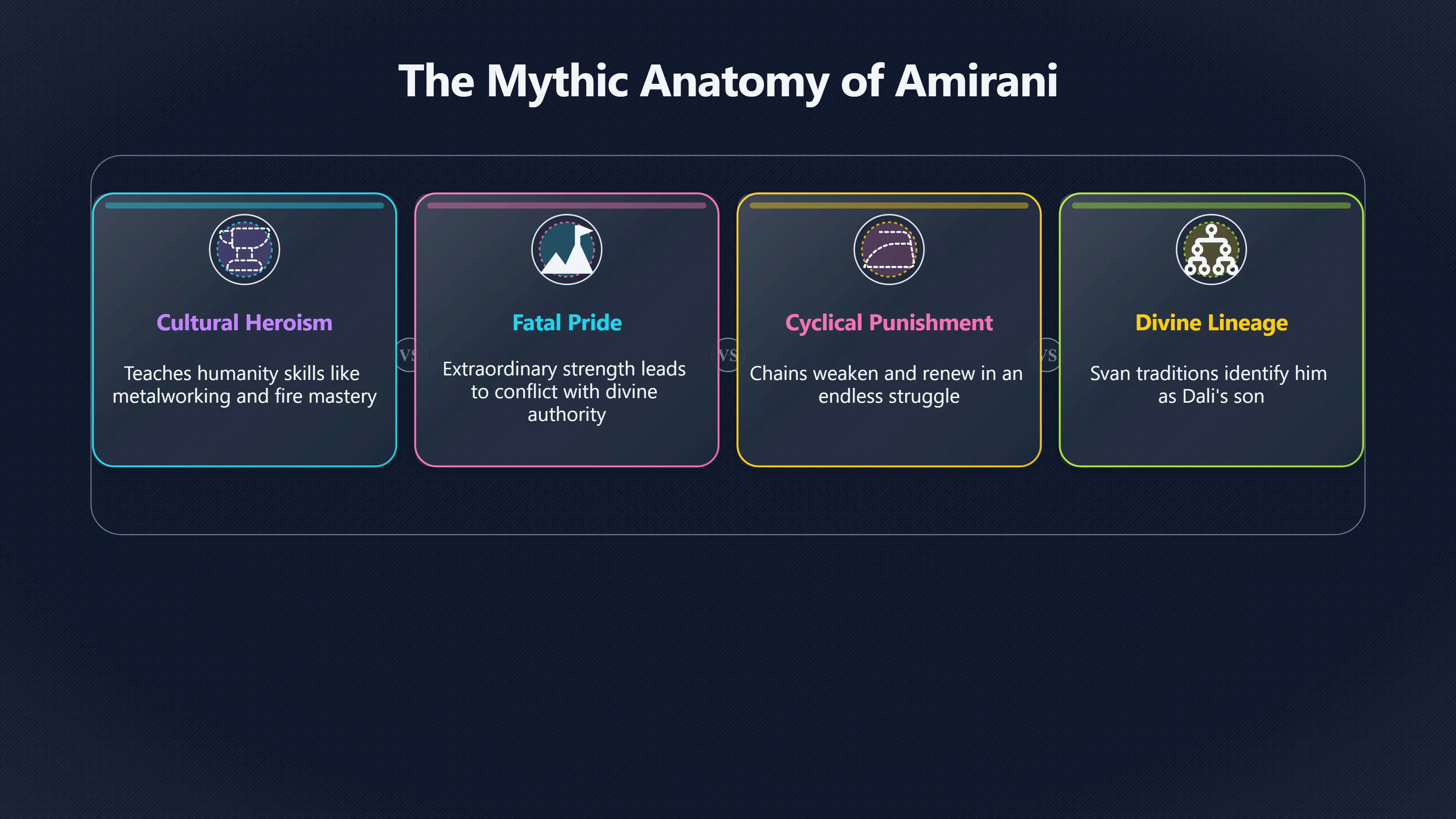
Amirani is usually compared with Prometheus because both figures steal or share knowledge that elevates humanity and are punished by being bound to a mountain. Georgian tradition, however, gives the story a distinctive purpose. Amirani is not simply a rebel against divine authority; he becomes a permanent warning against believing that extraordinary strength places someone above the order of the world. The Caucasus itself becomes his prison, turning a real landscape into a visible reminder of invisible law.[academia.edu]academia.eduPDF) Amirani, a Georgian Folk HeroAcademia(PDF) Amirani, a Georgian Folk HeroApril 1, 1974 — This research explores the connections between the Georgian folk hero Amirani…
Many versions describe Amirani as a culture hero who teaches people skills such as working metal and mastering fire before his growing pride leads him into conflict with divine authority. His punishment is deliberately cyclical rather than final. His chains weaken and are renewed, suggesting that rebellion can never quite be extinguished, but neither can it triumph. In folklore, this endless struggle explains why the mountains seem alive with hidden forces rather than standing as silent scenery.[Spekali]spekali.tsu.geview ArticleHe defeats the evil forces, eliminates the noxious plants, teaches the people the art of metal treatment.Read more…
An important detail often overlooked outside specialist studies is that, in several Svan traditions, Amirani is the son of Dali, the mountain hunting goddess. Modern analysis of more than two hundred collected versions of the epic places Dali at the beginning of the hero’s story, linking his miraculous birth directly to the wild mountain world that later becomes the place of his punishment. This relationship ties the two legends together as parts of one moral landscape rather than separate myths.[litinstituti.ge]literaryresearches.litinstituti.geLiterary ResearchesMythological Image of Dali in the Epos of Amiraniby M Khukhunaishvili-Tsiklauri · 2022 — The legend is divided into th…
Dali, hunters and dangerous mountain taboos
If Amirani warns against overwhelming pride, Dali governs everyday behaviour in the mountains. She is portrayed as the radiant mistress of wild game, especially ibex and deer, living among inaccessible cliffs and high pastures. Hunters may receive her favour, but only if they obey strict rules governing respect for animals, honesty and self-control.[openjournals.ge]icla.openjournals.geDali reveals not only the features of hunting Goddess, but of the Moon…Read more…
These taboos closely mirror genuine mountain hazards.
- Taking more animals than necessary invites punishment rather than prosperity.
- Breaking promises made to Dali almost always ends in disaster.
- Revealing a secret relationship with the goddess destroys the hunter’s good fortune.
- Ignoring warnings while pursuing beauty or wealth leads to fatal falls from cliffs.[Wikipedia]WikipediaDali (goddessDali (goddess
From a modern perspective, these supernatural rules encode practical lessons. Mountain hunting in Svaneti and other parts of the Caucasus has always involved unstable rock, hidden ravines, sudden weather changes and isolation. Folklore transforms these physical risks into moral ones. Someone who behaves recklessly is not merely unlucky; they have violated the mountain’s order.
One recurring story illustrates this perfectly. Dali’s extraordinary golden hair shines like a flame on the mountainside. A hunter who tries to possess part of it—or follows it out of desire or greed—ends up trapped high on the rocks or killed after losing his footing. The image is supernatural, yet it reflects an entirely recognisable danger: allowing fascination to override judgement in unforgiving terrain.[Wikipedia]WikipediaDali (goddessDali (goddess
How folklore makes the landscape behave like evidence
Unlike many European fairy tales that could occur almost anywhere, these Georgian traditions are anchored to specific kinds of places. Steep cliffs, caves, glaciers and inaccessible ridges are not merely settings but active participants in the story.
That geographical specificity gives the legends unusual staying power. A traveller can point to a dramatic rock face or remote cave and imagine it as Amirani’s prison or Dali’s domain. The physical landscape appears to support the tradition, even though no empirical evidence exists for the supernatural claims themselves. In Fortean terms, the terrain becomes a kind of witness: ordinary geology encourages extraordinary interpretation.[researchgate.net]researchgate.netResearch Gate(PDF) Georgia through its legends, folklore and peopleAmirani lies chained can. Dali – The Female Goddess of Nature, Animals and Hunting. 107. be seen in the Caucasus. Scholars agree that fol…
Scholars of Georgian folklore also note that these traditions continued to evolve after Christianity spread through the region. Rather than disappearing, older mountain beliefs were often reinterpreted. Saints, especially St George in some traditions, entered stories that had previously centred on Dali alone, while Amirani’s punishment increasingly reflected ideas about divine justice. The supernatural geography remained largely intact even as its religious meaning shifted.[ICLA Journals]icla.openjournals.geDali reveals not only the features of hunting Goddess, but of the Moon…Read more…
Why these stories remain part of Georgia’s Fortean landscape
For readers interested in strange traditions, the enduring appeal of Amirani and Dali lies not in proving that supernatural beings inhabit the Caucasus but in showing how folklore turns natural hazards into memorable systems of evidence. Every dangerous cliff suggests a cautionary tale. Every successful hunt implies respect for invisible rules. Every dramatic peak could conceal the prison of a chained hero.
This is why the legends continue to resonate within Georgia’s wider catalogue of uncanny traditions. They are not ghost stories detached from everyday life but narratives that explain why the mountains demand humility. The supernatural functions as a language for describing genuine experience: isolation, risk, temptation and the unsettling feeling that high places possess their own uncompromising laws.[researchgate.net]researchgate.netResearch Gate(PDF) Georgia through its legends, folklore and peopleAmirani lies chained can. Dali – The Female Goddess of Nature, Animals and Hunting. 107. be seen in the Caucasus. Scholars agree that fol…
Amazon book picks
Further Reading
Books and field guides related to Why Georgia's Mountains Feel Haunted by Rules. Use these as the next step if you want deeper reading beyond the article.

The hero with a thousand faces
Provides interpretive tools for heroic myths like Amirani.

Lonely Planet Georgia, Armenia & Azerbaijan
Provides regional context for the Caucasus landscape.

eBay marketplace picks
Marketplace Samples
Live-tested eBay searches with available results related to this page.




Endnotes
1.
Source: researchgate.net
Title: Research Gate(PDF) Georgia through its legends, folklore and people
Link:https://www.researchgate.net/publication/297513997_Georgia_through_its_legends_folklore_and_people
Source snippet
Amirani lies chained can. Dali – The Female Goddess of Nature, Animals and Hunting. 107. be seen in the Caucasus. Scholars agree that fol...
2.
Source: academia.edu
Title: (PDF) Amirani, a Georgian Folk Hero
Link:https://www.academia.edu/119883937/Amirani_a_Georgian_Folk_Hero
Source snippet
Academia(PDF) Amirani, a Georgian Folk HeroApril 1, 1974 — This research explores the connections between the Georgian folk hero Amirani...
Published: April 1, 1974
3.
Source: Wikipedia
Link:https://en.wikipedia.org/wiki/Amirani
4.
Source: Wikipedia
Title: Dali (goddess)
Link:https://en.wikipedia.org/wiki/Dali_%28goddess%29
5.
Source: Wikipedia
Title: Georgian mythology
Link:https://en.wikipedia.org/wiki/Georgian_mythology
6.
Source: researchgate.net
Link:https://www.researchgate.net/figure/Amirani-the-Georgian-Prometheus_fig11_297513997
Source snippet
could walk from the edges of the oceans to the deserts, flirting with...Read more...
7.
Source: literaryresearches.litinstituti.ge
Link:https://literaryresearches.litinstituti.ge/index.php/literaryresearches/article/view/6491
Source snippet
Literary ResearchesMythological Image of Dali in the Epos of Amiraniby M Khukhunaishvili-Tsiklauri · 2022 — The legend is divided into th...
8.
Source: geofolk.ge
Link:https://geofolk.ge/en/article/amirani–qartuli-khalkhuri-eposis-gmiri/148
Source snippet
Georgian FolkloreAmirani — the hero of the Georgian folk epicAccording to Svan variants, Amirani's mother is Dali, the goddess of the hun...
9.
Source: spekali.tsu.ge
Title: view Article
Link:https://www.spekali.tsu.ge/index.php/en/article/viewArticle/3/28
Source snippet
He defeats the evil forces, eliminates the noxious plants, teaches the people the art of metal treatment.Read more...
10.
Source: icla.openjournals.ge
Link:https://icla.openjournals.ge/index.php/icla/article/view/5742
Source snippet
Dali reveals not only the features of hunting Goddess, but of the Moon...Read more...
Additional References
11.
Source: allgeo.org
Link:https://www.allgeo.org/index.php/en/culture/amirani
Source snippet
AmiraniIn Georgian mythology, Amirani is a hero, the son of the goddess Dali and a mortal hunter. According to the Svan version, the hunt...
12.
Source: litinfo.ge
Link:https://www.litinfo.ge/volume-3-issue-2/gogochurinino.htm
Source snippet
he hunting idol – “Shepherdess of aurochs” (its historical-...Read more...
13.
Source: youtube.com
Link:https://www.youtube.com/watch?v=_x64Wn6PAoo
Source snippet
Georgian Mythology: Dali the Goddess of the Hunt...
14.
Source: youtube.com
Title: The Chain That Remembers | Georgian Mythology
Link:https://www.youtube.com/watch?v=2xbm8ewU_fg
Source snippet
Dali (Goddess)...
15.
Source: youtube.com
Title: Dali (Goddess)
Link:https://www.youtube.com/watch?v=XEWh_n-lEJY
Source snippet
Exploring a Mythology You've Never Heard of...
Topic Tree